JEE Main · Chemistry ↓ Falling

Chemical Bonding and Molecular Structure appeared 42 times across 3 years — 4.9% of Chemistry. This question is from Hybridization and Molecular Geometry.

Year 2026 2025 2024 Total
Questions 12 14 16 42

Which of the following statement is true with respect to H₂O, NH₃ and CH₄ ? A. The central atoms of all the molecules are sp³ hybridized. B. The H-O-H, H-N-H and H-C-H angles in the above molecules are 104.5° , 107.5° and 109.5° respectively. C. The increasing order of dipole moment is CH₄ < NH₃ < H₂O . D. Both H₂O and NH₃ are Lewis acids and CH₄ is a Lewis base E. A solution of NH₃ in H₂O is basic. In this solution NH₃ and H₂O act as Lowry-Bronsted acid and base respectively. Choose the correct answer from the options given below:

Solution & Explanation

Core Logic

Analyzing each statement individually:

  • Statement A is true: The central atoms (O, N, C) all possess an electron steric number equal to 4, indicating sp³ hybridization state pathways.
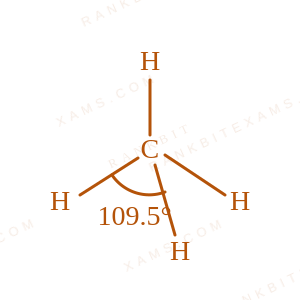
  • Statement B is true: Due to valence shell electron pair repulsions, the bond angles decrease from the ideal tetrahedral angle (109.5° in CH₄,
    Water molecule structural bond configuration shape representation
    Water molecule structural bond configuration shape representation
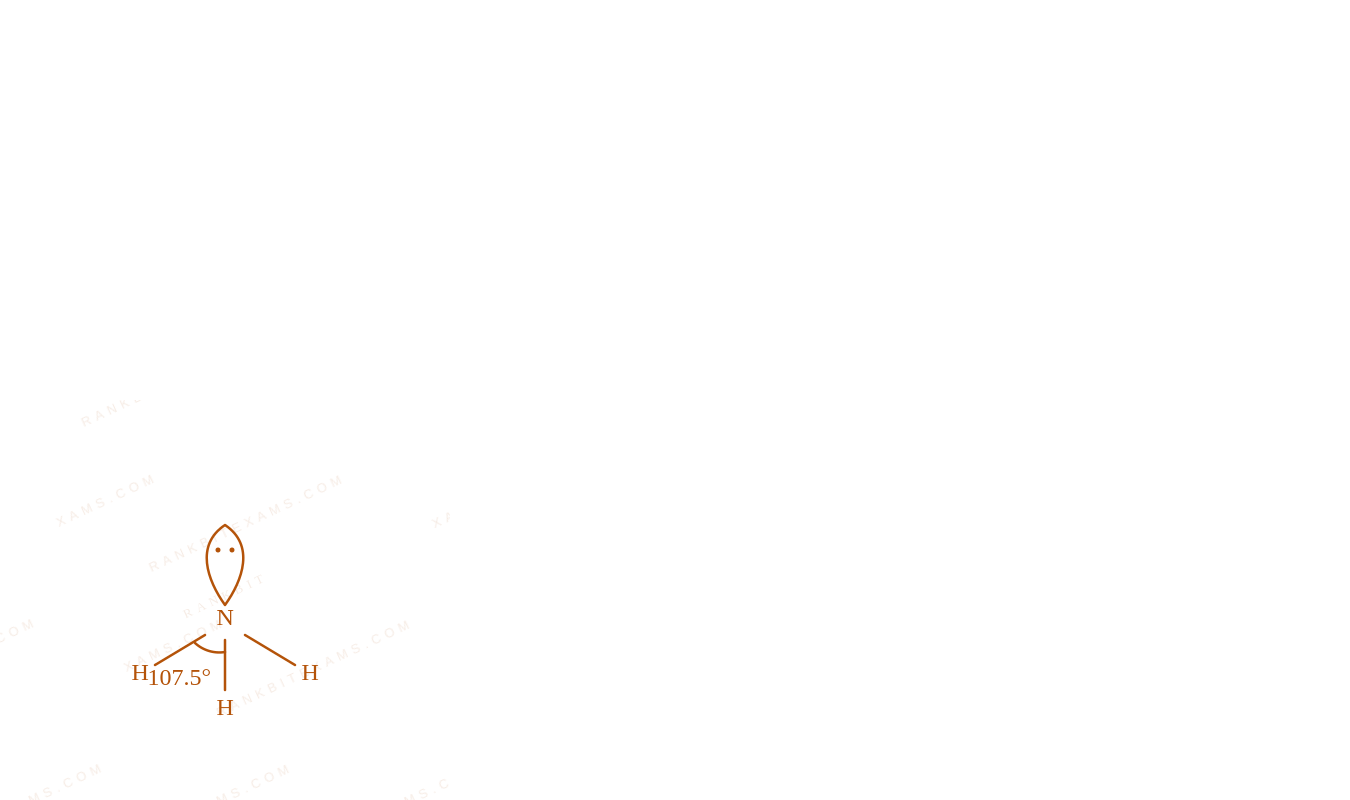
    ) as lone pairs are added (107.5° in NH₃ with 1 lone pair,
    Water molecule structural bond configuration shape representation
    Water molecule structural bond configuration shape representation
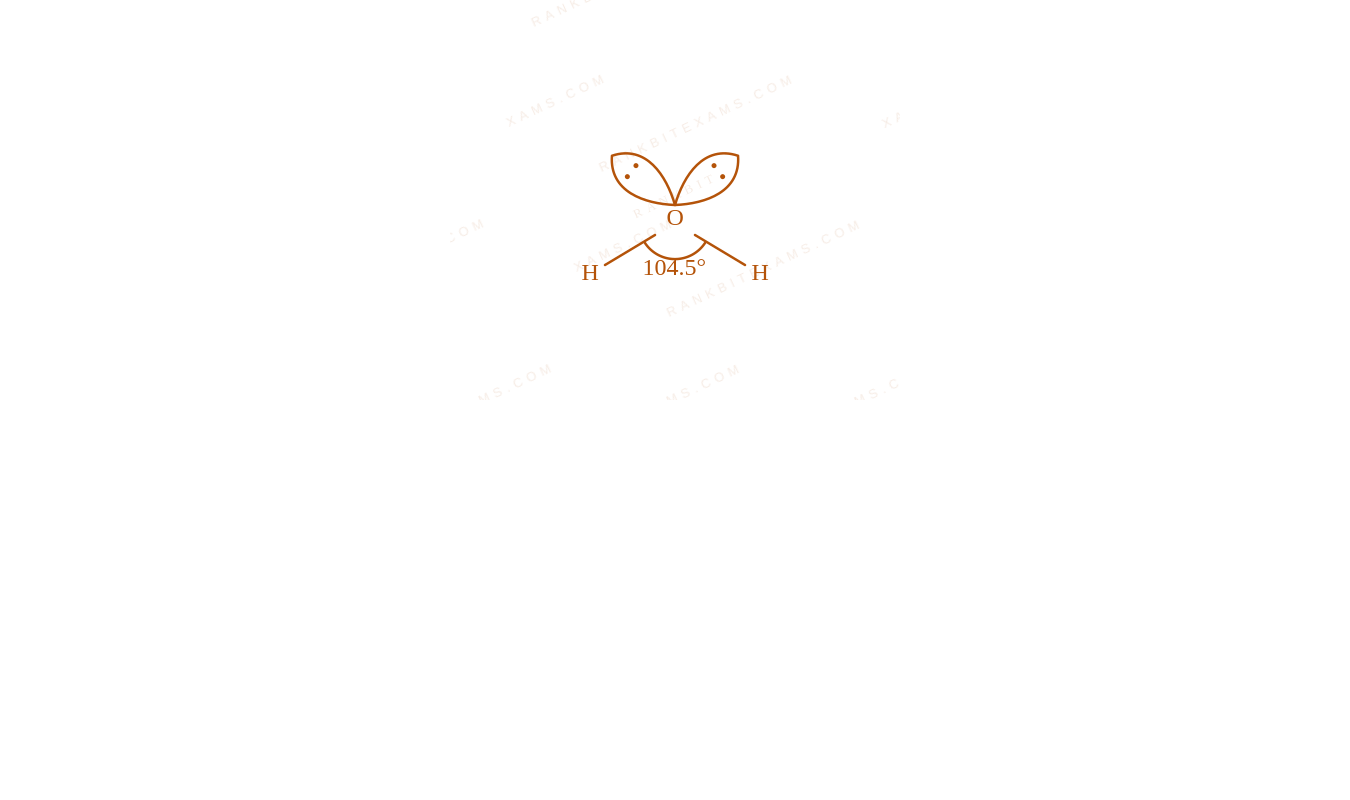
    ; 104.5° in H₂O with 2 lone pairs,
    Water molecule structural bond configuration shape representation
    Water molecule structural bond configuration shape representation
    ).
  • Statement C is true: The dipole moment increases alongside central atom electronegativity and asymmetric lone pair configurations, following the sequence CH₄ (0 D) < NH₃ (1.47 D) < H₂O (1.85 D).
Pattern Recognition

Lone pairs repel bonding electron pairs more strongly than bonding pairs repel each other, systematically compressing adjacent bond angles.

Chapter Mix

Class 11 Chemistry: Chemical Bonding and Molecular Structure

Reference Study Guides

More Chemical Bonding and Molecular Structure Previous-Year Questions — Page 9

Q77 jee_main_2024_31_jan_morning Molecular Orbital Theory
The linear combination of atomic orbitals to form molecular orbitals takes place only when the combining atomic orbitals A. have the same energy B. have the minimum overlap C. have same symmetry about the molecular axis D. have different symmetry about the molecular axis Choose the most appropriate from the options given below:
  • A. A, B, C only
  • B. A and C only
  • C. B, C, D only
  • D. B and D only

Solution

Core Logic

Conditions for the linear combination of atomic orbitals (LCAO) to form molecular orbitals:

  • The combining atomic orbitals must have the same or nearly the same energy.
  • The combining atomic orbitals must have the same symmetry about the molecular axis.
  • The combining atomic orbitals must overlap to the maximum extent (not minimum).
Chapter Mix

Class 11 Chemistry: Chemical Bonding and Molecular Structure

Q85 jee_main_2024_31_jan_morning Hybridization
The number of species from the following in which the central atom uses sp³ hybrid orbitals in its bonding is NH₃, SO₂, SiO₂, BeCl₂, CO₂, H₂O, CH₄, BF₃
Numerical Answer. Answer: 4 to 4

Solution

Core Logic

Analyzing the hybridization of the central atom in each species:

  • NH₃: 3 bp + 1 lp = 4 electron domains arrow sp³
  • SO₂: 2 bp + 1 lp = 3 electron domains arrow sp²
  • SiO₂: A giant covalent network where each Si is bonded to 4 oxygens tetrahedrally arrow sp³
  • BeCl₂: 2 bp + 0 lp = 2 electron domains arrow sp
  • CO₂: 2 bp + 0 lp = 2 electron domains arrow sp
  • H₂O: 2 bp + 2 lp = 4 electron domains arrow sp³
  • CH₄: 4 bp + 0 lp = 4 electron domains arrow sp³
  • BF₃: 3 bp + 0 lp = 3 electron domains arrow sp²
  • Total species with sp³ hybridization: NH₃, SiO₂, H₂O, CH₄. Total count = 4.

Chapter Mix

Class 11 Chemistry: Chemical Bonding and Molecular Structure

More Chemical Bonding and Molecular Structure Questions — jee_main_2025_24_jan_morning

Practice all Chemical Bonding and Molecular Structure previous-year questions →

Rankbit System
JEE Physics: Waves (+15.5%) | Electrostatics: Concentric Shells (-29.7%) | Modern Physics: Photoelectric Clones (+34.2%) | Mathematics: Definite Integrals (+18.1%) | Chemistry: Coordination Splitting (-11.4%) | JEE Physics: Waves (+15.5%) | Electrostatics: Concentric Shells (-29.7%) | Modern Physics: Photoelectric Clones (+34.2%) | Mathematics: Definite Integrals (+18.1%) | Chemistry: Coordination Splitting (-11.4%)