Chemical Bonding and Molecular Structure appeared 42 times across 3 years — 4.9% of Chemistry.
This question is from Hybridization and Molecular Geometry.
Which of the following statement is true with respect to H₂O, NH₃$\mathrm{H}_2\mathrm{O}, \mathrm{NH}_3$ and CH₄$\mathrm{CH}_4$ ?
A. The central atoms of all the molecules are sp³$\mathfrak{sp}^3$ hybridized.
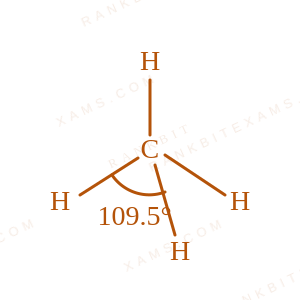
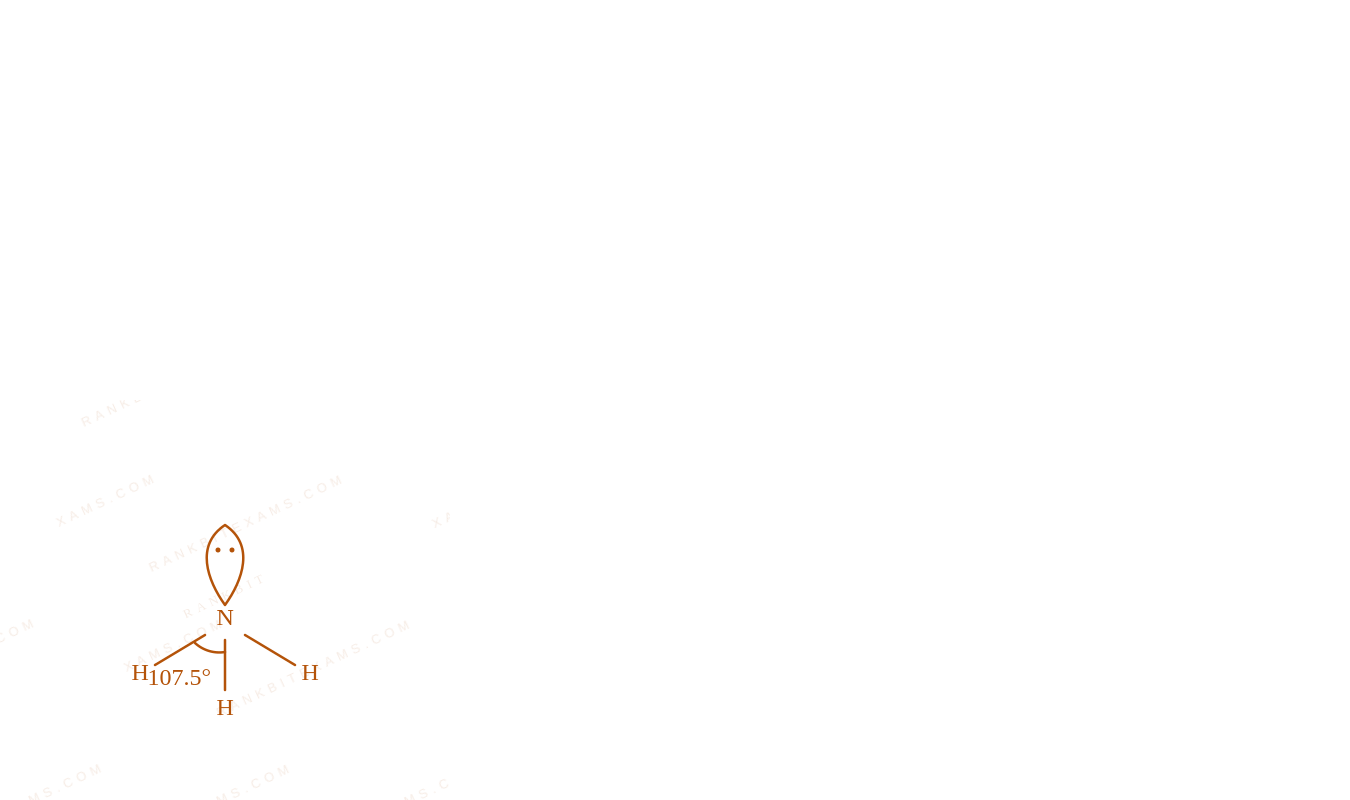
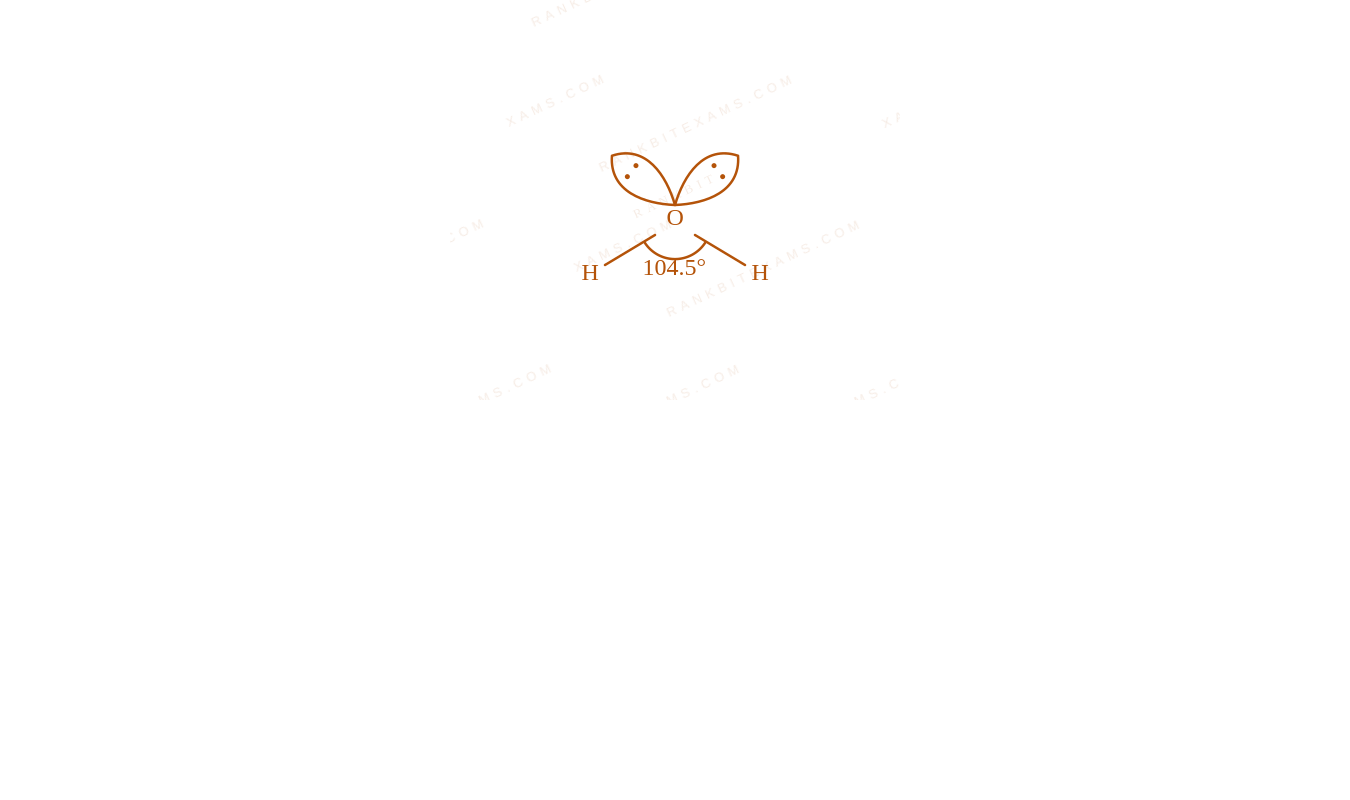
B. The H-O-H, H-N-H and H-C-H angles in the above molecules are 104.5°$104.5^{\circ}$ , 107.5°$107.5^{\circ}$ and 109.5°$109.5^{\circ}$ respectively.
C. The increasing order of dipole moment is CH₄ < NH₃ < H₂O$\mathrm{CH}_4 < \mathrm{NH}_3 < \mathrm{H}_2\mathrm{O}$ .
D. Both H₂O$\mathrm{H}_2\mathrm{O}$ and NH₃$\mathrm{NH}_3$ are Lewis acids and CH₄$\mathrm{CH}_4$ is a Lewis base
E. A solution of NH₃$\mathrm{NH}_3$ in H₂O$\mathrm{H}_2\mathrm{O}$ is basic. In this solution NH₃$\mathrm{NH}_3$ and H₂O$\mathrm{H}_2\mathrm{O}$ act as Lowry-Bronsted acid and base respectively.
Choose the correct answer from the options given below:
A.A, B and C only
B.C, D and E only
C.A, D and E only
D.A, B, C and E only
Solution & Explanation
Core Logic
Analyzing each statement individually:
Statement A is true: The central atoms (O, N, C$O, N, C$) all possess an electron steric number equal to 4, indicating sp³$\mathfrak{sp}^3$ hybridization state pathways.
Statement B is true: Due to valence shell electron pair repulsions, the bond angles decrease from the ideal tetrahedral angle (109.5°$109.5^{\circ}$ in CH₄$CH_4$, Water molecule structural bond configuration shape representation) as lone pairs are added (107.5°$107.5^{\circ}$ in NH₃$NH_3$ with 1 lone pair, Water molecule structural bond configuration shape representation; 104.5°$104.5^{\circ}$ in H₂O$H_2O$ with 2 lone pairs, Water molecule structural bond configuration shape representation).
Statement C is true: The dipole moment increases alongside central atom electronegativity and asymmetric lone pair configurations, following the sequence CH₄ (0 D) < NH₃ (1.47 D) < H₂O (1.85 D)$\mathrm{CH}_4 (0\text{ D}) < \mathrm{NH}_3 (1.47\text{ D}) < \mathrm{H}_2\mathrm{O} (1.85\text{ D})$.
Pattern Recognition
Lone pairs repel bonding electron pairs more strongly than bonding pairs repel each other, systematically compressing adjacent bond angles.
Chapter Mix
Class 11 Chemistry: Chemical Bonding and Molecular Structure
For CHCl₃$CHCl_3$, the individual dipole vectors do not cancel due to differing electronegativities of H and Cl, leading to a permanent non-zero dipole moment (μ ≠ 0$\mu \neq 0$). Dipole vectors structural cancellation schema for Q69 - JEE Main 2024 Morning
Class 11 Chemistry: Chemical Bonding and Molecular Structure
Q89jee_main_2024_27_jan_morningMolecular Orbital Theory
Sum of bond order of CO$\text{CO}$ and NO^+$\text{NO}^+$ is $\text{\quad\quad}$.
Numerical Answer.Answer: 6 to 6
Solution
Step 1: Determine the bond order of CO$\text{CO}$
Carbon monoxide (CO$\text{CO}$) contains 6 + 8 = 14$6 + 8 = 14$ total electrons.
Its structural representation is C$\text{C}\equiv\text{O}$, matching a bond order value of 3.
Step 2: Determine the bond order of NO^+$\text{NO}^+$
The nitrosonium ion (NO^+$\text{NO}^+$) contains 7 + 8 - 1 = 14$7 + 8 - 1 = 14$ total electrons.
Since it is isoelectronic with N₂$\text{N}_2$ and CO$\text{CO}$ (14 electrons$14\text{ electrons}$), its corresponding bond order value is also 3.
Step 3: Sum the results
Sum = 3 + 3 = 6$$\text{Sum} = 3 + 3 = 6$$
Pattern Recognition
Isoelectronic species possessing 14 total electrons consistently demonstrate a bond order value of 3.
Chapter Mix
Class 11 Chemistry: Chemical Bonding and Molecular Structure
Q81jee_main_2024_29_jan_morningVSEPR Theory
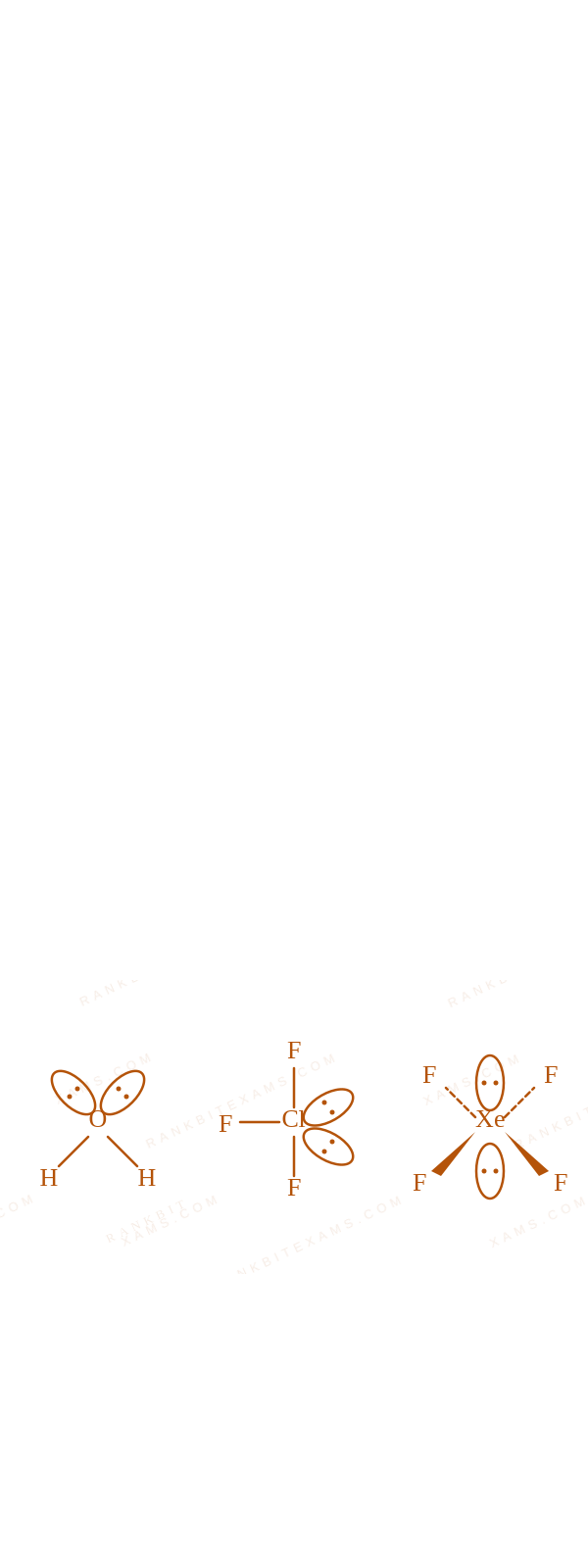
Number of compounds with one lone pair of electrons on central atom amongst following is
O₃$O_3$, H₂O$H_2O$, SF₄$SF_4$, ClF₃$ClF_3$, NH₃$NH_3$, BrF₅$BrF_5$, XeF₄$XeF_4$
Numerical Answer.Answer: 4 to 4
Solution
Core Logic
Let us determine the steric number (Z$Z$) and number of lone pairs (LP$LP$) for the central atom in each given molecule.
Formula: Z = (1)/(2) (V + M - C + A)$Z = \frac{1}{2} (V + M - C + A)$
Where V$V$ = valence electrons on central atom, M$M$ = number of monovalent atoms, C$C$ = cationic charge, A$A$ = anionic charge.
LP = Z - Bond Pairs (B.P.)$LP = Z - \text{Bond Pairs (B.P.)}$
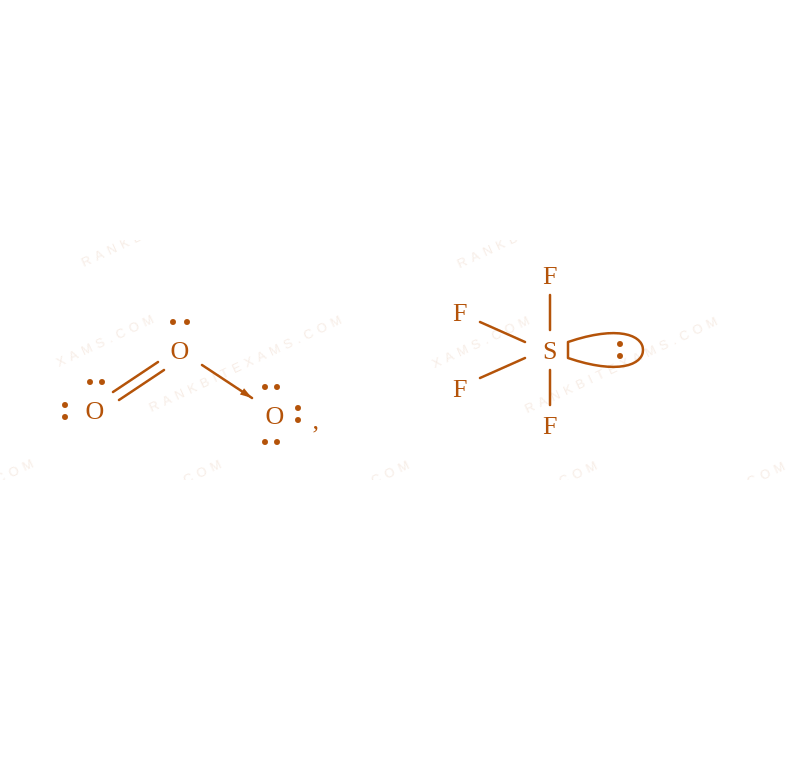
O₃$O_3$: Central atom O (V=6$V=6$). It forms one double bond and one dative bond. It has 1 lone pair remaining.
H₂O$H_2O$: Central atom O (V=6$V=6$). Z = (1)/(2)(6 + 2) = 4$Z = \frac{1}{2}(6 + 2) = 4$. LP = 4 - 2 = 2$LP = 4 - 2 = 2$.
SF₄$SF_4$: Central atom S (V=6$V=6$). Z = (1)/(2)(6 + 4) = 5$Z = \frac{1}{2}(6 + 4) = 5$. LP = 5 - 4 = 1$LP = 5 - 4 = 1$ (See-saw shape).
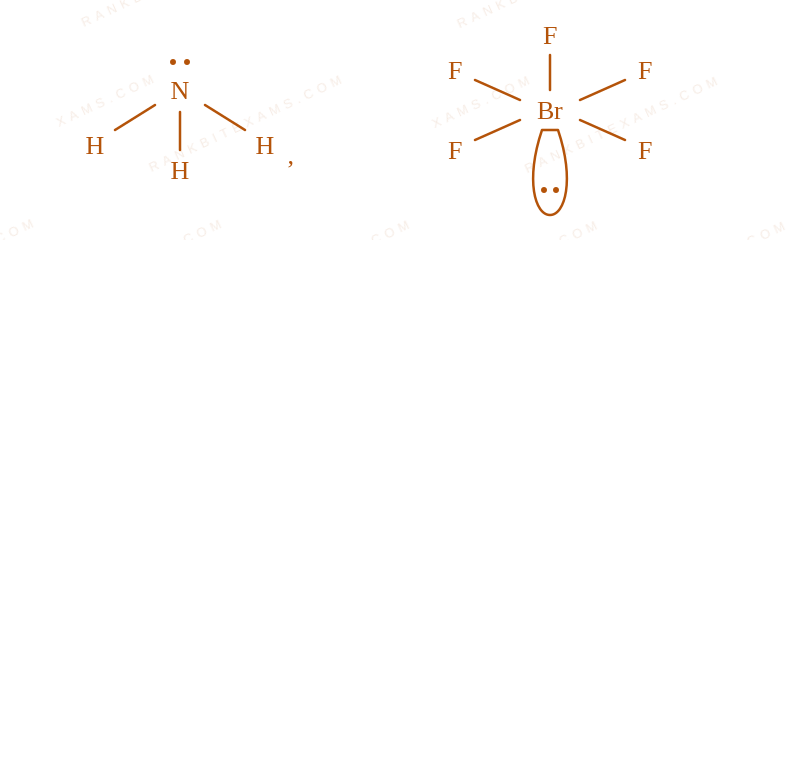
VSEPR Theory diagram for Q81 - JEE Main 2024 MorningVSEPR Theory diagram for Q81 - JEE Main 2024 MorningVSEPR Theory diagram for Q81 - JEE Main 2024 Morning
The compounds containing exactly ONE lone pair on the central atom are O₃$O_3$, SF₄$SF_4$, NH₃$NH_3$, and BrF₅$BrF_5$.
Total count = 4.
Chapter Mix
Class 11 Chemistry: Chemical Bonding and Molecular Structure
Q88jee_main_2024_29_jan_morningMolecular Orbital Theory
The number of species from the following which are paramagnetic and with bond order equal to one is
H₂, He₂^+, O₂^+, N₂²⁻, O₂²⁻, F₂, Ne₂^+, B₂$$\mathrm {H}_2, \mathrm{He}_2^+, \mathrm{O}_2^+, \mathrm{N}_2^{2-}, \mathrm{O}_2^{2-}, \mathrm{F}_2, \mathrm{Ne}_2^+, \mathrm{B}_2$$
Numerical Answer.Answer: 1 to 1
Solution
Core Logic
Using Molecular Orbital (MO) Theory, we evaluate the bond order (BO = (Nb - Nₐ)/(2)$BO = \frac{N_b - N_a}{2}$) and magnetic nature (unpaired electrons = paramagnetic, all paired = diamagnetic) for each species:
Species
Magnetic behaviour
Bond order
H₂$H_2$
Diamagnetic
1
He₂^+$He_2^+$
Paramagnetic
0.5
O₂^+$O_2^+$
Paramagnetic
2.5
N₂²⁻$N_2^{2-}$
Paramagnetic
2
O₂²⁻$O_2^{2-}$
Diamagnetic
1
F₂$F_2$
Diamagnetic
1
Ne₂^+$Ne_2^+$
Paramagnetic
0.5
B₂$B_2$
Paramagnetic
1
Step 1: Final Selection
We need the species that satisfies BOTH conditions:
Paramagnetic
Bond Order = 1
Looking at the table, B₂$B_2$ is the only molecule that is paramagnetic (it has 2 unpaired electrons in degenerate π₂ₚ$\pi_{2p}$ orbitals) and has a bond order of 1.
Total number of such species = 1.
Pattern Recognition
B₂$B_2$ (10 electrons) and O₂$O_2$ (16 electrons) are the classic exceptions in MO theory that are paramagnetic despite having an even number of electrons. B₂$B_2$ has BO = 1, and O₂$O_2$ has BO = 2.
Chapter Mix
Class 11 Chemistry: Chemical Bonding and Molecular Structure
Qjee_main_2024_30_january_eveningVSEPR Theory and Molecular Shapes
PCl₅$PCl_5$: sp³d$sp^3d$ hybridization with 0 lone pairs arrow$\rightarrow$ Trigonal Bipyramidal.
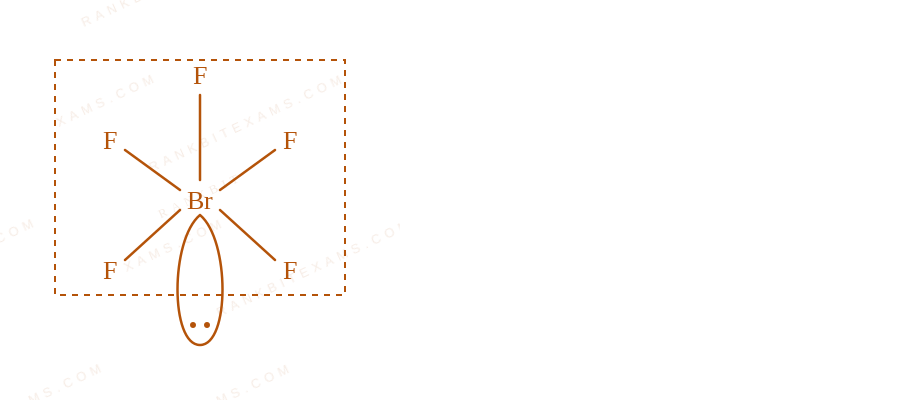
BrF₅$BrF_5$: Bromine has 7 valence electrons. It forms 5 single bonds with Fluorine, leaving 1 lone pair. sp³d²$sp^3d^2$ hybridization arrow$\rightarrow$ geometry is octahedral, but shape is Square Pyramidal.
PF₅$PF_5$: sp³d$sp^3d$ hybridization with 0 lone pairs arrow$\rightarrow$ Trigonal Bipyramidal.
Square Pyramidal structure of BrF5 diagram for Q69 - JEE Main 2024 Evening
Pattern Recognition
AX₅E₁$AX_5E_1$ configuration (5 bond pairs + 1 lone pair) typically yields a Square Pyramidal shape.
Chapter Mix
Class 11 Chemistry: Chemical Bonding and Molecular Structure
Class 12 Chemistry: Coordination Compounds
More Chemical Bonding and Molecular Structure Questions — jee_main_2025_24_jan_morning
Practice past-year questions one chapter at a time. Pick an exam → subject → chapter and get every PYQ for that topic — pulled together from all past papers — with the chapter's key formulas alongside.