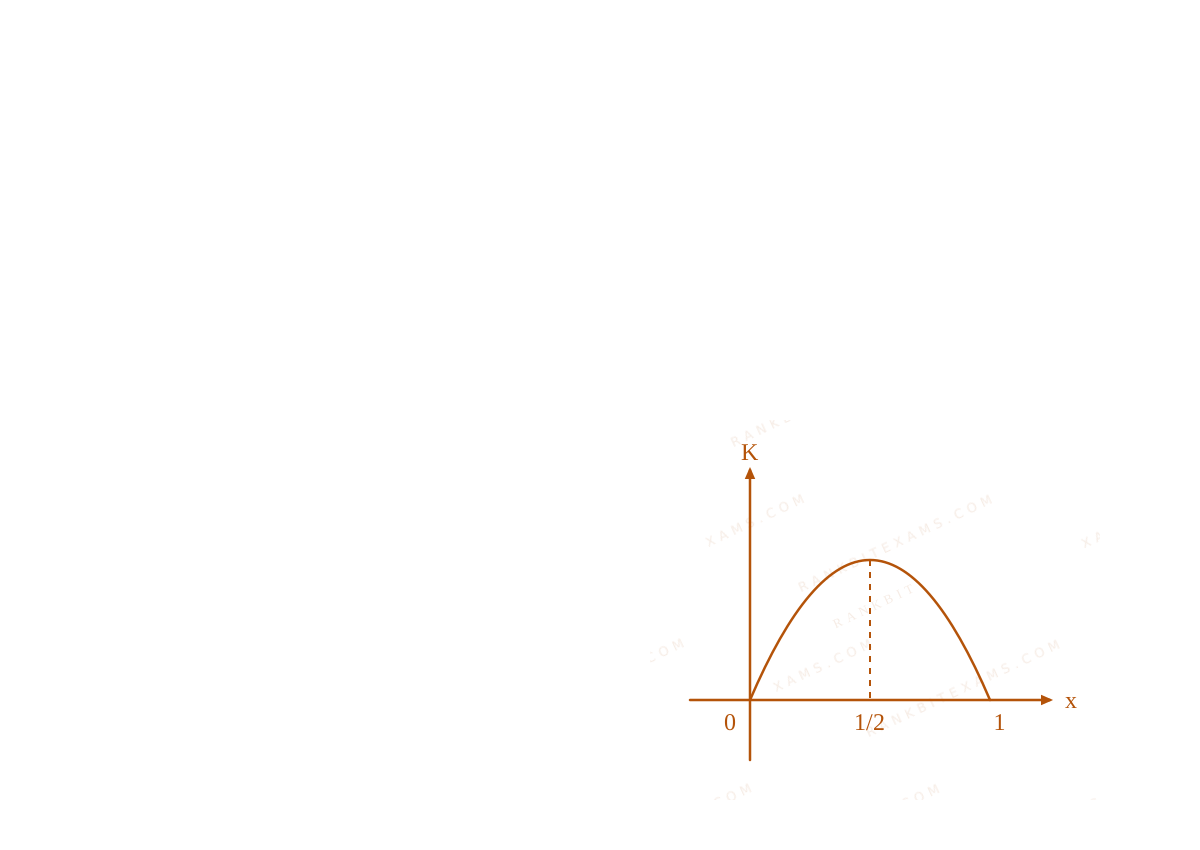
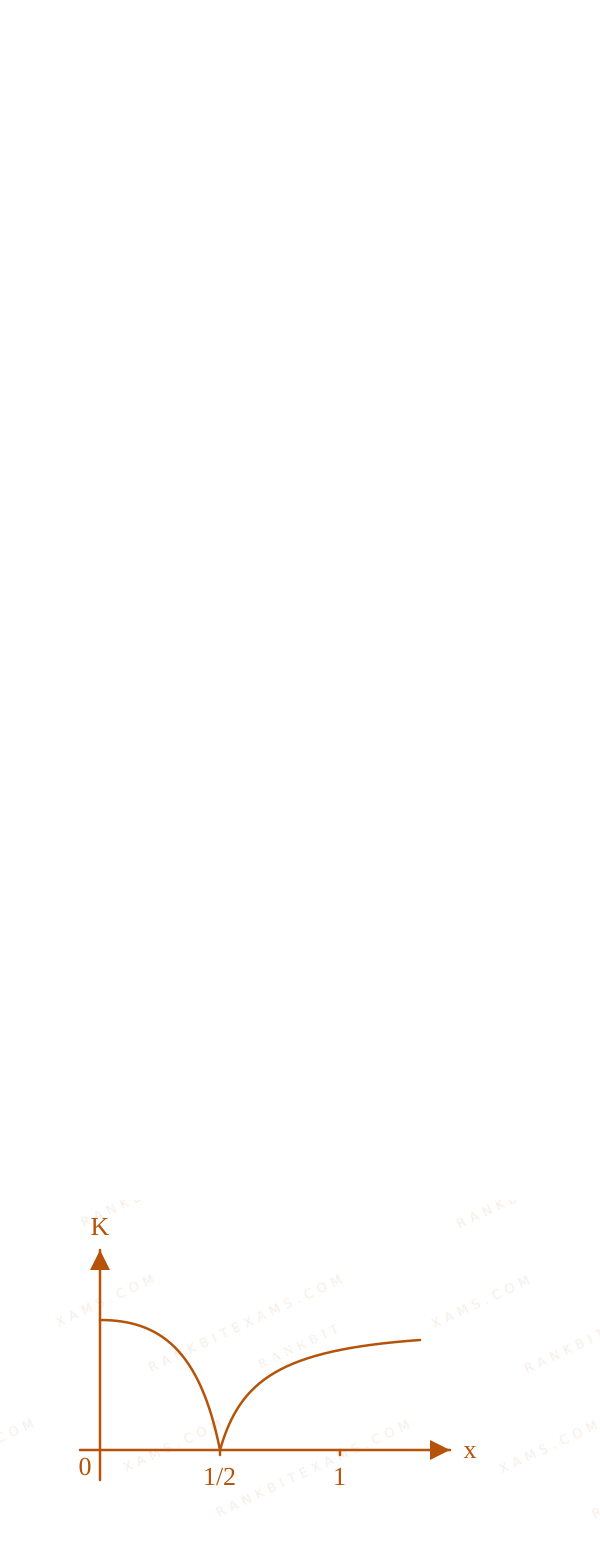
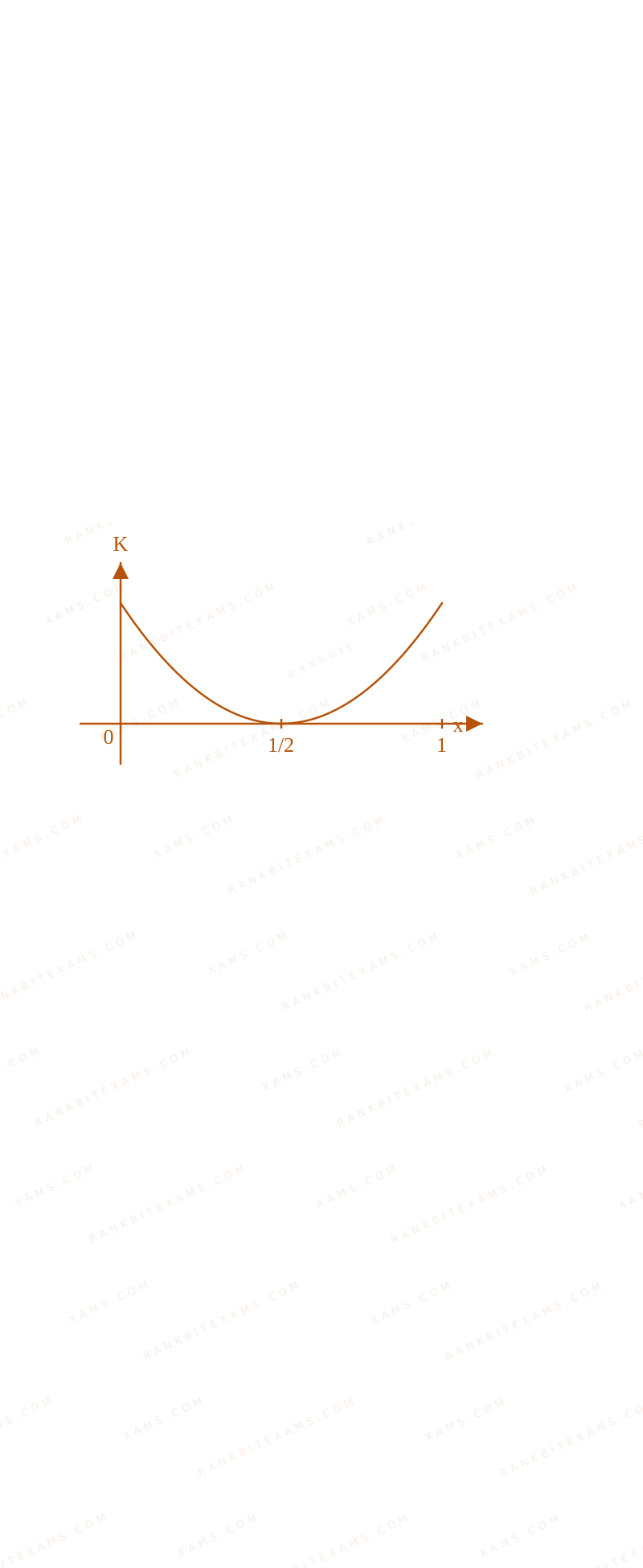
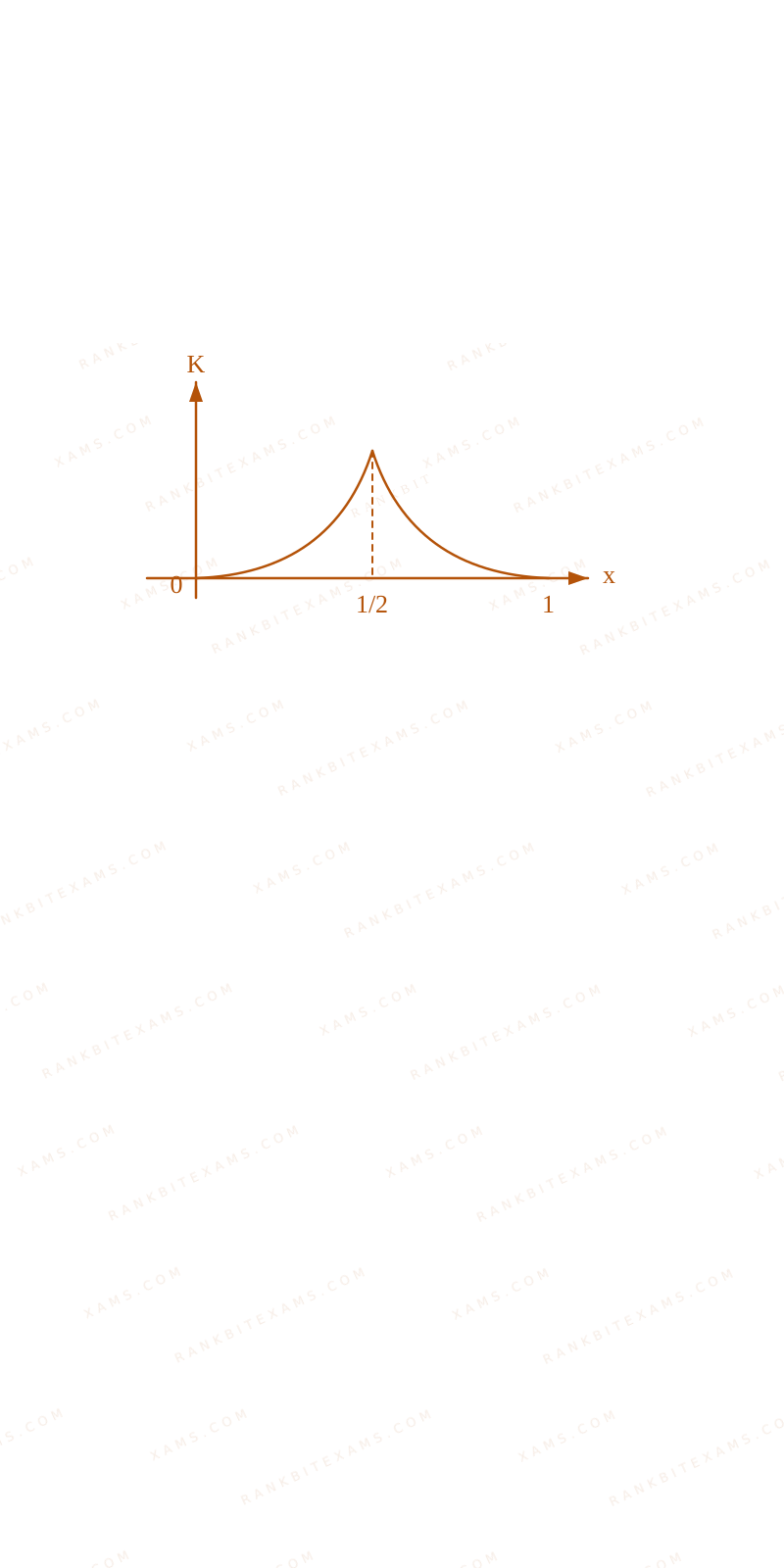
A particle oscillates along the x-axis according to the law, mathrmx(t) = mathrmx_0 sin^2left(fract2 ight) where x_0 = 1 \, m . The kinetic energy (K) of the particle as a function of x is correctly represented by the graph.

Solution & Explanation

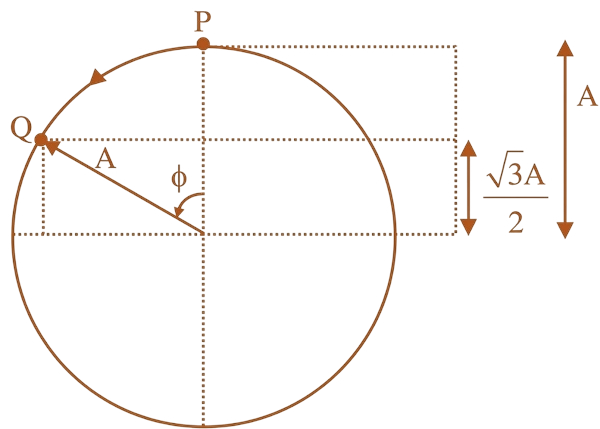
### Related Formula x(t) = x_0 sin^2left(fract2 ight) = x_0 left(frac1 - cos t2 ight) ### Core Logic Given x_0 = 1\ mathrmm, the position simplifies to: x = frac1 - cos t2 implies 2x - 1 = -cos t implies cos t = 1 - 2x Differentiating x(t) to find velocity v: v = fracdxdt = frac12sin t Kinetic energy K is proportional to v^2: K = frac12mv^2 = frac12m left(frac14sin^2 t ight) = fracm8(1 - cos^2 t) Substituting cos t = 1 - 2x: K = fracm8left[1 - (1 - 2x)^2 ight] = fracm8left[1 - (1 - 4x + 4x^2) ight] = fracm8(4x - 4x^2) = fracm2(x - x^2) This is an inverted parabola (K propto x - x^2) passing through x=0 and x=1, reaching a peak at x = 1/2. This matches Graph (1). ### Pattern Recognition The position oscillates purely within the boundary interval [0, 1]. Kinetic energy peaks perfectly at the equilibrium midpoint x = 1/2 where speed is maximum. ### Evaluation Rubric / Model Answer null ### Chapter Mix Class 11 Physics: Oscillations
Reference Study Guides

More Oscillations Previous-Year Questions — Page 3

Q59 jee_main_2024_31_jan_evening Spring Mass System
The time period of simple harmonic motion of mass M in the given figure is pi sqrtfracalpha M5K, where the value of alpha is
Spring Mass System diagram for Q59 - JEE Main 2024 Evening
The image shows a combination of springs attached to a mass. Springs of stiffness 2k and k are connected in parallel, which in turn are connected in series with a spring of stiffness k.
Numerical Answer. Answer: 12 to 12

Solution

### Related Formula Springs in parallel: k_p = k_1 + k_2 Springs in series: frac1k_s = frac1k_p + frac1k_3 Time period: T = 2pi sqrtfracMk_eq ### Core Logic Evaluate the equivalent spring constant of the given setup by first resolving the parallel configuration, then the series configuration. ### Step 1: Equivalent Spring Constant Based on the standard layout of the problem (as implied by the solution text), let's assume one section is 2k and k in parallel... Wait, the solution implies frac2k cdot k3k + k, which represents a series combination of 2k and k, followed by a parallel combination with another k. Let's trust the official PDF's algebraic step: k_eq = frac2k cdot k3k + k. This evaluates to: k_eq = frac2k3 + k = frac5k3 ### Step 2: Time Period Calculation T = 2pi sqrtfracMk_eq T = 2pi sqrtfracM5k/3 = 2pi sqrtfrac3M5k ### Step 3: Matching the Format Bring the 2 inside the square root as 4: T = pi sqrtfrac4 times 3M5k = pi sqrtfrac12M5k Comparing with pi sqrtfracalpha M5k: alpha = 12 ### Pattern Recognition Whenever an external coefficient like 2 (from 2pi) is pushed inside the square root to match a format, it squares. Don't forget 2 to 4, turning 3M into 12M. ### Evaluation Rubric / Model Answer null ### Chapter Mix Class 11 Physics: Oscillations

Q59 jee_main_2024_31_jan_morning Velocity In SHM
A particle performs simple harmonic motion with amplitude A. Its speed is increased to three times at an instant when its displacement is frac2A3. The new amplitude of motion is fracnA3. The value of n is ______.
Numerical Answer. Answer: 7 to 7

Solution

### Related Formula v = omega sqrtA^2 - x^2 ### Core Logic At displacement x = frac2A3, the initial velocity is: v = omega sqrtA^2 - left(frac2A3right)^2 v = omega sqrtA^2 - frac4A^29 = omega sqrtfrac5A^29 v = fracsqrt5Aomega3 ### Step 2: Velocity Tripled The speed is now increased to v' = 3v at the same position x = frac2A3. v' = 3 left(fracsqrt5Aomega3right) = sqrt5Aomega This new velocity corresponds to a new amplitude A': v' = omega sqrt(A')^2 - x^2 sqrt5Aomega = omega sqrt(A')^2 - left(frac2A3right)^2 ### Step 3: Finding new Amplitude Squaring both sides: 5A^2 = (A')^2 - frac4A^29 (A')^2 = 5A^2 + frac4A^29 = frac45A^2 + 4A^29 (A')^2 = frac49A^29 A' = frac7A3 Comparing with fracnA3, we get n = 7. ### Evaluation Rubric / Model Answer null ### Chapter Mix Class 11 Physics: Oscillations

More Oscillations Questions — jee_main_2025_24_jan_evening

Practice all Oscillations previous-year questions →

Rankbit System
JEE Physics: Waves (+15.5%) | Electrostatics: Concentric Shells (-29.7%) | Modern Physics: Photoelectric Clones (+34.2%) | Mathematics: Definite Integrals (+18.1%) | Chemistry: Coordination Splitting (-11.4%) | JEE Physics: Waves (+15.5%) | Electrostatics: Concentric Shells (-29.7%) | Modern Physics: Photoelectric Clones (+34.2%) | Mathematics: Definite Integrals (+18.1%) | Chemistry: Coordination Splitting (-11.4%)