A particle oscillates along the x-axis according to the law, x(t) = x₀ ²((t)/(2))$\mathrm{x}(t) = \mathrm{x}_{0} \sin^{2}\left(\frac{t}{2}\right)$ where x₀ = 1 m$x_{0} = 1 \, m$ . The kinetic energy (K) of the particle as a function of x is correctly represented by the graph.
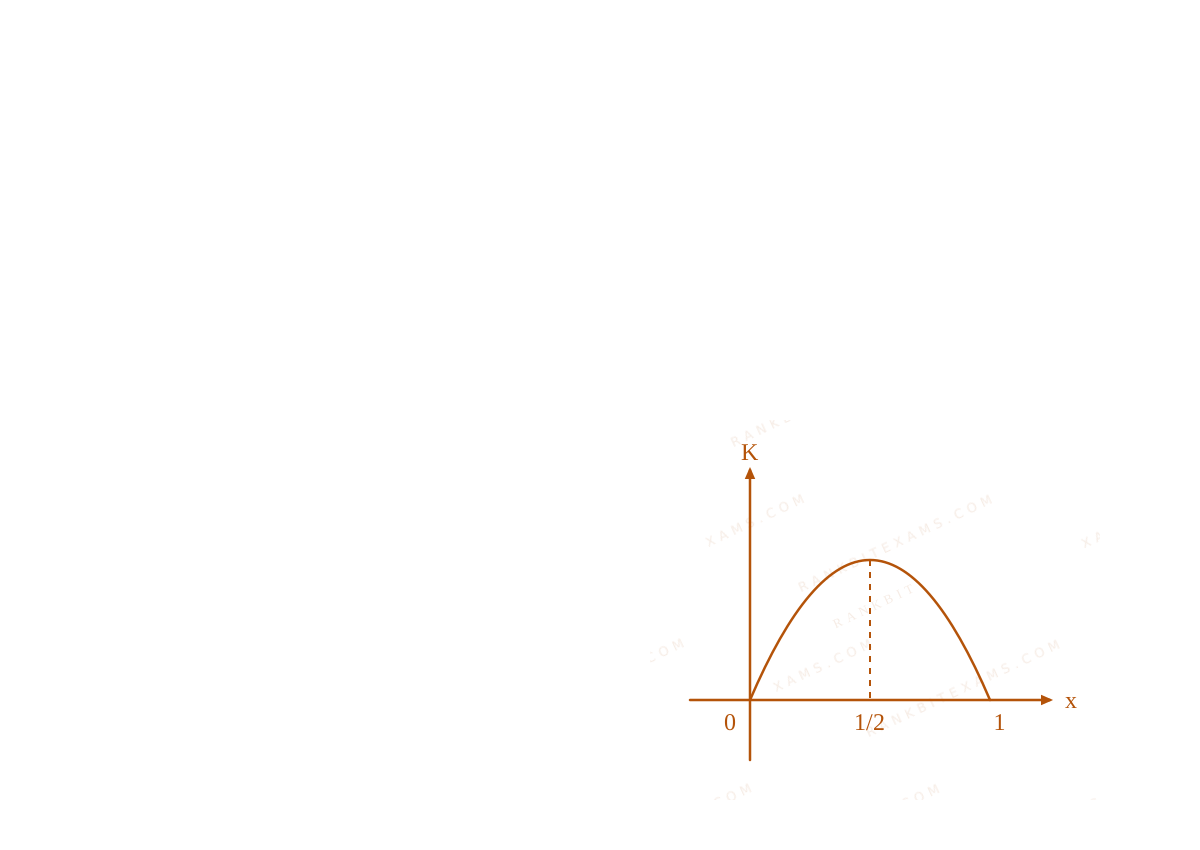
A.Graph (1)
kinetic energy graph shm, quadratic parabolic profiles, energy vs position plot
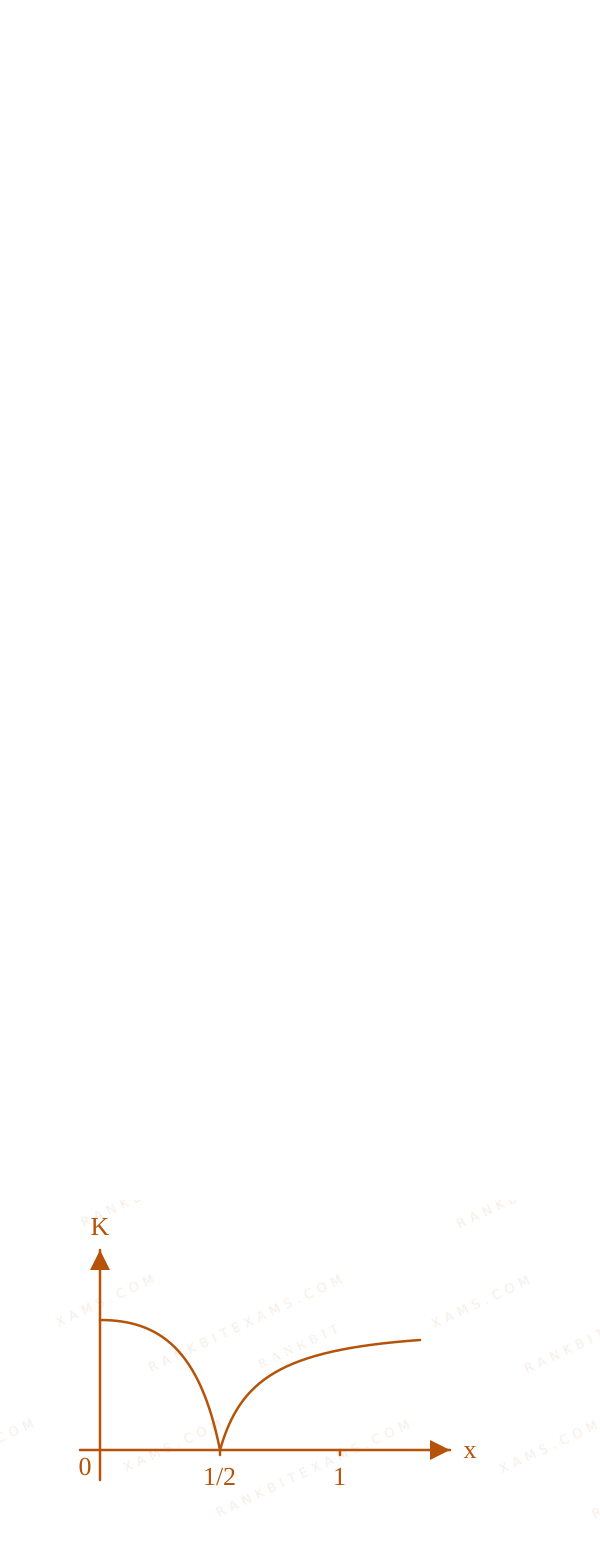
B.Graph (2)
kinetic energy graph shm, quadratic parabolic profiles, energy vs position plot
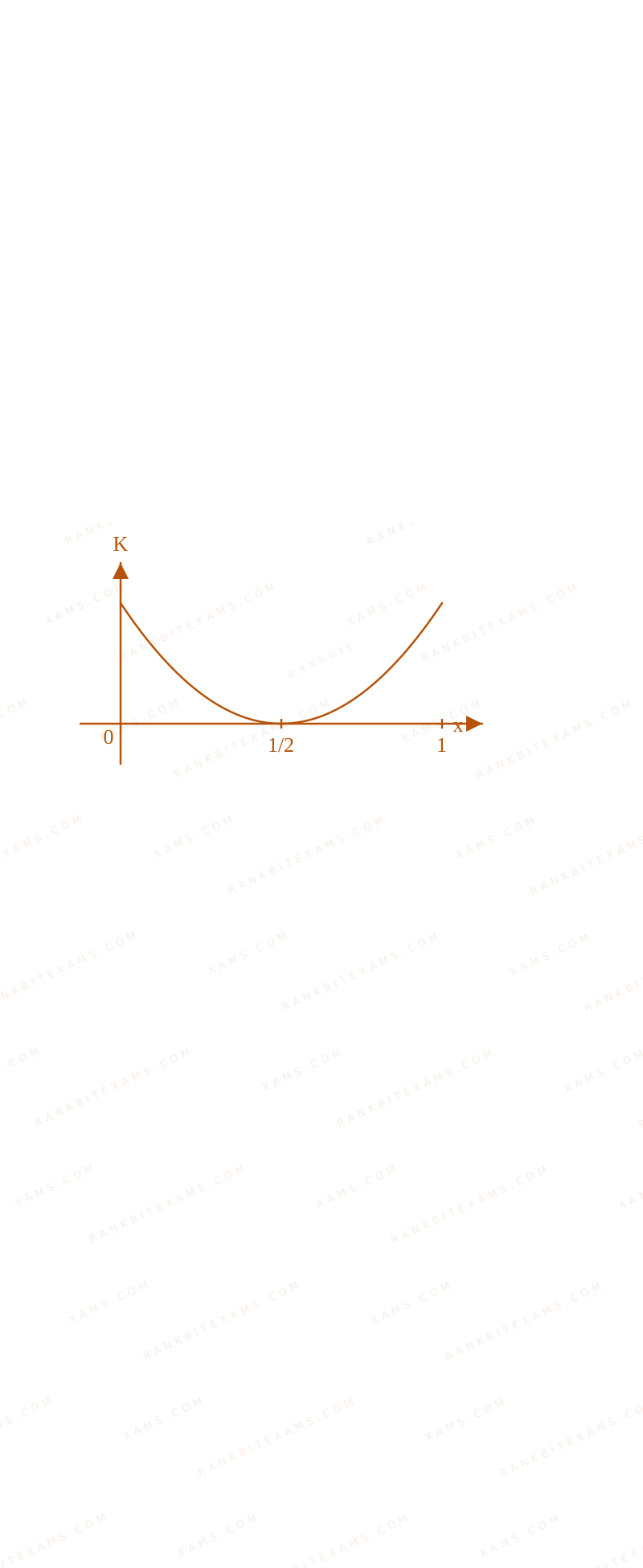
C.Graph (3)
kinetic energy graph shm, quadratic parabolic profiles, energy vs position plot
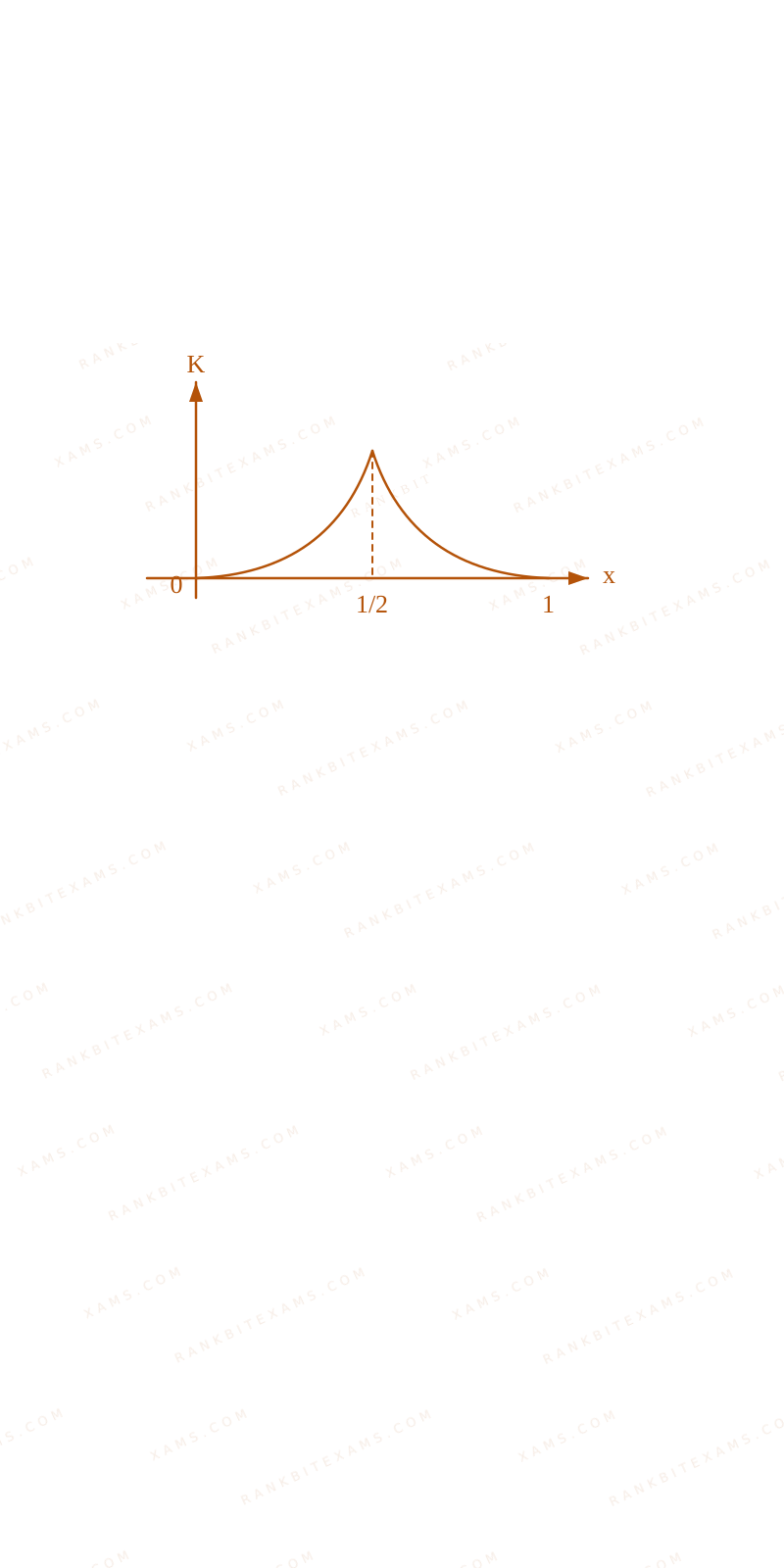
D.Graph (4)
kinetic energy graph shm, quadratic parabolic profiles, energy vs position plot
This is an inverted parabola (K ∝ x - x²$K \propto x - x^2$) passing through x=0$x=0$ and x=1$x=1$, reaching a peak at x = 1/2$x = 1/2$. This matches Graph (1).
Pattern Recognition
The position oscillates purely within the boundary interval [0, 1]$[0, 1]$. Kinetic energy peaks perfectly at the equilibrium midpoint x = 1/2$x = 1/2$ where speed is maximum.
Keywords:#Kinetic energy function of position#JEE Main 2025 Evening Q19#SHM energy parabola graph#Velocity expression from displacement#kinetic energy graph shm#quadratic parabolic profiles#energy vs position plot
More Oscillations Previous-Year Questions — Page 2
Q42jee_main_2026_28_january_eveningTwo Body Oscillator
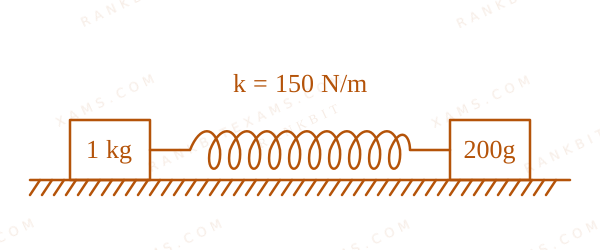
As shown in the figure, a spring is kept in a stretched position with some extension by holding the masses 1 kg$1 \text{ kg}$ and 0.2 kg$0.2 \text{ kg}$ with a separation more than spring natural length and are released. Assuming the horizontal surface to be frictionless, the angular frequency (in SI unit) of the system is :
Two masses attached to ends of a spring on a horizontal table.
A.30$30$
B.27$27$
C.20$20$
D.5$5$
Solution
Related Formula
ω = √((k)/(μ))$$\omega = \sqrt{\frac{k}{\mu}}$$
where μ$\mu$ is the reduced mass of the system given by:
For any two-body spring system free of external forces, always substitute the individual mass m$m$ with the reduced mass μ = (m₁ m₂)/(m₁ + m₂)$\mu = \frac{m_1 m_2}{m_1 + m_2}$ in the standard oscillator formula ω = √(k/m)$\omega = \sqrt{k/m}$.
Chapter Mix
Class 11 Physics: Oscillations
Qjee_main_2025_02_april_morningSuperposition of SHMs
A particle is subjected to two simple harmonic motions as:
x₁ = √(7) 5t~cm$$x_1 = \sqrt{7}\sin 5t\mathrm{~cm}$$
and
x₂ = 2√(7) (5t + (π)/(3))~cm$$x_2 = 2\sqrt{7}\sin\left(5t + \frac{\pi}{3}\right)\mathrm{~cm}$$
where x$x$ is displacement and t$t$ is time in seconds. The maximum acceleration of the particle is x × 10⁻²~ms⁻²$x \times 10^{-2}\mathrm{~ms}^{-2}$. The value of x$x$ is:
a = ω² A = (5)² × 0.07 = 25 × 0.07 = 1.75~ms⁻²$$a_{\max} = \omega^2 A = (5)^2 \times 0.07 = 25 \times 0.07 = 1.75\mathrm{~ms}^{-2}$$
Equating to x × 10⁻²~ms⁻²$x \times 10^{-2}\mathrm{~ms}^{-2}$:
1.75 = x × 10⁻² x = 175$$1.75 = x \times 10^{-2} \implies x = 175$$
Step 1: Final Conclusion
The value of x$x$ is 175.
Pattern Recognition
When superposing two SHMs of identical frequency, use the standard phasor addition formula to obtain the combined amplitude A$A$. Then compute maximum velocity v = ω A$v_{\max} = \omega A$ or maximum acceleration a = ω² A$a_{\max} = \omega^2 A$ directly.
Chapter Mix
Class 11 Physics: Simple Harmonic Motion
Q10jee_main_2025_29_jan_eveningEnergy in Simple Harmonic Motion
Two bodies A and B of equal mass are suspended from two massless springs of spring constant k₁$k_{1}$ and k₂$k_{2}$ , respectively. If the bodies oscillate vertically such that their amplitudes are equal, the ratio of the maximum velocity of A to the maximum velocity of B is:
A.√((k₁)/(k₂))$\sqrt{\frac{k_1}{k_2}}$
B.k₁k₂$\frac{\mathrm{k}_1}{\mathrm{k}_2}$
C.k₂k₁$\frac{\mathrm{k}_2}{\mathrm{k}_1}$
D.k₂k₁$\sqrt{\frac{k_{2}}{k_{1}}}$
Solution
Related Formula
v = Aω$$v_{\max} = A\omega$$ω = √((k)/(m))$$\omega = \sqrt{\frac{k}{m}}$$
Core Logic
The maximum velocity in vertical SHM happens at the mean equilibrium position and is given by v = Aω$v_{\max} = A\omega$.
Given mA = mB = m$m_A = m_B = m$ and AA = AB = A$A_A = A_B = A$:
vA = A ω₁ = A √((k₁)/(m))$$v_A = A \omega_1 = A \sqrt{\frac{k_1}{m}}$$vB = A ω₂ = A √((k₂)/(m))$$v_B = A \omega_2 = A \sqrt{\frac{k_2}{m}}$$
Since maximum velocity is directly proportional to angular frequency ω$\omega$ for equal amplitudes, and ω ∝ √(k)$\omega \propto \sqrt{k}$, the velocity ratio directly yields the square root of the spring constant ratio.
Chapter Mix
Class 11 Physics: Oscillations
Qjee_main_2025_04_april_morningSimple Pendulum
Two simple pendulums having lengths l₁$l_{1}$ and l₂$l_{2}$ with negligible string mass undergo angular displacements θ₁$\theta_{1}$ and θ₂$\theta_{2}$, from their mean positions, respectively. If the angular accelerations of both pendulums are same, then which expression is correct?
Angular acceleration scales inversely with length for a fixed angular displacement (α ∝ (θ)/(l)$\alpha \propto \frac{\theta}{l}$). To maintain identical angular accelerations, the ratio (θ)/(l)$\frac{\theta}{l}$ must remain constant, yielding the cross-multiplication relation θ₁ l₂ = θ₂ l₁$\theta_1 l_2 = \theta_2 l_1$.
Practice past-year questions one chapter at a time. Pick an exam → subject → chapter and get every PYQ for that topic — pulled together from all past papers — with the chapter's key formulas alongside.