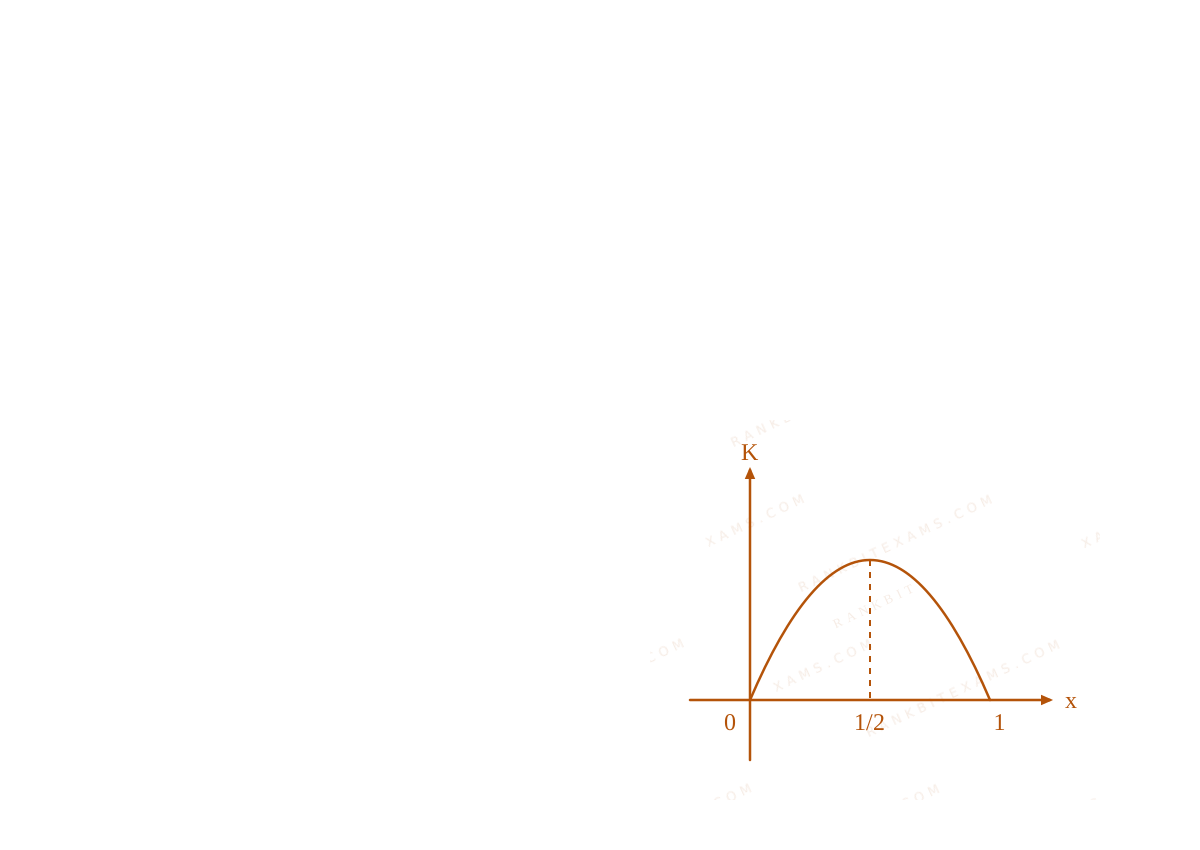
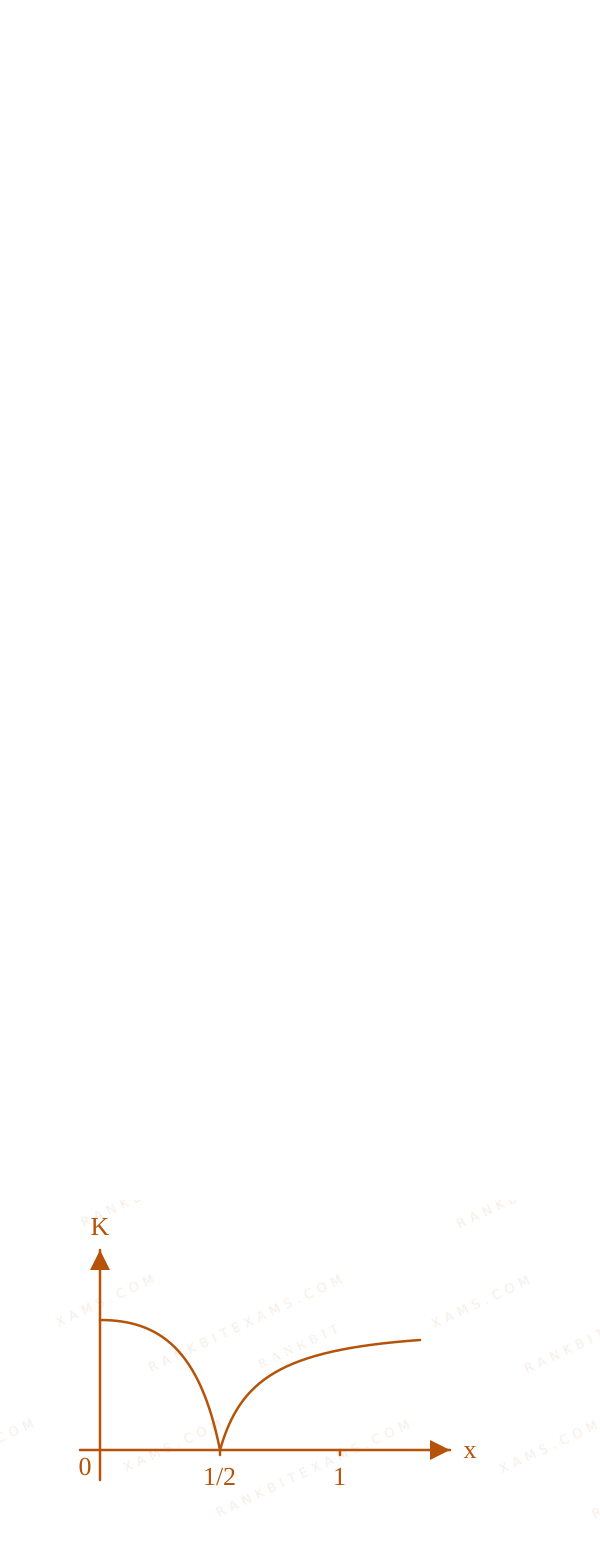

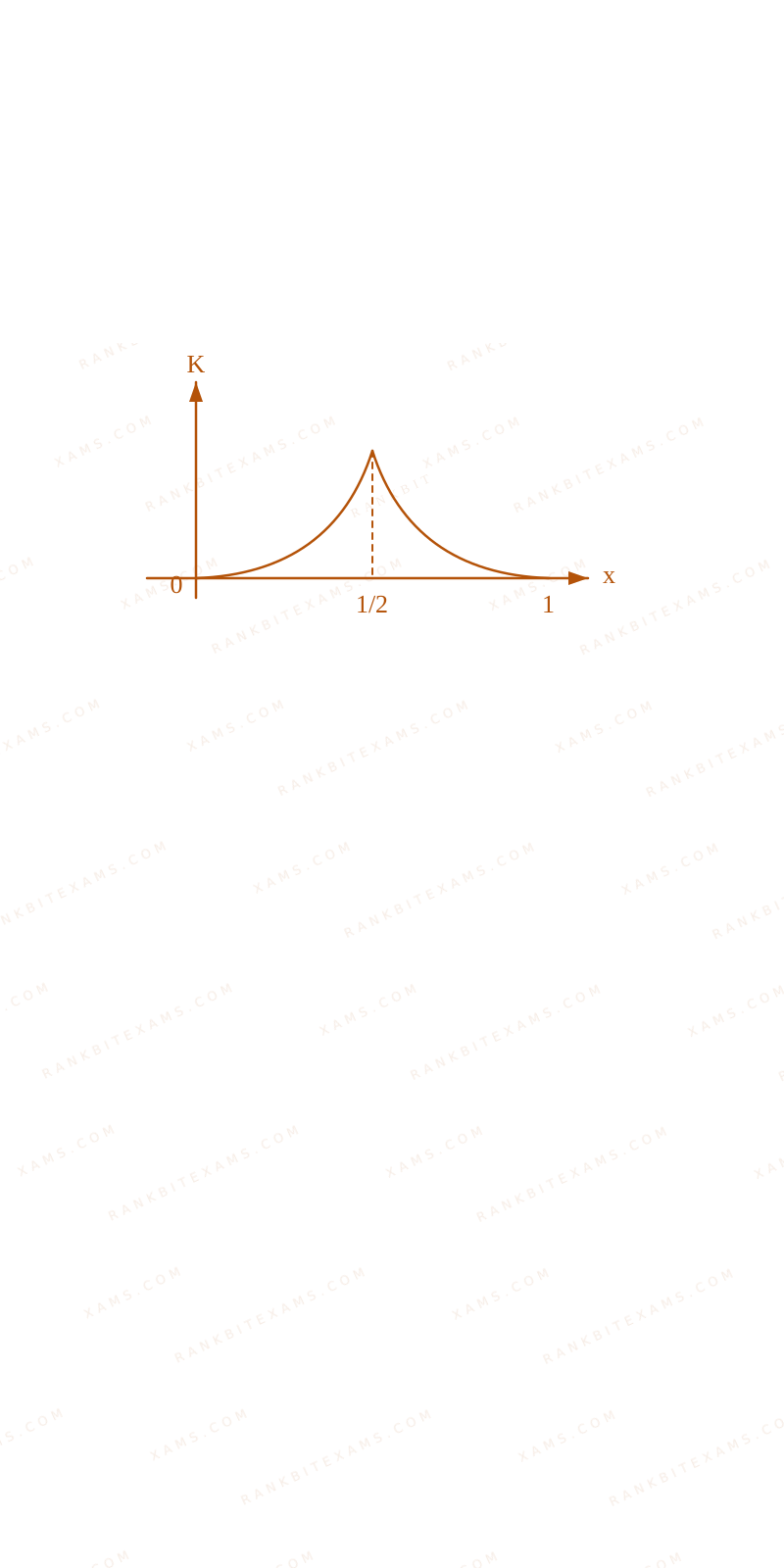
A particle oscillates along the x-axis according to the law, x(t) = x₀ ²((t)/(2)) where x₀ = 1 m . The kinetic energy (K) of the particle as a function of x is correctly represented by the graph.

Solution & Explanation

Related Formula
x(t) = x₀ ²((t)/(2)) = x₀ ((1 - t)/(2))
Core Logic

Given x₀ = 1 m, the position simplifies to:

x = (1 - t)/(2) 2x - 1 = - t t = 1 - 2x

Differentiating x(t) to find velocity v:

v = (dx)/(dt) = (1)/(2) t

Kinetic energy K is proportional to v²:

K = (1)/(2)mv² = (1)/(2)m ((1)/(4) ² t) = (m)/(8)(1 - ² t)

Substituting t = 1 - 2x:

K = (m)/(8)[1 - (1 - 2x)²] = (m)/(8)[1 - (1 - 4x + 4x²)] = (m)/(8)(4x - 4x²) = (m)/(2)(x - x²)

This is an inverted parabola (K ∝ x - x²) passing through x=0 and x=1, reaching a peak at x = 1/2. This matches Graph (1).

Pattern Recognition

The position oscillates purely within the boundary interval [0, 1]. Kinetic energy peaks perfectly at the equilibrium midpoint x = 1/2 where speed is maximum.

Chapter Mix

Class 11 Physics: Oscillations
Reference Study Guides

More Oscillations Previous-Year Questions — Page 4

Q58 jee_main_2024_29_jan_morning Energy in Simple Harmonic Motion
When the displacement of a simple harmonic oscillator is one third of its amplitude, the ratio of total energy to the kinetic energy is x8, where x = ________.
Numerical Answer. Answer: 9 to 9

Solution

Related Formula

Total energy (E) in simple harmonic motion is:

E = (1)/(2) k A²

Potential energy (U) at displacement y is:

U = (1)/(2) k y²

Kinetic energy (KE) is the remaining energy:

KE = E - U

Core Logic

Given the displacement is one-third of the amplitude:

y = (A)/(3)

Substituting this displacement into the potential energy expression:

U = (1)/(2) k ((A)/(3))² = (1)/(9) ( (1)/(2) k A² ) = (E)/(9)
Step 1: Calculate Kinetic Energy

The kinetic energy is:

KE = E - (E)/(9) = (8E)/(9)
Step 2: Find the Energy Ratio

The ratio of total energy to kinetic energy is:

(E)/(KE) = (E)/((8E)/(9)) = (9)/(8)

Comparing this with the given target form

Comparing this with the given target form $\frac{x}{8}:

$x = 9

Therefore, the value of

Therefore, the value of $xis9.

Pattern Recognition

Since

Pattern Recognition

Since $U \propto y^2, if displacement scales by a fraction\frac{1}{n}, potential energy scales instantly by\frac{1}{n^2}. The remaining kinetic energy is naturally1 - \frac{1}{n^2}, giving an immediate shortcut for the total-to-kinetic ratio:\frac{n^2}{n^2 - 1}$.

Chapter Mix

Class 11 Physics: Oscillations

Q58 jee_main_2024_30_january_evening Simple Pendulum Time Period
A simple pendulum is placed at a place where its distance from the earth's surface is equal to the radius of the earth. If the length of the string is 4 ~m, then the time period of small oscillations will be ________ s. [take g = π² ~m/s²]
Numerical Answer. Answer: 8 to 8

Solution

Related Formula
g' = (GM)/((R+h)²) = g((R)/(R+h))² T = 2π √((l)/(g'))
Core Logic

The distance of the pendulum from the earth's surface is h = R. The acceleration due to gravity at this height g' is:

g' = g((R)/(R+R))² = g((1)/(2))² = (g)/(4)
Step 1: Calculate Time Period

The time period of the simple pendulum is:

T = 2π √((l)/(g'))

Substitute l = 4 ~m and g' = (g)/(4):

T = 2π √((4)/(g/4)) = 2π √((16)/(g))

Given g = π²:

T = 2π √((16)/(π²)) = 2π ((4)/(π)) = 8 ~s
Pattern Recognition

At h=R, g drops to g/4. Thus, the time period doubles compared to its surface value.

Chapter Mix

Class 11 Physics: Oscillations Class 11 Physics: Gravitation

Q59 jee_main_2024_31_jan_evening Spring Mass System
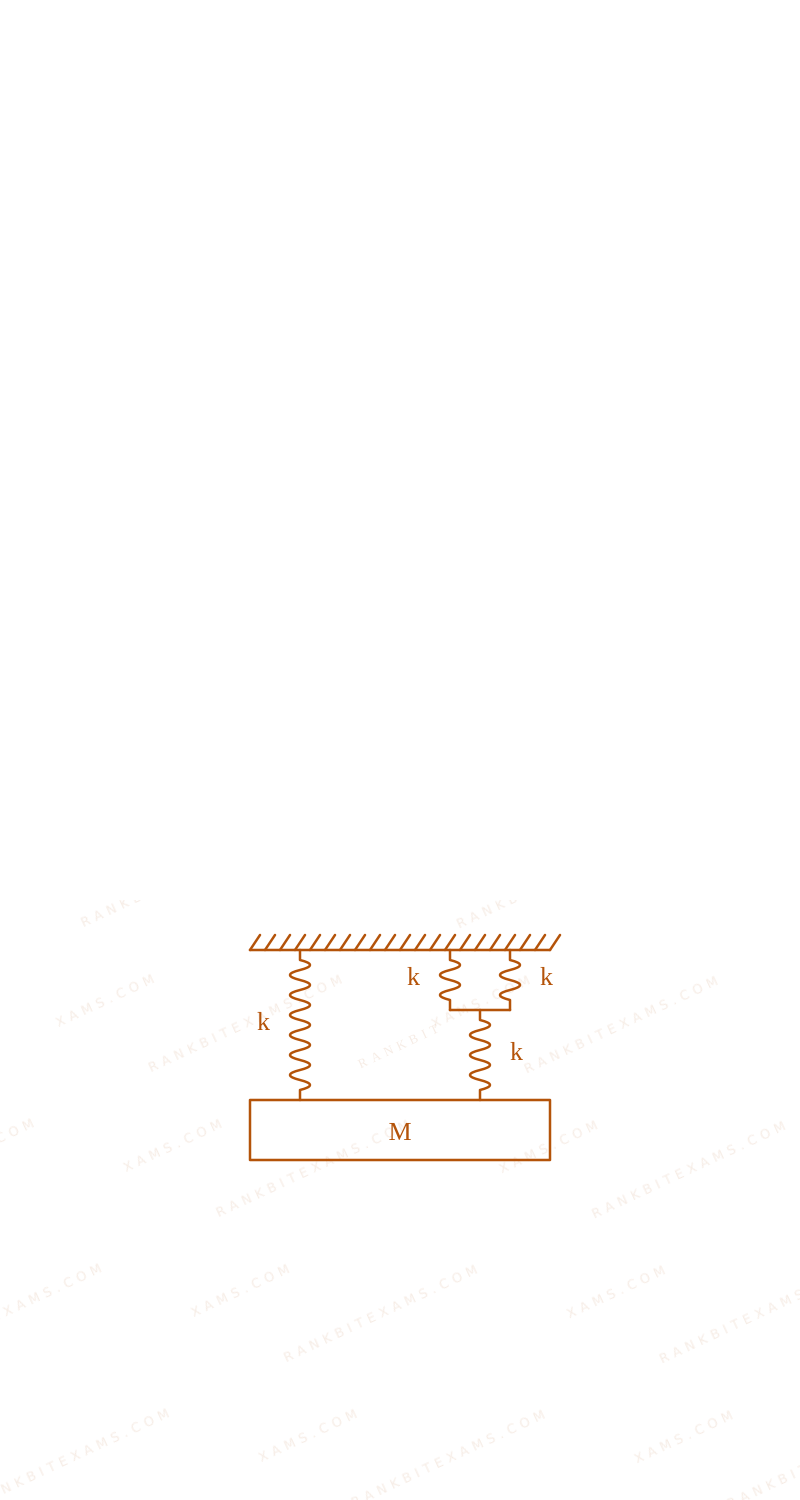
The time period of simple harmonic motion of mass M in the given figure is π √((α M)/(5K)), where the value of α is
Spring Mass System diagram for Q59 - JEE Main 2024 Evening
The image shows a combination of springs attached to a mass. Springs of stiffness 2k and k are connected in parallel, which in turn are connected in series with a spring of stiffness k.
Numerical Answer. Answer: 12 to 12

Solution

Related Formula

Springs in parallel: kₚ = k₁ + k₂ Springs in series:

(1)/(kₛ) = (1)/(kₚ) + (1)/(k₃)

Time period:

T = 2π Mkeq
Core Logic

Evaluate the equivalent spring constant of the given setup by first resolving the parallel configuration, then the series configuration.

Step 1: Equivalent Spring Constant

Based on the standard layout of the problem (as implied by the solution text), let's assume one section is 2k and k in parallel... Wait, the solution implies (2k · k)/(3k) + k, which represents a series combination of 2k and k, followed by a parallel combination with another k. Let's trust the official PDF's algebraic step: keq = (2k · k)/(3k) + k. This evaluates to:

keq = (2k)/(3) + k = (5k)/(3)
Step 2: Time Period Calculation
T = 2π Mkeq T = 2π √((M)/(5k/3)) = 2π √((3M)/(5k))
Step 3: Matching the Format

Bring the 2 inside the square root as 4:

T = π √((4 × 3M)/(5k)) = π √((12M)/(5k))

Comparing with π √((α M)/(5k)): α = 12

Pattern Recognition

Whenever an external coefficient like 2 (from 2π) is pushed inside the square root to match a format, it squares. Don't forget 2 → 4, turning 3M into 12M.

Chapter Mix

Class 11 Physics: Oscillations

Q59 jee_main_2024_31_jan_morning Velocity In SHM
A particle performs simple harmonic motion with amplitude A. Its speed is increased to three times at an instant when its displacement is (2A)/(3). The new amplitude of motion is (nA)/(3). The value of n is ______.
Numerical Answer. Answer: 7 to 7

Solution

Related Formula
v = ω √(A² - x²)
Core Logic

At displacement x = (2A)/(3), the initial velocity is:

v = ω √(A² - ((2A)/(3))²) v = ω √(A² - (4A²)/(9)) = ω √((5A²)/(9)) v = √(5)Aω3
Step 2: Velocity Tripled

The speed is now increased to v' = 3v at the same position x = (2A)/(3).

v' = 3 ( √(5)Aω3) = √(5)Aω

This new velocity corresponds to a new amplitude A':

v' = ω √((A')² - x²) √(5)Aω = ω √((A')² - ((2A)/(3))²)
Step 3: Finding new Amplitude

Squaring both sides:

5A² = (A')² - (4A²)/(9) (A')² = 5A² + (4A²)/(9) = (45A² + 4A²)/(9) (A')² = (49A²)/(9) A' = (7A)/(3)

Comparing with (nA)/(3), we get n = 7.

Chapter Mix

Class 11 Physics: Oscillations

More Oscillations Questions — jee_main_2025_24_jan_evening

Practice all Oscillations previous-year questions →

Rankbit System
JEE Physics: Waves (+15.5%) | Electrostatics: Concentric Shells (-29.7%) | Modern Physics: Photoelectric Clones (+34.2%) | Mathematics: Definite Integrals (+18.1%) | Chemistry: Coordination Splitting (-11.4%) | JEE Physics: Waves (+15.5%) | Electrostatics: Concentric Shells (-29.7%) | Modern Physics: Photoelectric Clones (+34.2%) | Mathematics: Definite Integrals (+18.1%) | Chemistry: Coordination Splitting (-11.4%)