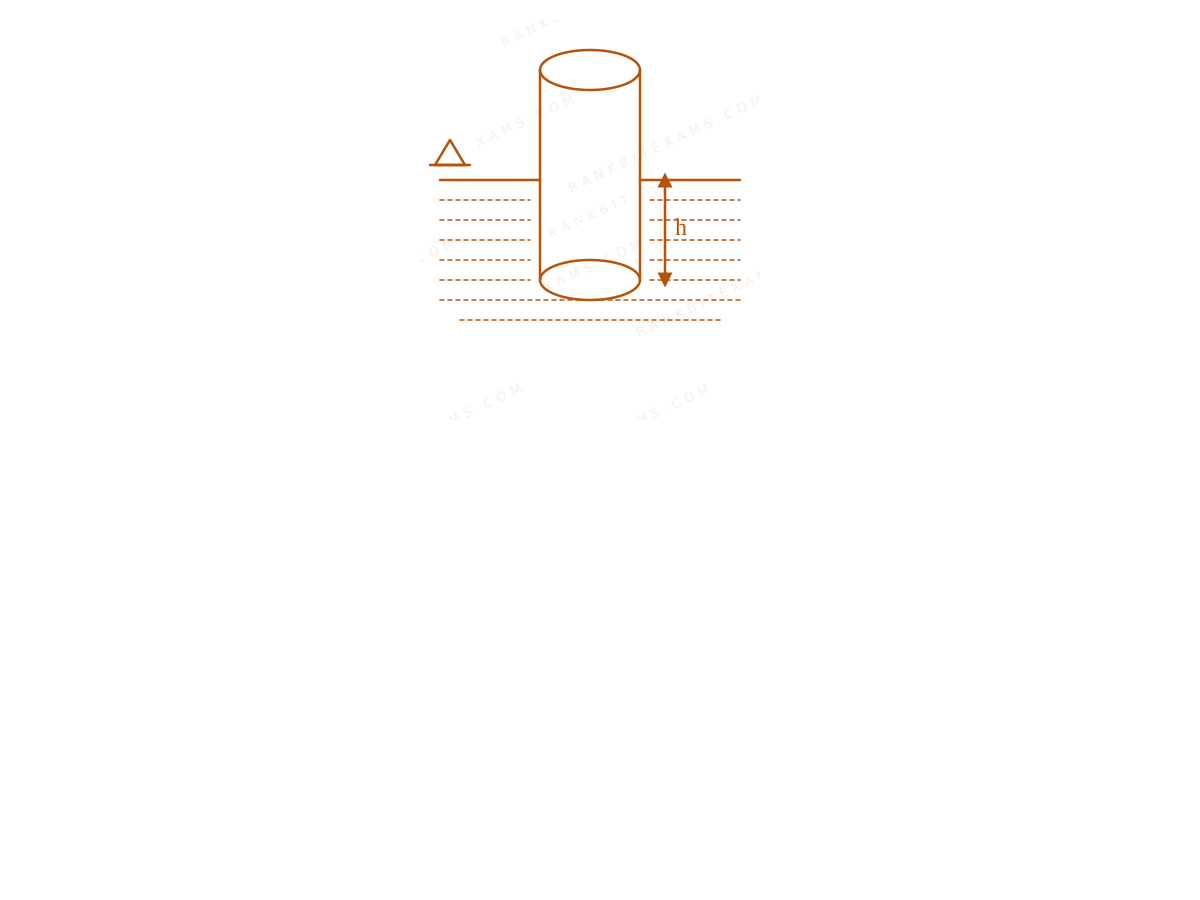
A cylindrical block of mass M and area of cross section A is floating in a liquid of density rho and with its axis vertical. When depressed a little and released the block starts oscillating. The period of oscillation is ____.

Solution & Explanation

### Related Formula T = 2pi sqrtfracMk_texteffective F_textbuoyancy = rho V g ### Core Logic
Floating cylindrical block in liquid
At equilibrium, the buoyant force balances the weight: rho Ahg = Mg After displacing the block downward by a small distance x, the net restoring force is: Ma = -rho A(h+x)g + Mg Ma = -rho Ahg - rho Axg + Mg Since rho Ahg = Mg, this simplifies to: Ma = -rho Axg a = left(frac-rho AgMright) x ### Step 1: Compare with Standard SHM Equation Comparing with a = -omega^2 x, we get: omega = sqrtfracrho AgM The time period T is: T = frac2piomega = 2pi sqrtfracMrho Ag ### Pattern Recognition For a floating body of uniform cross-section A, the restoring force constant is simply k = rho A g. The time period is immediately T = 2pi sqrtm/k. ### Evaluation Rubric / Model Answer null ### Chapter Mix Class 11 Physics: Oscillations Class 11 Physics: Mechanical Properties of Fluids

Reference Study Guides

More Oscillations Previous-Year Questions

Q33 jee_main_2026_21_jan_evening Simple Harmonic Motion
The kinetic energy of a simple harmonic oscillator is oscillating with angular frequency of 176 text rad/s. The frequency of this simple harmonic oscillator is ________ Hz. [texttake pi = frac227]
  • A. 14
  • B. 88
  • C. 28
  • D. 176

Solution

### Related Formula omega_k = 2pi f_k f_textoscillator = fracf_k2 ### Core Logic For a simple harmonic oscillator with an angular frequency omega, the kinetic energy oscillates at double the angular frequency (2omega). The given angular frequency of kinetic energy oscillation is omega_k = 176 text rad/s. ### Step 1: Finding Kinetic Energy Frequency First, find the frequency of kinetic energy oscillations (f_k): f_k = fracomega_k2pi = frac1762 times frac227 f_k = frac176 times 744 = 4 times 7 = 28 text Hz ### Step 2: Final Conclusion Since kinetic energy oscillates at twice the frequency of the oscillator itself: f_textoscillator = fracf_k2 = frac282 = 14 text Hz ### Pattern Recognition KE and PE always oscillate at twice the frequency (2nu) of the underlying SHM (v) due to the sin^2(omega t) or cos^2(omega t) terms resolving to (1 - cos(2omega t))/2. ### Evaluation Rubric / Model Answer null ### Chapter Mix Class 11 Physics: Oscillations

Q31 jee_main_2026_23_january_morning Simple Pendulum
A simple pendulum of string length 30 cm performs 20 oscillations in 10s. The length of the string required for the pendulum to perform 40 oscillations in the same time duration is ____ cm. [Assume that the mass of the pendulum remains same.]
  • A. 120
  • B. 0.75
  • C. 7.5
  • D. 15

Solution

### Related Formula T = 2pi sqrtfraclg T propto sqrtl ### Core Logic For a simple pendulum, the period is proportional to the square root of the length. If the frequency is doubled, the period is halved, which requires the length to become one-fourth of its original value. ### Step 1: Find Old and New Period Initial time period T_1 = frac1020 = 0.5 text s New time period T_2 = frac1040 = 0.25 text s So, T_2 = fracT_12 ### Step 2: Calculate New Length fracT_1T_2 = sqrtfracl_1l_2 2 = sqrtfrac30l_2 4 = frac30l_2 l_2 = frac304 = 7.5 text cm ### Pattern Recognition Sees: "Oscillations doubled in same time" → Frequency is doubled → Time period is halved. Since T propto sqrtl, l must be reduced to frac14 of the original. ### Evaluation Rubric / Model Answer null ### Chapter Mix Class 11 Physics: Oscillations
Q10 jee_main_2025_29_jan_evening Energy in Simple Harmonic Motion
Two bodies A and B of equal mass are suspended from two massless springs of spring constant k_1 and k_2 , respectively. If the bodies oscillate vertically such that their amplitudes are equal, the ratio of the maximum velocity of A to the maximum velocity of B is:
  • A. sqrtfrack_1k_2
  • B. fracmathrmk_1mathrmk_2
  • C. fracmathrmk_2mathrmk_1
  • D. sqrtfrack_2k_1

Solution

### Related Formula v_max = Aomega omega = sqrtfrackm ### Core Logic The maximum velocity in vertical SHM happens at the mean equilibrium position and is given by v_max = Aomega. Given m_A = m_B = m and A_A = A_B = A: v_A = A omega_1 = A sqrtfrack_1m v_B = A omega_2 = A sqrtfrack_2m Taking the ratio: fracv_Av_B = fracomega_1omega_2 = fracsqrtfrack_1msqrtfrack_2m = sqrtfrack_1k_2 ### Pattern Recognition Since maximum velocity is directly proportional to angular frequency omega for equal amplitudes, and omega propto sqrtk, the velocity ratio directly yields the square root of the spring constant ratio. ### Evaluation Rubric / Model Answer null ### Chapter Mix Class 11 Physics: Oscillations
Q jee_main_2025_04_april_morning Simple Pendulum
Two simple pendulums having lengths l_1 and l_2 with negligible string mass undergo angular displacements theta_1 and theta_2, from their mean positions, respectively. If the angular accelerations of both pendulums are same, then which expression is correct?
  • A. theta_1l_2^2 = theta_2l_1^2
  • B. theta_1l_1 = theta_2l_2
  • C. theta_1l_1^2 = theta_2l_2^2
  • D. theta_1l_2 = theta_2l_1

Solution

### Related Formula Angular acceleration definition for a simple pendulum swinging at small angle theta: alpha = -omega^2 theta where: omega = sqrtfracgl implies omega^2 = fracgl Hence, the magnitude of angular acceleration is: alpha = fracgltheta ### Core Logic Given that angular accelerations are exactly identical in magnitude (alpha_1 = alpha_2): fracgl_1theta_1 = fracgl_2theta_2 ### Step 1: Simplify Expression Cancelling out the constant gravitational acceleration g: fractheta_1l_1 = fractheta_2l_2 implies theta_1 l_2 = theta_2 l_1 ### Pattern Recognition Angular acceleration scales inversely with length for a fixed angular displacement (alpha propto fracthetal). To maintain identical angular accelerations, the ratio fracthetal must remain constant, yielding the cross-multiplication relation theta_1 l_2 = theta_2 l_1. ### Evaluation Rubric / Model Answer Option D: theta_1l_2 = theta_2l_1 ### Chapter Mix Class 11 Physics: Oscillations

More Oscillations Questions — jee_main_2026_24_january_morning

Practice all Oscillations previous-year questions →

Rankbit System
JEE Physics: Waves (+15.5%) | Electrostatics: Concentric Shells (-29.7%) | Modern Physics: Photoelectric Clones (+34.2%) | Mathematics: Definite Integrals (+18.1%) | Chemistry: Coordination Splitting (-11.4%) | JEE Physics: Waves (+15.5%) | Electrostatics: Concentric Shells (-29.7%) | Modern Physics: Photoelectric Clones (+34.2%) | Mathematics: Definite Integrals (+18.1%) | Chemistry: Coordination Splitting (-11.4%)