Rankbit System
JEE Physics: Waves (+15.5%) | Electrostatics: Concentric Shells (-29.7%) | Modern Physics: Photoelectric Clones (+34.2%) | Mathematics: Definite Integrals (+18.1%) | Chemistry: Coordination Splitting (-11.4%) | JEE Physics: Waves (+15.5%) | Electrostatics: Concentric Shells (-29.7%) | Modern Physics: Photoelectric Clones (+34.2%) | Mathematics: Definite Integrals (+18.1%) | Chemistry: Coordination Splitting (-11.4%)

A string of length L is fixed at one end and carries a mass of M at the other end. The mass makes left(frac3pi ight) rotations per second about the vertical axis passing through end of the string as shown. The tension in the string is ____ ML.

Numerical Answer Type:
Enter a numerical value Answer: 36 to 36 +4 marks

Solution & Explanation

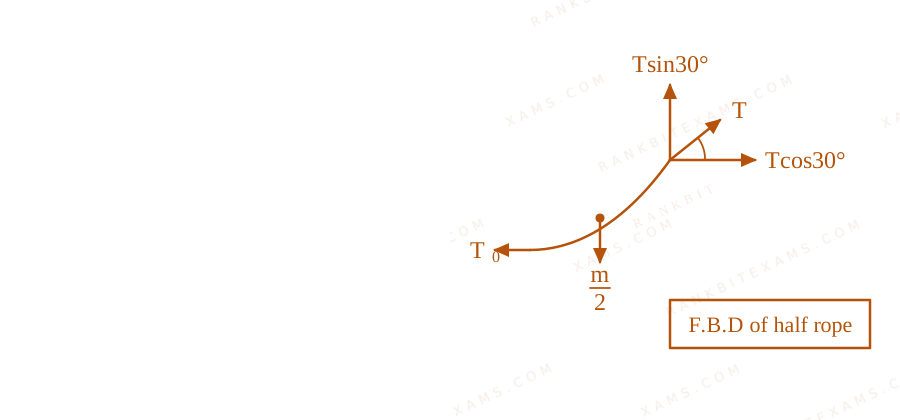
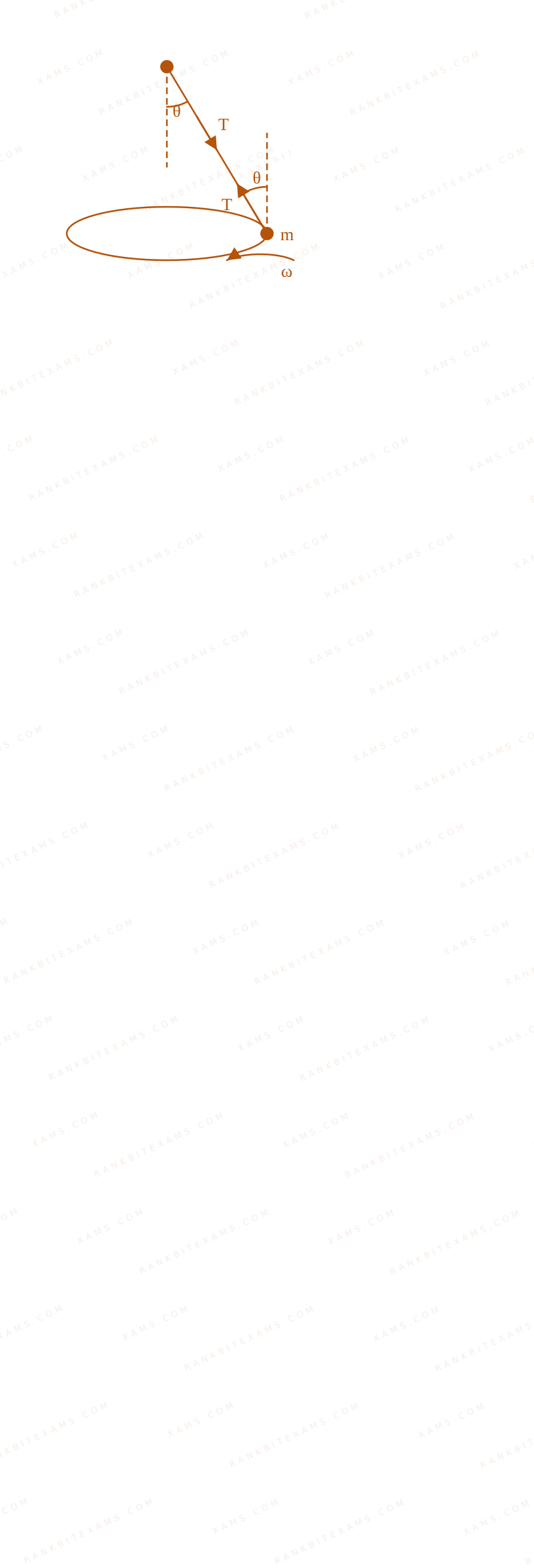
### Related Formula For a conical pendulum: T cos theta = Mg T sin theta = Momega^2 R where R = L sin theta. ### Core Logic Substituting R = L sin theta into the centripetal equation:
Conical pendulum string force vectors diagram Q22
T sin theta = M omega^2 (L sin theta) T = M omega^2 L Given rotational frequency: f = frac3pi\ mathrmrev/s Angular velocity: omega = 2pi f = 2pi left(frac3pi ight) = 6\ mathrmrad/s Substituting omega back into the simplified tension equation: T = M (6)^2 L = 36\ ML ### Pattern Recognition In a conical pendulum, the horizontal projection of tension provides the exact centripetal force. The sintheta terms cancel out, making string tension independent of the semi-vertical angle. ### Evaluation Rubric / Model Answer null ### Chapter Mix Class 11 Physics: Laws of Motion
Reference Study Guides

More Laws of Motion Previous-Year Questions — Page 2

Q14 2025 Friction
A block of mass 25 kg is pulled along a horizontal surface by a force at an angle 45^circ with the horizontal. The friction coefficient between the block and the surface is 0.25. The work done for a displacement of 5 m of the block with uniform velocity is:
  • A. 970 J
  • B. 735 J
  • C. 245 J
  • D. 490 J

Solution

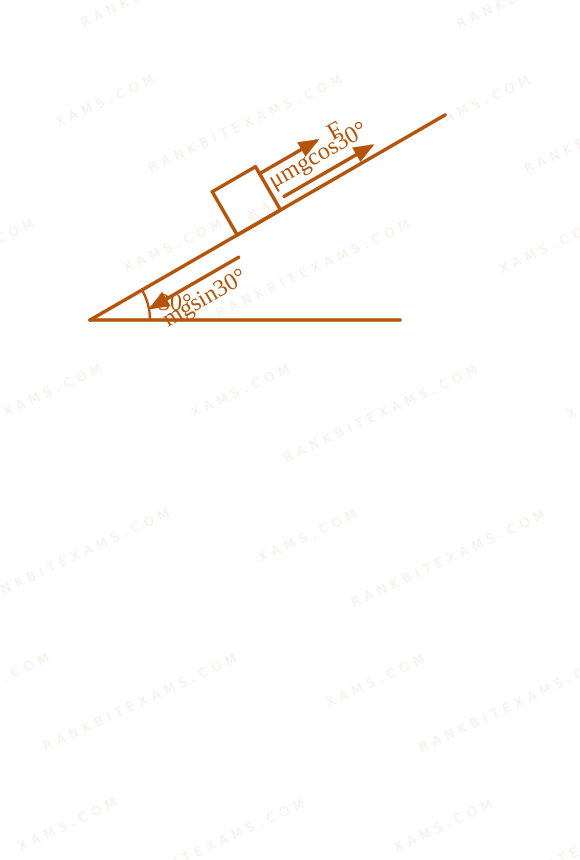
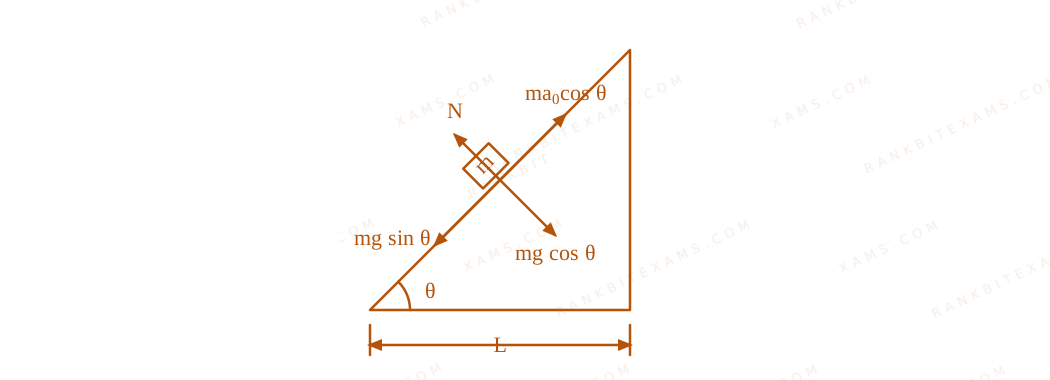
### Related Formula N + Fsintheta = mg implies N = mg - Fsintheta Fcostheta = f_k = mu_k N W = F cdot S cdot costheta ### Core Logic Since the block moves with uniform velocity, horizontal acceleration is zero. Fcos(45^circ) = mu [mg - Fsin(45^circ)] fracFsqrt2 = 0.25 left[25 times 9.8 - fracFsqrt2right] fracFsqrt2 = 61.25 - 0.25 fracFsqrt2 implies 1.25 fracFsqrt2 = 61.25 ### Step 1: Compute Force and Work Done fracFsqrt2 = frac61.251.25 = 49 implies F = 49sqrt2text N The work done by the external force over displacement S=5text m is: W = F S cos(45^circ) = (49sqrt2) times 5 times frac1sqrt2 = 245text J
Free body diagram of the block showing external force components and friction
### Pattern Recognition When uniform velocity is sustained, work done by the external pulling component perfectly matches the work consumed against internal friction dissipation (W = f_k cdot S). ### Evaluation Rubric / Model Answer null ### Chapter Mix Class 11 Physics: Laws of Motion
Q12 2025 Equilibrium of Forces
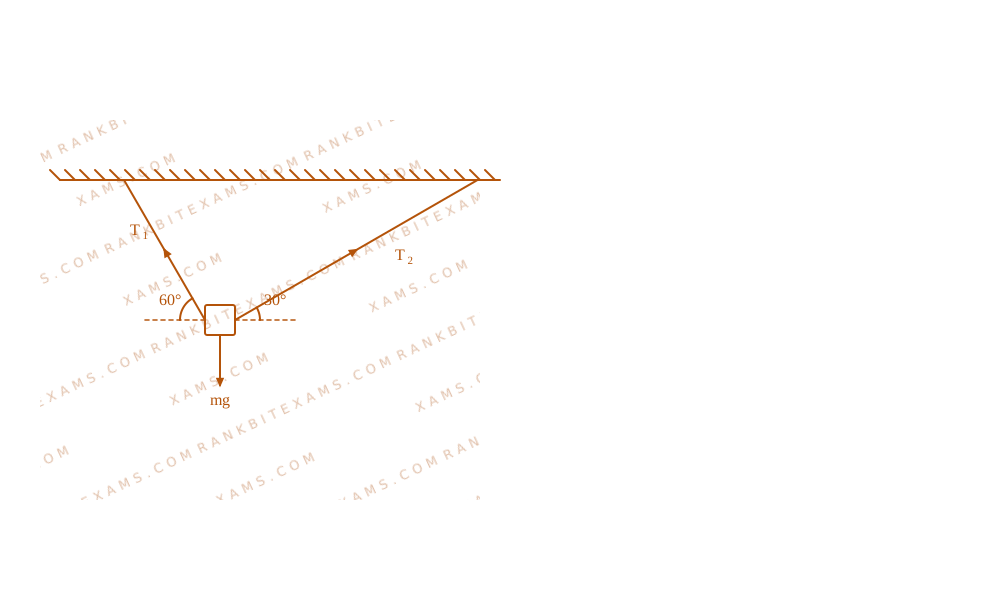
A body of mass m is suspended by two strings making angles theta1 and theta_2 with the horizontal ceiling with tensions T_1 and T_2 simultaneously. T_1 and T_2 are related by T_1=sqrt3T_2 the angles \theta_{1} and \theta_{2} are
  • A. theta_1=30^circ, theta_2=60^circtext with T_2=frac3mg4
  • B. theta_1=60^circ, theta_2=30^circtext with T_2=fracmg2
  • C. theta_1=45^circ, theta_2=45^circtext with T_2=frac3mg4
  • D. theta_1=30^circ, theta_2=60^circtext with T_2=frac4mg5

Solution

### Related Formula Horizontal equilibrium equation: T_1 costheta_1 = T_2 costheta_2 Vertical balancing equation: T_1 sintheta_1 + T_2 sintheta_2 = mg ### Core Logic Substitute T_1 = sqrt3T_2 into horizontal equilibrium: sqrt3T_2 costheta_1 = T_2 costheta_2 implies sqrt3costheta_1 = costheta_2 ### Step 1: Audit Options Pattern Match Let's check option (2) where theta_1 = 60^circ and theta_2 = 30^circ: sqrt3cos(60^circ) = sqrt3 cdot frac12 = fracsqrt32 cos(30^circ) = fracsqrt32 This perfectly matches the horizontal check expression constraints. ### Step 2: Solve for T2 Now map the variables into the vertical component balancing equation: T_2 left[ sqrt3sin(60^circ) + sin(30^circ) ight] = mg T_2 left[ sqrt3left(fracsqrt32 ight) + frac12 ight] = mg T_2 left[ frac32 + frac12 ight] = mg implies T_2 (2) = mg implies T_2 = fracmg2 ### Pattern Recognition Lami's Theorem or standard rectangular splitting. When tension is scaled by sqrt3, it directly hints at complementary 30^circ-60^circ geometric alignments. ### Evaluation Rubric / Model Answer null ### Chapter Mix Class 11 Physics: Laws of Motion
Q10 2025 Circular Motion and Banking of Roads
A car of mass 'm' moves on a banked road having radius 'r' and banking angle theta To avoid slipping from banked road, the maximum permissible speed of the car is v_0. The coefficient of friction mu between the wheels of the car and the banked road is :-
  • A. mu=fracv_0^2+rg~tan~thetarg-v_0^2tan~theta
  • B. mu=fracv_0^2+rg~tan~thetarg+v_0^2tan~theta
  • C. mu=fracv_0^2-rg~tan~thetarg+v_0^2tan~theta
  • D. mu=fracv_0^2-rg~tan~thetarg-v_0^2tan~theta

Solution

### Related Formula The maximum velocity limit preventing outer slide breakout on a rough banked plane profile is given by standard centrifugal force equations: v_0 = sqrtrg left(fractantheta + mu1 - mutantheta ight) ### Core Logic By writing out the components shown in the free body layout
Circular Motion and Banking of Roads diagram for Q10 - JEE Main 2025 Morning
: Nsintheta + fcostheta = fracmv_0^2r Ncostheta - fsintheta = mg ### Step 1: Isolate Coefficient of Friction Squaring the velocity boundary relation gives : fracv_0^2rg = fractantheta + mu1 - mutantheta Cross multiply to isolate the variable terms : v_0^2 - mu v_0^2tantheta = rgtantheta + mu rg v_0^2 - rgtantheta = mu(rg + v_0^2tantheta) mu = fracv_0^2 - rgtanthetarg + v_0^2tantheta ### Pattern Recognition Maximum limits always balance with plus signs in the numerator fraction. Simply rearrange that template expression directly to map the targeted parameter. ### Evaluation Rubric / Model Answer null ### Chapter Mix Class 11 Physics: Laws of Motion
Q20 2025 Newton Second Law Applications
A balloon and its content having mass M is moving up with an acceleration 'a'. The mass that must be released from the content so that the balloon starts moving up with an acceleration '3a' will be : (Take 'g' as acceleration due to gravity) [cite: 174, 175]
  • A. frac3mathrmMa2mathrma - mathrmg
  • B. frac3 mathrmMa2 mathrma + mathrmg
  • C. frac2 mathrmMa3 mathrma + mathrmg
  • D. frac2 mathrmMa3 mathrma - mathrmg

Solution

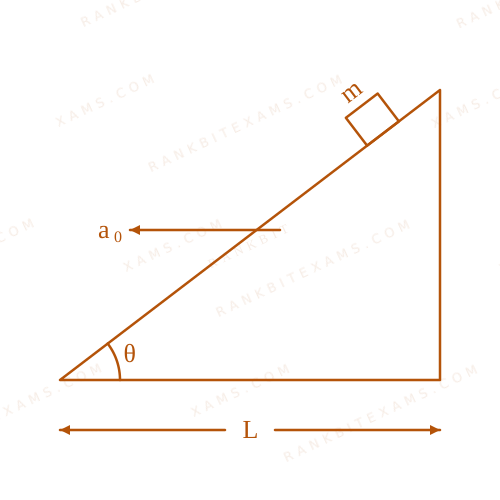
### Related Formula By Newton's second law of motion, the net upward force acting on an accelerating balloon system is given by: F_textbuoyant - m_texttotal g = m_texttotal a ### Core Logic Let F be the constant buoyant force acting upward on the balloon. **Case 1 (Initial upward acceleration)** : F - M g = M a implies F = M(g + a) quad text **Case 2 (After releasing mass x)** : The new total mass becomes (M - x), and its acceleration increases to 3a: F - (M - x)g = (M - x)3a quad text Substitute the value of F from Case 1 into Case 2 [cite: 836, 839]: M(g + a) - (M - x)g = (M - x)3a M g + M a - M g + x g = 3 M a - 3 x a quad text M a + x g = 3 M a - 3 x a x(g + 3a) = 2 M a x = frac2 M a3a + g quad text ### Step 1: Visual Context The free-body force layout for both accelerating phases is shown below:
Newton Second Law Applications free body diagrams for Q20
### Pattern Recognition Since the upward buoyant force is completely determined by the balloon's volume, it remains constant. Expressing this constant force in terms of the initial conditions allows you to quickly solve for mass changes when acceleration states vary. ### Evaluation Rubric / Model Answer null ### Chapter Mix Class 11 Physics: Laws of Motion

More Laws of Motion Questions — jee_main_2025_24_jan_evening

Practice all Laws of Motion previous-year questions →

YOUR FIRST PREP STEP STARTS HERE

We Map Every Repeating Question in Competitive Exams.

Say goodbye to generic mock test fatigue. RankBit uses smart analysis to group past exam questions into their foundational Repeating Question Types. Find chapter weightage, track repeating questions, and score higher with targeted practice.

Select Your Target Exam

Choose an exam track below to find formulas per chapter and patterns.

Syncing Exam Intelligence

Mapping formulas and patterns across all tracks…

PATH A — FULL LENGTH PRACTICE

Full Mock Test Hub

Simulate real NTA exam conditions with fully tracked mocks. Time yourself against past papers.

Under Development
PATH B — TARGETED PRACTICE

Topic-wise Practice Hub

Practice past-year questions one chapter at a time. Pick an exam → subject → chapter and get every PYQ for that topic — pulled together from all past papers — with the chapter's key formulas alongside.

Loading Questions... Browse Topics
Latest from the Blog
View all →

Loading articles...