Let veca=3hati-hatj+2hatk, vecb=vecatimes(hati-2hatk) and vecc=vecbtimeshatk. Then the projection of vecc-2hatj on veca is: [cite: 3358, 3359, 3364]

Solution & Explanation

### Related Formula The scalar projection of vector vecv onto vector vecw is calculated as: textProjection = fracvecv cdot vecw|vecw| ### Step 1: Calculate vecb Compute the cross product using standard matrix expansion [cite: 4013, 4015]: vecb = veca times (hati - 2hatk) = beginvmatrix hati & hatj & hatk \\ 3 & -1 & 2 \\ 1 & 0 & -2 endvmatrix vecb = hati(2 - 0) - hatj(-6 - 2) + hatk(0 - (-1)) = 2hati + 8hatj + hatk ### Step 2: Calculate vecc and vecc - 2hatj Perform the second cross product with unit vector hatk [cite: 3359, 4016]: vecc = vecb times hatk = (2hati + 8hatj + hatk) times hatk = 2(hati times hatk) + 8(hatj times hatk) + vec0 vecc = 2(-hatj) + 8(hati) = 8hati - 2hatj Subtract 2hatj [cite: 3364, 4016]: vecc - 2hatj = (8hati - 2hatj) - 2hatj = 8hati - 4hatj ### Step 3: Compute the projection onto veca Using the \dot product formula : textProjection = frac(vecc - 2hatj) cdot veca|veca| = fraclangle 8, -4, 0 rangle cdot langle 3, -1, 2 ranglesqrt3^2 + (-1)^2 + 2^2 [cite: 3358, 3995] textProjection = frac24 + 4 + 0sqrt9 + 1 + 4 = frac28sqrt14 = 2sqrt14 ### Pattern Recognition Keep cyclic unit cross products clear: hati times hatk = -hatj and hatj times hatk = hati. Missing a negative sign during basic cross multiplications ruins multi-step vector projections easily. ### Evaluation Rubric / Model Answer null ### Chapter Mix Class 12 Mathematics: Vector Algebra

Reference Study Guides

More Vector Algebra Previous-Year Questions — Page 6

Q13 jee_main_2024_29_jan_morning Vector Angle Bisector
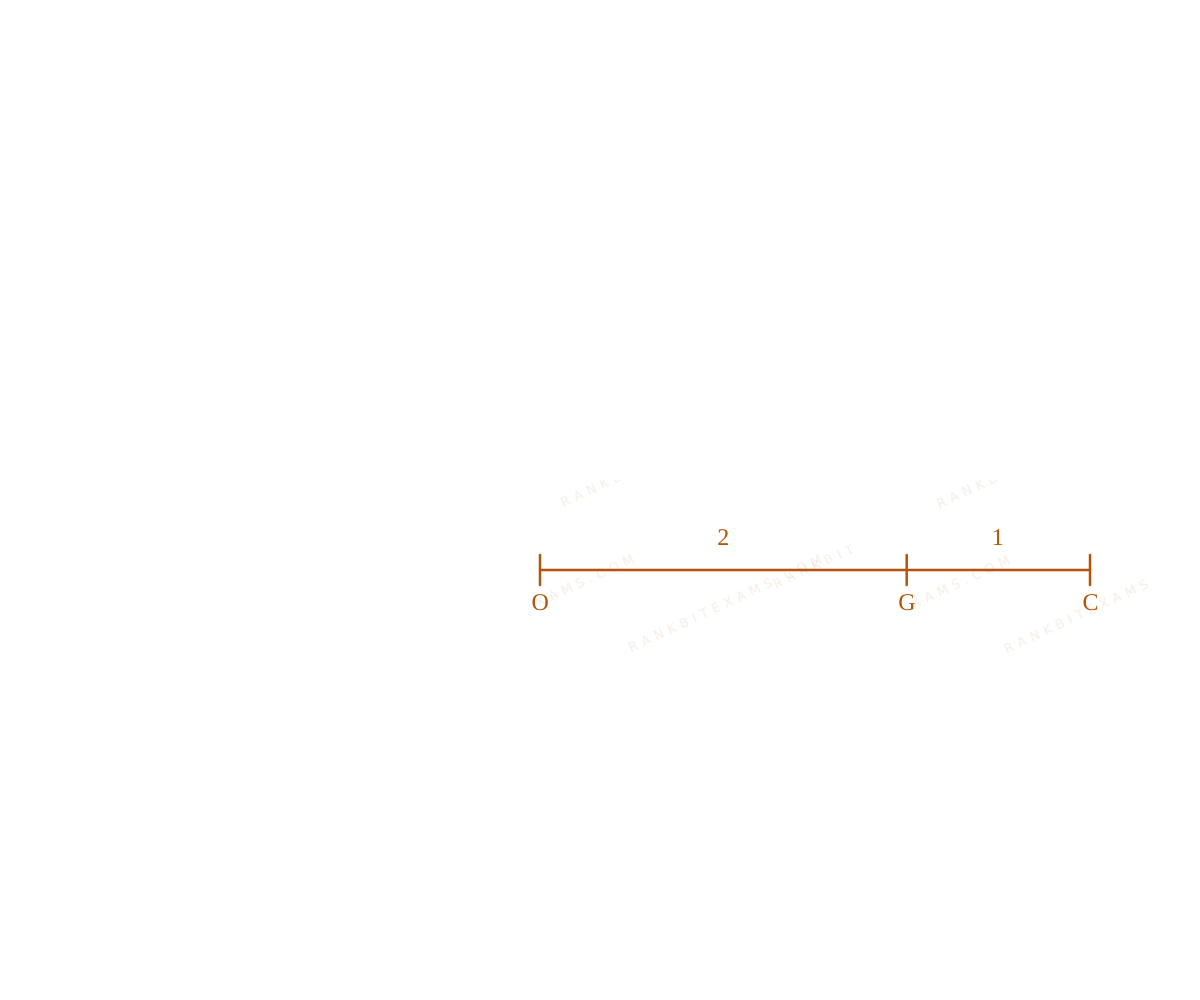
Let O be the origin and the position vector of A and B be 2hati+2hatj+hatk and 2hati+4hatj+4hatk respectively. If the internal bisector of angle AOB meets the line AB at C, then the length of OC is
  • A. frac23sqrt31
  • B. frac23sqrt34
  • C. frac34sqrt34
  • D. frac32sqrt31

Solution

### Related Formula textInternal Angle Bisector Theorem: fracACCB = frac|vecOA||vecOB| textSection Formula: vecOC = fracmvecOB + nvecOAm+n ### Core Logic Find the magnitudes of the position vectors vecOA and vecOB: |vecOA| = sqrt2^2 + 2^2 + 1^2 = sqrt4+4+1 = sqrt9 = 3 |vecOB| = sqrt2^2 + 4^2 + 4^2 = sqrt4+16+16 = sqrt36 = 6 According to the internal angle bisector theorem in Delta AOB, the point C divides the segment AB in the ratio of the adjacent sides: fracACCB = frac|vecOA||vecOB| = frac36 = frac12
Vector Angle Bisector
### Step 1: Apply Section Formula Using the section formula to find the position vector of C, dividing AB internally in ratio m:n = 1:2: vecOC = frac1(vecOB) + 2(vecOA)1 + 2 vecOC = frac1(2hati+4hatj+4hatk) + 2(2hati+2hatj+hatk)3 vecOC = frac(2+4)hati + (4+4)hatj + (4+2)hatk3 vecOC = frac6hati + 8hatj + 6hatk3 = 2hati + frac83hatj + 2hatk ### Step 2: Compute Length of OC Now, find the magnitude (length) of the vector vecOC: |vecOC| = sqrt2^2 + left(frac83right)^2 + 2^2 = sqrt4 + frac649 + 4 = sqrt8 + frac649 = sqrtfrac72 + 649 = sqrtfrac1369 = fracsqrt4 times 343 = frac2sqrt343 ### Pattern Recognition Vector angle bisector questions invariably test the geometric property that the bisector divides the opposite side in the ratio of the side lengths. Combine this directly with the 3D coordinate section formula. ### Evaluation Rubric / Model Answer null ### Chapter Mix Class 12 Mathematics: Vector Algebra
Q4 jee_main_2024_30_january_evening Cross Product
Let veca = hati +alpha hatj +beta hatk,alpha ,beta in mathbbR .Let a vector vecb be such that the angle between veca and vecb is fracpi4 and |vecb |^2 = 6 If vecacdotvecb = 3sqrt2 , then the value of (alpha^2 + beta^2)|vecatimes vecb |^2 is equal to
  • A. 90
  • B. 75
  • C. 95
  • D. 85

Solution

### Related Formula vecacdotvecb = |veca||vecb| cos theta |veca times vecb|^2 = |veca|^2 |vecb|^2 sin^2 theta |veca|^2 = a_x^2 + a_y^2 + a_z^2 ### Core Logic Given |vecb|^2 = 6, angle theta = fracpi4, and vecacdotvecb = 3sqrt2. |veca||vecb| cos theta = 3sqrt2 Squaring both sides: |veca|^2 |vecb|^2 cos^2 theta = 18 |veca|^2 (6) left(frac1sqrt2right)^2 = 18 |veca|^2 (6) left(frac12right) = 18 Rightarrow 3|veca|^2 = 18 Rightarrow |veca|^2 = 6 ### Step 1: Finding alpha and beta relation We have veca = hati + alpha hatj + beta hatk. |veca|^2 = 1^2 + alpha^2 + beta^2 1 + alpha^2 + beta^2 = 6 Rightarrow alpha^2 + beta^2 = 5 ### Step 2: Evaluating the Target Expression We need to find the value of (alpha^2 + beta^2)|veca times vecb|^2. |veca times vecb|^2 = |veca|^2 |vecb|^2 sin^2 theta |veca times vecb|^2 = (6) (6) sin^2left(fracpi4right) = 36 left(frac12right) = 18 Thus, the required value is: (alpha^2 + beta^2)|veca times vecb|^2 = (5)(18) = 90 ### Pattern Recognition Vector magnitude and dot product give direct length values. |vecatimesvecb|^2 + (vecacdotvecb)^2 = |veca|^2|vecb|^2 (Lagrange's Identity) skips sin^2theta calculations completely. ### Evaluation Rubric / Model Answer null ### Chapter Mix Class 12 Maths: Vector Algebra
Q8 jee_main_2024_30_january_evening Cross Product
Let veca and vecb be two vectors such that |vecb| = 1 and |vecb times veca| = 2 . Then left|left(vecb times vecaright) - vecbright|^2 is equal to
  • A. 3
  • B. 5
  • C. 1
  • D. 4

Solution

### Related Formula |vecx - vecy|^2 = |vecx|^2 + |vecy|^2 - 2(vecx cdot vecy) (vecb times veca) cdot vecb = 0 quad text(Scalar triple product with repeated vectors is zero) ### Core Logic Given |vecb| = 1 and |vecb times veca| = 2. Expand the requested expression: |(vecb times veca) - vecb|^2 = |vecb times veca|^2 + |vecb|^2 - 2((vecb times veca) cdot vecb) ### Step 1: Simplify using Vector Properties The cross product (vecb times veca) produces a vector orthogonal to both vecb and veca. Therefore, (vecb times veca) cdot vecb = 0. Substituting this back: |(vecb times veca) - vecb|^2 = |vecb times veca|^2 + |vecb|^2 - 0 |(vecb times veca) - vecb|^2 = (2)^2 + (1)^2 |(vecb times veca) - vecb|^2 = 4 + 1 = 5 ### Pattern Recognition A cross product vecu times vecv is inherently perpendicular to vecu. Any length squared involving (vecu times vecv) pm vecu resolves simply via Pythagorean sum. ### Evaluation Rubric / Model Answer null ### Chapter Mix Class 12 Maths: Vector Algebra
Q4 jee_main_2024_30_jan_morning Vector Cross Product
Let veca = a_1hati + a_2hatj + a_3hatk and vecb = b_1hati + b_2hatj + b_3hatk be two vectors such that |veca| = 1; vecacdotvecb = 2 and |vecb| = 4. If vecc = 2(veca times vecb) - 3vecb, then the angle between vecb and vecc is equal to:
  • A. cos^-1left(frac2sqrt3right)
  • B. cos^-1left(-frac1sqrt3right)
  • C. cos^-1left(-fracsqrt32right)
  • D. cos^-1left(frac23right)

Solution

### Related Formula |veca times vecb|^2 + (veca cdot vecb)^2 = |veca|^2 |vecb|^2 cos theta = fracvecb cdot vecc|vecb| |vecc| ### Core Logic Given |veca| = 1, |vecb| = 4, veca cdot vecb = 2. Let's evaluate |veca times vecb|^2 using Lagrange's identity: |veca times vecb|^2 = |veca|^2 |vecb|^2 - (veca cdot vecb)^2 |veca times vecb|^2 = (1)(16) - (2)^2 = 16 - 4 = 12 ### Step 1: Dot products with c We are given: vecc = 2(veca times vecb) - 3vecb To find the angle between vecb and vecc, we need vecb cdot vecc and |vecc|. Taking the dot product with vecb on both sides: vecb cdot vecc = 2(vecb cdot (veca times vecb)) - 3(vecb cdot vecb) Since vecb cdot (veca times vecb) = 0 (scalar triple product with repeated vector): vecb cdot vecc = 0 - 3|vecb|^2 = -3(16) = -48 quad dots (1) ### Step 2: Finding magnitude of c Now, let's find |vecc|^2: |vecc|^2 = vecc cdot vecc = (2(veca times vecb) - 3vecb) cdot (2(veca times vecb) - 3vecb) Since (veca times vecb) cdot vecb = 0, the cross terms vanish: |vecc|^2 = 4|veca times vecb|^2 + 9|vecb|^2 |vecc|^2 = 4(12) + 9(16) = 48 + 144 = 192 |vecc| = sqrt192 = 8sqrt3 ### Step 3: Calculating angle Now apply the angle formula: cos theta = fracvecb cdot vecc|vecb| |vecc| = frac-48(4)(8sqrt3) cos theta = frac-4832sqrt3 = frac-32sqrt3 = -fracsqrt32 theta = cos^-1left(-fracsqrt32right) ### Pattern Recognition Always remember that the cross product vector (veca times vecb) is orthogonal to both veca and vecb. This immediately eliminates cross terms when finding the magnitude of linear combinations like x(veca times vecb) + yvecb. ### Evaluation Rubric / Model Answer null ### Chapter Mix Class 12 Maths: Vector Algebra
Q18 jee_main_2024_30_jan_morning Cross Product
Let A (2, 3, 5) and C(-3, 4, -2) be opposite vertices of a parallelogram ABCD if the diagonal overrightarrowBD = hati + 2hatj + 3hatk then the area of the parallelogram is equal to
  • A. frac12sqrt410
  • B. frac12sqrt474
  • C. frac12sqrt586
  • D. frac12sqrt306

Solution

### Related Formula textArea of parallelogram = frac12 |overrightarrowd_1 times overrightarrowd_2| ### Core Logic The diagonals of the parallelogram are overrightarrowAC and overrightarrowBD. First, calculate the diagonal vector overrightarrowAC: overrightarrowAC = textPosition vector of C - textPosition vector of A overrightarrowAC = (-3 - 2)hati + (4 - 3)hatj + (-2 - 5)hatk = -5hati + 1hatj - 7hatk Alternatively, taking overrightarrowCA = 5hati - hatj + 7hatk. Let's use overrightarrowCA or overrightarrowAC, the magnitude of the cross product will be the same. The second diagonal is given: overrightarrowBD = hati + 2hatj + 3hatk ### Step 1: Finding Cross Product overrightarrowArea = frac12 |overrightarrowAC times overrightarrowBD| overrightarrowAC times overrightarrowBD = beginvmatrix hati & hatj & hatk \\ -5 & 1 & -7 \\ 1 & 2 & 3 endvmatrix = hati(3 - (-14)) - hatj(-15 - (-7)) + hatk(-10 - 1) = hati(17) - hatj(-8) + hatk(-11) = 17hati + 8hatj - 11hatk ### Step 2: Calculating Magnitude textArea = frac12 |17hati + 8hatj - 11hatk| = frac12 sqrt17^2 + 8^2 + (-11)^2 = frac12 sqrt289 + 64 + 121 = frac12 sqrt474 ### Pattern Recognition When opposite vertices and one full diagonal vector are provided, immediately calculate the second diagonal vector via displacement and evaluate half the magnitude of their cross product. ### Evaluation Rubric / Model Answer null ### Chapter Mix Class 12 Maths: Vector Algebra

More Vector Algebra Questions — jee_main_2025_24_jan_evening

Practice all Vector Algebra previous-year questions →

Rankbit System
JEE Physics: Waves (+15.5%) | Electrostatics: Concentric Shells (-29.7%) | Modern Physics: Photoelectric Clones (+34.2%) | Mathematics: Definite Integrals (+18.1%) | Chemistry: Coordination Splitting (-11.4%) | JEE Physics: Waves (+15.5%) | Electrostatics: Concentric Shells (-29.7%) | Modern Physics: Photoelectric Clones (+34.2%) | Mathematics: Definite Integrals (+18.1%) | Chemistry: Coordination Splitting (-11.4%)