Let the position vectors of three vertices of a $$$$$$\triangle$$$be$ be $4\vec{p}+\vec{q}-3\vec{r},$, $-5\vec{p}+\vec{q}+2\vec{r}and$ and $2\vec{p}-\vec{q}+2\vec{r}If the position vectors of the orthocenter and the circumcenter of the$ If the position vectors of the orthocenter and the circumcenter of the $\triangleare$ are $\frac{\vec{p}+\vec{q}+\vec{r}}{4}and$ and $\alpha\vec{p}+\beta\vec{q}+\gamma\vec{r}respectively, then$ respectively, then $\alpha+2\beta+5\gamma$ is equal to:
A.3$3$
B.1$1$
C.6$6$
D.4$4$
Solution & Explanation
Related Formula
Centroid (G$G$) of a $$$$$$\triangle$$with vertices $A, B, C$ is given by:
$$ with vertices $A, B, C$ is given by:
$$\vec{G} = \frac{\vec{A} + \vec{B} + \vec{C}}{3}
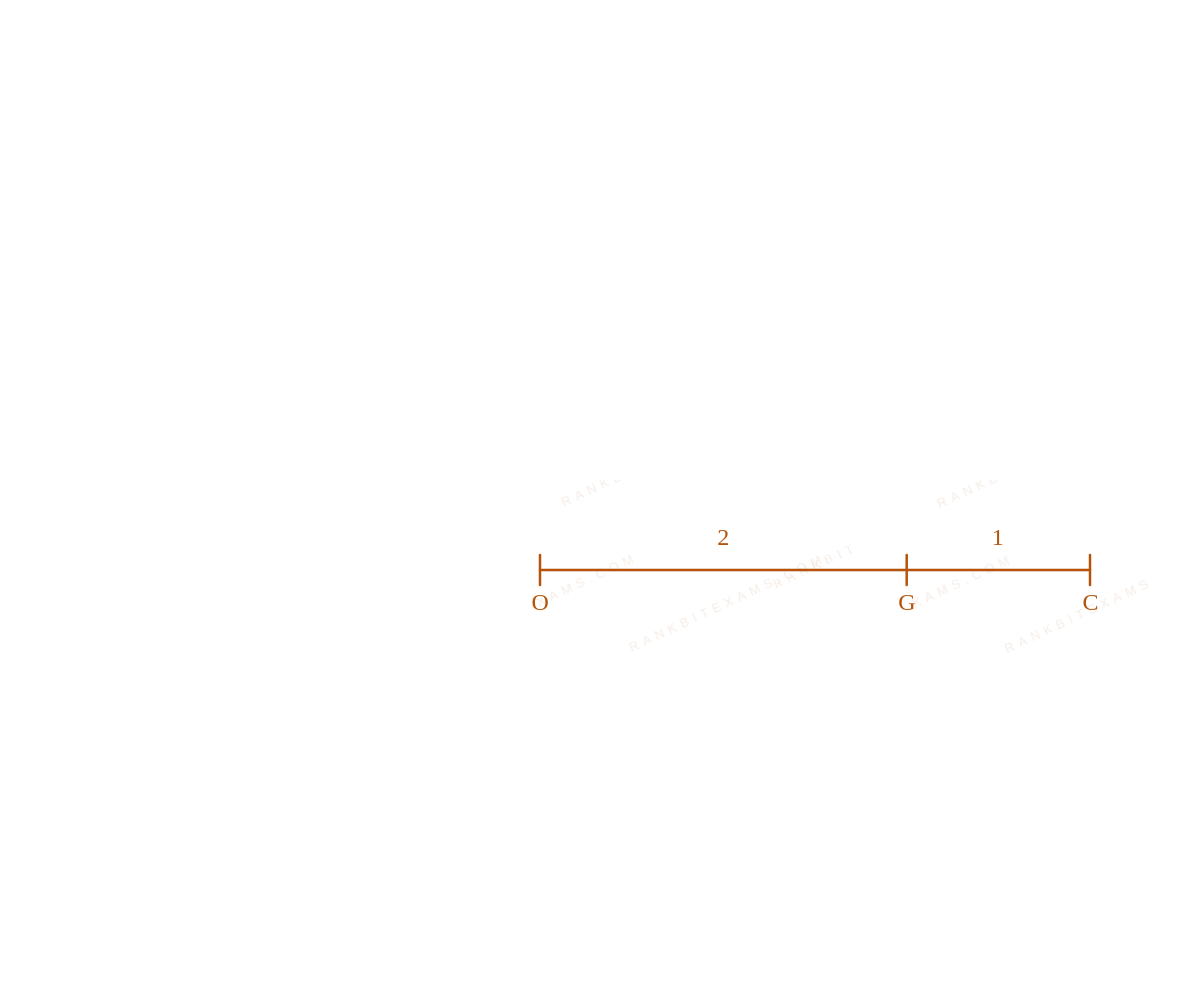
Euler's line property: The orthocenter ($O$), centroid ($G$), and circumcenter ($C$) are collinear, and $G$ divides the segment $OC$ internally in the ratio $2:1$.
Step 1: Compute the Centroid Vector
Sum the vectors of the three given vertices:
$$
Euler's line property: The orthocenter ($O$), centroid ($G$), and circumcenter ($C$) are collinear, and $G$ divides the segment $OC$ internally in the ratio $2:1$.
O-G-Cin$ in $2:1. Remember the mnemonic 'Oil-Gas-Company' or simply$. Remember the mnemonic 'Oil-Gas-Company' or simply $3G = 2C + O$ to prevent swapping structural coefficients under exam stress.
Chapter Mix
Class 12 Mathematics: Vector Algebra
Class 11 Mathematics: Properties of Triangles
Keywords:#Euler line section formula \triangle#JEE Main 2025 Evening Q56#Centroid vector calculation#orthocenter circumcenter vector relationship
More Vector Algebra Previous-Year Questions — Page 9
Q8jee_main_2024_30_january_eveningCross Product
Let a$\vec{a}$ and b$\vec{b}$ be two vectors such that | b| = 1$|\vec{b}| = 1$ and | b × a| = 2$|\vec{b} \times \vec{a}| = 2$ . Then |( b × a) - b|²$\left|\left(\vec{b} \times \vec{a}\right) - \vec{b}\right|^2$ is equal to
A.3$3$
B.5$5$
C.1$1$
D.4$4$
Solution
Related Formula
| x - y|² = | x|² + | y|² - 2( x · y)$$|\vec{x} - \vec{y}|^2 = |\vec{x}|^2 + |\vec{y}|^2 - 2(\vec{x} \cdot \vec{y})$$( b × a) · b = 0 (Scalar triple product with repeated vectors is zero)$$(\vec{b} \times \vec{a}) \cdot \vec{b} = 0 \quad \text{(Scalar triple product with repeated vectors is zero)}$$
Core Logic
Given | b| = 1$|\vec{b}| = 1$ and | b × a| = 2$|\vec{b} \times \vec{a}| = 2$.
Expand the requested expression:
|( b × a) - b|² = | b × a|² + | b|² - 2(( b × a) · b)$$|(\vec{b} \times \vec{a}) - \vec{b}|^2 = |\vec{b} \times \vec{a}|^2 + |\vec{b}|^2 - 2((\vec{b} \times \vec{a}) \cdot \vec{b})$$
Step 1: Simplify using Vector Properties
The cross product ( b × a)$(\vec{b} \times \vec{a})$ produces a vector orthogonal to both b$\vec{b}$ and a$\vec{a}$.
Therefore, ( b × a) · b = 0$(\vec{b} \times \vec{a}) \cdot \vec{b} = 0$.
Substituting this back:
|( b × a) - b|² = | b × a|² + | b|² - 0$$|(\vec{b} \times \vec{a}) - \vec{b}|^2 = |\vec{b} \times \vec{a}|^2 + |\vec{b}|^2 - 0$$|( b × a) - b|² = (2)² + (1)²$$|(\vec{b} \times \vec{a}) - \vec{b}|^2 = (2)^2 + (1)^2$$|( b × a) - b|² = 4 + 1 = 5$$|(\vec{b} \times \vec{a}) - \vec{b}|^2 = 4 + 1 = 5$$
Pattern Recognition
A cross product u × v$\vec{u} \times \vec{v}$ is inherently perpendicular to u$\vec{u}$. Any length squared involving ( u × v) ± u$(\vec{u} \times \vec{v}) \pm \vec{u}$ resolves simply via Pythagorean sum.
Let a = a₁ i + a₂ j + a₃ k$\vec{a} = a_{1}\hat{i} + a_{2}\hat{j} + a_{3}\hat{k}$ and b = b₁ i + b₂ j + b₃ k$\vec{b} = b_{1}\hat{i} + b_{2}\hat{j} + b_{3}\hat{k}$ be two vectors such that | a| = 1$|\vec{a}| = 1$; a· b = 2$\vec{a}\cdot\vec{b} = 2$ and | b| = 4$|\vec{b}| = 4$. If c = 2( a × b) - 3 b$\vec{c} = 2(\vec{a} \times \vec{b}) - 3\vec{b}$, then the angle between b$\vec{b}$ and c$\vec{c}$ is equal to:
c = 2( a × b) - 3 b$$\vec{c} = 2(\vec{a} \times \vec{b}) - 3\vec{b}$$
To find the angle between b$\vec{b}$ and c$\vec{c}$, we need b · c$\vec{b} \cdot \vec{c}$ and | c|$|\vec{c}|$.
Taking the dot product with b$\vec{b}$ on both sides:
b · c = 2( b · ( a × b)) - 3( b · b)$$\vec{b} \cdot \vec{c} = 2(\vec{b} \cdot (\vec{a} \times \vec{b})) - 3(\vec{b} \cdot \vec{b})$$
Since b · ( a × b) = 0$\vec{b} \cdot (\vec{a} \times \vec{b}) = 0$ (scalar triple product with repeated vector):
Always remember that the cross product vector ( a × b)$(\vec{a} \times \vec{b})$ is orthogonal to both a$\vec{a}$ and b$\vec{b}$. This immediately eliminates cross terms when finding the magnitude of linear combinations like x( a × b) + y b$x(\vec{a} \times \vec{b}) + y\vec{b}$.
Chapter Mix
Class 12 Maths: Vector Algebra
Q18jee_main_2024_30_jan_morningCross Product
Let A (2, 3, 5)$A (2, 3, 5)$ and C(-3, 4, -2)$C(-3, 4, -2)$ be opposite vertices of a parallelogram ABCD if the diagonal BD = i + 2 j + 3 k$\overrightarrow{BD} = \hat{i} + 2\hat{j} + 3\hat{k}$ then the area of the parallelogram is equal to
A.(1)/(2)√(410)$\frac{1}{2}\sqrt{410}$
B.(1)/(2)√(474)$\frac{1}{2}\sqrt{474}$
C.(1)/(2)√(586)$\frac{1}{2}\sqrt{586}$
D.(1)/(2)√(306)$\frac{1}{2}\sqrt{306}$
Solution
Related Formula
Area of parallelogram = (1)/(2) | d₁ × d₂|$$\text{Area of parallelogram} = \frac{1}{2} |\overrightarrow{d_1} \times \overrightarrow{d_2}|$$
Core Logic
The diagonals of the parallelogram are AC$\overrightarrow{AC}$ and BD$\overrightarrow{BD}$.
First, calculate the diagonal vector AC$\overrightarrow{AC}$:
AC = Position vector of C - Position vector of A$$\overrightarrow{AC} = \text{Position vector of } C - \text{Position vector of } A$$AC = (-3 - 2) i + (4 - 3) j + (-2 - 5) k = -5 i + 1 j - 7 k$$\overrightarrow{AC} = (-3 - 2)\hat{i} + (4 - 3)\hat{j} + (-2 - 5)\hat{k} = -5\hat{i} + 1\hat{j} - 7\hat{k}$$
Alternatively, taking CA = 5 i - j + 7 k$\overrightarrow{CA} = 5\hat{i} - \hat{j} + 7\hat{k}$. Let's use CA$\overrightarrow{CA}$ or AC$\overrightarrow{AC}$, the magnitude of the cross product will be the same.
The second diagonal is given:
When opposite vertices and one full diagonal vector are provided, immediately calculate the second diagonal vector via displacement and evaluate half the magnitude of their cross product.
Let a = 3 i + 2 j + k$\vec{a} = 3\hat{i} + 2\hat{j} + \hat{k}$, b = 2 i - j + 3 k$\vec{b} = 2\hat{i} - \hat{j} + 3\hat{k}$ and c$\vec{c}$ be a vector such that ( a + b) × c = 2( a × b) + 24 j - 6 k$(\vec{a} + \vec{b}) \times \vec{c} = 2(\vec{a} \times \vec{b}) + 24\hat{j} - 6\hat{k}$ and ( a - b + i) · c = -3$(\vec{a} - \vec{b} + \hat{i}) \cdot \vec{c} = -3$. Then | c|²$|\vec{c}|^2$ is equal to
Substitute into given cross product equation, letting c = (x, y, z)$\vec{c} = (x, y, z)$:
(5 i + j + 4 k) × (x i + y j + z k) = 2(7 i - 7 j - 7 k) + 24 j - 6 k$$(5\hat{i} + \hat{j} + 4\hat{k}) \times (x\hat{i} + y\hat{j} + z\hat{k}) = 2(7\hat{i} - 7\hat{j} - 7\hat{k}) + 24\hat{j} - 6\hat{k}$$vmatrix i & j & k 5 & 1 & 4 x & y & z vmatrix = (14, -14, -14) + (0, 24, -6)$$\begin{vmatrix} \hat{i} & \hat{j} & \hat{k} \\ 5 & 1 & 4 \\ x & y & z \end{vmatrix} = (14, -14, -14) + (0, 24, -6)$$(z-4y) i - (5z-4x) j + (5y-x) k = (14, 10, -20)$$(z-4y)\hat{i} - (5z-4x)\hat{j} + (5y-x)\hat{k} = (14, 10, -20)$$
Equating components:
z - 4y = 14 z = 4y + 14$$z - 4y = 14 \implies z = 4y + 14$$
4x - 5z = 10$4x - 5z = 10$
5y - x = -20 x = 5y + 20$$5y - x = -20 \implies x = 5y + 20$$
Now use the dot product constraint:
a - b + i = (3-2+1) i + (2+1) j + (1-3) k = (2, 3, -2)$\vec{a} - \vec{b} + \hat{i} = (3-2+1)\hat{i} + (2+1)\hat{j} + (1-3)\hat{k} = (2, 3, -2)$.
( a - b + i) · c = -3$$(\vec{a} - \vec{b} + \hat{i}) \cdot \vec{c} = -3$$2x + 3y - 2z = -3$$2x + 3y - 2z = -3$$
Substitute x = 5y + 20$x = 5y + 20$ and z = 4y + 14$z = 4y + 14$:
Q12jee_main_2024_31_jan_morningCross and Dot Product Operations
Let a = 3 i + j - 2 k, b = 4 i + j + 7 k$\vec{a} = 3\hat{i} + \hat{j} - 2\hat{k}, \vec{b} = 4\hat{i} + \hat{j} + 7\hat{k}$ and c = i - 3 j + 4 k$\vec{c} = \hat{i} - 3\hat{j} + 4\hat{k}$ be three vectors. If a vector p$\vec{p}$ satisfies p × b = c × b$\vec{p} \times \vec{b} = \vec{c} \times \vec{b}$ and p · a = 0$\vec{p} \cdot \vec{a} = 0$, then p · ( i - j - k)$\vec{p} \cdot (\hat{i} - \hat{j} - \hat{k})$ is equal to
A.24$24$
B.36$36$
C.28$28$
D.32$32$
Solution
Core Logic
Given p × b = c × b$\vec{p} \times \vec{b} = \vec{c} \times \vec{b}$.
( p - c) × b = 0$$(\vec{p} - \vec{c}) \times \vec{b} = \vec{0}$$
Thus, p - c = λ b p = c + λ b$\vec{p} - \vec{c} = \lambda \vec{b} \implies \vec{p} = \vec{c} + \lambda \vec{b}$.
Step 1: Utilize Dot Product Condition
Given p · a = 0$\vec{p} \cdot \vec{a} = 0$.
( c + λ b) · a = 0$$(\vec{c} + \lambda \vec{b}) \cdot \vec{a} = 0$$c · a + λ ( b · a) = 0$$\vec{c} \cdot \vec{a} + \lambda (\vec{b} \cdot \vec{a}) = 0$$
Practice past-year questions one chapter at a time. Pick an exam → subject → chapter and get every PYQ for that topic — pulled together from all past papers — with the chapter's key formulas alongside.