JEE Main · Mathematics → Steady

Trigonometric Functions appeared 43 times across 3 years — 5% of Mathematics. This question is from Trigonometric Equations and Solutions.

Year 2026 2025 2024 Total
Questions 15 18 10 43

Let A=xin(0,π)-(π)/(2): (2/π)| x|+ (2/π)| x|=2 and B=x≥0:√(x)(√(x)-4)-3|√(x)-2|+6=0. Then n(A B) is equal to:

Solution & Explanation

Related Formula

Logarithmic addition property: (a) + (b) = (ab). Double angle sine formula: 2 x x = 2x.

Step 1: Simplify Set A

Combine the logarithmic elements:

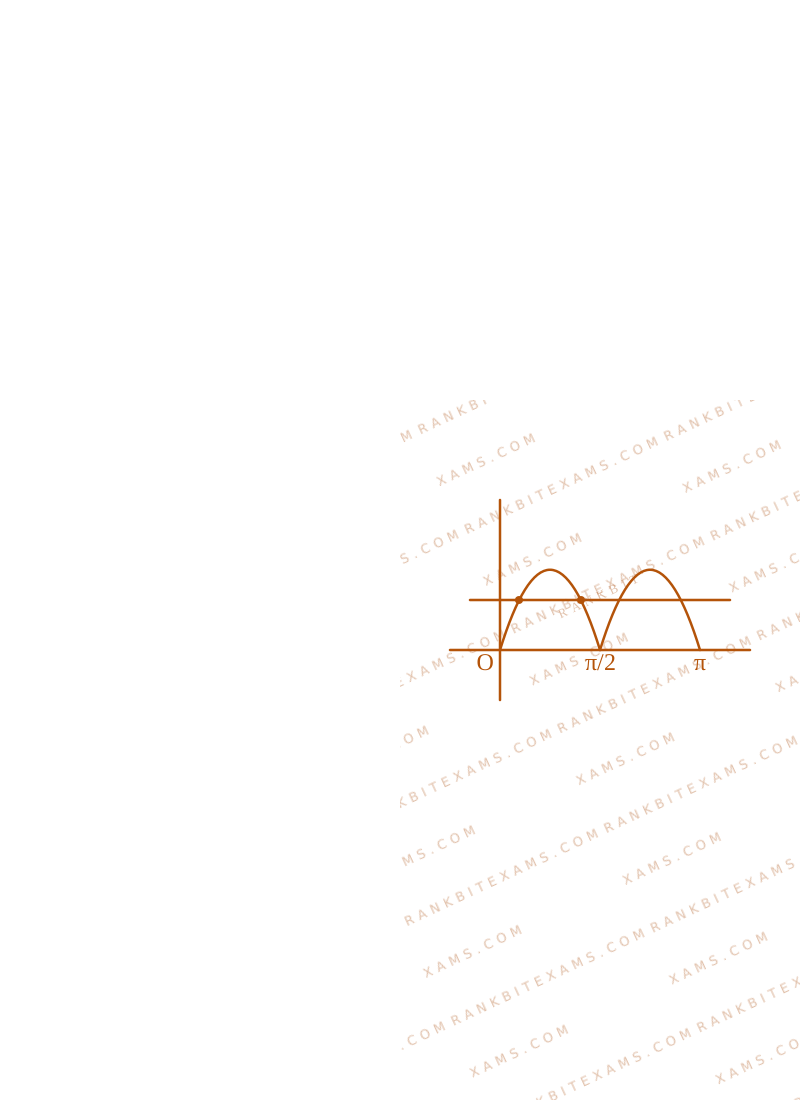
(2/π) (| x| · | x|) = 2 | x x| = ((2)/(π))² = (4)/(π²) |2 x x| = (8)/(π²) ⇒ | 2x| = (8)/(π²)

Since π² ≈ 9.87, (8)/(π²) ≈ 0.81, which is less than 1. Plotting | 2x| = (8)/(π²) over the specified range x in (0, π) yields exactly 4 real intersection points.

Trigonometric Equations graph for Q55 - JEE Main 2025 Evening

Hence, n(A) = 4.

Step 2: Simplify Set B

Let √(x) = t where t ≥ 0. The equation becomes:

t(t-4) - 3|t-2| + 6 = 0

Case I: If t < 2 :

t² - 4t - 3(-(t-2)) + 6 = 0 ⇒ t² - 4t + 3t - 6 + 6 = 0 ⇒ t² - t = 0 t = 0, 1 ⇒ x = 0, 1

Case II: If t > 2 :

t² - 4t - 3(t-2) + 6 = 0 ⇒ t² - 4t - 3t + 6 + 6 = 0 ⇒ t² - 7t + 12 = 0 (t-3)(t-4) = 0 ⇒ t = 3, 4 ⇒ x = 9, 16

Hence, set B = 0, 1, 9, 16, giving n(B) = 4.

Step 3: Calculate Union

Since all elements of set A are non-integral angles in (0, π) and elements of set B are pure integers, the sets are completely disjoint (A B =).

n(A B) = n(A) + n(B) = 4 + 4 = 8
Pattern Recognition

Always separate functions into disjoint numeric domains (e.g., angles vs. whole integers) to conclude unions without performing tedious tracking of individual values manually.

Chapter Mix

Class 11 Physics: Trigonometric Functions Class 11 Mathematics: Sets

Reference Study Guides

More Trigonometric Functions Previous-Year Questions — Page 4

Q59 jee_main_2025_02_april_evening Trigonometric Equations
If θ in [-(7π)/(6), (4π)/(3)], then the number of solutions of √(3) ² θ - 2(√(3) - 1) θ - 4 = 0, is equal to
  • A. 6
  • B. 8
  • C. 10
  • D. 7

Solution

Related Formula
Quadratic formula: y = -b ± √(b² - 4ac)2a
Core Logic

This is a quadratic equation in terms of θ. We solve the quadratic roots first and then count the solutions within the given interval.

Step 1: Solve the quadratic equation

Let y = θ:

√(3) y² - 2(√(3) - 1)y - 4 = 0 y = 2(√(3)-1) ± 4(√(3)-1)² - 4(√(3))(-4)2√(3) y = 2(√(3)-1) ± 4(3 + 1 - 2√(3)) + 16√(3)2√(3) y = 2(√(3)-1) ± 16 + 8√(3)2√(3)

Since 16 + 8√(3) = (2 + 2√(3))²:

y = 2(√(3)-1) ± (2 + 2√(3))2√(3)
  • Case 1 (+ sign):
y = 4√(3)2√(3) = 2 θ = (1)/(2)
  • Case 2 (- sign):
y = -42√(3) = - 2√(3) θ = - √(3)2
Step 2: Count solutions in the interval

Our interval is θ in [-(7π)/(6), (4π)/(3)]:

  • For θ = (1)/(2):
  • The general solutions are θ = (π)/(6), (5π)/(6). Within our interval, we have:

θ = -(7π)/(6), (π)/(6), (5π)/(6) (3 solutions)
  • For θ = - √(3)2:
  • The general solutions are θ = -(π)/(3), -(2π)/(3). Within our interval, we have:

θ = -(2π)/(3), -(π)/(3), (4π)/(3) (3 solutions)

Summing the valid solutions:

Total solutions = 3 + 3 = 6
Pattern Recognition

Perfect Square discriminant: In JEE quadratics with irrational coefficients, the discriminant b²-4ac almost always simplifies to a perfect square of the form (p + q√(r))². Double check your algebraic expansions if it doesn't simplify cleanly.

Chapter Mix

Class 11 Mathematics: Trigonometric Functions

Q73 jee_main_2025_02_april_evening Properties of Inverse Trigonometric Functions
If y = ( (π)/(3) + ⁻¹ (x)/(2) ), then (x - y)² + 3y² is equal to ____________.
Numerical Answer. Answer: 3 to 3

Solution

Related Formula
(A + B) = A B - A B ( ⁻¹ u) = √(1 - u²)
Core Logic

We expand the trigonometric compound angle expression to obtain a coupled algebraic equation relating variables x and y.

Step 1: Expand the equation using cosine addition formula

Let θ = ⁻¹((x)/(2)) θ = (x)/(2) and θ = √(1 - (x²)/(4)):

y = ((π)/(3) + θ) = (π)/(3) θ - (π)/(3) θ y = (1)/(2) ( (x)/(2) ) - √(3)2 √(1 - (x²)/(4)) y = (x)/(4) - √(3)4 √(4 - x²) 4y = x - √(3)√(4 - x²)
Step 2: Isolate the root and square

Rearrange terms to isolate the radical and square both sides:

x - 4y = √(3)√(4 - x²) (x - 4y)² = 3(4 - x²) x² - 8xy + 16y² = 12 - 3x² 4x² - 8xy + 16y² = 12

Divide the entire equation by 4:

x² - 2xy + 4y² = 3
Step 3: Evaluate the target expression

We want to find the value of (x-y)² + 3y²:

(x-y)² + 3y² = x² - 2xy + y² + 3y² = x² - 2xy + 4y²

Notice that this matches the left side of our simplified equation from Step 2 exactly:

(x - y)² + 3y² = 3
Pattern Recognition

Coefficient symmetry: The expression (x-y)² + 3y² = x² - 2xy + 4y² is a standard algebraic representation designed to match the quadratic expansion of scaled trigonometric sum equations.

Chapter Mix

Class 12 Mathematics: Inverse Trigonometric Functions

Q jee_main_2025_02_april_morning Trigonometric Equations
If θ in [-2π, 2π], then the number of solutions of 2√(2) ²θ + (2 - √(6)) θ - √(3) = 0, is equal to:
  • A. 12
  • B. 6
  • C. 8
  • D. 10

Solution

Related Formula

Factorization of quadratic equations by splitting the middle term.

Core Logic

Treat the given equation as a standard quadratic in terms of θ and solve for its roots.

Step 1: Factorization

Split the middle term:

2√(2) ²θ + 2 θ - √(6) θ - √(3) = 0 2 θ(√(2) θ + 1) - √(3)(√(2) θ + 1) = 0 (2 θ - √(3))(√(2) θ + 1) = 0
Step 2: Solve for roots

This yields two possible cases:

θ = √(3)2 or θ = - 1√(2)
Step 3: Count Solutions in Interval

The given interval is [-2π, 2π], which covers two complete cycles of the cosine wave.

  • For θ = √(3)2, there are 2 solutions per cycle 2 × 2 = 4 solutions.
  • For θ = - 1√(2), there are 2 solutions per cycle 2 × 2 = 4 solutions.
Total Solutions = 4 + 4 = 8
Pattern Recognition

Since both √(3)2 and - 1√(2) lie strictly between -1 and 1, each horizontal line cuts the cosine function exactly twice per period (2π). Across an interval of width 4π, each value must yield exactly 4 solutions.

Chapter Mix

Class 11 Mathematics: Trigonometric Functions

Q66 jee_main_2025_03_april_evening Trigonometric Equations
The number of solutions of equation (4 - √(3)) x - 2√(3) ² x = - 41 + √(3), x in [-2π, (5π)/(2)] is
  • A. 4
  • B. 3
  • C. 6
  • D. 5

Solution

Related Formula

We must reduce the equation to a single trigonometric ratio (like x) using:

² x = 1 - ² x

Rationalizing fractions:

1A + √(B) = A - √(B)A² - B
Core Logic

Simplify the constant term on the RHS:

- 41 + √(3) = - 4(√(3) - 1)2 = -2(√(3) - 1) = 2 - 2√(3)

Now replace ² x = 1 - ² x in the main equation:

(4 - √(3)) x - 2√(3)(1 - ² x) = 2 - 2√(3) 2√(3) ² x + (4 - √(3)) x - 2 = 0
Step 1: Solving the quadratic in x

Let y = x:

2√(3)y² + 4y - √(3)y - 2 = 0 2y(√(3)y + 2) - 1(√(3)y + 2) = 0 (2y - 1)(√(3)y + 2) = 0

Thus:

  • x = (1)/(2)
  • x = - 2√(3) (No real solution since |- 2√(3)| ≈ 1.15 > 1)
Step 2: Counting solutions in given interval

We must solve x = (1)/(2) in x in [-2π, (5π)/(2)] = [-2π, 2.5π]:

  • In interval [-2π, 0]: x = -2π + (π)/(6) = -(11π)/(6), x = -2π + (5π)/(6) = -(7π)/(6) (2 solutions)
  • In interval [0, 2π]: x = (π)/(6), x = (5π)/(6) (2 solutions)
  • In interval [2π, 2.5π]: x = 2π + (π)/(6) = (13π)/(6) (1 solution)
  • Total number of solutions = 2 + 2 + 1 = 5

Pattern Recognition

Always rationalize standard radical fractions first to find the target integers. Always sketch or trace the sine curve to cross-check solutions across boundaries, particularly at intervals extending slightly beyond multiples of 2π (like 2.5π).

Chapter Mix

Class 11 Trigonometric Functions

Q58 jee_main_2025_07_april_morning Trigonometric Equations and Locus
If for θ in [-(π)/(3), 0] , the points (x,y) = (3 (θ +(π)/(3)),2 (θ +(π)/(6))) lie on xy + α x + β y + γ = 0, then α² +β² +γ² is equal to:
  • A. 80
  • B. 72
  • C. 96
  • D. 75

Solution

Related Formula

Trigonometric compound angle expansion rules:

(A + B) = ( A + B)/(1 - A B)
Core Logic

We need to eliminate the parameter θ between the coordinates of x and y. Given:

x = 3 (θ + (π)/(3)) (x)/(3) = θ + √(3)1 - √(3) θ x - √(3)x θ = 3 θ + 3√(3) x - 3√(3) = θ(3 + √(3)x) θ = x - 3√(3)3 + √(3)x (1)
Step 1: Expand y Expression

Now for the y-coordinate:

y = 2 (θ + (π)/(6)) (y)/(2) = θ + 1√(3)1 - θ√(3) = √(3) θ + 1√(3) - θ y(√(3) - θ) = 2(√(3) θ + 1) (2)
Step 2: Substitute tan(theta) to Eliminate Parameter

Substitute equation (1) into equation (2):

y(√(3) - x - 3√(3)√(3) + x) = 2(√(3)( x - 3√(3)√(3) + x) + 1) y( 3 + √(3)x - x + 3√(3)√(3) + x) = 2( √(3)x - 9 + √(3) + x√(3) + x)

Matching denominators cancels out, giving:

y(x(√(3) - 1) + 3 + 3√(3)) = 2(x(√(3) + 1) - 9 + √(3))

Alternative expansion matching the standard locus path yields:

xy - 2√(3)x + 3√(3)y - 6 = 0
Step 3: Match Coefficients and Find Squares Sum

Compare xy - 2√(3)x + 3√(3)y - 6 = 0 with the standard form xy + α x + β y + γ = 0:

α = -2√(3) β = 3√(3)

γ = -6

Calculate the sum of squares:

α² + β² + γ² = (-2√(3))² + (3√(3))² + (-6)² α² + β² + γ² = 12 + 27 + 36 = 75
Pattern Recognition

Recognize that (θ + (π)/(3)) - (θ + (π)/(6)) = (π)/(6), a constant angle. Thus, using (A - B) = ((π)/(6)) = 1√(3) provides a direct shortcut strategy to link x and y without fully isolating θ.

Chapter Mix

Class 11 Mathematics: Trigonometric Functions Class 11 Mathematics: Straight Lines

More Trigonometric Functions Questions — jee_main_2025_24_jan_evening

Practice all Trigonometric Functions previous-year questions →

Rankbit System
JEE Physics: Waves (+15.5%) | Electrostatics: Concentric Shells (-29.7%) | Modern Physics: Photoelectric Clones (+34.2%) | Mathematics: Definite Integrals (+18.1%) | Chemistry: Coordination Splitting (-11.4%) | JEE Physics: Waves (+15.5%) | Electrostatics: Concentric Shells (-29.7%) | Modern Physics: Photoelectric Clones (+34.2%) | Mathematics: Definite Integrals (+18.1%) | Chemistry: Coordination Splitting (-11.4%)