JEE Main · Mathematics → Steady

Trigonometric Functions appeared 43 times across 3 years — 5% of Mathematics. This question is from Trigonometric Equations and Solutions.

Year 2026 2025 2024 Total
Questions 15 18 10 43

Let A=xin(0,π)-(π)/(2): (2/π)| x|+ (2/π)| x|=2 and B=x≥0:√(x)(√(x)-4)-3|√(x)-2|+6=0. Then n(A B) is equal to:

Solution & Explanation

Related Formula

Logarithmic addition property: (a) + (b) = (ab). Double angle sine formula: 2 x x = 2x.

Step 1: Simplify Set A

Combine the logarithmic elements:

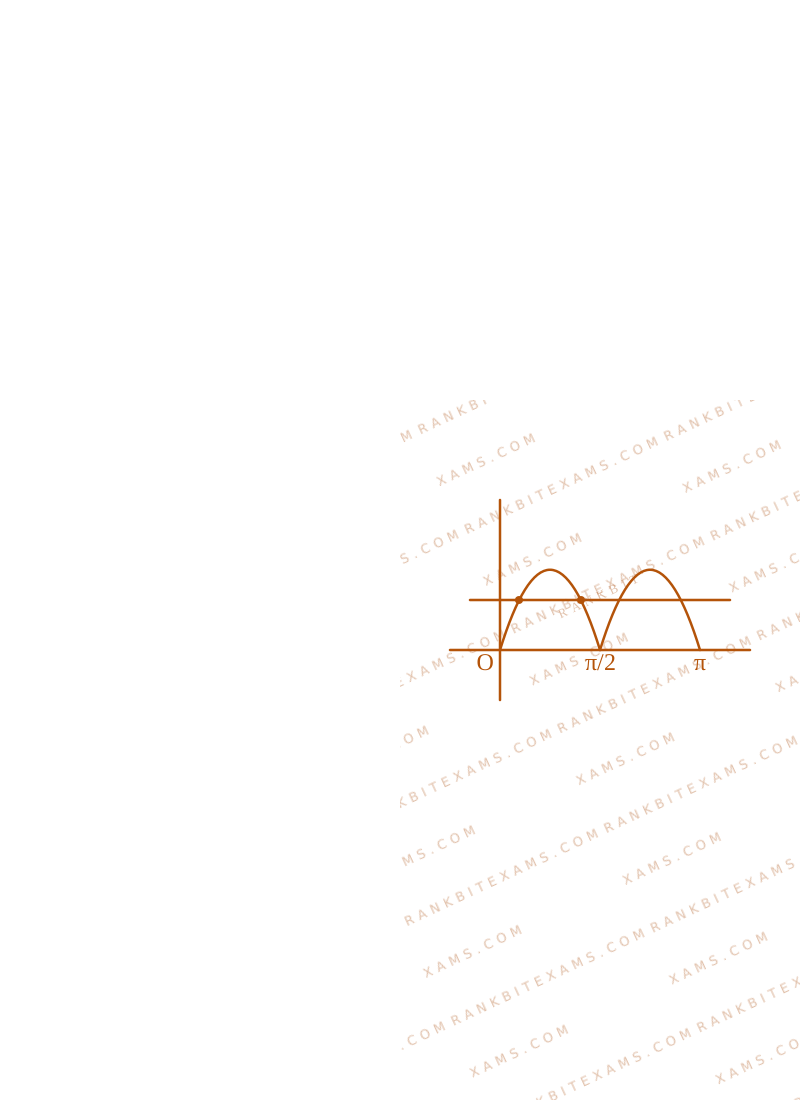
(2/π) (| x| · | x|) = 2 | x x| = ((2)/(π))² = (4)/(π²) |2 x x| = (8)/(π²) ⇒ | 2x| = (8)/(π²)

Since π² ≈ 9.87, (8)/(π²) ≈ 0.81, which is less than 1. Plotting | 2x| = (8)/(π²) over the specified range x in (0, π) yields exactly 4 real intersection points.

Trigonometric Equations graph for Q55 - JEE Main 2025 Evening

Hence, n(A) = 4.

Step 2: Simplify Set B

Let √(x) = t where t ≥ 0. The equation becomes:

t(t-4) - 3|t-2| + 6 = 0

Case I: If t < 2 :

t² - 4t - 3(-(t-2)) + 6 = 0 ⇒ t² - 4t + 3t - 6 + 6 = 0 ⇒ t² - t = 0 t = 0, 1 ⇒ x = 0, 1

Case II: If t > 2 :

t² - 4t - 3(t-2) + 6 = 0 ⇒ t² - 4t - 3t + 6 + 6 = 0 ⇒ t² - 7t + 12 = 0 (t-3)(t-4) = 0 ⇒ t = 3, 4 ⇒ x = 9, 16

Hence, set B = 0, 1, 9, 16, giving n(B) = 4.

Step 3: Calculate Union

Since all elements of set A are non-integral angles in (0, π) and elements of set B are pure integers, the sets are completely disjoint (A B =).

n(A B) = n(A) + n(B) = 4 + 4 = 8
Pattern Recognition

Always separate functions into disjoint numeric domains (e.g., angles vs. whole integers) to conclude unions without performing tedious tracking of individual values manually.

Chapter Mix

Class 11 Physics: Trigonometric Functions Class 11 Mathematics: Sets

Reference Study Guides

More Trigonometric Functions Previous-Year Questions — Page 3

Q10 jee_main_2026_24_january_morning Half Angle and Compound Angle Formulas
If x = (5)/(12) for some x in ( π, (3π)/(2) ), then 7x( (13x)/(2) + (13x)/(2) ) + 7x( (13x)/(2) - (13x)/(2) ) is equal to
  • A. 4√(26)
  • B. 6√(26)
  • C. 1√(13)
  • D. 5√(13)

Solution

Related Formula
(A + B) = A B + A B (A - B) = A B - A B x = 2 ²((x)/(2)) - 1 = 1 - 2 ²((x)/(2))
Core Logic

Given x = (5)/(12) and x in (π, 3π/2) (3rd quadrant), x = (-5)/(13). Find (x/2) and (x/2). Since π < x < (3π)/(2) ⇒ (π)/(2) < (x)/(2) < (3π)/(4) (2nd quadrant, so > 0, < 0).

Step 1: Half Angle Values
x = (-5)/(13) = 2 ²((x)/(2)) - 1 ⇒ 2 ²((x)/(2)) = (8)/(13) ⇒ ((x)/(2)) = - 2√(13) -1 + 2 ²((x)/(2)) = (5)/(13) ⇒ ((x)/(2)) = 3√(13)
Step 2: Expression Simplification

The expression is:

E = 7x (13x)/(2) + 7x (13x)/(2) + 7x (13x)/(2) - 7x (13x)/(2)

Regrouping:

E = ( 7x (13x)/(2) - 7x (13x)/(2)) + ( 7x (13x)/(2) + 7x (13x)/(2))

Using identities (A-B) and (A-B):

E = (7x - (13x)/(2)) + (7x - (13x)/(2)) E = ((x)/(2)) + ((x)/(2))
Step 3: Final Calculation
E = 3√(13) + (- 2√(13)) = 1√(13)
Pattern Recognition

Expanding and rearranging mixed sine/cosine terms often collapses large coefficients (7x, 13x/2) into their simple difference (x/2).

Chapter Mix

Class 11 Maths: Trigonometric Functions

Q25 jee_main_2026_24_january_evening General Solutions of Trigonometric Equations
The number of elements in the set x in [0, 180°] : (x + 100°) = (x + 50°) x (x - 50°) is
Numerical Answer. Answer: 4 to 4

Solution

Related Formula
Componendo and Dividendo: (a)/(b) = (c)/(d) (a+b)/(a-b) = (c+d)/(c-d) A B ± A B = (A ± B)
Core Logic

Rewrite the given equation by dividing x to the LHS:

(x + 100°) x = (x + 50°) (x - 50°)

Convert all terms to sines and cosines:

(x + 100°) x (x + 100°) x = (x + 50°) (x - 50°) (x + 50°) (x - 50°)
Step 1: Componendo and Dividendo

Apply Componendo and Dividendo on both sides:

(x + 100°) x + (x + 100°) x (x + 100°) x - (x + 100°) x = (x + 50°) (x - 50°) + (x + 50°) (x - 50°) (x + 50°) (x - 50°) - (x + 50°) (x - 50°)

Simplify numerators and denominators using addition formulas:

(2x + 100°) (100°) = (100°)- (2x)

Cross multiply:

- (2x + 100°) (2x) = (100°) (100°)
Step 2: Trigonometric Simplification

Multiply by 2:

-2 (2x + 100°) (2x) = 2 (100°) (100°)

Use product-to-sum formulas:

- ( (4x + 100°) + (100°)) = (200°) (4x + 100°) + (100°) + (200°) = 0

Combine the constant sines:

(100°) + (200°) = 2 (150°) (-50°) = 2 ((1)/(2)) (50°) = (50°)

So,

(4x + 100°) = - (50°)
Step 3: Solving for x

Convert - (50°) into sine:

- (50°) = - (40°) = (-40°)

Therefore:

(4x + 100°) = (-40°)

The general solution is:

4x + 100° = n(180°) + (-1)ⁿ (-40°) 4x = n(180°) + (-1)ⁿ⁺¹(40°) - 100° x = n(45°) + (-1)ⁿ⁺¹(10°) - 25°
Step 4: Finding Specific Roots

Substitute integers for n to find roots in the interval x in [0, 180°]: For n = 1: x = 45° + (1)(10°) - 25° = 30° For n = 2: x = 90° + (-1)(10°) - 25° = 55° For n = 3: x = 135° + (1)(10°) - 25° = 120° For n = 4: x = 180° + (-1)(10°) - 25° = 145° For n = 5: x = 225° + (1)(10°) - 25° = 210° (Out of bounds)

There are exactly 4 solutions in [0, 180°].

Pattern Recognition

Fractional equality of sine and cosine products heavily points to Componendo and Dividendo. Pushing x to the left immediately creates the standard format ready to collapse back into (A ± B) and (A ± B).

Chapter Mix

Class 11 Maths: Trigonometric Equations

Q4 jee_main_2026_28_january_morning Trigonometric Identities
If ( (A-B))/( A) + ( ² C)/( ² A) = 1, A, B, C in (0, (π)/(2)), then
  • A. A, C, B are in G.P.
  • B. A, B, C are in G.P.
  • C. A, C, B are in A.P.
  • D. A, B, C are in A.P.

Solution

Related Formula
(A-B) = ( A - B)/(1 + A B) (1)/( ² θ) = 1 + ² θ
Core Logic

Given equation:

( A - B)/((1 + A B) A) + (1 + ² A)/(1 + ² C) = 1

Let A = x, B = y, C = z. Substitute these into the equation:

(x - y)/(x(1 + xy)) + ((1 + (1)/(x²)))/((1 + (1)/(z²))) = 1 (x - y)/(x(1 + xy)) + ((x² + 1)z²)/(x²(z² + 1)) = 1
Step 1: Algebraic Simplification

Multiply through to clear denominators:

x(x - y)(z² + 1) + z² (1 + x²)(1 + xy) = x²(1 + xy)(z² + 1)

Expanding both sides:

(x² - xy)(z² + 1) + z²(1 + xy + x² + x³ y) = x²(z² + 1 + xyz² + xy) x²z² + x² - xyz² - xy + z² + xyz² + x²z² + x³yz² = x²z² + x² + x³yz² + x³y

Cancel common terms on both sides to isolate the relation between x, y, z.

Step 2: Conclusion

After fully expanding and rearranging, we obtain:

z² (1 + x²) = xy (1 + x²)

Since A in (0, (π)/(2)), x ≠ 0 and 1 + x² ≠ 0, we can divide by (1+x²): z² = xy Substituting back our tangent terms:

² C = A · B

This is the condition for a Geometric Progression.

Step 3: Final Answer

A, C, B are in G.P.

Chapter Mix

Class 11 Mathematics: Trigonometric Functions Class 11 Mathematics: Sequences and Series

Q23 jee_main_2026_28_january_morning Properties of Inverse Trigonometric Functions
If k = ((π)/(4) +(1)/(2) ⁻¹((2)/(3))) + ((1)/(2) ⁻¹((2)/(3))) then the number of solutions of the equation ⁻¹(kx - 1) = ⁻¹x - ⁻¹x is ____.
Numerical Answer. Answer: 1 to 1

Solution

Core Logic

First, evaluate k. Let θ = (1)/(2) ⁻¹((2)/(3)). This implies (2θ) = (2)/(3). Since ⁻¹ x + ⁻¹ x = (π)/(2), we have:

⁻¹((2)/(3)) = (π)/(2) - ⁻¹((2)/(3)) (1)/(2) ⁻¹((2)/(3)) = (π)/(4) - (1)/(2) ⁻¹((2)/(3)) = (π)/(4) - θ

Substitute this back into k:

k = ((π)/(4) + (π)/(4) - θ) + (θ) k = ((π)/(2) - θ) + (θ) k = θ + θ
Step 1: Simplify k
k = ( θ)/( θ) + ( θ)/( θ) = ( ²θ + ²θ)/( θ θ) = (1)/( θ θ)

Multiply by 2/2:

k = (2)/(2 θ θ) = (2)/( (2θ))

Since (2θ) = (2)/(3):

k = (2)/(2/3) = 3
Step 2: Solve the Equation

Now solve ⁻¹(3x - 1) = ⁻¹x - ⁻¹x. We know ⁻¹x = (π)/(2) - ⁻¹x.

⁻¹(3x - 1) = ⁻¹x - ((π)/(2) - ⁻¹x) ⁻¹(3x - 1) = 2 ⁻¹x - (π)/(2) ⁻¹(3x - 1) = -((π)/(2) - 2 ⁻¹x)

Take sine of both sides:

3x - 1 = (-((π)/(2) - 2 ⁻¹x)) 3x - 1 = - (2 ⁻¹x)
Step 3: Finding Roots

Let ⁻¹x = α, so x = α.

3x - 1 = - (2α) = -(1 - 2 ²α) = 2x² - 1

2x² - 3x = 0 x(2x - 3) = 0 x = 0 or x = (3)/(2). Since domain of ⁻¹ is [-1, 1], x = 3/2 is rejected.

Now check x=0 in original equation: LHS: ⁻¹(-1) = -π/2 RHS: ⁻¹(0) - ⁻¹(0) = 0 - π/2 = -π/2 Both sides match, so x=0 is a valid solution. Wait, the official solution says x=0 is rejected and number of solutions is 1? No, the snippet says "x=0, 3/2 (rejected)" which implies 3/2 is rejected. Then it says "No. of solution = 1". So x=0 is indeed the 1 solution.

Chapter Mix

Class 12 Mathematics: Inverse Trigonometric Functions Class 11 Mathematics: Trigonometric Functions

Q6 jee_main_2026_28_january_evening Transformation of Inverse Trig Expressions
Considering the principal values of inverse trigonometric functions, the value of the expression (2 ⁻¹( 2√(13))-2 ⁻¹( 3√(10))) is equal to:
  • A. -(33)/(56)
  • B. (33)/(56)
  • C. (16)/(63)
  • D. -(16)/(63)

Solution

Related Formula
(A - B) = ( A - B)/(1 + A B) 2θ = (2 θ)/(1 - ²θ)
Core Logic

Let ⁻¹ 2√(13) = θ and ⁻¹ 3√(10) = φ. Then θ = 2√(13) ⇒ θ = (2)/(3). And φ = 3√(10) ⇒ φ = (1)/(3).

Execution

Calculate 2θ:

2θ = (2(2/3))/(1 - (4/9)) = (4/3)/(5/9) = (12)/(5)

Calculate 2φ:

2φ = (2(1/3))/(1 - (1/9)) = (2/3)/(8/9) = (6)/(8) = (3)/(4)

Now, substitute into the (2θ - 2φ) identity:

(2θ - 2φ) = ((12)/(5) - (3)/(4))/(1 + ((12)/(5))((3)/(4))) = ((48 - 15)/(20))/(1 + (36)/(20)) = ((33)/(20))/((56)/(20)) = (33)/(56)
Pattern Recognition

For compound inverse trigonometric expressions involving coefficients, map them entirely to their equivalents early to avoid cumbersome algebraic radicals.

Chapter Mix

Class 12 Maths: Inverse Trigonometric Functions

More Trigonometric Functions Questions — jee_main_2025_24_jan_evening

Practice all Trigonometric Functions previous-year questions →

Rankbit System
JEE Physics: Waves (+15.5%) | Electrostatics: Concentric Shells (-29.7%) | Modern Physics: Photoelectric Clones (+34.2%) | Mathematics: Definite Integrals (+18.1%) | Chemistry: Coordination Splitting (-11.4%) | JEE Physics: Waves (+15.5%) | Electrostatics: Concentric Shells (-29.7%) | Modern Physics: Photoelectric Clones (+34.2%) | Mathematics: Definite Integrals (+18.1%) | Chemistry: Coordination Splitting (-11.4%)