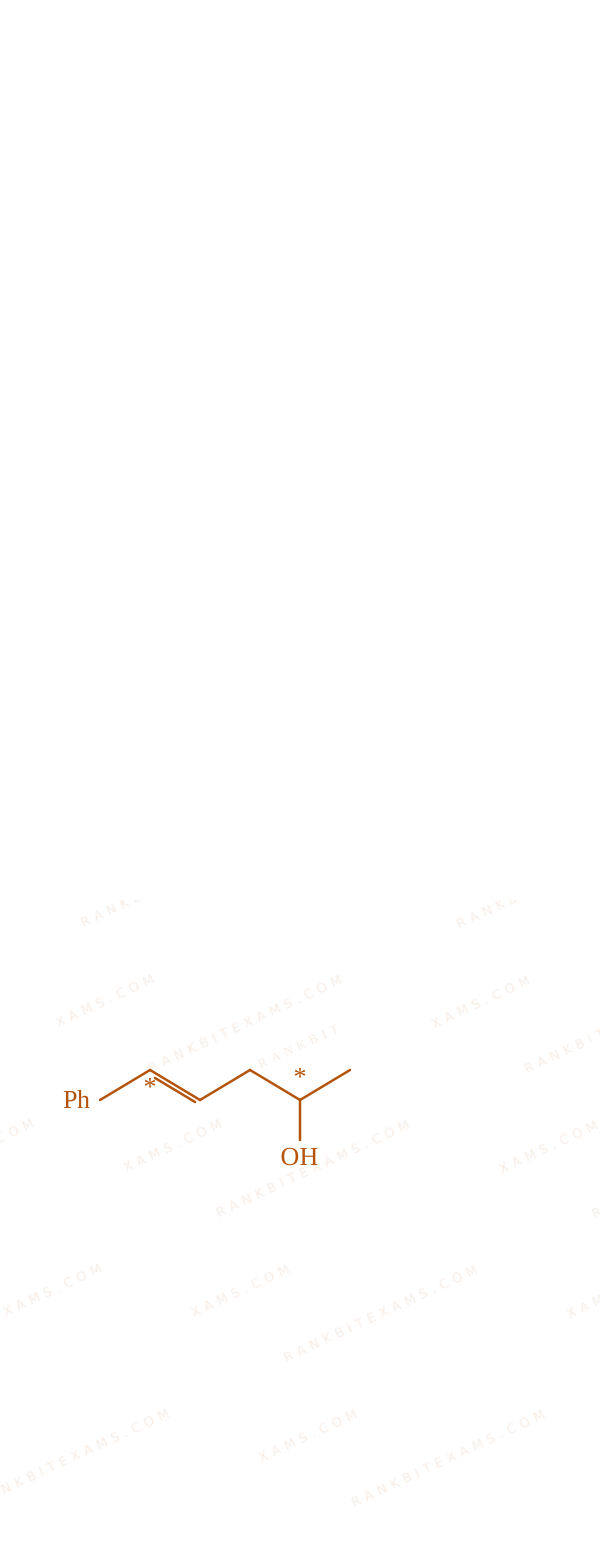
Double Bond (-CH=CH-$\mathrm{-CH=CH-}$): Positioned between carbons 4 and 5, this alkene group can exist in 2 distinct geometric configurations: cis (Z$Z$) or trans (E$E$).
**Chiral Carbon Center (*C$*\mathrm{C}$):** Carbon-2 is attached to four distinct groups: -H$-\mathrm{H}$, -OH$-\mathrm{OH}$, -CH₃$-\mathrm{CH}_3$, and -CH₂-CH=CH-Ph$-\mathrm{CH_2-CH=CH-Ph}$. This asymmetric carbon center can exist in 2 distinct optical configurations: (R$R$) or (S$S$).
Since the molecule is unsymmetrical, the two stereogenic units behave independently (n = 2$n = 2$):
The structural tracking confirms the presence of these stereogenic sites:
Isomerism solution diagram for Q47 - JEE Main 2025 Evening
Pattern Recognition
Always break the molecule down to count chiral centers and stereogenic double bonds independently. Since the molecule has asymmetric ends, you can safely use the simplified 2ⁿ$2^n$ formula without worrying about meso configurations.
Chapter Mix
Class 11 Chemistry: Organic Chemistry - Some Basic Principles and Techniques
An organic compound weighing 500 mg$500\mathrm{\ mg}$, produced 220 mg$220\mathrm{\ mg}$ of CO₂$\mathrm{CO}_2$ on complete combustion. The percentage composition of carbon in the compound is ______ %. (nearest integer)
(Given molar mass in g mol⁻¹$\mathrm{g\ mol}^{-1}$ of C: 12$\mathrm{C}: 12$, O: 16$\mathrm{O}: 16$)
Numerical Answer.Answer: 12 to 12
Solution
Related Formula
% C = (12)/(44) × Mass of CO₂ producedMass of organic compound taken × 100$$\% \mathrm{C} = \frac{12}{44} \times \frac{\text{Mass of } \mathrm{CO}_2 \text{ produced}}{\text{Mass of organic compound taken}} \times 100$$
Core Logic
Given:
Mass of organic compound taken = 500 mg = 500 × 10⁻³ g$= 500 \text{ mg} = 500 \times 10^{-3} \text{ g}$
Mass of CO₂$\mathrm{CO}_2$ produced = 220 mg = 220 × 10⁻³ g$= 220 \text{ mg} = 220 \times 10^{-3} \text{ g}$
Carbon dioxide has exactly 12/44 ≈ 27.27%$12/44 \approx 27.27\%$ carbon by mass. Multiply the mass fraction of CO₂$\mathrm{CO}_2$ (220/500 = 0.44$220/500 = 0.44$) by 12/44$12/44$ to directly get 0.12$0.12$ or 12%$12\%$.
Evaluation Rubric / Model Answer
A perfect step-by-step conversion of organic compound mass and combustion carbon dioxide mass to obtain a precise 12$12$ percent carbon composition.
Chapter Mix
Class 11 Chemistry: Organic Chemistry - Some Basic Principles and Techniques
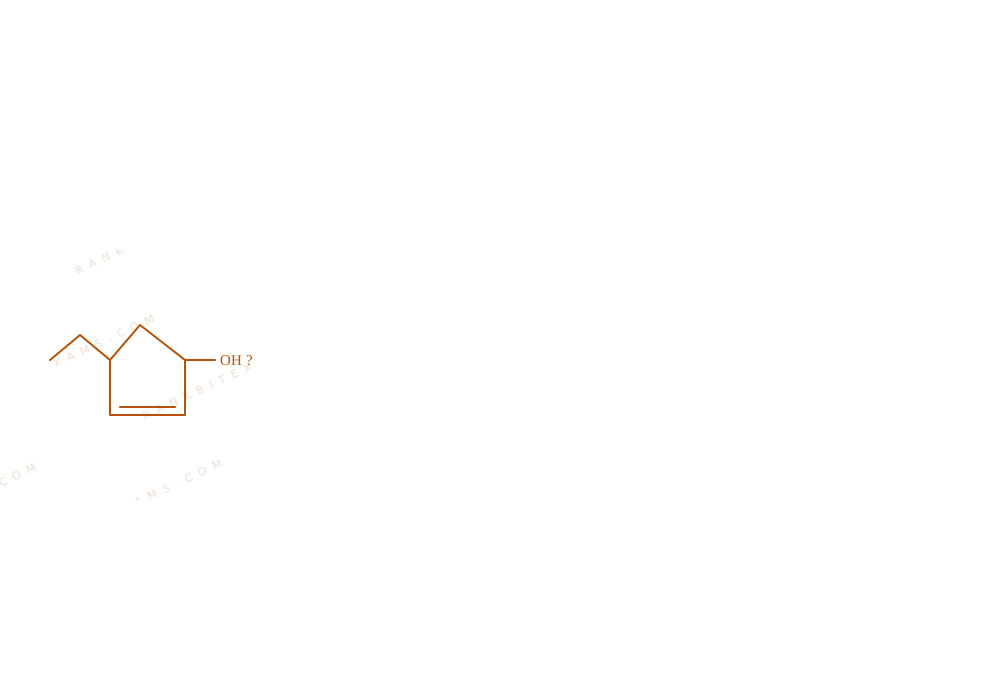
Qjee_main_2025_08_april_eveningIUPAC Nomenclature
What is the correct IUPAC name of the following organic compound?
The molecule contains a five-membered carbon ring with one double bond, a hydroxyl substituent, and an ethyl group.
A. 4-Ethyl-1-hydroxycyclopent-2-ene
B. 1-Ethyl-3-hydroxycyclopent-2-ene
C. 1-Ethylcyclopent-2-en-3-ol
D. 4-Ethylcyclopent-2-en-1-ol
Solution
Core Logic
Let us apply official IUPAC priority indexing rules:
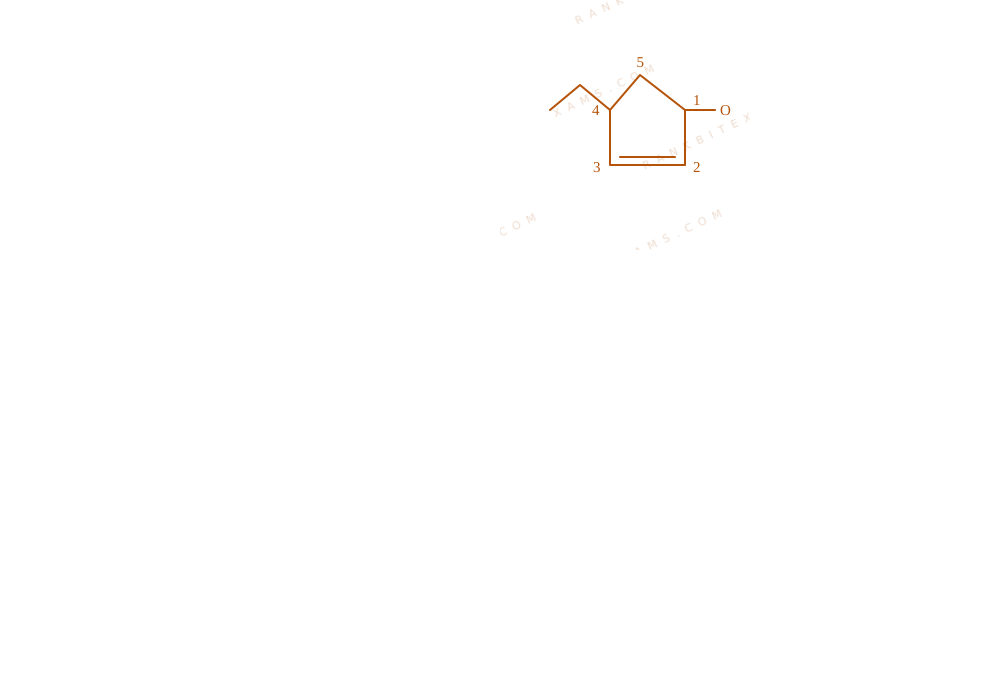
Principal Functional Group: The hydroxyl group (-OH$-\text{OH}$) possesses higher naming priority over double bonds and simple alkyl side chains. Thus, the carbon bearing the -OH$-\text{OH}$ group is assigned position C-1.
Numbering Direction: We must number through the ring towards the double bond to assign it the lowest possible locant. Hence, the alkene carbons are given coordinates C-2 and C-3.
Locating Side Chains: Proceeding with this direction puts the ethyl group at position C-4. The molecule contains a five-membered carbon ring with one double bond, a hydroxyl substituent, and an ethyl group.
Principal suffix priority hierarchy: -OH > Double bond > Alkyl side-chain$-\text{OH} > \text{Double bond} > \text{Alkyl side-chain}$. Always fix the highest priority suffix at index 1 and head instantly towards the alkene bond to safely restrict locant numbers.
Chapter Mix
Class 11 Chemistry: Organic Chemistry - Some Basic Principles and Techniques
Q27jee_main_2025_08_april_eveningReactive Intermediates and Reagents
Match the LIST-I with LIST-II:
LIST-I
LIST-II
A. Carbocation
I. Species that can supply a pair of electrons.
B. C-Free radical
II. Species that can receive a pair of electrons.
C. Nucleophile
III. sp²$sp^2$ hybridized carbon with empty p-orbital.
D. Electrophile
IV. sp²/sp³$sp^2/sp^3$ hybridized carbon with one unpaired electron.
Choose the correct answer from the options given below:
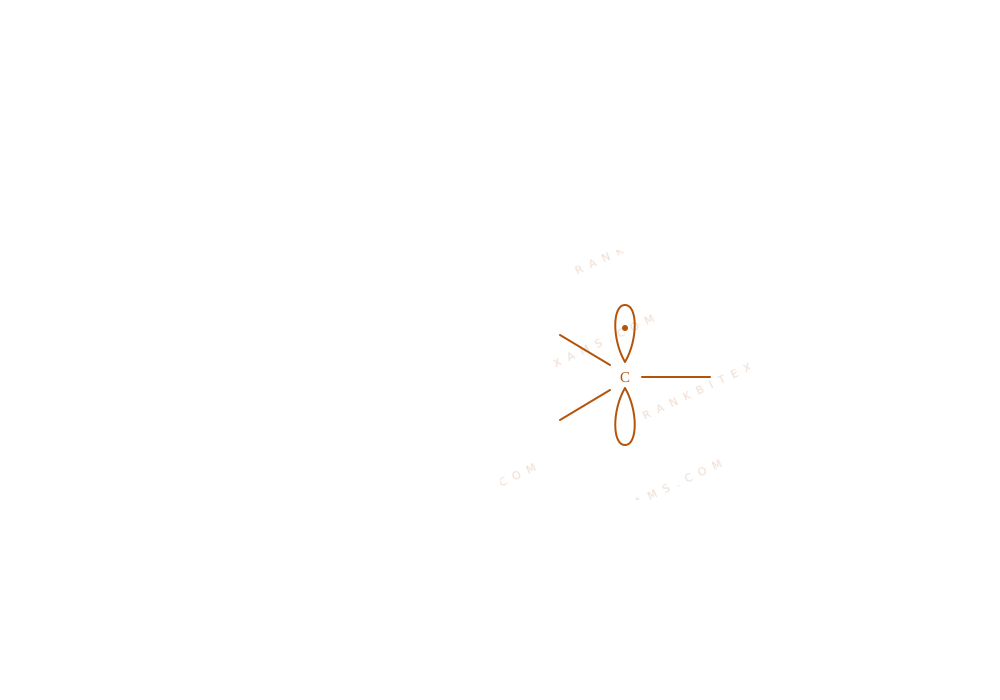
A. Carbocation: Features a positively charged trivalent carbon atom. It represents an sp²$sp^2$ hybridized carbon with an empty unhybridized p-orbital. Carbocation orbital hybridization diagram for Q27 - JEE Main 2025
B. Carbon Free Radical: Contains a trivalent carbon carrying a single unpaired lone electron. It typically exhibits sp²$sp^2$ or sp³$sp^3$ hybridization depending on structural environments. Carbocation orbital hybridization diagram for Q27 - JEE Main 2025
C. Nucleophile: An electron-rich chemical species containing a lone pair or negative charge capable of donating/supplying a pair of electrons.
D. Electrophile: An electron-deficient chemical species possessing empty low-lying orbitals capable of accepting/receiving a pair of electrons.
Step 1: Alignment Matrix
Matching each item yields:
A arrow III$\text{A} \rightarrow \text{III}$
B arrow IV$\text{B} \rightarrow \text{IV}$
C arrow I$\text{C} \rightarrow \text{I}$
D arrow II$\text{D} \rightarrow \text{II}$
This sequence aligns flawlessly with Option (4).
Pattern Recognition
Nucleophiles donate ('nucleo-loving' = seeks positive sites with its electrons), Electrophiles accept ('electro-loving' = seeks electron density). Carbocations explicitly harbor a vacant p-orbital because of their positive charge configuration, making identification extremely swift.
Chapter Mix
Class 11 Chemistry: Organic Chemistry - Some Basic Principles and Techniques
On complete combustion, 0.210 g$0.210 \text{ g}$ of an organic compound containing C, H, and O yielded 0.127 g$0.127 \text{ g}$ of H₂O$\text{H}_2\text{O}$ and 0.307 g$0.307 \text{ g}$ of CO₂$\text{CO}_2$. The mass percentages of hydrogen and oxygen in the given organic compound respectively are:
A. 53.41, 39.6
B. 6.72, 53.41
C. 7.55, 43.85
D. 6.72, 39.87
Solution
Related Formula
Percentage of Hydrogen in organic analysis:
%H = (2)/(18) × Mass of H₂OMass of Compound × 100$$\%\text{H} = \frac{2}{18} \times \frac{\text{Mass of } H_2O}{\text{Mass of Compound}} \times 100$$
Percentage of Carbon:
%C = (12)/(44) × Mass of CO₂Mass of Compound × 100$$\%\text{C} = \frac{12}{44} \times \frac{\text{Mass of } CO_2}{\text{Mass of Compound}} \times 100$$
Thus, the values of hydrogen and oxygen percentage are 6.72%$6.72\%$ and 53.41%$53.41\%$, matches with Option (2).
Pattern Recognition
Always focus on the order requested by the question stem. The query specifies 'hydrogen and oxygen respectively'. Option 2 and Option 4 both show these numbers but reversed—verifying the targeted sequence protects your score line.
Chapter Mix
Class 11 Chemistry: Organic Chemistry - Some Basic Principles and Techniques
Q42jee_main_2025_08_april_eveningQualitative Analysis of Functional Groups
Match the reagents in LIST-I with the corresponding chemical functional groups they detect in LIST-II:
LIST-I (Reagent)
LIST-II (Functional Group detected)
A. Sodium bicarbonate solution
I. double bond / unsaturation
B. Neutral ferric chloride
II. carboxylic acid
C. Ceric ammonium nitrate
III. phenolic - OH
D. Alkaline KMnO₄$\text{KMnO}_4$
IV. alcoholic - OH
Choose the correct answer from the options given below:
Let us review the chemical basis for each qualitative test:
A. Sodium bicarbonate (NaHCO₃$\text{NaHCO}_3$) solution: Carboxylic acids are sufficiently acidic to decompose NaHCO₃$\text{NaHCO}_3$, liberating carbon dioxide gas observed as vigorous effervescence. Therefore, A arrow II$\text{A} \rightarrow \text{II}$.
B. Neutral ferric chloride (FeCl₃$\text{FeCl}_3$): Phenols react with neutral FeCl₃$\text{FeCl}_3$ solution to form characteristic deeply colored violet coordination complexes. Therefore, B arrow III$\text{B} \rightarrow \text{III}$.
C. Ceric ammonium nitrate (CAN): Alcohols react with CAN reagent to cause a distinct color shift to deep dark red due to complexation. Therefore, C arrow IV$\text{C} \rightarrow \text{IV}$.
D. Alkaline KMnO₄$\text{KMnO}_4$ (Baeyer's Reagent): Reacts readily via syn-hydroxylation across carbon-carbon double/triple bonds, resulting in decolored solutions alongside brown MnO₂$\text{MnO}_2$ precipitates. This detects unsaturation. Therefore, D arrow I$\text{D} \rightarrow \text{I}$.
Baeyer's test (alkaline KMnO₄$\text{KMnO}_4$) always tests for alkenes/alkynes. NaHCO₃$\text{NaHCO}_3$ is unique for acidic groups like carboxylic acids. Matching these two reliable pairs isolates the correct option without needing to review the entire table.
Chapter Mix
Class 11 Chemistry: Organic Chemistry - Some Basic Principles and Techniques

Class 12 Chemistry: Alcohols, Phenols and Ethers
More Organic Chemistry - Some Basic Principles and Techniques Questions — jee_main_2025_24_jan_evening
Practice past-year questions one chapter at a time. Pick an exam → subject → chapter and get every PYQ for that topic — pulled together from all past papers — with the chapter's key formulas alongside.