Organic Chemistry - Some Basic Principles and Techniques appeared 101 times across 3 years — 11.7% of Chemistry.
This question is from Hybridization of Carbon.
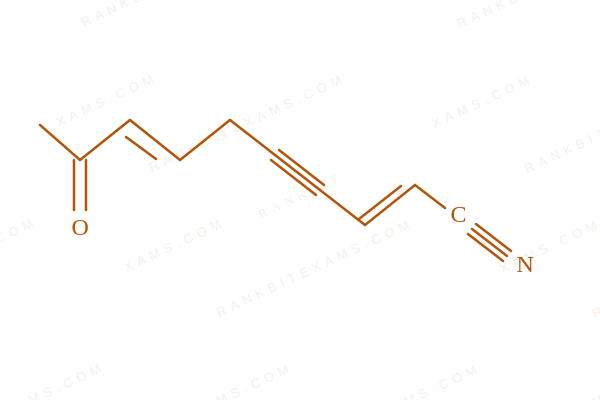
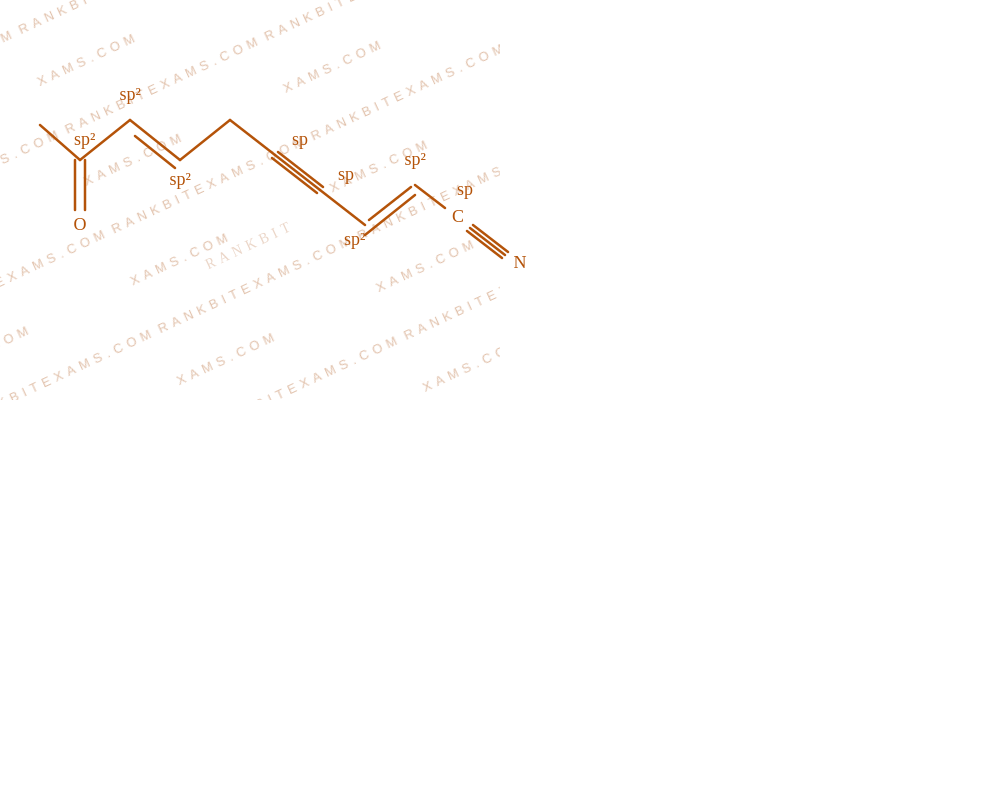
In the given structure, number of sp and sp²$sp^{2}$ hybridized carbon atoms present respectively are :
The skeletal molecular diagram presents a chain containing carbonyl, double bonds, a triple bond, and a nitrile terminal functional grouping.
A.\text{3 and 6}
B.\text{3 and 5}
C.\text{4 and 6}
D.\text{4 and 5}
Solution & Explanation
Core Logic
To determine carbon atom hybridization within skeletal networks, evaluate the count of steric components (σ$\sigma$-bonds attached to each carbon):
3 σ-bonds arrow sp²$3 \text{ } \sigma\text{-bonds} \rightarrow sp^2$ (typically carbons forming one double bond like C=O$\mathrm{C=O}$ or C=C$\mathrm{C=C}$)
2 σ-bonds arrow sp$2 \text{ } \sigma\text{-bonds} \rightarrow sp$ (typically carbons forming a triple bond like -C≡ C-$-\mathrm{C\equiv C}-$ or -C≡ N$-\mathrm{C\equiv N}$)
Step 1: Specific Atom Assignment
Let's perform an audit across the skeletal sequence:
The skeletal molecular diagram presents a chain containing carbonyl, double bonds, a triple bond, and a nitrile terminal functional grouping.
Count all carbons involved in triple bonds (alkynes, nitriles) to find sp$sp$ items. Count all double-bonded carbons (alkenes, ketones) to quickly isolate the sp²$sp^2$ population.
Chapter Mix
Class 11 Chemistry: Organic Chemistry - Some Basic Principles and Techniques
An organic compound weighing 500 mg$500\mathrm{\ mg}$, produced 220 mg$220\mathrm{\ mg}$ of CO₂$\mathrm{CO}_2$ on complete combustion. The percentage composition of carbon in the compound is ______ %. (nearest integer)
(Given molar mass in g mol⁻¹$\mathrm{g\ mol}^{-1}$ of C: 12$\mathrm{C}: 12$, O: 16$\mathrm{O}: 16$)
Numerical Answer.Answer: 12 to 12
Solution
Related Formula
% C = (12)/(44) × Mass of CO₂ producedMass of organic compound taken × 100$$\% \mathrm{C} = \frac{12}{44} \times \frac{\text{Mass of } \mathrm{CO}_2 \text{ produced}}{\text{Mass of organic compound taken}} \times 100$$
Core Logic
Given:
Mass of organic compound taken = 500 mg = 500 × 10⁻³ g$= 500 \text{ mg} = 500 \times 10^{-3} \text{ g}$
Mass of CO₂$\mathrm{CO}_2$ produced = 220 mg = 220 × 10⁻³ g$= 220 \text{ mg} = 220 \times 10^{-3} \text{ g}$
Carbon dioxide has exactly 12/44 ≈ 27.27%$12/44 \approx 27.27\%$ carbon by mass. Multiply the mass fraction of CO₂$\mathrm{CO}_2$ (220/500 = 0.44$220/500 = 0.44$) by 12/44$12/44$ to directly get 0.12$0.12$ or 12%$12\%$.
Evaluation Rubric / Model Answer
A perfect step-by-step conversion of organic compound mass and combustion carbon dioxide mass to obtain a precise 12$12$ percent carbon composition.
Chapter Mix
Class 11 Chemistry: Organic Chemistry - Some Basic Principles and Techniques
Qjee_main_2025_08_april_eveningIUPAC Nomenclature
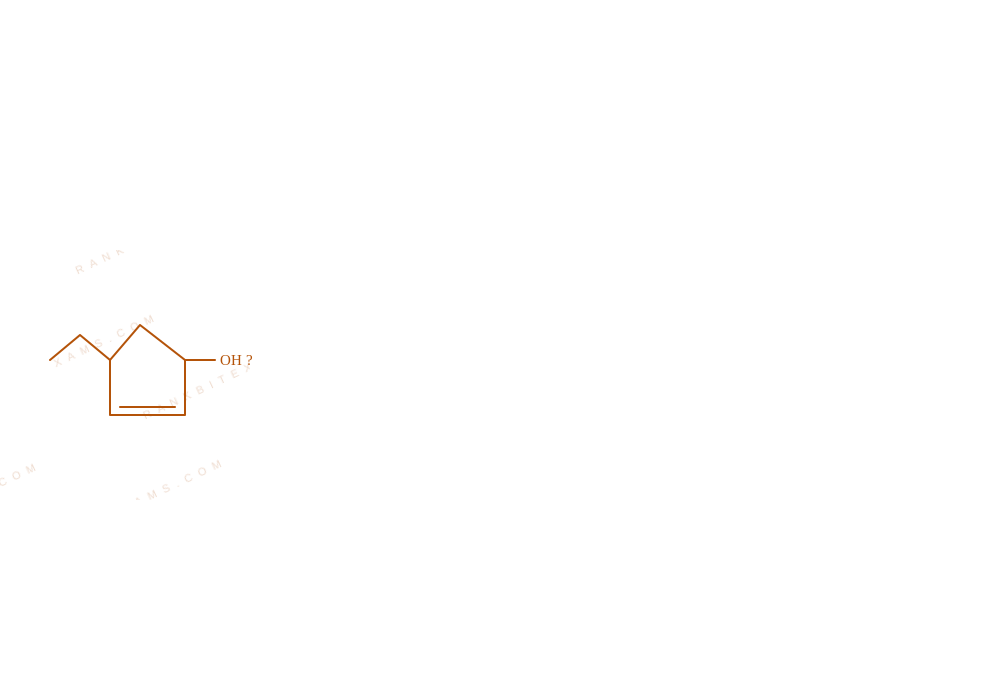
What is the correct IUPAC name of the following organic compound?
The molecule contains a five-membered carbon ring with one double bond, a hydroxyl substituent, and an ethyl group.
A. 4-Ethyl-1-hydroxycyclopent-2-ene
B. 1-Ethyl-3-hydroxycyclopent-2-ene
C. 1-Ethylcyclopent-2-en-3-ol
D. 4-Ethylcyclopent-2-en-1-ol
Solution
Core Logic
Let us apply official IUPAC priority indexing rules:
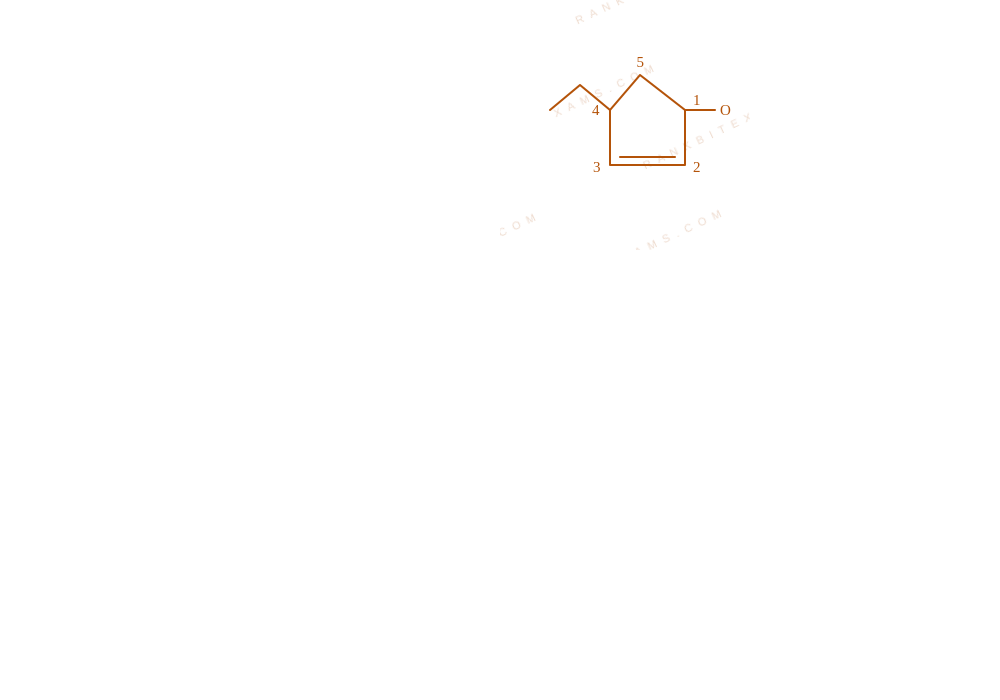
Principal Functional Group: The hydroxyl group (-OH$-\text{OH}$) possesses higher naming priority over double bonds and simple alkyl side chains. Thus, the carbon bearing the -OH$-\text{OH}$ group is assigned position C-1.
Numbering Direction: We must number through the ring towards the double bond to assign it the lowest possible locant. Hence, the alkene carbons are given coordinates C-2 and C-3.
Locating Side Chains: Proceeding with this direction puts the ethyl group at position C-4. The molecule contains a five-membered carbon ring with one double bond, a hydroxyl substituent, and an ethyl group.
Principal suffix priority hierarchy: -OH > Double bond > Alkyl side-chain$-\text{OH} > \text{Double bond} > \text{Alkyl side-chain}$. Always fix the highest priority suffix at index 1 and head instantly towards the alkene bond to safely restrict locant numbers.
Chapter Mix
Class 11 Chemistry: Organic Chemistry - Some Basic Principles and Techniques
Q27jee_main_2025_08_april_eveningReactive Intermediates and Reagents
Match the LIST-I with LIST-II:
LIST-I
LIST-II
A. Carbocation
I. Species that can supply a pair of electrons.
B. C-Free radical
II. Species that can receive a pair of electrons.
C. Nucleophile
III. sp²$sp^2$ hybridized carbon with empty p-orbital.
D. Electrophile
IV. sp²/sp³$sp^2/sp^3$ hybridized carbon with one unpaired electron.
Choose the correct answer from the options given below:
A. Carbocation: Features a positively charged trivalent carbon atom. It represents an sp²$sp^2$ hybridized carbon with an empty unhybridized p-orbital. Carbocation orbital hybridization diagram for Q27 - JEE Main 2025
B. Carbon Free Radical: Contains a trivalent carbon carrying a single unpaired lone electron. It typically exhibits sp²$sp^2$ or sp³$sp^3$ hybridization depending on structural environments. Carbocation orbital hybridization diagram for Q27 - JEE Main 2025
C. Nucleophile: An electron-rich chemical species containing a lone pair or negative charge capable of donating/supplying a pair of electrons.
D. Electrophile: An electron-deficient chemical species possessing empty low-lying orbitals capable of accepting/receiving a pair of electrons.
Step 1: Alignment Matrix
Matching each item yields:
A arrow III$\text{A} \rightarrow \text{III}$
B arrow IV$\text{B} \rightarrow \text{IV}$
C arrow I$\text{C} \rightarrow \text{I}$
D arrow II$\text{D} \rightarrow \text{II}$
This sequence aligns flawlessly with Option (4).
Pattern Recognition
Nucleophiles donate ('nucleo-loving' = seeks positive sites with its electrons), Electrophiles accept ('electro-loving' = seeks electron density). Carbocations explicitly harbor a vacant p-orbital because of their positive charge configuration, making identification extremely swift.
Chapter Mix
Class 11 Chemistry: Organic Chemistry - Some Basic Principles and Techniques
On complete combustion, 0.210 g$0.210 \text{ g}$ of an organic compound containing C, H, and O yielded 0.127 g$0.127 \text{ g}$ of H₂O$\text{H}_2\text{O}$ and 0.307 g$0.307 \text{ g}$ of CO₂$\text{CO}_2$. The mass percentages of hydrogen and oxygen in the given organic compound respectively are:
A. 53.41, 39.6
B. 6.72, 53.41
C. 7.55, 43.85
D. 6.72, 39.87
Solution
Related Formula
Percentage of Hydrogen in organic analysis:
%H = (2)/(18) × Mass of H₂OMass of Compound × 100$$\%\text{H} = \frac{2}{18} \times \frac{\text{Mass of } H_2O}{\text{Mass of Compound}} \times 100$$
Percentage of Carbon:
%C = (12)/(44) × Mass of CO₂Mass of Compound × 100$$\%\text{C} = \frac{12}{44} \times \frac{\text{Mass of } CO_2}{\text{Mass of Compound}} \times 100$$
Thus, the values of hydrogen and oxygen percentage are 6.72%$6.72\%$ and 53.41%$53.41\%$, matches with Option (2).
Pattern Recognition
Always focus on the order requested by the question stem. The query specifies 'hydrogen and oxygen respectively'. Option 2 and Option 4 both show these numbers but reversed—verifying the targeted sequence protects your score line.
Chapter Mix
Class 11 Chemistry: Organic Chemistry - Some Basic Principles and Techniques

Q42jee_main_2025_08_april_eveningQualitative Analysis of Functional Groups
Match the reagents in LIST-I with the corresponding chemical functional groups they detect in LIST-II:
LIST-I (Reagent)
LIST-II (Functional Group detected)
A. Sodium bicarbonate solution
I. double bond / unsaturation
B. Neutral ferric chloride
II. carboxylic acid
C. Ceric ammonium nitrate
III. phenolic - OH
D. Alkaline KMnO₄$\text{KMnO}_4$
IV. alcoholic - OH
Choose the correct answer from the options given below:
Let us review the chemical basis for each qualitative test:
A. Sodium bicarbonate (NaHCO₃$\text{NaHCO}_3$) solution: Carboxylic acids are sufficiently acidic to decompose NaHCO₃$\text{NaHCO}_3$, liberating carbon dioxide gas observed as vigorous effervescence. Therefore, A arrow II$\text{A} \rightarrow \text{II}$.
B. Neutral ferric chloride (FeCl₃$\text{FeCl}_3$): Phenols react with neutral FeCl₃$\text{FeCl}_3$ solution to form characteristic deeply colored violet coordination complexes. Therefore, B arrow III$\text{B} \rightarrow \text{III}$.
C. Ceric ammonium nitrate (CAN): Alcohols react with CAN reagent to cause a distinct color shift to deep dark red due to complexation. Therefore, C arrow IV$\text{C} \rightarrow \text{IV}$.
D. Alkaline KMnO₄$\text{KMnO}_4$ (Baeyer's Reagent): Reacts readily via syn-hydroxylation across carbon-carbon double/triple bonds, resulting in decolored solutions alongside brown MnO₂$\text{MnO}_2$ precipitates. This detects unsaturation. Therefore, D arrow I$\text{D} \rightarrow \text{I}$.
Baeyer's test (alkaline KMnO₄$\text{KMnO}_4$) always tests for alkenes/alkynes. NaHCO₃$\text{NaHCO}_3$ is unique for acidic groups like carboxylic acids. Matching these two reliable pairs isolates the correct option without needing to review the entire table.
Chapter Mix
Class 11 Chemistry: Organic Chemistry - Some Basic Principles and Techniques

Class 12 Chemistry: Alcohols, Phenols and Ethers
More Organic Chemistry - Some Basic Principles and Techniques Questions — jee_main_2025_24_jan_evening
Practice past-year questions one chapter at a time. Pick an exam → subject → chapter and get every PYQ for that topic — pulled together from all past papers — with the chapter's key formulas alongside.