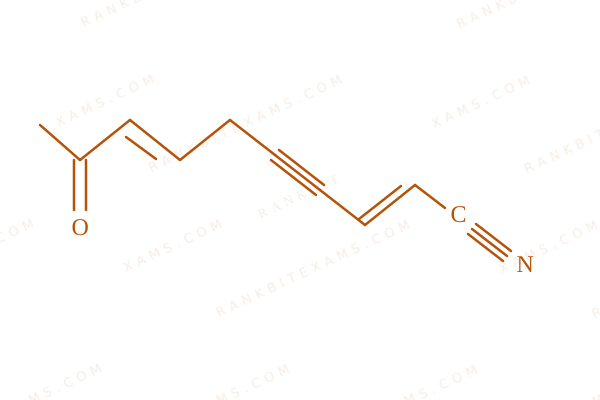
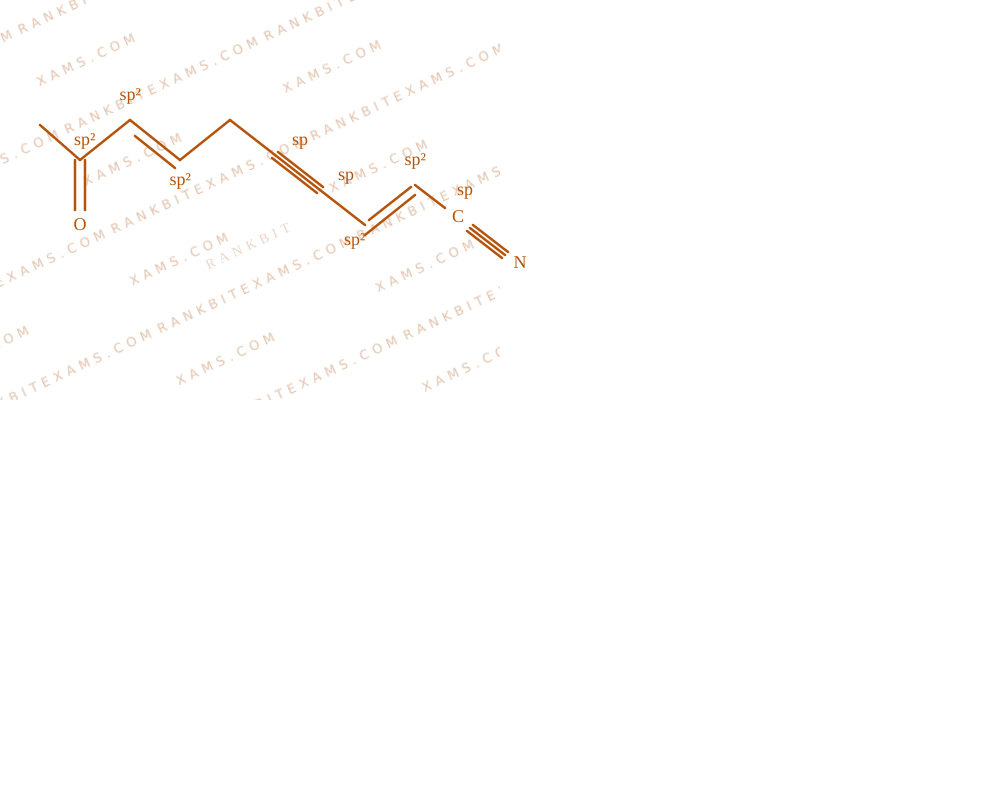
In the given structure, number of sp and sp^2$sp^{2}$ hybridized carbon atoms present respectively are :
The skeletal molecular diagram presents a chain containing carbonyl, double bonds, a triple bond, and a nitrile terminal functional grouping.
A.\text{3 and 6}
B.\text{3 and 5}
C.\text{4 and 6}
D.\text{4 and 5}
Solution & Explanation
### Core Logic
To determine carbon atom hybridization within skeletal networks, evaluate the count of steric components (sigma$\sigma$-bonds attached to each carbon):
* 4 text sigmatext-bonds
ightarrow sp^3$4 \text{ } \sigma\text{-bonds}
ightarrow sp^3$
* 3 text sigmatext-bonds
ightarrow sp^2$3 \text{ } \sigma\text{-bonds}
ightarrow sp^2$ (typically carbons forming one double bond like mathrmC=O$\mathrm{C=O}$ or mathrmC=C$\mathrm{C=C}$)
* 2 text sigmatext-bonds
ightarrow sp$2 \text{ } \sigma\text{-bonds}
ightarrow sp$ (typically carbons forming a triple bond like -mathrmCequiv C-$-\mathrm{C\equiv C}-$ or -mathrmCequiv N$-\mathrm{C\equiv N}$)
### Step 1: Specific Atom Assignment
Let's perform an audit across the skeletal sequence:
The skeletal molecular diagram presents a chain containing carbonyl, double bonds, a triple bond, and a nitrile terminal functional grouping.
* sp^2$sp^2$ Carbons:
1. Carbonyl carbon (mathrmC=O$\mathrm{C=O}$)
2. Carbons sharing the first alkene motif (2 atoms)
3. Carbons sharing the second alkene motif (2 atoms)
Total sp^2$sp^2$ carbons = 1 + 2 + 2 = 5$1 + 2 + 2 = 5$
* sp$sp$ Carbons:
1. Carbons bound in the central alkyne group (-mathrmCequiv C-$-\mathrm{C\equiv C}-$) (2 atoms)
2. Terminal nitrile carbon (-mathrmCequiv N$-\mathrm{C\equiv N}$) (1 atom)
Total sp$sp$ carbons = 2 + 1 = 3$2 + 1 = 3$
### Pattern Recognition
Count all carbons involved in triple bonds (alkynes, nitriles) to find sp$sp$ items. Count all double-bonded carbons (alkenes, ketones) to quickly isolate the sp^2$sp^2$ population.
### Evaluation Rubric / Model Answer
null
### Chapter Mix
Class 11 Chemistry: Organic Chemistry - Some Basic Principles and Techniques
'Adsorption' principle is used for which of the following purification method?
A.textExtraction$\text{Extraction}$
B.textChromatography$\text{Chromatography}$
C.textDistillation$\text{Distillation}$
D.textSublimation$\text{Sublimation}$
Solution
### Core Logic
The fundamental principle used in chromatography (such as column chromatography or thin-layer chromatography) is adsorption. Different components of a mixture are adsorbed to different extents on an adsorbent stationary phase.
### Evaluation Rubric / Model Answer
null
### Chapter Mix
Class 11 Chemistry: Organic Chemistry - Some Basic Principles and Techniques
### Core Logic
(A) Simple distillation is used to separate a mixture of miscible liquids with a sufficiently large difference in their boiling points, such as chloroform and aniline. (A rightarrow$\rightarrow$ IV)
(B) Fractional distillation is used to separate crude oil fractions. (B rightarrow$\rightarrow$ III)
(C) Steam distillation is used to separate steam-volatile substances that are immiscible with water, like an aniline-water mixture. (C rightarrow$\rightarrow$ II)
(D) Distillation under reduced pressure is used for liquids that decompose at or below their normal boiling points, like separating glycerol from spent lye. (D rightarrow$\rightarrow$ I)
### Evaluation Rubric / Model Answer
null
### Chapter Mix
Class 11 Chemistry: Organic Chemistry - Some Basic Principles and Techniques
More Organic Chemistry - Some Basic Principles and Techniques Questions — jee_main_2025_24_jan_evening
We Map Every Repeating Question in Competitive Exams.
Say goodbye to generic mock test fatigue. RankBit uses smart analysis to group past exam questions into their foundational Repeating Question Types. Find chapter weightage, track repeating questions, and score higher with targeted practice.
Select Your Target Exam
Choose an exam track below to find formulas per chapter and patterns.
Syncing Exam Intelligence
Mapping formulas and patterns across all tracks…
PATH A — FULL LENGTH PRACTICE
Full Mock Test Hub
Simulate real NTA exam conditions with fully tracked mocks. Time yourself against past papers.
Practice past-year questions one chapter at a time. Pick an exam → subject → chapter and get every PYQ for that topic — pulled together from all past papers — with the chapter's key formulas alongside.