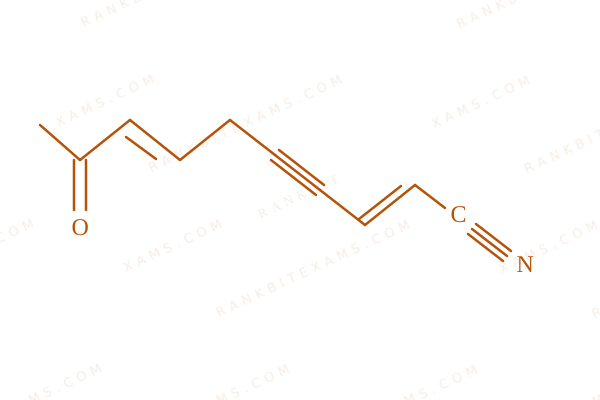
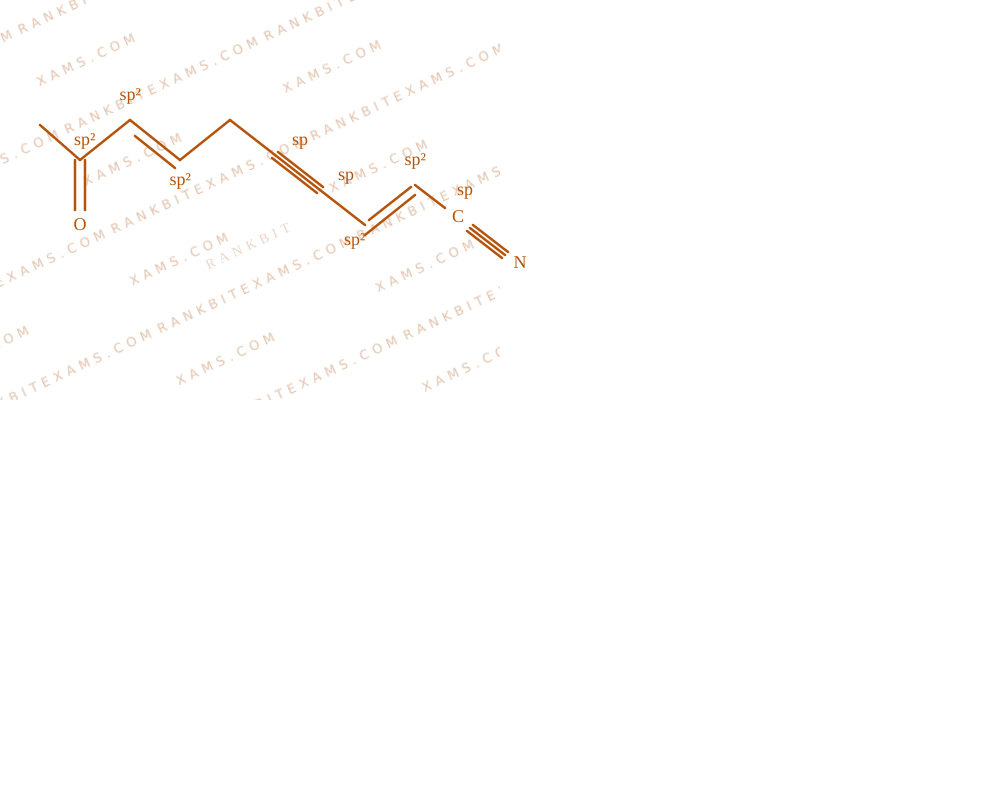
In the given structure, number of sp and sp^2$sp^{2}$ hybridized carbon atoms present respectively are :
The skeletal molecular diagram presents a chain containing carbonyl, double bonds, a triple bond, and a nitrile terminal functional grouping.
A.\text{3 and 6}
B.\text{3 and 5}
C.\text{4 and 6}
D.\text{4 and 5}
Solution & Explanation
### Core Logic
To determine carbon atom hybridization within skeletal networks, evaluate the count of steric components (sigma$\sigma$-bonds attached to each carbon):
* 4 text sigmatext-bonds
ightarrow sp^3$4 \text{ } \sigma\text{-bonds}
ightarrow sp^3$
* 3 text sigmatext-bonds
ightarrow sp^2$3 \text{ } \sigma\text{-bonds}
ightarrow sp^2$ (typically carbons forming one double bond like mathrmC=O$\mathrm{C=O}$ or mathrmC=C$\mathrm{C=C}$)
* 2 text sigmatext-bonds
ightarrow sp$2 \text{ } \sigma\text{-bonds}
ightarrow sp$ (typically carbons forming a triple bond like -mathrmCequiv C-$-\mathrm{C\equiv C}-$ or -mathrmCequiv N$-\mathrm{C\equiv N}$)
### Step 1: Specific Atom Assignment
Let's perform an audit across the skeletal sequence:
The skeletal molecular diagram presents a chain containing carbonyl, double bonds, a triple bond, and a nitrile terminal functional grouping.
* sp^2$sp^2$ Carbons:
1. Carbonyl carbon (mathrmC=O$\mathrm{C=O}$)
2. Carbons sharing the first alkene motif (2 atoms)
3. Carbons sharing the second alkene motif (2 atoms)
Total sp^2$sp^2$ carbons = 1 + 2 + 2 = 5$1 + 2 + 2 = 5$
* sp$sp$ Carbons:
1. Carbons bound in the central alkyne group (-mathrmCequiv C-$-\mathrm{C\equiv C}-$) (2 atoms)
2. Terminal nitrile carbon (-mathrmCequiv N$-\mathrm{C\equiv N}$) (1 atom)
Total sp$sp$ carbons = 2 + 1 = 3$2 + 1 = 3$
### Pattern Recognition
Count all carbons involved in triple bonds (alkynes, nitriles) to find sp$sp$ items. Count all double-bonded carbons (alkenes, ketones) to quickly isolate the sp^2$sp^2$ population.
### Evaluation Rubric / Model Answer
null
### Chapter Mix
Class 11 Chemistry: Organic Chemistry - Some Basic Principles and Techniques
### Core Logic
The enol form of structure (2) produces a fully conjugated, aromatic ring system (phenol derivative) which provides immense resonance stabilization. Therefore, the equilibrium lies heavily toward the enol form. Four choices depicting structure inputs for keto compounds tautomerizing to enols.
### Pattern Recognition
Look for enol forms that attain aromaticity. Aromatic stabilization overrides typical keto-preference factors.
### Chapter Mix
Class 11 Chemistry: Organic Chemistry - Some Basic Principles and Techniques
### Core Logic
Option (4) is a cyclic secondary aliphatic amine (piperidine derivative) where the nitrogen atom is textsp^3$\text{sp}^3$ hybridized and its lone pair is entirely localized, making it highly available to accept a proton. In contrast, options (1), (2), and (3) have lone pairs involved in resonance with aromatic systems or unsaturated structures. Four different amine ring structures listed as options.
### Pattern Recognition
Localized aliphatic amines are consistently stronger Bronsted bases than aromatic or delocalized analogs.
### Chapter Mix
Class 11 Chemistry: Organic Chemistry - Some Basic Principles and Techniques
### Core Logic
Option (4) features an active methylene group flanked directly between two electron-withdrawing carbonyl groupings. The removal of a proton from this central -textCH_2-$-\text{CH}_2-$ carbon produces a conjugate base that is strongly stabilized via extensive delocalization across both oxygen atoms. Four carbonyl organic structures presented as options.
### Pattern Recognition
Look for hydrogens between two -M$-M$ / -I$-I$ carbonyl complexes rightarrow$\rightarrow$ Active methylene effect.
### Chapter Mix
Class 11 Chemistry: Organic Chemistry - Some Basic Principles and Techniques
Q74jee_main_2024_27_jan_morningClassification of Organic Compounds
Cyclohexene is textquadquad$\text{\quad\quad}$ type of an organic compound.
A. Benzenoid aromatic
B. Benzenoid non-aromatic
C. Acyclic
D. Alicyclic
Solution
### Core Logic
Cyclohexene features an aliphatic carbon ring framework containing an unsaturated double bond but lacks an aromatic sextet ring structure. It belongs to the alicyclic category (aliphatic + cyclic compounds). Cyclohexene chemical ring diagram for Q74 - JEE Main 2024 Morning
### Chapter Mix
Class 11 Chemistry: Organic Chemistry - Some Basic Principles and Techniques
Q77jee_main_2024_27_jan_morningIUPAC Nomenclature
IUPAC name of following compound (P) is:
Substituted cyclohexane molecule labeled as compound P.Substituted cyclohexane molecule labeled as compound P.
A. 1-Ethyl-5, 5-dimethylcyclohexane
B. 3-Ethyl-1,1-dimethylcyclohexane
C. 1-Ethyl-3, 3-dimethylcyclohexane
D. 1,1-Dimethyl-3-ethylcyclohexane
Solution
### Core Logic
Number the ring to give substituents the lowest possible locants. Setting locant 1 at the carbon carrying the two methyl groups provides a locant list of (1,1,3)$(1,1,3)$, whereas setting it at the ethyl-bearing carbon gives (1,3,3)$(1,3,3)$. The set (1,1,3)$(1,1,3)$ wins by the lowest locant rule. Then arrange alphabetically: 3-ethyl precedes 1,1-dimethyl. Hence, the correct systematic tag is 3-Ethyl-1,1-dimethylcyclohexane. Substituted cyclohexane molecule labeled as compound P.
### Pattern Recognition
Lowest locant grouping set takes ultimate priority before checking alphabetical organization rules.
### Chapter Mix
Class 11 Chemistry: Organic Chemistry - Some Basic Principles and Techniques
More Organic Chemistry - Some Basic Principles and Techniques Questions — jee_main_2025_24_jan_evening
We Map Every Repeating Question in Competitive Exams.
Say goodbye to generic mock test fatigue. RankBit uses smart analysis to group past exam questions into their foundational Repeating Question Types. Find chapter weightage, track repeating questions, and score higher with targeted practice.
Select Your Target Exam
Choose an exam track below to find formulas per chapter and patterns.
Syncing Exam Intelligence
Mapping formulas and patterns across all tracks…
PATH A — FULL LENGTH PRACTICE
Full Mock Test Hub
Simulate real NTA exam conditions with fully tracked mocks. Time yourself against past papers.
Practice past-year questions one chapter at a time. Pick an exam → subject → chapter and get every PYQ for that topic — pulled together from all past papers — with the chapter's key formulas alongside.