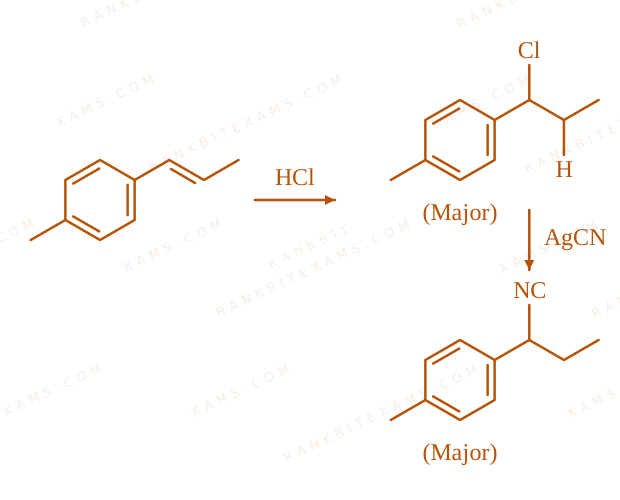
The structure of the major product formed in the following reaction is :
Nucleophilic Substitution Reactions diagram for Q43 - JEE Main 2025 Evening
The reaction shows a dihalogenated aromatic derivative reacting with silver cyanide to generate a major product.

Solution & Explanation

### Core Logic The substrate contains two distinct carbon-halogen bonds: an aryl-bromide bond (mathrmAr-Br) on the ring and an aliphatic alkyl-chloride bond (mathrmCH_2-Cl) on the side chain. 1. **Aryl Halide Site (mathrmC_sp^2mathrm-Br):** The bromine atom attached directly to the aromatic ring does not undergo standard nucleophilic substitution (S_N2 or S_N1) under normal conditions due to resonance stabilization, which gives the bond partial double-bond character. 2. **Alkyl Halide Site (mathrmC_sp^3mathrm-Cl):** The side-chain aliphatic carbon bond undergoes smooth, unhindered nucleophilic substitution. When reacting with silver cyanide (mathrmAgCN): mathrmAgCN is predominantly covalent. The lone pair on the nitrogen atom acts as the primary nucleophilic center rather than the carbon atom. Consequently, substitution at the aliphatic site yields an **isonitrile (-mathrmNC)** derivative as the major product, leaving the aryl bromide group completely untouched. ### Step 1: Structural Resolution The reaction progresses cleanly at the side-chain carbon:
Nucleophilic Substitution Reactions solution diagram for Q43 - JEE Main 2025 Evening
The reaction shows a dihalogenated aromatic derivative reacting with silver cyanide to generate a major product.
### Pattern Recognition Remember the key selectivity rule for cyanide nucleophiles: * mathrmKCN / mathrmNaCN ightarrow ionic reagents ightarrow attacks via carbon to form a **Nitrile (-mathrmCN)**. * mathrmAgCN ightarrow covalent reagent ightarrow attacks via nitrogen to form an **Isonitrile (-mathrmNC)**. ### Evaluation Rubric / Model Answer null ### Chapter Mix Class 12 Chemistry: Haloalkanes and Haloarenes
Reference Study Guides

More Haloalkanes and Haloarenes Previous-Year Questions — Page 6

Q67 jee_main_2024_31_jan_evening IUPAC Nomenclature of Haloalkanes
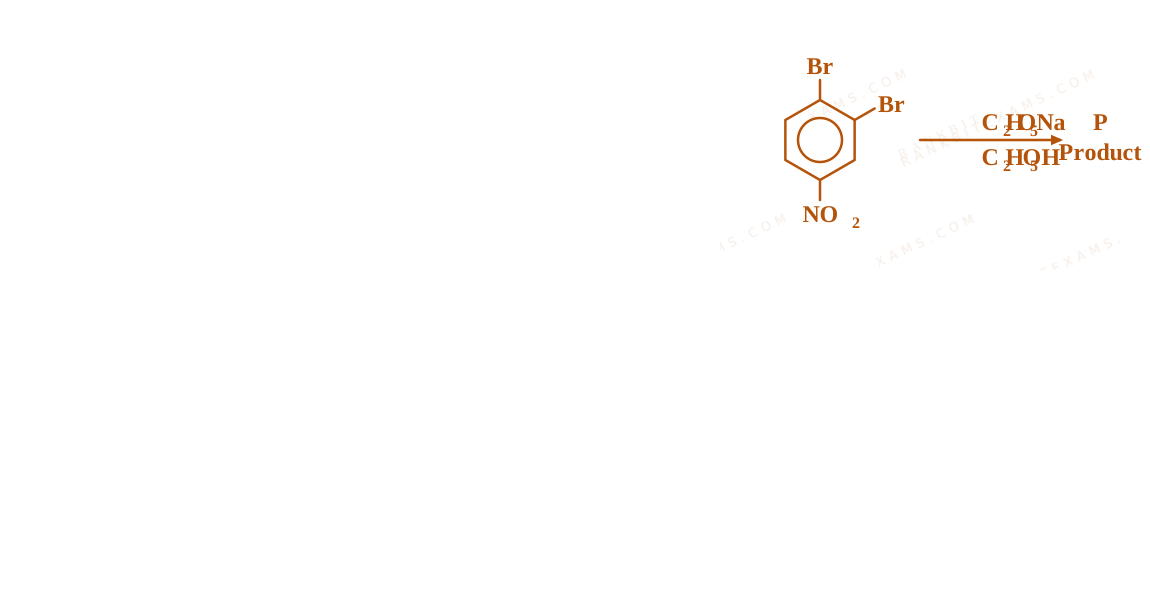
Identify structure of 2,3-dibromo-1-phenylpentane.
  • A. text(1) Structure A
  • B. text(2) Structure B
  • C. text(3) Structure C
  • D. text(4) Structure D

Solution

### Core Logic Decode the IUPAC name: 2,3-dibromo-1-phenylpentane. 1) Parent chain is pentane (5 carbon chain: C1-C2-C3-C4-C5). 2) Substituents: - Phenyl group at position 1. - Bromo groups at positions 2 and 3. Option (3) correctly displays a 5-carbon straight chain. The first carbon attaches to the benzene ring (phenyl group), and the second and third carbons each hold a bromine atom.
IUPAC Nomenclature of Haloalkanes diagram for Q67 - JEE Main 2024 Evening
### Evaluation Rubric / Model Answer null ### Chapter Mix Class 12 Chemistry: Haloalkanes and Haloarenes
Q68 jee_main_2024_31_jan_morning Elimination and Addition Reactions
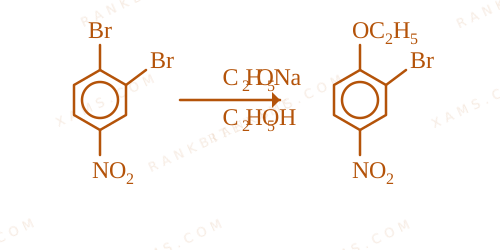
The product (C) in the below mentioned reaction is: CH_3-CH_2-CH_2-Br xrightarrow[Delta]KOH_(alc) A xrightarrow[Delta]HBr B xrightarrow[Delta]KOH_(aq) C
  • A. textPropan-1-ol
  • B. textPropene
  • C. textPropyne
  • D. textPropan-2-ol

Solution

### Step 1: Elimination to form Propene CH_3-CH_2-CH_2-Br xrightarrowtextKOH (alc), Delta CH_3-CH=CH_2 quad text(Compound A: Propene) ### Step 2: Electrophilic Addition of HBr Addition of HBr follows Markovnikov's rule: CH_3-CH=CH_2 + HBr xrightarrowDelta CH_3-CH(Br)-CH_3 quad text(Compound B: 2-Bromopropane) ### Step 3: Nucleophilic Substitution Reaction with aqueous KOH leads to S_N2/S_N1 substitution of Br^- with OH^-: CH_3-CH(Br)-CH_3 xrightarrowtextKOH (aq), Delta CH_3-CH(OH)-CH_3 quad text(Compound C: Propan-2-ol) ### Pattern Recognition Alc. KOH gives elimination (alkene). Aq. KOH gives substitution (alcohol). HBr on unsymmetrical alkene gives Markovnikov addition. ### Evaluation Rubric / Model Answer null ### Chapter Mix Class 12 Chemistry: Haloalkanes and Haloarenes
Q86 jee_main_2024_31_jan_morning Elimination and Substitution
CH_3CH_2Br + NaOH rightarrow textProduct A CH_3CH_2Br + NaOH / H_2O rightarrow textProduct B The total number of hydrogen atoms in product A and product B is
Numerical Answer. Answer: 10 to 10

Solution

### Core Logic Reaction 1: If the reagent is alcoholic NaOH (implied due to formation of a distinct product A to contrast B), elimination occurs: CH_3CH_2Br + NaOH (textalc) rightarrow CH_2=CH_2 text (Ethene) Hydrogen atoms in ethene (C_2H_4) = 4. Reaction 2: If the reagent is aqueous NaOH (NaOH / H_2O), nucleophilic substitution (S_N2) occurs: CH_3CH_2Br + NaOH (textaq) rightarrow CH_3CH_2OH text (Ethanol) Hydrogen atoms in ethanol (C_2H_6O) = 6. Total hydrogen atoms = 4 + 6 = 10. ### Evaluation Rubric / Model Answer null ### Chapter Mix Class 12 Chemistry: Haloalkanes and Haloarenes

More Haloalkanes and Haloarenes Questions — jee_main_2025_24_jan_evening

Practice all Haloalkanes and Haloarenes previous-year questions →

Rankbit System
JEE Physics: Waves (+15.5%) | Electrostatics: Concentric Shells (-29.7%) | Modern Physics: Photoelectric Clones (+34.2%) | Mathematics: Definite Integrals (+18.1%) | Chemistry: Coordination Splitting (-11.4%) | JEE Physics: Waves (+15.5%) | Electrostatics: Concentric Shells (-29.7%) | Modern Physics: Photoelectric Clones (+34.2%) | Mathematics: Definite Integrals (+18.1%) | Chemistry: Coordination Splitting (-11.4%)