JEE Main · Chemistry → Steady

Chemical Kinetics appeared 42 times across 3 years — 4.9% of Chemistry. This question is from Arrhenius Equation and Activation Energy.

Year 2026 2025 2024 Total
Questions 14 20 8 42

Consider a complex reaction taking place in three steps with rate constants k₁ , k₂ and k₃ respectively. The overall rate constant k is given by the expression k = k₁k₃k₂ . If the activation energies of the three steps are 60, 30 and 10 kJ mol ⁻¹ respectively, then the overall energy of activation in kJ mol ⁻¹ is . (Nearest integer)

Numerical Answer Type:
Enter a numerical value Answer: 20 to 20 +4 marks

Solution & Explanation

Related Formula

From the Arrhenius equation, rate constants vary exponentially with temperature:

k = A · e-Eₐ / RT

When rate constants combine multiplicatively or via roots, their corresponding activation energies combine linearly.

Core Logic

Given the overall rate constant expression:

k = ((k₁ · k₃)/(k₂))1/2

Substitute the Arrhenius expression (kᵢ = Aᵢ · e^-Eₐᵢ/RT) for each rate constant:

A · e-Eₐ/RT = [ (A₁ · e^-Eₐ₁/RT) · (A₃ · e^-Eₐ₃/RT)A₂ · e^-Eₐ₂/RT]1/2

Equating the exponential terms yields the linear relationship for the overall activation energy (Eₐ):

(Eₐ)/(RT) = (1)/(2) ( Eₐ₁RT + Eₐ₃RT - Eₐ₂RT) Eₐ = Eₐ₁ + Eₐ₃ - Eₐ₂2

Substitute the given activation energy values (Eₐ₁ = 60, Eₐ₂ = 30, Eₐ₃ = 10 kJ/mol):

Eₐ = (60 + 10 - 30)/(2) = (40)/(2) = 20 kJ mol⁻¹

The overall activation energy is 20 kJ/mol.

Pattern Recognition

Shortcut: Convert the rate constant algebraic expression directly into an activation energy formula by swapping k for Eₐ, turning multiplications into additions, divisions into subtractions, and powers into multipliers. Here, k = (k₁ k₃ / k₂)1/2 translates directly to Eₐ = (1)/(2)(Eₐ₁ + Eₐ₃ - Eₐ₂).

Chapter Mix

Class 12 Chemistry: Chemical Kinetics

Reference Study Guides

More Chemical Kinetics Previous-Year Questions — Page 7

Q jee_main_2025_24_jan_morning First Order Reactions and Pressure dependence
For a reaction, N₂O5(g) arrow 2NO2(g) + (1)/(2)O2(g) in a constant volume container, no products were present initially. The final pressure of the system when 50% of reaction gets completed is
  • A. 7 / 2 times of initial pressure
  • B. 5 times of initial pressure
  • C. 5 / 2 times of initial pressure
  • D. 7 / 4 times of initial pressure

Solution

Core Logic

Let the initial pressure of the reactant N₂O₅ be P₀.

Setting up the stoichiometric reaction table:

arraylcccc & N₂O5(g) & arrow & 2NO2(g) & + & (1)/(2)O2(g) Initially (t = 0): & P₀ & & 0 & & 0 At time t: & P₀ - x & & 2x & & (x)/(2) array

The total pressure of the gaseous mixture at any time t is given by:

Ptotal = (P₀ - x) + 2x + (x)/(2) = P₀ + (3x)/(2)

When 50% of the reaction is completed, the change in the reactant's pressure is:

x = 0.5 P₀ = (P₀)/(2)

Substituting the value of x into the total pressure expression:

Ptotal = P₀ + (3)/(2)((P₀)/(2)) = P₀ + (3P₀)/(4) = (7)/(4)P₀
Pattern Recognition

Track the change in the total pressure carefully using stoichiometric coefficients. For a 50% completion step, substitute the fractional equivalent (x = 0.5 P₀) directly into your total pressure expression.

Q26 jee_main_2025_28_jan_evening Order and Rate of Reaction
consider the elementary reaction A(g) + B(g) arrow C(g) + D(g) If the volume of reaction mixture is suddenly reduced to (1)/(3) of its initial volume, the reaction rate will become 'x' times of the original reaction rate. The value of x is:
  • A. (1)/(9)
  • B. 9
  • C. (1)/(3)
  • D. 3

Solution

Related Formula

For an elementary reaction, the rate law corresponds directly to its stoichiometry:

R = K[A]¹[B]¹

Concentration (C) is inversely proportional to volume (V):

C = (n)/(V)
Core Logic

Initial rate expression:

R₁ = K[(nA)/(V)]¹[(nB)/(V)]¹

When volume is reduced to (1)/(3)V, the new concentration becomes 3 times the initial concentration:

R₂ = K[(3nA)/(V)]¹[(3nB)/(V)]¹ = 9 · K[(nA)/(V)]¹[(nB)/(V)]¹
Step 1: Calculating the Value of x

Comparing the two rates:

R₂ = 9R₁

Therefore, the value of x is 9.

Pattern Recognition

For a second-order overall elementary reaction (1+1=2), reducing the volume by a factor of n increases the rate by a factor of n². Here n=3, so the rate increases by 3² = 9 times.

Chapter Mix

Class 12 Chemistry: Chemical Kinetics

Q40 jee_main_2025_28_jan_evening First Order Kinetics
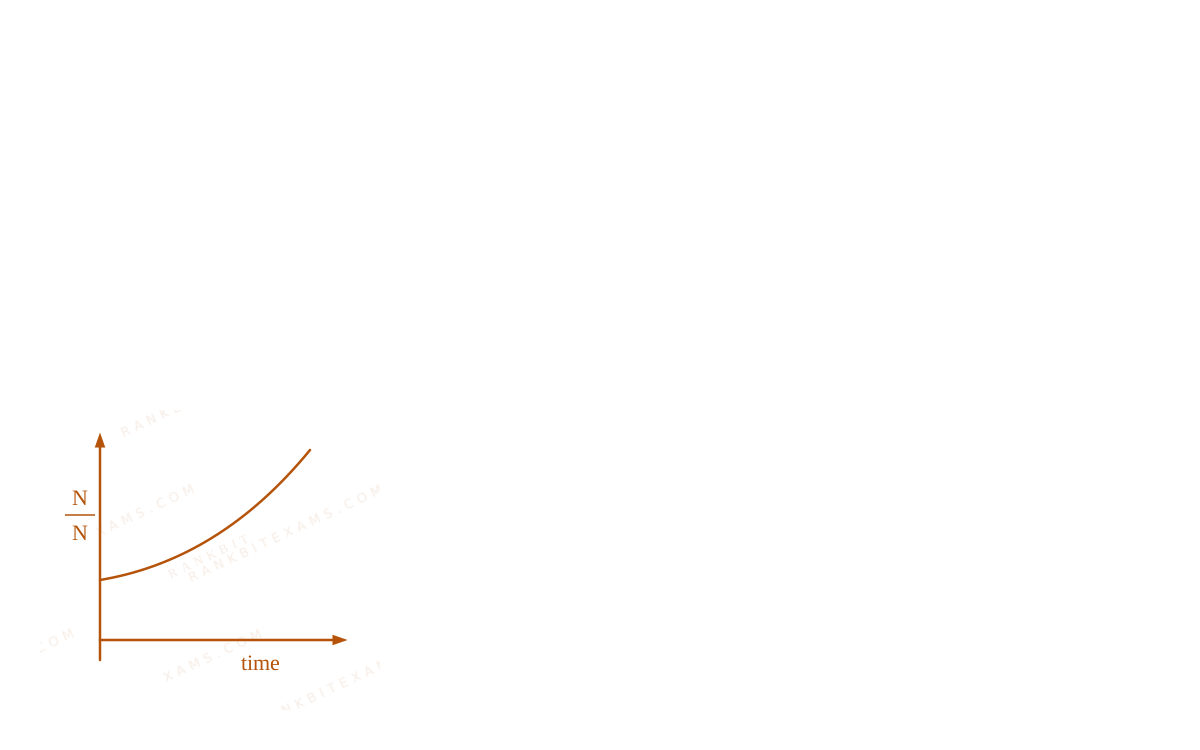
For bacterial growth in a cell culture, growth law is very similar to the law of radioactive decay. Which of the following graphs is most suitable to represent bacterial colony growth?
  • A. (1)
  • B. (2)
  • C. (3)
  • D. (4)

Solution

Related Formula

Exponential growth equation model:

N = N₀ eKt

Normalized configuration formula:

(N)/(N₀) = eKt
Core Logic

Radioactive decay follows a decreasing exponential path (N = N₀ e-λ t).

Conversely, cell culture growth functions via an increasing exponential pattern because the rate of growth is directly proportional to the current population size (dN/dt = KN). This results in an exponential curve that starts at (N)/(N₀) = 1 when t = 0 and curves sharply upward over time.

Step 1: Finding the Matching Curve

Plotting (N)/(N₀) against time shows an upward-clinging exponential profile starting from 1, which perfectly matches the curve in option (4).

Exponential growth profile plot for Q40

Pattern Recognition

The expression eKt dictates an exponential increase. Ensure the curve starts from a non-zero value (1) at t=0, as (N₀)/(N₀) = 1, rather than starting from the origin (0).

Chapter Mix

Class 12 Chemistry: Chemical Kinetics

Q jee_main_2025_29_jan_morning Reaction Mechanism and Rate Law
The reaction A₂ + B₂ arrow 2 AB follows the mechanism: A₂ k₋₁ k₁leftharpoons A + A (fast) A + B₂ k₂ AB + B (slow) A + B arrow AB (fast) The overall order of the reaction is :
  • A. 1.5
  • B. 3
  • C. 2.5
  • D. 2

Solution

Related Formula
Rate = k · [Reactants]order
Core Logic

The slowest elementary step controls the net kinetic pathway rate law :

Rate = k₂[A][B2] Equation (1)

Since [A] behaves as a transient intermediate species, replace it using the prior fast equilibrium step :

k₁k-1 = [A]²[A2] [A]² = ( k₁k-1) [A2] [A] = k₁k-1 · [A2]1/2

Substitute [A] back into Equation (1) :

Rate = k₂ k₁k-1 · [A2]1/2[B2]

Sum of powers determining overall order:

Order = (1)/(2) + 1 = 1.5

Hence, Option (1) is correct.

Pattern Recognition

Whenever a fast initial step dissociates a molecule into matching independent halves, it always injects a fractional order component of 0.5 relative to that parent species.

Q84 jee_main_2024_01_february_morning Kinetics of Radioactive Decay
The ratio of ¹⁴C¹²C in a piece of wood is (1)/(8) part that of atmosphere. If half life of ¹⁴C is 5730 years, the age of wood sample is .... years.
Numerical Answer. Answer: 17190 to 17190

Solution

Related Formula
N = (N₀)/(2ⁿ)

where n = tt1/2 (number of half-lives).

Alternatively, using the first-order decay formula:

t = (2.303)/(λ) ( (N₀)/(Nₜ) )

where λ = 0.693t1/2.

Core Logic

The atmospheric ratio of ¹⁴C/¹²C acts as the initial activity or amount (N₀) when the tree was alive. The current ratio in the wood represents the amount left at time t (Nₜ). Given that Nₜ = (1)/(8) N₀.

Step 1: Calculate Half-lives
(Nₜ)/(N₀) = (1)/(8) ((1)/(2))ⁿ = (1)/(8) = ((1)/(2))³

So, the number of half-lives passed, n = 3.

Step 2: Calculate Age
t = n × t1/2 t = 3 × 5730 years t = 17190 years
Pattern Recognition

Whenever the remaining fraction is a perfect power of 1/2 (like 1/2, 1/4, 1/8, 1/16), just find the exponent n and multiply by t1/2. Here, 1/8 = (1/2)³ arrow 3 half-lives.

Chapter Mix

Class 12 Chemistry: Chemical Kinetics

More Chemical Kinetics Questions — jee_main_2025_24_jan_evening

Practice all Chemical Kinetics previous-year questions →

Rankbit System
JEE Physics: Waves (+15.5%) | Electrostatics: Concentric Shells (-29.7%) | Modern Physics: Photoelectric Clones (+34.2%) | Mathematics: Definite Integrals (+18.1%) | Chemistry: Coordination Splitting (-11.4%) | JEE Physics: Waves (+15.5%) | Electrostatics: Concentric Shells (-29.7%) | Modern Physics: Photoelectric Clones (+34.2%) | Mathematics: Definite Integrals (+18.1%) | Chemistry: Coordination Splitting (-11.4%)