Let the function f(x) = fracx3 + frac3x + 3, x neq 0$f(x) = \frac{x}{3} + \frac{3}{x} + 3, x \neq 0$ be strictly increasing in (-infty, alpha_1) cup (alpha_2, infty)$(-\infty, \alpha_1) \cup (\alpha_2, \infty)$ and strictly decreasing in (alpha_3, alpha_4) cup (alpha_4, alpha_5)$(\alpha_3, \alpha_4) \cup (\alpha_4, \alpha_5)$. Then sum_i=1^5 alpha_i^2$\sum_{i=1}^{5} \alpha_i^2$ is equal to:
A.48$48$
B.28$28$
C.40$40$
D.36$36$
Solution & Explanation
### Related Formula
f'(x) > 0 implies textIncreasing$$f'(x) > 0 \implies \text{Increasing}$$f'(x) < 0 implies textDecreasing$$f'(x) < 0 \implies \text{Decreasing}$$
### Core Logic
Differentiate the rational function and determine the critical intervals by assessing where the derivative flips signs around critical points and domain boundaries.
### Step 1: Derivative Assessment
Given f(x) = fracx3 + frac3x + 3$f(x) = \frac{x}{3} + \frac{3}{x} + 3$f'(x) = frac13 - frac3x^2 = fracx^2 - 93x^2$$f'(x) = \frac{1}{3} - \frac{3}{x^2} = \frac{x^2 - 9}{3x^2}$$
Critical points occur at x = pm 3$x = \pm 3$, and a domain discontinuity sits at x = 0$x = 0$.
### Step 2: Sign Scheme Mapping
Analyzing interval signs:
* Strictly Increasing (f'(x) > 0$f'(x) > 0$): x in (-infty, -3) cup (3, infty)$x \in (-\infty, -3) \cup (3, \infty)$
* Strictly Decreasing (f'(x) < 0$f'(x) < 0$): x in (-3, 0) cup (0, 3)$x \in (-3, 0) \cup (0, 3)$
### Step 3: Interval Summation
Comparing bounds with assigned symbols:
alpha_1 = -3, quad alpha_2 = 3, quad alpha_3 = -3, quad alpha_4 = 0, quad alpha_5 = 3$$\alpha_1 = -3, \quad \alpha_2 = 3, \quad \alpha_3 = -3, \quad \alpha_4 = 0, \quad \alpha_5 = 3$$sum_i=1^5 alpha_i^2 = (-3)^2 + (3)^2 + (-3)^2 + (0)^2 + (3)^2 = 9 + 9 + 9 + 0 + 9 = 36$$\sum_{i=1}^{5} \alpha_i^2 = (-3)^2 + (3)^2 + (-3)^2 + (0)^2 + (3)^2 = 9 + 9 + 9 + 0 + 9 = 36$$
### Pattern Recognition
Functions of the form x + frackx$x + \frac{k}{x}$ always present localized extrema turning symmetric zones at pmsqrtk$\pm\sqrt{k}$. Always include the asymptotes (x=0$x=0$) when stating precise disjoint decreasing intervals.
### Evaluation Rubric / Model Answer
null
### Chapter Mix
Class 12 Mathematics: Application of Derivatives
Keywords:#strictly increasing intervals#JEE Main 2025 Evening Q53#rational function derivative#application of derivatives
More Application of Derivatives Previous-Year Questions — Page 4
Q5jee_main_2024_30_january_eveningMaxima and Minima
Let f(x) = (x + 3)^2 (x - 2)^3, x in [-4, 4]$f(x) = (x + 3)^2 (x - 2)^3, x \in [-4, 4]$ . If M$M$ and m$m$ are the maximum and minimum values of f$f$ , respectively in [-4, 4]$[-4, 4]$ , then the value of M - m$M - m$ is:
A.600$600$
B.392$392$
C.608$608$
D.108$108$
Solution
### Related Formula
textTo find absolute extrema, evaluate f(x) text at critical points and domain boundaries.$$\text{To find absolute extrema, evaluate } f(x) \text{ at critical points and domain boundaries.}$$
### Core Logic
Calculate the derivative of f(x)$f(x)$ using the product rule:
f'(x) = fracddx [(x + 3)^2] cdot (x - 2)^3 + (x + 3)^2 cdot fracddx [(x - 2)^3]$$f'(x) = \frac{d}{dx} [(x + 3)^2] \cdot (x - 2)^3 + (x + 3)^2 \cdot \frac{d}{dx} [(x - 2)^3]$$f'(x) = 2(x + 3)(x - 2)^3 + 3(x + 3)^2(x - 2)^2$$f'(x) = 2(x + 3)(x - 2)^3 + 3(x + 3)^2(x - 2)^2$$
Factor out the common terms (x+3)(x-2)^2$(x+3)(x-2)^2$:
f'(x) = (x + 3)(x - 2)^2 [2(x - 2) + 3(x + 3)]$$f'(x) = (x + 3)(x - 2)^2 [2(x - 2) + 3(x + 3)]$$f'(x) = (x + 3)(x - 2)^2 [2x - 4 + 3x + 9]$$f'(x) = (x + 3)(x - 2)^2 [2x - 4 + 3x + 9]$$f'(x) = 5(x + 3)(x - 2)^2 (x + 1)$$f'(x) = 5(x + 3)(x - 2)^2 (x + 1)$$
Setting f'(x) = 0$f'(x) = 0$ gives the critical points:
x = -3, -1, 2$x = -3, -1, 2$
### Step 1: Evaluating at Critical Points and Boundaries
Evaluate f(x)$f(x)$ at x = -4, -3, -1, 2, 4$x = -4, -3, -1, 2, 4$:
Maxima and Minima diagram for Q5 - JEE Main 2024 Evening
For x = -4$x = -4$: f(-4) = (-4 + 3)^2(-4 - 2)^3 = (1)(-216) = -216$f(-4) = (-4 + 3)^2(-4 - 2)^3 = (1)(-216) = -216$
For x = -3$x = -3$: f(-3) = 0$f(-3) = 0$
For x = -1$x = -1$: f(-1) = (-1 + 3)^2(-1 - 2)^3 = (4)(-27) = -108$f(-1) = (-1 + 3)^2(-1 - 2)^3 = (4)(-27) = -108$
For x = 2$x = 2$: f(2) = 0$f(2) = 0$
For x = 4$x = 4$: f(4) = (4 + 3)^2(4 - 2)^3 = 49 times 8 = 392$f(4) = (4 + 3)^2(4 - 2)^3 = 49 \times 8 = 392$
### Step 2: Finding M and m
From the evaluated values, the maximum M = 392$M = 392$ and the minimum m = -216$m = -216$.
M - m = 392 - (-216) = 392 + 216 = 608$$M - m = 392 - (-216) = 392 + 216 = 608$$
### Pattern Recognition
For polynomials on a closed interval, critical points combined with boundary values reliably expose the absolute max and min.
### Evaluation Rubric / Model Answer
null
### Chapter Mix
Class 12 Maths: Application of Derivatives
Q5jee_main_2024_30_jan_morningMaxima and Minima
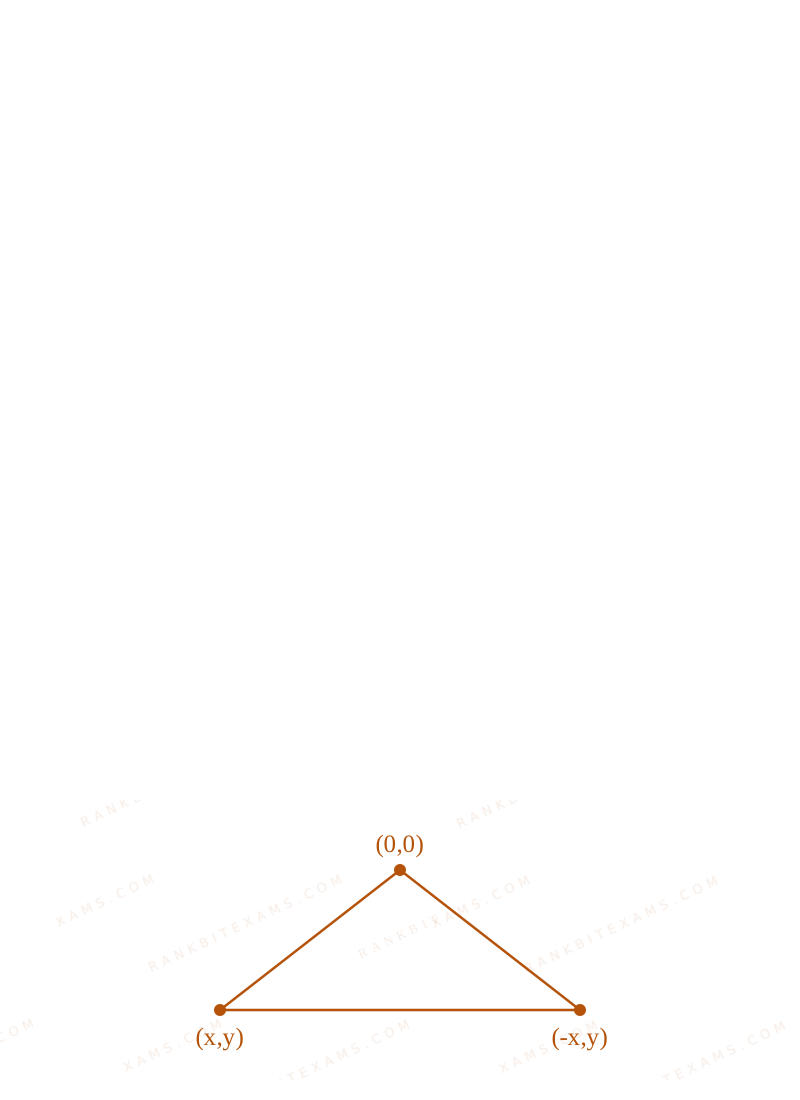
The maximum area of a triangle whose one vertex is at (0, 0)$(0, 0)$ and the other two vertices lie on the curve y = -2x^2 + 54$y = -2x^2 + 54$ at points (x, y)$(x, y)$ and (-x, y)$(-x, y)$ where y > 0$y > 0$ is:
A.88$88$
B.122$122$
C.92$92$
D.108$108$
Solution
### Related Formula
textArea of Delta = frac12 times textbase times textheight$$\text{Area of } \Delta = \frac{1}{2} \times \text{base} \times \text{height}$$
### Core Logic
Maxima and Minima diagram for Q5 - JEE Main 2024 Morning
The vertices of the triangle are (0, 0)$(0, 0)$, (x, y)$(x, y)$, and (-x, y)$(-x, y)$.
The base of the triangle lies along the horizontal line segment joining (-x, y)$(-x, y)$ and (x, y)$(x, y)$.
Length of base = 2x$= 2x$.
The height of the triangle from (0,0)$(0,0)$ to the line segment is y$y$.
So, Area Delta = frac12 (2x) (y) = xy$\Delta = \frac{1}{2} (2x) (y) = xy$ (Assuming x > 0$x > 0$).
### Step 1: Setting up the area function
Substitute y = -2x^2 + 54$y = -2x^2 + 54$ into the area function:
textArea(Delta) = A(x) = x(-2x^2 + 54) = -2x^3 + 54x$$\text{Area}(\Delta) = A(x) = x(-2x^2 + 54) = -2x^3 + 54x$$
### Step 2: Differentiating to find maximum area
To find the maximum area, take the derivative with respect to x$x$ and set it to zero:
A'(x) = fracdAdx = -6x^2 + 54$$A'(x) = \frac{dA}{dx} = -6x^2 + 54$$
Setting A'(x) = 0$A'(x) = 0$:
-6x^2 + 54 = 0 Rightarrow 6x^2 = 54 Rightarrow x^2 = 9$$-6x^2 + 54 = 0 \Rightarrow 6x^2 = 54 \Rightarrow x^2 = 9$$
Since x$x$ represents half the base length, x = 3$x = 3$.
### Step 3: Calculating maximum area
Substitute x = 3$x = 3$ back into the area function:
A_textmax = 3(-2(3)^2 + 54) = 3(-18 + 54) = 3(36) = 108$$A_{\text{max}} = 3(-2(3)^2 + 54) = 3(-18 + 54) = 3(36) = 108$$
### Pattern Recognition
For symmetric figures inscribed under a parabolic arch, the area function A(x) = x cdot y(x)$A(x) = x \cdot y(x)$ is standard. Differentiate and find the critical point directly.
### Evaluation Rubric / Model Answer
null
### Chapter Mix
Class 12 Maths: Application of Derivatives
Q7jee_main_2024_30_jan_morningMean Value Theorems
Let g : mathbbR to mathbbR$g : \mathbb{R} \to \mathbb{R}$ be a non-constant twice differentiable such that g'left(frac12right) = g'left(frac32right)$g'\left(\frac{1}{2}\right) = g'\left(\frac{3}{2}\right)$. If a real valued function f$f$ is defined as f(x) = frac12left[g(x) + g(2 - x)right]$f(x) = \frac{1}{2}\left[g(x) + g(2 - x)\right]$, then
A.f'(x) = 0$f'(x) = 0$ for at least two x$x$ in (0,2)$(0,2)$
B.f'(x) = 0$f'(x) = 0$ for exactly one x$x$ in (0,1)$(0,1)$
C.f'(x) = 0$f'(x) = 0$ for no x$x$ in (0,1)$(0,1)$
### Related Formula
Rolle's Theorem: If f(x)$f(x)$ is continuous on [a, b]$[a, b]$, differentiable on (a, b)$(a, b)$, and f(a) = f(b)$f(a) = f(b)$, then there exists at least one c in (a, b)$c \in (a, b)$ such that f'(c) = 0$f'(c) = 0$.
### Core Logic
Given f(x) = frac12left[g(x) + g(2 - x)right]$f(x) = \frac{1}{2}\left[g(x) + g(2 - x)\right]$.
Differentiating f(x)$f(x)$ with respect to x$x$:
f'(x) = fracg'(x) - g'(2 - x)2$$f'(x) = \frac{g'(x) - g'(2 - x)}{2}$$
### Step 1: Evaluating the derivative at given points
Evaluate f'left(frac32right)$f'\left(\frac{3}{2}\right)$:
f'left(frac32right) = fracg'left(frac32right) - g'left(frac12right)2$$f'\left(\frac{3}{2}\right) = \frac{g'\left(\frac{3}{2}\right) - g'\left(\frac{1}{2}\right)}{2}$$
Since g'left(frac12right) = g'left(frac32right)$g'\left(\frac{1}{2}\right) = g'\left(\frac{3}{2}\right)$, we get:
f'left(frac32right) = 0$$f'\left(\frac{3}{2}\right) = 0$$
Also evaluate f'left(frac12right)$f'\left(\frac{1}{2}\right)$:
f'left(frac12right) = fracg'left(frac12right) - g'left(frac32right)2 = 0$$f'\left(\frac{1}{2}\right) = \frac{g'\left(\frac{1}{2}\right) - g'\left(\frac{3}{2}\right)}{2} = 0$$
Additionally, observe that f'(1) = fracg'(1) - g'(1)2 = 0$f'(1) = \frac{g'(1) - g'(1)}{2} = 0$.
### Step 2: Applying Rolle's Theorem
We have f'left(frac12right) = 0$f'\left(\frac{1}{2}\right) = 0$, f'(1) = 0$f'(1) = 0$, and f'left(frac32right) = 0$f'\left(\frac{3}{2}\right) = 0$.
By Rolle's Theorem on f'(x)$f'(x)$ (though we are asked about f'(x)=0$f'(x)=0$ directly), we already found three distinct roots for f'(x) = 0$f'(x) = 0$: x = frac12, 1, frac32$x = \frac{1}{2}, 1, \frac{3}{2}$.
Notice that x = 1/2$x = 1/2$ and x=1$x=1$ are in (0, 2)$(0, 2)$, and x=3/2$x=3/2$ is in (0, 2)$(0, 2)$. Thus f'(x) = 0$f'(x) = 0$ for at least three values in (0, 2)$(0, 2)$, which satisfies the condition "at least two x$x$ in (0, 2)$(0, 2)$".
### Pattern Recognition
Symmetry in function definition g(x) + g(a-x)$g(x) + g(a-x)$ guarantees a critical point at x = a/2$x = a/2$. Additional critical points arise due to the given condition on g'(x)$g'(x)$, creating a scenario perfectly suited for Rolle's implications.
### Evaluation Rubric / Model Answer
null
### Chapter Mix
Class 12 Maths: Application of Derivatives
Q13jee_main_2024_31_jan_eveningMonotonicity and Distances
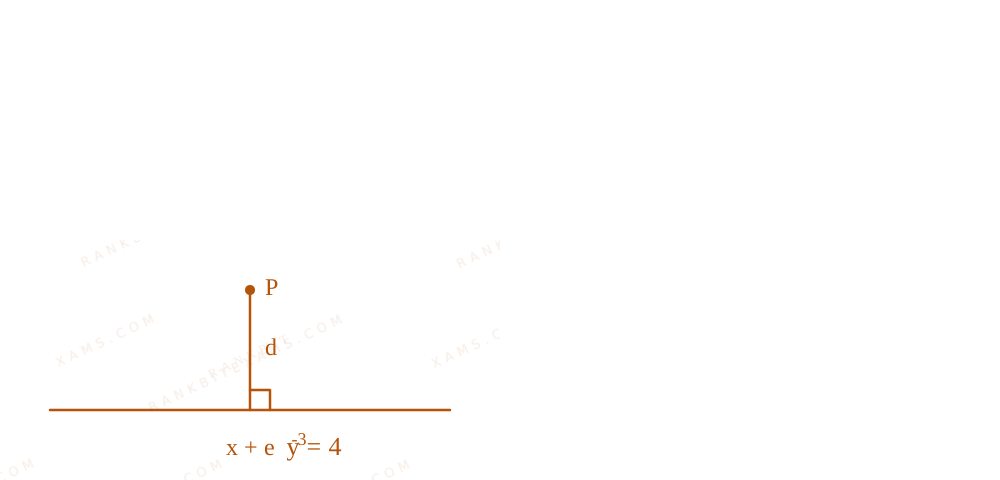
If the function f: (-infty, -1] to (a, b]$f: (-\infty, -1] \to (a, b]$ defined by f(x) = e^x^3 - 3x + 1$f(x) = e^{x^3 - 3x + 1}$ is one-one and onto, then the distance of the point P(2b + 4, a + 2)$P(2b + 4, a + 2)$ from the line x + e^-3y = 4$x + e^{-3}y = 4$ is :
A.2sqrt1 + mathrme^6$2\sqrt{1 + \mathrm{e}^6}$
B.4sqrt1 + mathrme^6$4\sqrt{1 + \mathrm{e}^6}$
C.3sqrt1 + mathrme^6$3\sqrt{1 + \mathrm{e}^{6}}$
D.sqrt1 + mathrme^6$\sqrt{1 + \mathrm{e}^{6}}$
Solution
### Related Formula
textDistance of point (x_1, y_1) text from line Ax+By+C=0 text is d = frac|Ax_1 + By_1 + C|sqrtA^2 + B^2$$\text{Distance of point } (x_1, y_1) \text{ from line } Ax+By+C=0 \text{ is } d = \frac{|Ax_1 + By_1 + C|}{\sqrt{A^2 + B^2}}$$
### Core Logic
Monotonicity and Distances diagram for Q13 - JEE Main 2024 Evening
Given f(x) = e^x^3 - 3x + 1$f(x) = e^{x^3 - 3x + 1}$.
Check monotonicity on (-infty, -1]$(-\infty, -1]$:
f'(x) = e^x^3 - 3x + 1 cdot (3x^2 - 3) = 3(x-1)(x+1)e^x^3 - 3x + 1$$f'(x) = e^{x^3 - 3x + 1} \cdot (3x^2 - 3) = 3(x-1)(x+1)e^{x^3 - 3x + 1}$$
For x le -1$x \le -1$, (x+1) le 0$(x+1) \le 0$ and (x-1) < 0$(x-1) < 0$, making f'(x) ge 0$f'(x) \ge 0$. Hence f(x)$f(x)$ is strictly increasing.
Since f$f$ is onto (a,b]$(a,b]$, the range is dictated by the domain boundaries:
a = lim_xto-infty f(x) = e^-infty = 0$$a = \lim_{x\to-\infty} f(x) = e^{-\infty} = 0$$b = f(-1) = e^-1 + 3 + 1 = e^3$$b = f(-1) = e^{-1 + 3 + 1} = e^3$$
Point P(2b + 4, a + 2) equiv P(2e^3 + 4, 2)$P(2b + 4, a + 2) \equiv P(2e^3 + 4, 2)$.
Find distance from line x + e^-3y - 4 = 0$x + e^{-3}y - 4 = 0$:
d = frac|2e^3 + 4 + e^-3(2) - 4|sqrt1^2 + (e^-3)^2 = frac2e^3 + 2e^-3sqrt1 + e^-6$$d = \frac{|2e^3 + 4 + e^{-3}(2) - 4|}{\sqrt{1^2 + (e^{-3})^2}} = \frac{2e^3 + 2e^{-3}}{\sqrt{1 + e^{-6}}}$$d = frac2e^3(1 + e^-6)sqrt1 + e^-6 = 2e^3 sqrt1 + e^-6 = 2sqrte^6 + 1$$d = \frac{2e^3(1 + e^{-6})}{\sqrt{1 + e^{-6}}} = 2e^3 \sqrt{1 + e^{-6}} = 2\sqrt{e^6 + 1}$$
### Evaluation Rubric / Model Answer
null
### Chapter Mix
Class 12 Maths: Applications of Derivatives
Class 11 Maths: Straight Lines
Q22jee_main_2024_31_jan_morningMaxima and Minima
Let S = (-1, infty)$S = (-1, \infty)$ and f : S to mathbbR$f : S \to \mathbb{R}$ be defined as f(x) = int_-1^x (e^t - 1)^11 (2t - 1)^5 (t - 2)^7 (t - 3)^12 (2t - 10)^61 dt$f(x) = \int_{-1}^{x} (e^t - 1)^{11} (2t - 1)^5 (t - 2)^7 (t - 3)^{12} (2t - 10)^{61} dt$. Let p =$p =$ Sum of square of the values of x$x$, where f(x)$f(x)$ attains local maxima on S$S$ and q =$q =$ Sum of the values of x$x$, where f(x)$f(x)$ attains local minima on S$S$. Then, the value of p^2 + 2q$p^2 + 2q$ is
Numerical Answer.Answer: 27 to 27
Solution
### Related Formula
f'(x) = 0 text for critical points. Change from + to - text means local maxima, - to + text means local minima.$$f'(x) = 0 \text{ for critical points. Change from } + \to - \text{ means local maxima, } - \to + \text{ means local minima.}$$
### Core Logic
Using Newton-Leibniz formula:
f'(x) = (e^x - 1)^11 (2x - 1)^5 (x - 2)^7 (x - 3)^12 (2x - 10)^61$$f'(x) = (e^x - 1)^{11} (2x - 1)^5 (x - 2)^7 (x - 3)^{12} (2x - 10)^{61}$$
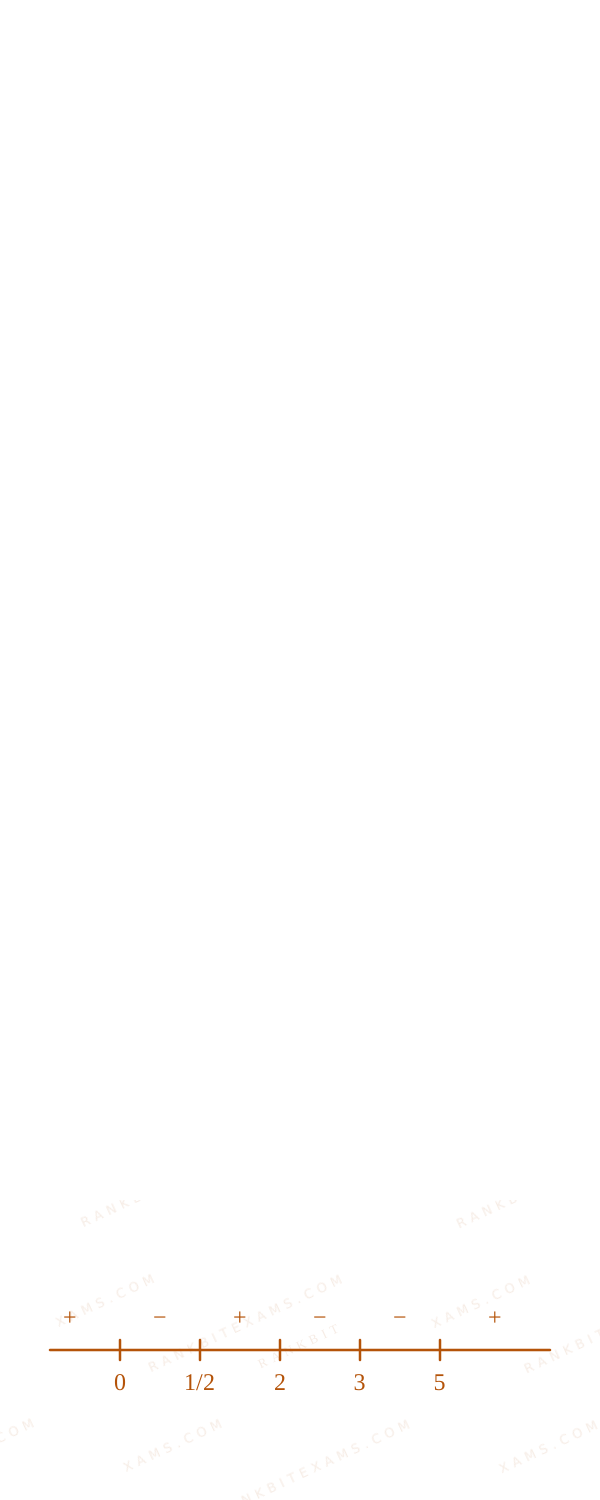
The critical points are roots of f'(x) = 0$f'(x) = 0$: x = 0, frac12, 2, 3, 5$x = 0, \frac{1}{2}, 2, 3, 5$.
Maxima and Minima diagram for Q22 - JEE Main 2024 Morning
### Step 1: Sign Change Analysis
Perform the Wavy Curve Method for x in (-1, infty)$x \in (-1, \infty)$:
At x=5$x=5$ (odd power 61): sign changes - to +$- \to +$ (Local Minima)
At x=3$x=3$ (even power 12): sign doesn't change (Neither)
At x=2$x=2$ (odd power 7): sign changes + to -$+ \to -$ (Local Maxima)
At x=1/2$x=1/2$ (odd power 5): sign changes - to +$- \to +$ (Local Minima)
At x=0$x=0$ (from e^x - 1$e^x - 1$, odd power 11): sign changes + to -$+ \to -$ (Local Maxima)
### Step 2: Compute p and q
Local minima at x = 5, frac12$x = 5, \frac{1}{2}$.
Local maxima at x = 2, 0$x = 2, 0$.
p = 0^2 + 2^2 = 4$$p = 0^2 + 2^2 = 4$$q = 5 + frac12 = frac112$$q = 5 + \frac{1}{2} = \frac{11}{2}$$
### Step 3: Final Computation
p^2 + 2q = 16 + 2left(frac112right) = 16 + 11 = 27$$p^2 + 2q = 16 + 2\left(\frac{11}{2}\right) = 16 + 11 = 27$$
### Evaluation Rubric / Model Answer
null
### Chapter Mix
Class 12 Maths: Application of Derivatives
Class 12 Maths: Integrals
More Application of Derivatives Questions — jee_main_2025_08_april_evening
We Map Every Repeating Question in Competitive Exams.
Say goodbye to generic mock test fatigue. RankBit uses smart analysis to group past exam questions into their foundational Repeating Question Types. Find chapter weightage, track repeating questions, and score higher with targeted practice.
Select Your Target Exam
Choose an exam track below to find formulas per chapter and patterns.
Syncing Exam Intelligence
Mapping formulas and patterns across all tracks…
PATH A — FULL LENGTH PRACTICE
Full Mock Test Hub
Simulate real NTA exam conditions with fully tracked mocks. Time yourself against past papers.
Practice past-year questions one chapter at a time. Pick an exam → subject → chapter and get every PYQ for that topic — pulled together from all past papers — with the chapter's key formulas alongside.