Let the function f(x) = fracx3 + frac3x + 3, x neq 0 be strictly increasing in (-infty, alpha_1) cup (alpha_2, infty) and strictly decreasing in (alpha_3, alpha_4) cup (alpha_4, alpha_5). Then sum_i=1^5 alpha_i^2 is equal to:

Solution & Explanation

### Related Formula f'(x) > 0 implies textIncreasing f'(x) < 0 implies textDecreasing ### Core Logic Differentiate the rational function and determine the critical intervals by assessing where the derivative flips signs around critical points and domain boundaries. ### Step 1: Derivative Assessment Given f(x) = fracx3 + frac3x + 3 f'(x) = frac13 - frac3x^2 = fracx^2 - 93x^2 Critical points occur at x = pm 3, and a domain discontinuity sits at x = 0. ### Step 2: Sign Scheme Mapping Analyzing interval signs: * Strictly Increasing (f'(x) > 0): x in (-infty, -3) cup (3, infty) * Strictly Decreasing (f'(x) < 0): x in (-3, 0) cup (0, 3) ### Step 3: Interval Summation Comparing bounds with assigned symbols: alpha_1 = -3, quad alpha_2 = 3, quad alpha_3 = -3, quad alpha_4 = 0, quad alpha_5 = 3 sum_i=1^5 alpha_i^2 = (-3)^2 + (3)^2 + (-3)^2 + (0)^2 + (3)^2 = 9 + 9 + 9 + 0 + 9 = 36 ### Pattern Recognition Functions of the form x + frackx always present localized extrema turning symmetric zones at pmsqrtk. Always include the asymptotes (x=0) when stating precise disjoint decreasing intervals. ### Evaluation Rubric / Model Answer null ### Chapter Mix Class 12 Mathematics: Application of Derivatives
Reference Study Guides

More Application of Derivatives Previous-Year Questions — Page 2

Q51 jee_main_2025_04_april_evening Maxima and Minima
Let a > 0. If the function f(x) = 6x^3 - 45ax^2 + 108a^2x + 1 attains its local maximum and minimum values at the points x_1 and x_2 respectively such that x_1x_2 = 54, then a + x_1 + x_2 is equal to :-
  • A. 15
  • B. 18
  • C. 24
  • D. 13

Solution

### Related Formula For a function f(x) to have a local maximum or minimum at a point, its first derivative must vanish at that point: f'(x) = 0 ### Core Logic Differentiating the given function f(x) = 6x^3 - 45ax^2 + 108a^2x + 1 with respect to x: f'(x) = 18x^2 - 90ax + 108a^2 = 0 Dividing the entire equation by 18: x^2 - 5ax + 6a^2 = 0 Factoring the quadratic equation: (x - 2a)(x - 3a) = 0 Thus, the critical points are x = 2a and x = 3a. Since a > 0, we assign x_1 = 2a and x_2 = 3a. ### Step 1: Finding the value of a Given that the product of the roots x_1x_2 = 54: (2a)(3a) = 54 6a^2 = 54 implies a^2 = 9 Since a > 0, we have a = 3. ### Step 2: Calculating the final expression Substituting a = 3 back to find x_1 and x_2: x_1 = 2(3) = 6 x_2 = 3(3) = 9 Now, evaluating a + x_1 + x_2: a + x_1 + x_2 = 3 + 6 + 9 = 18 ### Pattern Recognition When critical points are expressed in terms of a parameter, relate the given root condition (x_1x_2 = 54) directly to the product of roots formula (fracca) of the simplified quadratic equation to save factoring time. ### Evaluation Rubric / Model Answer null ### Chapter Mix Class 12 Mathematics: Application of Derivatives
Q62 jee_main_2025_24_jan_evening Increasing and Decreasing Functions
Let (2, 3) be the largest open interval in which the function f(x)=2log_e(x-2)-x^2+ax+1 is strictly increasing and (b, c) be the largest open interval, in which the function g(x)=(x-1)^3(x+2-a)^2 is strictly decreasing. Then 100(a+b-c) is equal to: [cite: 3335, 3336, 3337]
  • A. 280
  • B. 360
  • C. 420
  • D. 160

Solution

### Related Formula A differentiable function is strictly increasing where its first derivative is positive (f'(x) ge 0) and strictly decreasing where its first derivative is negative (g'(x) le 0). ### Step 1: Differentiate f(x) to solve for a Find f'(x) : f'(x) = frac2x-2 - 2x + a ge 0 Since (2,3) is the largest open interval of increasing behavior [cite: 3335, 3336], the transition root occurs at the upper boundary x=3 : f'(3) = 0 Rightarrow frac23-2 - 2(3) + a = 0 Rightarrow 2 - 6 + a = 0 Rightarrow a = 4 [cite: 3989, 3990, 3991] ### Step 2: Differentiate g(x) to solve for interval (b, c) Substitute a = 4 into g(x) [cite: 4002, 4003]: g(x) = (x-1)^3(x + 2 - 4)^2 = (x-1)^3(x-2)^2 Compute g'(x) using the product rule : g'(x) = 3(x-1)^2(x-2)^2 + (x-1)^3 cdot 2(x-2) g'(x) = (x-1)^2(x-2)left[3(x-2) + 2(x-1)right] = (x-1)^2(x-2)(5x - 8) [cite: 4005, 4006] For g(x) to be strictly decreasing, set g'(x) < 0 : Since (x-1)^2 ge 0, we require (x-2)(5x-8) < 0 Rightarrow x in left(frac85, 2right) [cite: 4006, 4007]. Thus, the interval is (b, c) = left(frac85, 2right), yielding b = frac85 = 1.6 and c = 2[cite: 3336, 4007]. ### Step 3: Compute Target Value Evaluate the objective expression [cite: 3337, 4008]: 100(a + b - c) = 100left(4 + frac85 - 2right) = 100(3.6) = 360 ### Pattern Recognition Boundary parameters of maximal monotonic intervals are always the exact zero-crossings of the derivative function. Setting f'(3) = 0 immediately establishes a=4 without secondary algebraic transformations. ### Evaluation Rubric / Model Answer null ### Chapter Mix Class 12 Mathematics: Application of Derivatives

Q62 jee_main_2025_24_jan_morning Maxima and Minima
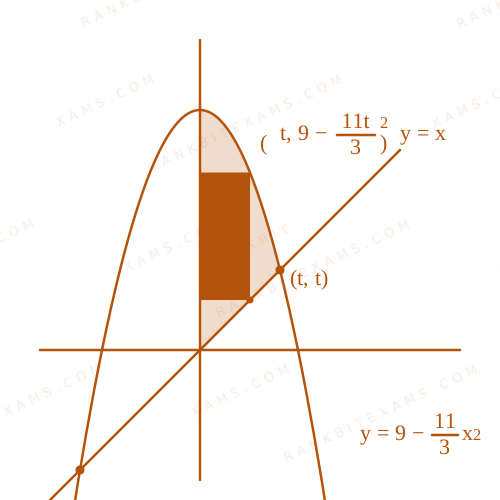
Consider the region R = left\(x,y)colon x leq y leq 9 - frac113x^2, \, x geq 0right\. The area of the largest rectangle with sides parallel to the coordinate axes inscribed in R is :
  • A. frac625111
  • B. frac730119
  • C. frac567121
  • D. frac821123

Solution

### Related Formula The area of a rectangle bounded between an upper function curve y_2(x) and lower function curve y_1(x) spanning width x = t is formulated as: A(t) = t cdot [y_2(t) - y_1(t)] ### Core Logic The region is bounded below by the line y = x and above by the downward opening parabola y = 9 - frac113x^2 in the first quadrant:
Maxima and Minima
Maxima and Minima
Let a vertex of the rectangle lie on the upper parabolic boundary at x = t. The corresponding height span of the rectangle is bounded by the line y = t at the base:
Maxima and Minima
Maxima and Minima
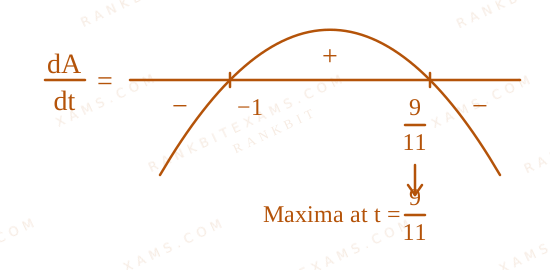
Thus, the area equation as a function of variable parameter t is: A(t) = t cdot left( 9 - frac113t^2 - t right) = 9t - t^2 - frac113t^3 ### Step 1: Differentiate to Identify Critical Values Differentiate the area function with respect to t and equate to zero: fracdAdt = 9 - 2t - 11t^2 = 0 11t^2 + 2t - 9 = 0 11t^2 + 11t - 9t - 9 = 0 +(11t - 9)(t + 1) = 0 Since x \geq 0, we reject the negative root t = -1. This isolates the physical critical point at: t = frac911 ### Step 2: Evaluate Maximum Inscribed Area Substitute t = \frac{9}{11} back into the factored area equation formulation: A_textmax = frac911 cdot left( 9 - frac911 - frac113left(frac911right)^2 right) A_textmax = frac911 cdot left( 9 - frac911 - frac2711 right) A_textmax = frac911 cdot left( 9 - frac3611 right) = frac911 cdot frac6311 = frac567121$ ### Pattern Recognition For optimized area allocation inside custom functional borders, setting the optimization parameter strictly to the horizontal coordinates simplifies high-degree polynomials down to standard derivative templates. ### Evaluation Rubric / Model Answer null ### Chapter Mix Class 12 Mathematics: Application of Derivatives
Q19 jee_main_2024_01_february_morning Monotonicity of Functions
If 5f(x)+4fleft(frac1xright)=x^2-2, forall xne0 and y=9x^2f(x), then y is strictly increasing in:
  • A. left(0,frac1sqrt5right)cupleft(frac1sqrt5,inftyright)
  • B. left(-frac1sqrt5,0right)cupleft(frac1sqrt5,inftyright)
  • C. left(-frac1sqrt5,0right)cupleft(0,frac1sqrt5right)
  • D. left(-infty,-frac1sqrt5right)cupleft(0,frac1sqrt5right)

Solution

### Related Formula 1. Functional equations containing x and frac1x can be solved by substituting x to frac1x to create a system of simultaneous equations. 2. A function is strictly increasing in intervals where its first derivative is positive: fracdydx > 0. ### Core Logic Given the functional equation equation: 5f(x) + 4fleft(frac1xright) = x^2 - 2 quad implies (1) Substitute x to frac1x: 5fleft(frac1xright) + 4f(x) = frac1x^2 - 2 quad implies (2) ### Step 1: Solve for f(x) To eliminate fleft(frac1xright), multiply equation (1) by 5 and equation (2) by 4: 25f(x) + 20fleft(frac1xright) = 5x^2 - 10 16f(x) + 20fleft(frac1xright) = frac4x^2 - 8 Subtract the second equation from the first: 9f(x) = 5x^2 - frac4x^2 - 2 ### Step 2: Differentiate the Target Equation We are given y = 9x^2 f(x) = x^2 [9f(x)]. Substituting our equation for 9f(x): y = x^2 left( 5x^2 - frac4x^2 - 2 right) y = 5x^4 - 2x^2 - 4 Differentiating with respect to x: fracdydx = 20x^3 - 4x = 4x(5x^2 - 1) ### Step 3: Analyze the Monotonicity Intervals For the function to be strictly increasing, set fracdydx > 0: 4x(5x^2 - 1) > 0 implies xleft(x - frac1sqrt5right)left(x + frac1sqrt5right) > 0 Using the wavy curve method with critical roots -frac1sqrt5, \, 0, \, frac1sqrt5: - Positive regions occur where x in left(-frac1sqrt5, 0right) cup left(frac1sqrt5, inftyright). ### Pattern Recognition Sees: Symmetric reciprocal arguments inside a functional format. Shortcut: Recognizing that y = 9x^2 f(x) simplifies directly to an even polynomial (5x^4 - 2x^2 - 4) means the final derivative will be odd, ensuring a symmetric layout across the origin. ### Evaluation Rubric / Model Answer null ### Chapter Mix Class 12 Mathematics: Application of Derivatives Class 11 Mathematics: Relations and Functions
Q5 jee_main_2024_29_january_evening Maxima and Minima
The function f(x) = 2x + 3(x)^frac23, x in mathbbR, has
  • A. exactly one point of local minima and no point of local maxima
  • B. exactly one point of local maxima and no point of local minima
  • C. exactly one point of local maxima and exactly one point of local minima
  • D. exactly two points of local maxima and exactly one point of local minima

Solution

### Related Formula For local maxima or minima, check the sign flip of f'(x) across critical points. ### Core Logic Given f(x) = 2x + 3x^2/3. Differentiating with respect to x: f'(x) = 2 + 3 cdot frac23 x^-1/3 = 2 + 2x^-1/3 = 2 left(1 + frac1x^1/3right) = 2 left(fracx^1/3 + 1x^1/3right) Critical points occur where f'(x) = 0 or where f'(x) is undefined: * f'(x) = 0 implies x^1/3 + 1 = 0 implies x = -1 * f'(x) is undefined at x = 0 ### Step 1: Sign Scheme Analysis Let us check the sign changes of f'(x): * For x < -1: x^1/3+1 < 0 and x^1/3 < 0 implies f'(x) > 0 (+) * For -1 < x < 0: x^1/3+1 > 0 and x^1/3 < 0 implies f'(x) < 0 (-) * For x > 0: x^1/3+1 > 0 and x^1/3 > 0 implies f'(x) > 0 (+) Sign changes: * At x = -1: positive to negative rightarrow Local Maxima * At x = 0: negative to positive rightarrow Local Minima Thus, there is exactly one point of local maxima and exactly one point of local minima. ### Pattern Recognition Points where the derivative is undefined (cusps or vertical tangents) are equally valid critical point candidates for local extrema. Always include them in your sign scheme layout. ### Evaluation Rubric / Model Answer null ### Chapter Mix Class 12 Mathematics: Application of Derivatives

More Application of Derivatives Questions — jee_main_2025_08_april_evening

Practice all Application of Derivatives previous-year questions →

Rankbit System
JEE Physics: Waves (+15.5%) | Electrostatics: Concentric Shells (-29.7%) | Modern Physics: Photoelectric Clones (+34.2%) | Mathematics: Definite Integrals (+18.1%) | Chemistry: Coordination Splitting (-11.4%) | JEE Physics: Waves (+15.5%) | Electrostatics: Concentric Shells (-29.7%) | Modern Physics: Photoelectric Clones (+34.2%) | Mathematics: Definite Integrals (+18.1%) | Chemistry: Coordination Splitting (-11.4%)