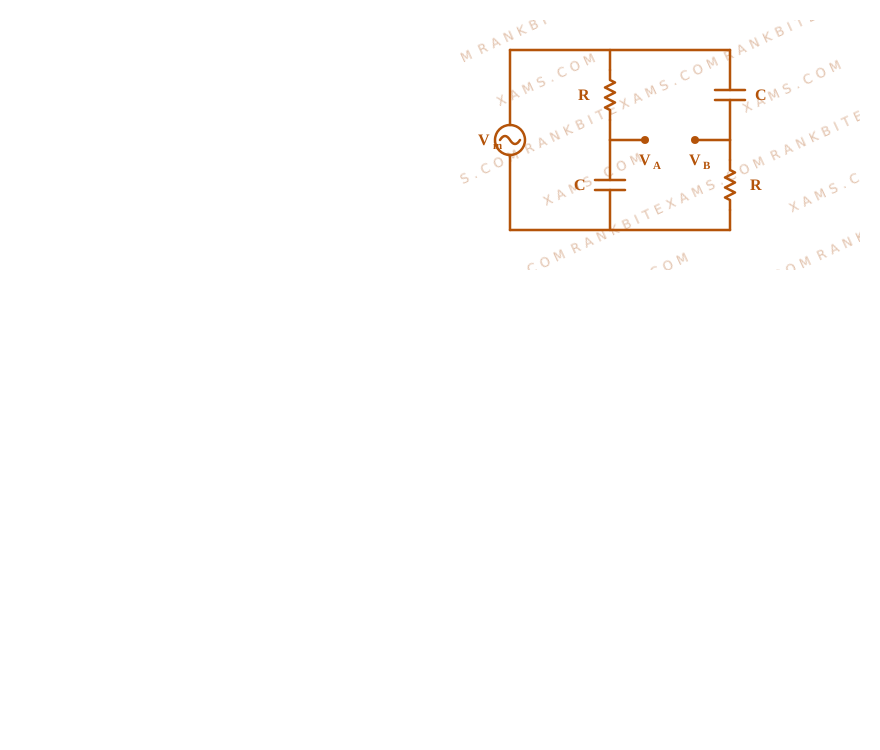
For ac circuit shown in figure, R = 100 kΩ$R = 100 \, \text{k}\Omega$ and C = 100 pF$C = 100 \, \text{pF}$ and the phase difference between Vᵢₙ$V_{\text{in}}$ and (VB - VA)$(V_{\text{B}} - V_{\text{A}})$ is 90^°$90^\circ$ . The input signal frequency is 10x$10^{\text{x}}$ rad/sec, where 'x' is An AC bridge circuit with input voltage connected across symmetrically crossed pairs of 100 kOhm resistors and 100 pF capacitors.
Numerical Answer Type:
Enter a numerical valueAnswer: 5 to 5+4 marks
Solution & Explanation
Related Formula
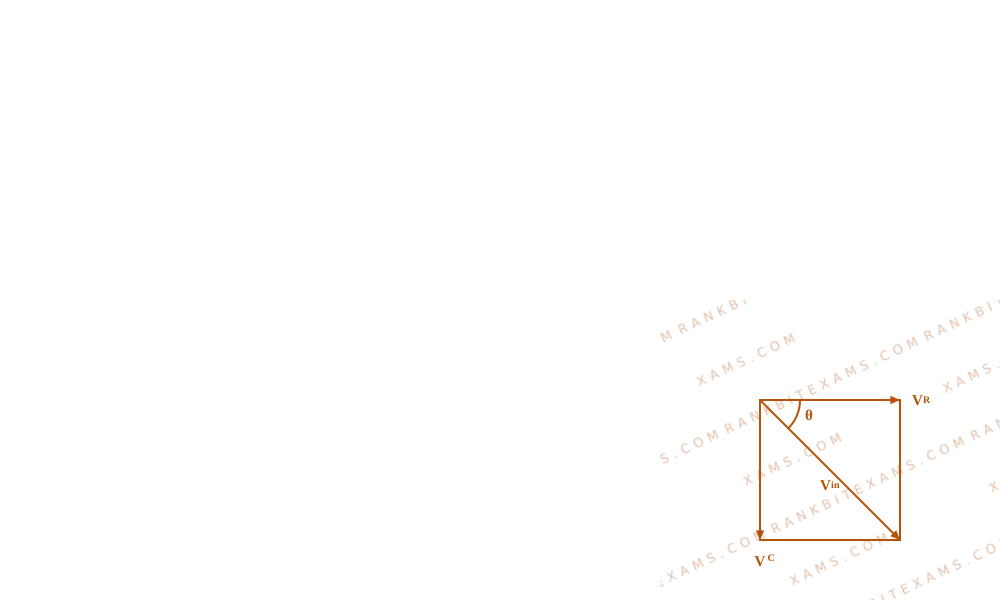
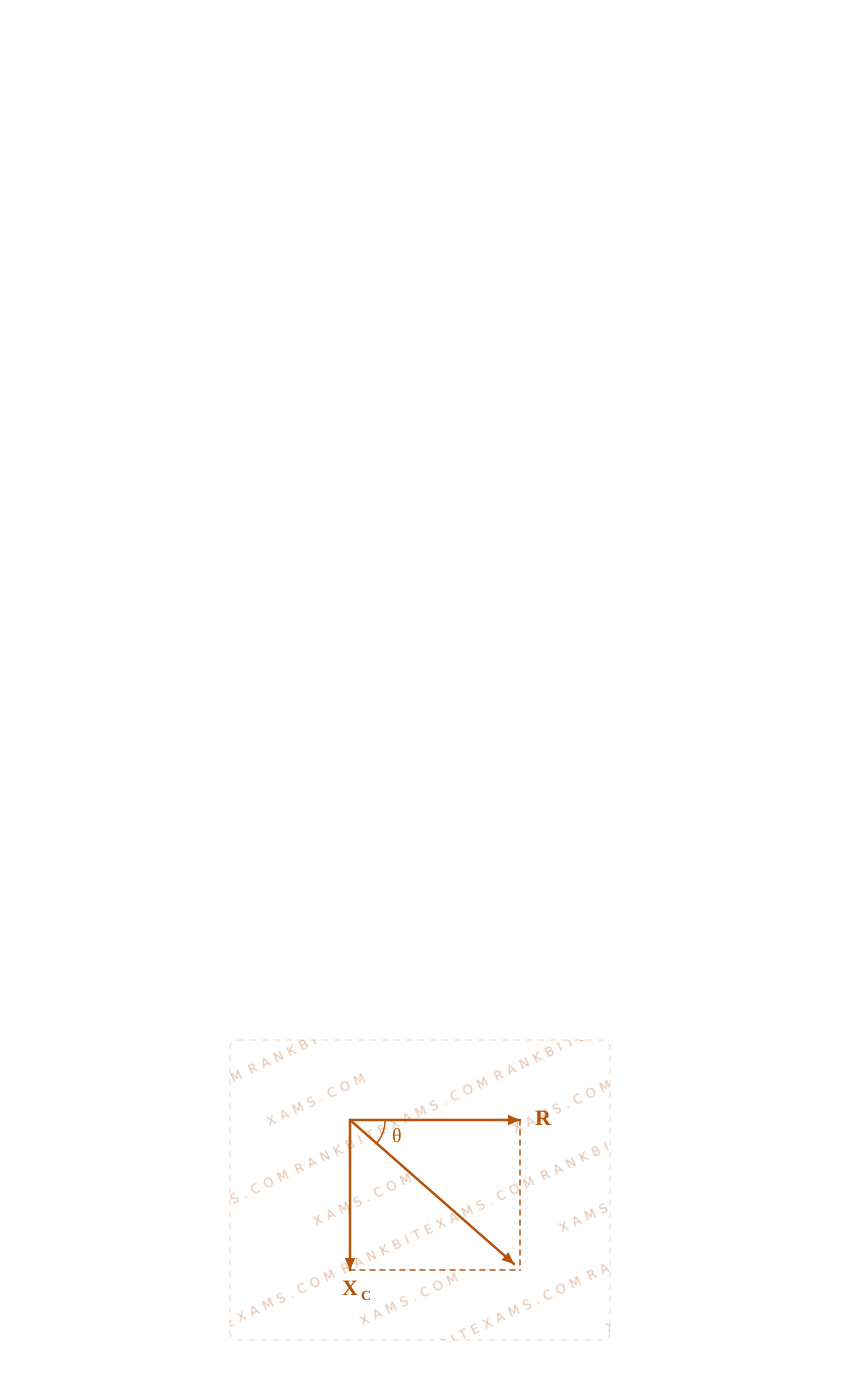
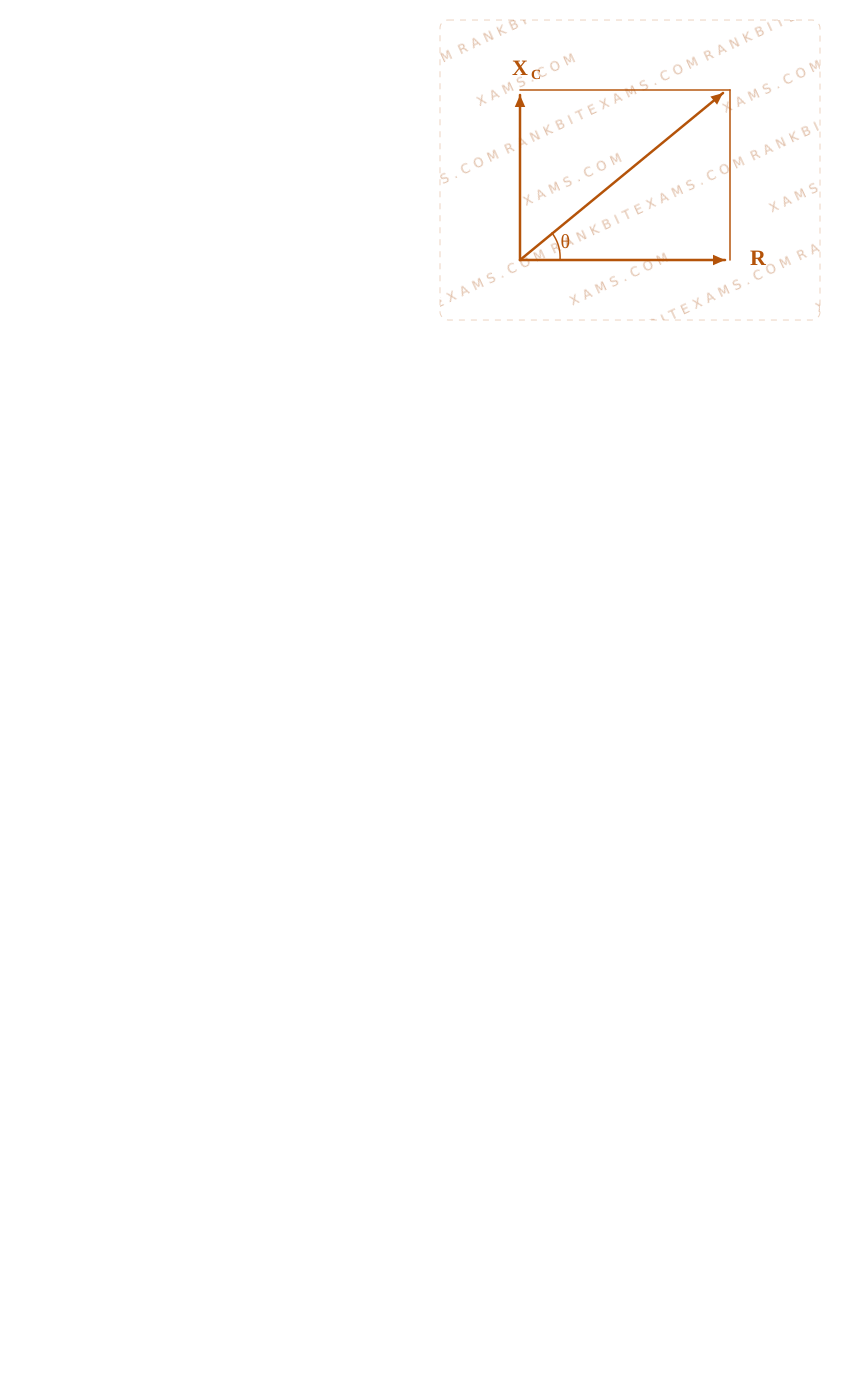
For a series RC branch, the voltage phase angle θ$\theta$ is:
θ = (XC)/(R) = (1)/(ω C R)$$\tan\theta = \frac{X_C}{R} = \frac{1}{\omega C R}$$
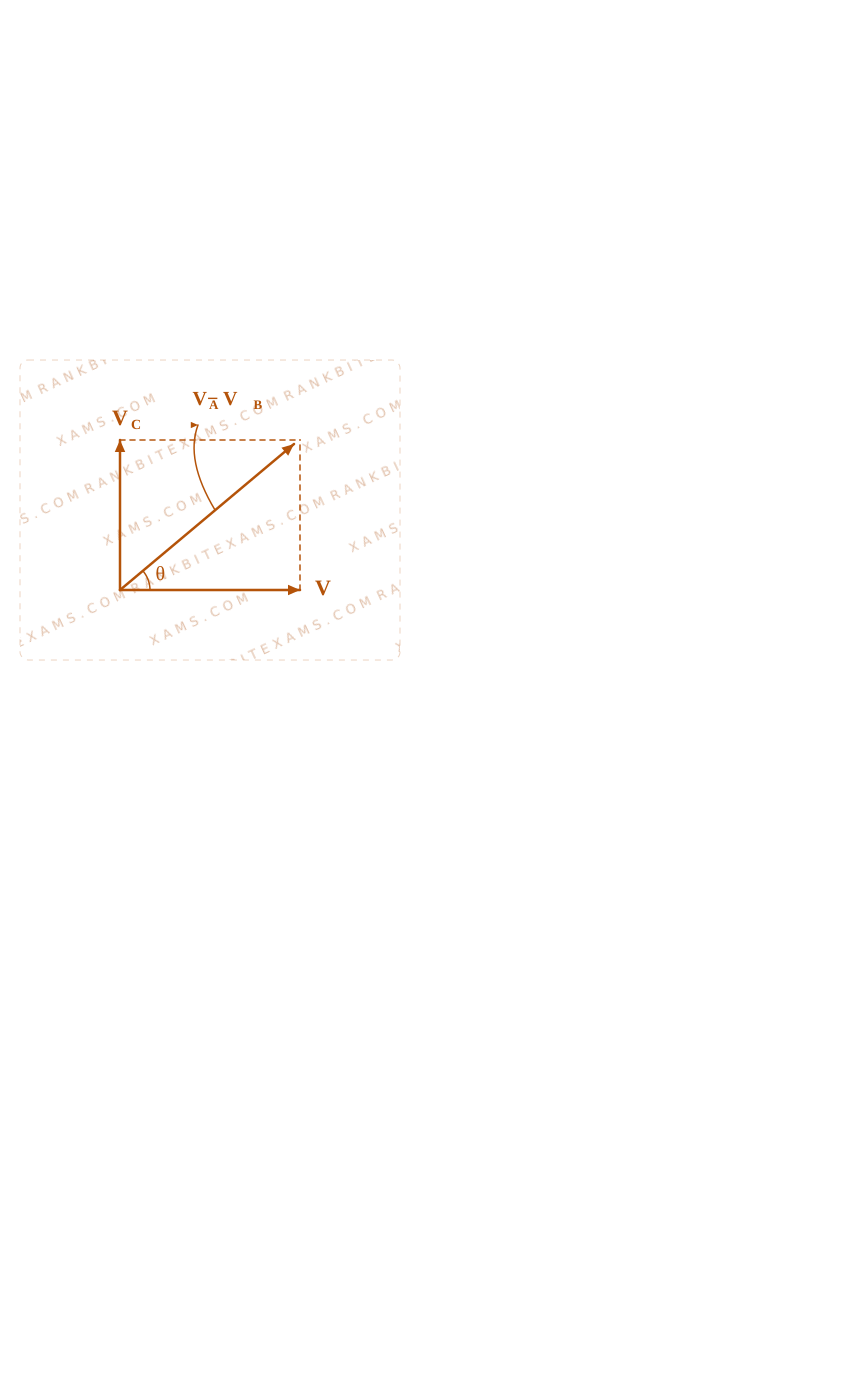
If the phase difference between Vᵢₙ$V_{\text{in}}$ and (VB - VA)$(V_B - V_A)$ is 90^°$90^\circ$:
An AC bridge circuit with input voltage connected across symmetrically crossed pairs of 100 kOhm resistors and 100 pF capacitors.An AC bridge circuit with input voltage connected across symmetrically crossed pairs of 100 kOhm resistors and 100 pF capacitors.
From the phasor representation of the symmetric RC divider bridge:
The phase angle of VA$V_A$ is θ$\theta$ behind the input voltage.
The phase angle of VB$V_B$ is 90^° - θ$90^\circ - \theta$ ahead of the input.
If their combined relative phase difference is 90^°$90^\circ$, this symmetry dictates:
An AC bridge circuit with input voltage connected across symmetrically crossed pairs of 100 kOhm resistors and 100 pF capacitors.An AC bridge circuit with input voltage connected across symmetrically crossed pairs of 100 kOhm resistors and 100 pF capacitors.
Since ω = 10^x$\omega = 10^x$, we get x = 5$x = 5$.
Pattern Recognition
Sees: Phase shift of 90^°$90^\circ$ across a symmetric RC bridge.
Shortcut: Clamping phase shift at 90^°$90^\circ$ implies the reactive impedance equals the resistive impedance (XC = R$X_C = R$). The frequency is simply the characteristic time constant frequency ω = 1/τ = 1/(RC)$\omega = 1/\tau = 1/(RC)$.
Orthogonal sine and cosine functions are independent. Their mean squared averages add linearly, so you can think of it as a vector addition: (IA²)/(2) + (IB²)/(2)$\frac{I_A^2}{2} + \frac{I_B^2}{2}$ under the square root.
Chapter Mix
Class 12 Physics: Alternating Current
Qjee_main_2025_29_jan_morningChoke Coil and AC Circuits
Given below are two statements : one is labelled as Assertion (A) and the other is labelled as Reason (R).
Assertion (A): Choke coil is simply a coil having a large inductance but a small resistance. Choke coils are used with fluorescent mercury-tube fittings. If household electric power is directly connected to a mercury tube, the tube will be damaged.
Reason (R): By using the choke coil, the voltage across the tube is reduced by a factor (R / R² + ω²L²)$\left(\mathrm{R} / \sqrt{\mathrm{R}^2 + \omega^2\mathrm{L}^2}\right)$ , where ω$\omega$ is frequency of the supply across resistor R and inductor L. If the choke coil were not used, the voltage across the resistor would be the same as the applied voltage.
In the light of the above statements, choose the most appropriate answer from the options given below:
A.Both (A) and (R) are true but (R) is not the correct explanation of (A).$\text{Both (A) and (R) are true but (R) is not the correct explanation of (A).}$
B.(A) is false but (R) is true.$\text{(A) is false but (R) is true.}$
C.Both (A) and (R) are true and (R) is the correct explanation of (A).$\text{Both (A) and (R) are true and (R) is the correct explanation of (A).}$
D.(A) is true but (R) is false.$\text{(A) is true but (R) is false.}$
A choke coil has a high inductance L$L$ and low resistance R$R$. It reduces the current through the mercury tube without wasting electrical power as heat. Statement (A) is correct. The average power dissipation is controlled by the low power factor φ$\cos \phi$. Reason (R) correctly explains that without a choke coil, the direct supply voltage could cause an overflow of current, destroying the tube filament.
Pattern Recognition
Choke coils use high L$L$ and low R$R$ to minimize power loss while reducing circuit current efficiently.
Chapter Mix
Class 12 Physics: Alternating Current
Q43jee_main_2024_01_february_morningLCR Resonance
In a series LCR circuit, the capacitance is changed from C$C$ to 4C$4C$. To keep the resonance frequency unchanged, the new inductance should be:
L'(4C) = LC L' = (L)/(4)$$L'(4C) = LC \implies L' = \frac{L}{4}$$
Step 1: Calculate the Change Needed
The question asks for the reduction increment or statement matching the dynamic shift:
Δ L = L - L' = L - (L)/(4) = (3)/(4)L$$\Delta L = L - L' = L - \frac{L}{4} = \frac{3}{4}L$$
Therefore, the inductance must be reduced by (3)/(4)L$\frac{3}{4}L$.
Pattern Recognition
Read options carefully. The new value is (1)/(4)L$\frac{1}{4}L$, which means it must be reduced by(3)/(4)L$\frac{3}{4}L$.
Chapter Mix
Class 12 Physics: Alternating Current
Q34jee_main_2024_29_january_eveningPower in AC Circuits
In an a.c. circuit, voltage and current are given by:
V = 100 (100t) V$$V = 100\sin(100t)\text{ V}$$
and
I = 100 (100t + (π)/(3)) mA$$I = 100\sin\left(100t + \frac{\pi}{3}\right)\text{ mA}$$
respectively. The average power dissipated in one cycle is:
Remember to look closely at units! The current is given in mA (10⁻³ A$10^{-3}\text{ A}$). Missing this conversion leads directly to the trap answer (2500 W$2500\text{ W}$ or similar scaling errors).
Chapter Mix
Class 12 Physics: Alternating Current
Q48jee_main_2024_29_jan_morningLC Oscillations
A capacitor of capacitance 100 μ F$100 \, \mu \mathrm{F}$ is charged to a potential of 12 ~V$12 \mathrm{~V}$ and connected to a 6.4 ~mH$6.4 \mathrm{~mH}$ inductor to produce oscillations. The maximum current in the circuit would be:
A. 3.2 A
B. 1.5 A
C. 2.0 A
D. 1.2 A
Solution
Related Formula
By conservation of energy in an ideal LC$LC$ oscillating circuit, the maximum electrostatic energy stored in the capacitor equals the maximum magnetic energy stored in the inductor:
(1)/(2) C V² = (1)/(2) L I²$$\frac{1}{2} C V^2 = \frac{1}{2} L I_{\max}^2$$
Core Logic
Rearranging the energy equation to express maximum current:
I = V √((C)/(L))$$I_{\max} = V \sqrt{\frac{C}{L}}$$
This problem represents basic harmonic energy transfer between potential states. You can also derive this via peak relations: I = q₀ ω = (C V) 1√(L C) = V √((C)/(L))$I_{\max} = q_0 \omega = (C V) \frac{1}{\sqrt{L C}} = V \sqrt{\frac{C}{L}}$, which bypasses square root conversion hazards if performed methodically.
Chapter Mix
Class 12 Physics: Alternating Current
More Alternating Current Questions — jee_main_2025_07_april_morning
Practice past-year questions one chapter at a time. Pick an exam → subject → chapter and get every PYQ for that topic — pulled together from all past papers — with the chapter's key formulas alongside.