Q
jee_main_2025_02_april_morning
Maxima and Minima
If the function f(x) = 2x³ - 9ax² + 12a²x + 1, where a > 0, attains its local maximum and local minimum values at p and q, respectively, such that p² = q, then f(3) is equal to:
Solution
Related Formula
For local extrema of a differentiable function, set the first derivative to zero:
f'(x) = 0
Core Logic
Differentiate f(x) to obtain its critical points p and q in terms of a, use the constraint p² = q to fix a, and evaluate f(3).
Step 1: Differentiate and Find Critical Points
f'(x) = 6x² - 18ax + 12a²
Set
Set $f'(x) = 0:
6(x² - 3ax + 2a²) = 0 6(x-a)(x-2a) = 0The critical points are
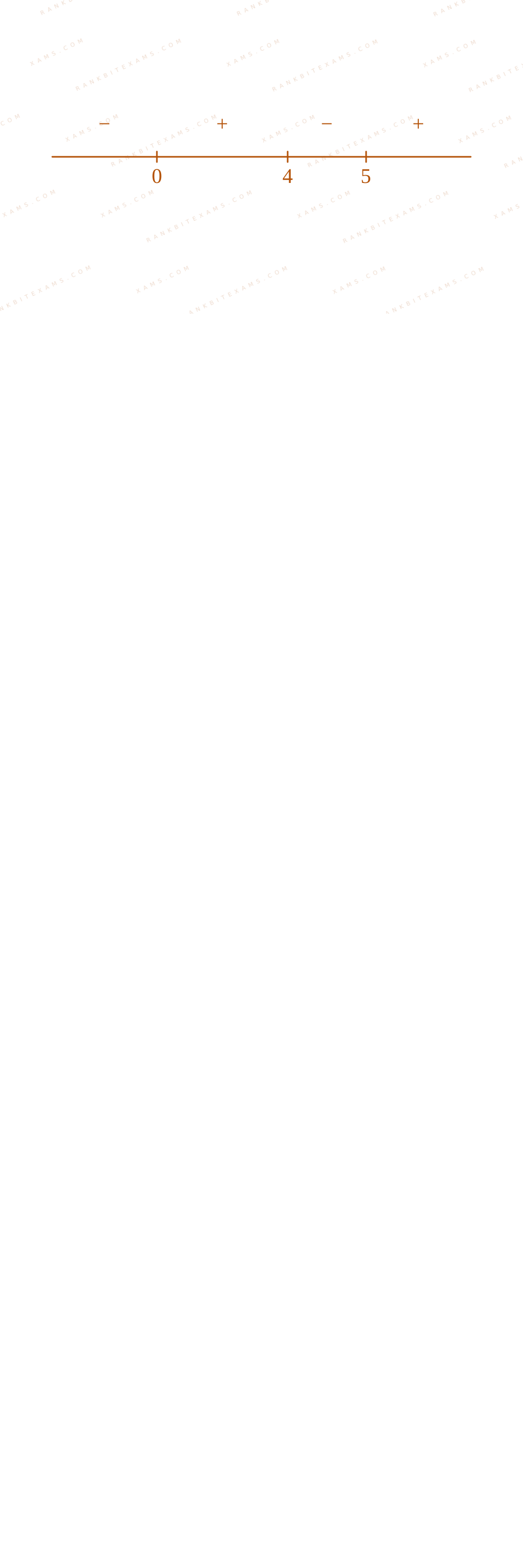
x = aandx = 2a. Sincea > 0, checking the sign change off'(x)shows that the local maximum occurs at the smaller root (p = a) and the local minimum at the larger root (q = 2a).Step 2: Apply Root Constraint
Given
p^2 = q:a² = 2a a(a-2) = 0Since
a > 0, we geta = 2.Step 3: Evaluate function at x = 3
Substitute
a = 2back into the definition off(x):f(x) = 2x³ - 18x² + 48x + 1Now compute
f(3):f(3) = 2(3)³ - 18(3)² + 48(3) + 1 = 54 - 162 + 144 + 1 = 37Pattern Recognition
For cubic equations with two distinct real critical roots, the smaller root is always the local maximum if the leading coefficient is positive (
2 > 0). This ensuresp=aandq=2a$ immediately without relying on secondary derivative checks.Chapter Mix
Class 12 Mathematics: Application of Derivatives