Consider the following three statements for the function f: (0, infty) to mathbbR defined by f(x) = |log_e x| - |x - 1|: (I) f is differentiable at all x > 0. (II) f is increasing in (0, 1). (III) f is decreasing in (1, infty). Then.

Solution & Explanation

### Related Formula textFor x geq 1, quad ln x geq 0 text and x-1 geq 0 textFor 0 < x < 1, quad ln x < 0 text and x-1 < 0 ### Core Logic Break the function into piecewise intervals based on the critical point x=1. f(x) = begincases ln x - (x - 1) & x geq 1 \\ -ln x - (-(x - 1)) & 0 < x < 1 endcases f(x) = begincases ln x - x + 1 & x geq 1 \\ -ln x + x - 1 & 0 < x < 1 endcases ### Step 1: Checking Differentiability (Statement I) Find the derivative f'(x): f'(x) = begincases frac1x - 1 & x > 1 \\ -frac1x + 1 & 0 < x < 1 endcases Check left-hand derivative (LHD) and right-hand derivative (RHD) at x = 1: textRHD = f'(1^+) = frac11 - 1 = 0 textLHD = f'(1^-) = -frac11 + 1 = 0 Since textLHD = textRHD, f(x) is differentiable at x=1 (and clearly everywhere else in its domain). Thus, Statement (I) is TRUE. ### Step 2: Checking Monotonicity (Statements II and III) Check for x > 1: f'(x) = frac1x - 1 < 0 text for all x > 1. Therefore, f is decreasing in (1, infty). Statement (III) is TRUE. Check for 0 < x < 1: f'(x) = 1 - frac1x = fracx-1x < 0 text for all 0 < x < 1. Therefore, f is also decreasing in (0, 1). Statement (II) is FALSE. Since f is decreasing in both intervals, it is monotonically decreasing across (0, infty). ### Step 3: Final Conclusion Only Statement (I) and Statement (III) are true. ### Pattern Recognition Adding or subtracting two modulus functions that change sign at the exact same critical point often smooths out the sharp corner, leading to a perfectly differentiable curve at that node. Always compute LHD and RHD to confirm. ### Evaluation Rubric / Model Answer null ### Chapter Mix Class 12 Maths: Application of Derivatives Class 12 Maths: Limits, Continuity and Differentiability
Reference Study Guides

More Application of Derivatives Previous-Year Questions

Q2 jee_main_2026_21_jan_evening Monotonicity
Let f : R rightarrow R be a twice differentiable function such that f''(x) > 0 for all x in R and f'(a-1) = 0, where a is a real number. Let g(x) = f(tan^2 x - 2tan x + a), 0 < x < fracpi2. Consider the following two statements: (I) g is increasing in left(0, fracpi4right) (II) g is decreasing in left(fracpi4, fracpi2right) Then,
  • A. textNeither (I) nor (II) is True
  • B. textOnly (II) is True
  • C. textOnly (I) is True
  • D. textBoth (I) and (II) are True

Solution

### Related Formula g'(x) = f'(h(x)) cdot h'(x) For monotonicity, g'(x) > 0 implies increasing, and g'(x) < 0 implies decreasing. ### Core Logic Given g(x) = f((tan x - 1)^2 + a - 1). Differentiating w.r.t. x: g'(x) = f'((tan x - 1)^2 + a - 1) cdot 2(tan x - 1)sec^2 x ### Step 1: Analyze the Sign of the Derivative We know f''(x) > 0 implies f'(x) is strictly increasing. Since f'(a-1) = 0, for any input X > a-1, f'(X) > 0. Here, the input to f' is (tan x - 1)^2 + a - 1. Since (tan x - 1)^2 geq 0, it is strictly positive for x neq fracpi4 in the given interval. Thus, (tan x - 1)^2 + a - 1 geq a - 1 implies f'((tan x - 1)^2 + a - 1) > 0 for all valid x. ### Step 2: Determine Intervals of Monotonicity Now, the sign of g'(x) depends solely on the term (tan x - 1) because 2sec^2 x > 0. Case 1: x in left(0, fracpi4right) Here tan x < 1 implies tan x - 1 < 0. So, g'(x) < 0 implies g(x) is decreasing. Case 2: x in left(fracpi4, fracpi2right) Here tan x > 1 implies tan x - 1 > 0. So, g'(x) > 0 implies g(x) is increasing. Therefore, neither statement (I) nor (II) is true. ### Pattern Recognition When a function wraps a quadratic, f((u-k)^2 + c), the critical points match the inner function's extrema. Evaluate the sign directly from the inner derivative u' and (u-k). ### Evaluation Rubric / Model Answer null ### Chapter Mix Class 12 Maths: Application of Derivatives

Q5 jee_main_2026_22_january_morning Maxima and Minima
Let f(x) = x^2025 - x^2000, x in [0,1] and the minimum value of the function f(x) in the interval [0,1] be (80)^80(n)^-81. Then n is equal to
  • A. -81
  • B. -40
  • C. -41
  • D. -80

Solution

### Related Formula f'(x) = 0 text gives the critical points for extreme values. ### Core Logic Given f(x) = x^2025 - x^2000 on x in [0,1]. Differentiate to find critical points: f'(x) = 2025 x^2024 - 2000 x^1999 = 0 x^1999(2025x^25 - 2000) = 0 ### Step 1: Identifying the Minima The critical points are x = 0 and x = left(frac20002025right)^frac125 = left(frac8081right)^frac125. Let this root be alpha. Evaluating the function at endpoints and the critical point: - f(0) = 0 - f(1) = 1 - 1 = 0 - f(alpha) = alpha^2025 - alpha^2000 = alpha^2000(alpha^25 - 1) Substitute alpha^25 = frac8081: f(alpha) = left(left(frac8081right)^frac125right)^2000 cdot left(frac8081 - 1right) f(alpha) = left(frac8081right)^80 cdot left(-frac181right) ### Step 2: Structuring into the Given Format f(alpha) = frac80^8081^80 cdot (-81)^-1 = 80^80 cdot (-81)^-81 Comparing this with (80)^80(n)^-81, we immediately get n = -81. ### Pattern Recognition When evaluating exponents in the form x^A - x^B, the stationary point occurs at x = (B/A)^1/(A-B). Plugging this back into the original function seamlessly factors out (B/A)^B cdot (B/A - 1). ### Evaluation Rubric / Model Answer null ### Chapter Mix Class 12 Maths: Applications of Derivatives
Q24 jee_main_2026_24_january_morning Maxima and Minima
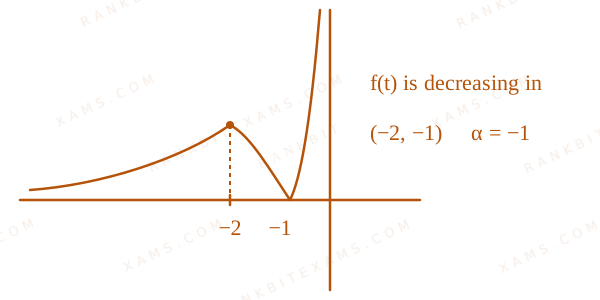
Let (2alpha, alpha) be the largest interval in which the function f(t) = frac|t + 1|t^2, t < 0, is strictly decreasing. Then the local maximum value of the function g(x) = 2 log_e(x - 2) + alpha x^2 + 4x - alpha, x > 2, is
Numerical Answer. Answer: 4 to 4

Solution

### Related Formula f'(x) < 0 text for strictly decreasing function g'(x) = 0 text to find critical points for extrema ### Core Logic For f(t) = frac|t + 1|t^2, graph evaluation reveals decreasing behavior.
Decreasing function curve tracking
For t in (-2, -1), the function is decreasing. Thus, the interval is (-2, -1). Given the interval is (2alpha, alpha), this implies 2alpha = -2 Rightarrow alpha = -1. ### Step 1: Finding function g(x) g(x) = 2 log_e(x - 2) - x^2 + 4x + 1 quad (x > 2) g'(x) = frac2x - 2 - 2x + 4 g'(x) = frac2 - 2x(x - 2) + 4(x - 2)x - 2 g'(x) = frac2 - 2x^2 + 4x + 4x - 8x - 2 = frac-2x^2 + 8x - 6x - 2 g'(x) = frac-2(x^2 - 4x + 3)x - 2 = frac-2(x - 3)(x - 1)x - 2 ### Step 2: Determining Maxima For x > 2, critical point is x = 3. Testing signs around x = 3: For 2 < x < 3, g'(x) > 0 (Increasing) For x > 3, g'(x) < 0 (Decreasing) Maxima occurs at x = 3. ### Step 3: Calculating Local Maximum Value g(3) = 2 log_e(3 - 2) - (3)^2 + 4(3) + 1 g(3) = 2 log_e(1) - 9 + 12 + 1 g(3) = 0 + 4 = 4 ### Pattern Recognition Connecting nested parameter values (alpha) between independent functions ( f(t) and g(x)) demands extreme care on interval boundaries. Derivative sign analysis effortlessly identifies maximums on restricted domains. ### Evaluation Rubric / Model Answer null ### Chapter Mix Class 12 Maths: Application of Derivatives
Q jee_main_2025_02_april_morning Maxima and Minima
If the function f(x) = 2x^3 - 9ax^2 + 12a^2x + 1, where a > 0, attains its local maximum and local minimum values at p and q, respectively, such that p^2 = q, then f(3) is equal to:
  • A. 55
  • B. 10
  • C. 23
  • D. 37

Solution

### Related Formula For local extrema of a differentiable function, set the first derivative to zero: f'(x) = 0 ### Core Logic Differentiate f(x) to obtain its critical points p and q in terms of a, use the constraint p^2 = q to fix a, and evaluate f(3). ### Step 1: Differentiate and Find Critical Points f'(x) = 6x^2 - 18ax + 12a^2 Set f'(x) = 0: 6(x^2 - 3ax + 2a^2) = 0 implies 6(x-a)(x-2a) = 0 The critical points are x = a and x = 2a. Since a > 0, checking the sign change of f'(x) shows that the local maximum occurs at the smaller root (p = a) and the local minimum at the larger root (q = 2a). ### Step 2: Apply Root Constraint Given p^2 = q: a^2 = 2a implies a(a-2) = 0 Since a > 0, we get a = 2. ### Step 3: Evaluate function at x = 3 Substitute a = 2 back into the definition of f(x): f(x) = 2x^3 - 18x^2 + 48x + 1 Now compute f(3): f(3) = 2(3)^3 - 18(3)^2 + 48(3) + 1 = 54 - 162 + 144 + 1 = 37 ### Pattern Recognition For cubic equations with two distinct real critical roots, the smaller root is always the local maximum if the leading coefficient is positive (2 > 0). This ensures p=a and q=2a$ immediately without relying on secondary derivative checks. ### Evaluation Rubric / Model Answer null ### Chapter Mix Class 12 Mathematics: Application of Derivatives

More Application of Derivatives Questions — jee_main_2026_24_january_evening

Practice all Application of Derivatives previous-year questions →

Rankbit System
JEE Physics: Waves (+15.5%) | Electrostatics: Concentric Shells (-29.7%) | Modern Physics: Photoelectric Clones (+34.2%) | Mathematics: Definite Integrals (+18.1%) | Chemistry: Coordination Splitting (-11.4%) | JEE Physics: Waves (+15.5%) | Electrostatics: Concentric Shells (-29.7%) | Modern Physics: Photoelectric Clones (+34.2%) | Mathematics: Definite Integrals (+18.1%) | Chemistry: Coordination Splitting (-11.4%)