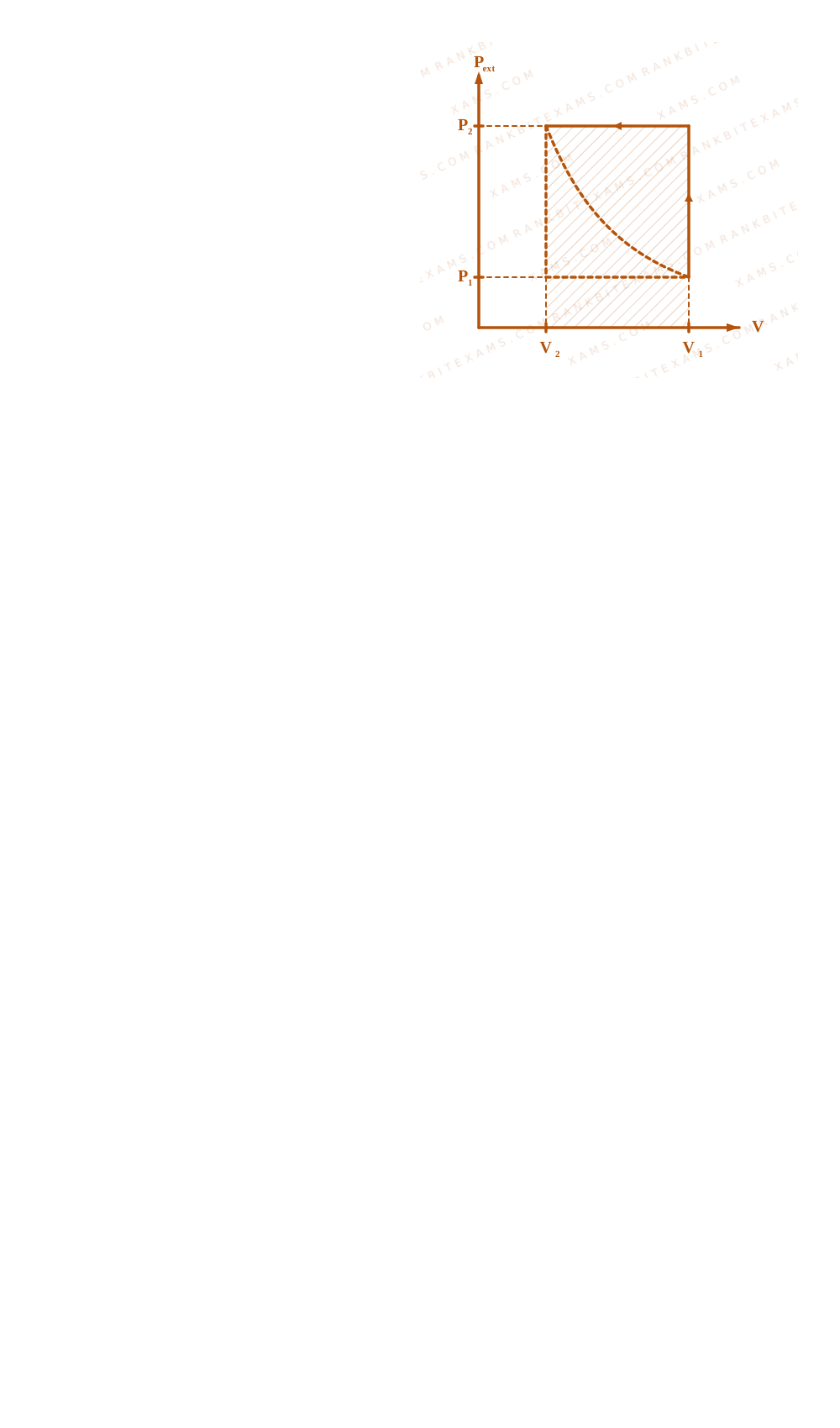
Total enthalpy change for freezing of 1 ~mol of water at 10° C to ice at -10° C is (Given: ΔfusH = x kJ/mol, Cₚ[H₂O( )] = y J mol⁻¹ K⁻¹, Cₚ[H₂O(s)] = z J mol⁻¹ K⁻¹)

Solution & Explanation

Related Formula
Δ Htotal = n Cp( ) Δ T₁ - nΔ Hfusion + n Cp(s) Δ T₂
Core Logic

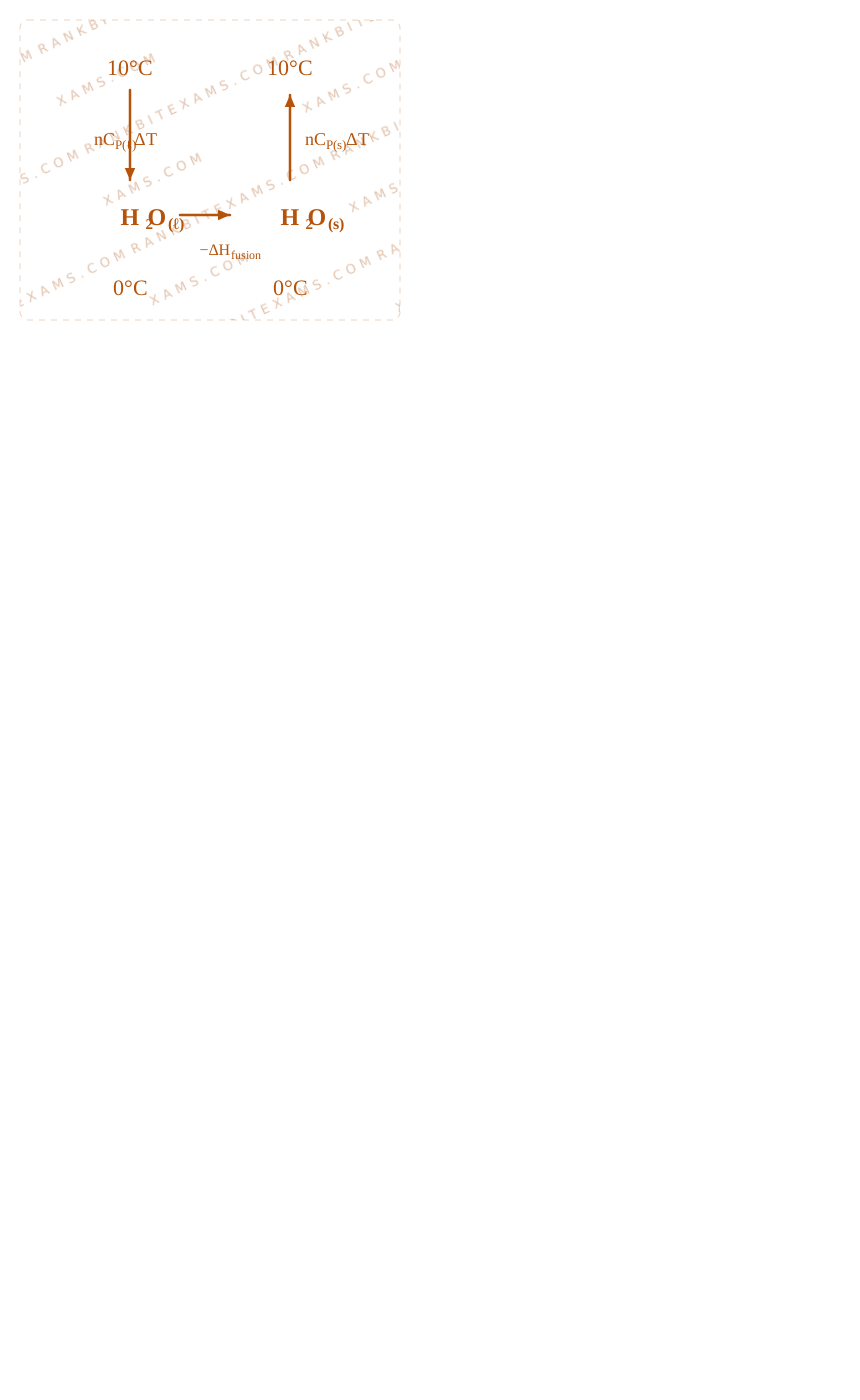
We need to compute the enthalpy change for the pathway:

H₂O( , 10°C) arrow H₂O(s, -10°C)

This can be divided into three consecutive steps:

  • Cool liquid water from 10°C to 0°C:
Δ H₁ = n · Cₚ[H₂O( )] · (0 - 10) = 1 · y · (-10) = -10y J
  • Freeze water to ice at 0°C:
Δ H₂ = -n · ΔfusH = -1 · x kJ = -1000x J
  • Cool ice from 0°C to -10°C:
Δ H₃ = n · Cₚ[H₂O(s)] · (-10 - 0) = 1 · z · (-10) = -10z J

Thermodynamics enthalpy cycle for freezing Q29

Adding these three steps yields:

Δ Htotal = -10y - 1000x - 10z = -10(100x + y + z) Joule
Pattern Recognition

Freezing is an exothermic process, so all three steps (cooling water, freezing, and cooling ice) must carry a negative sign. Factoring out -10 cleanly yields the expression -10(100x+y+z).

Chapter Mix

Class 11 Chemistry: Chemical Thermodynamics

Reference Study Guides

More Chemical Thermodynamics Previous-Year Questions — Page 3

Q51 jee_main_2026_28_january_morning Isothermal Reversible Expansion
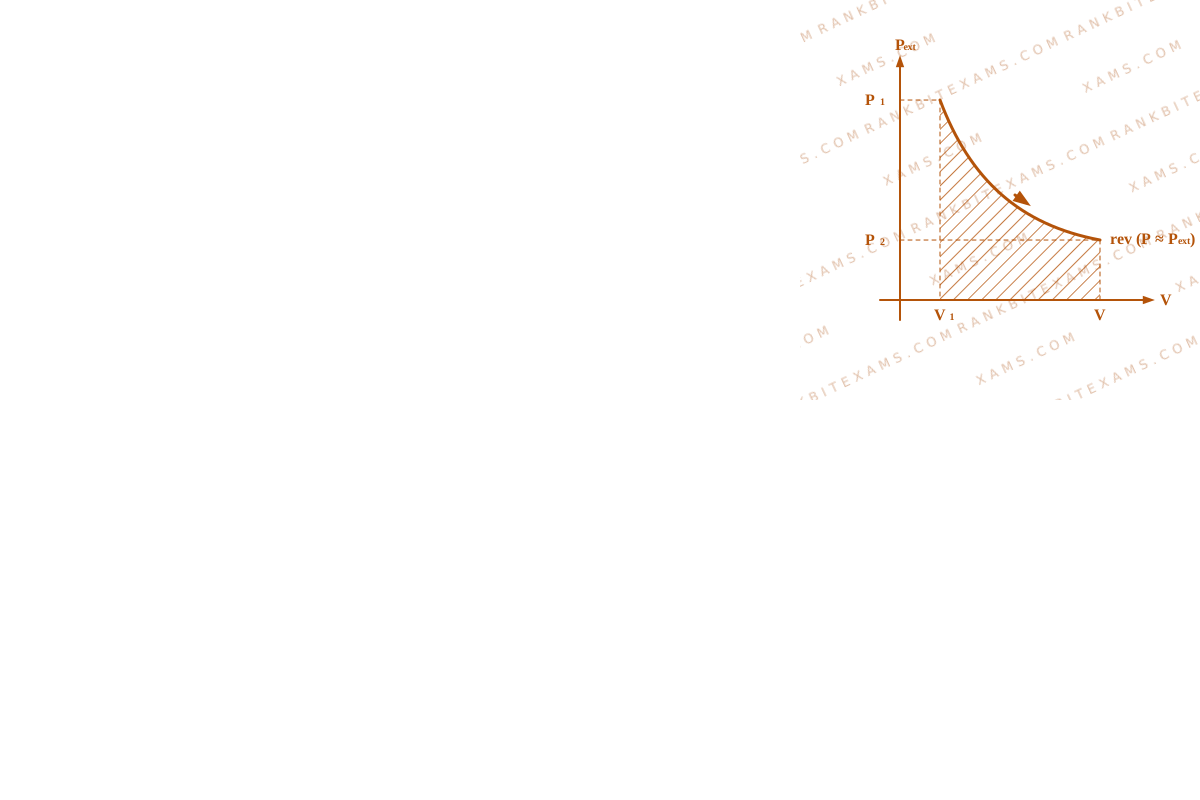
20.0~dm³ of an ideal gas 'X' at 600~K and 0.5~MPa undergoes isothermal reversible expansion until pressure of the gas is 0.2~MPa. Which of the following option is correct? (Given: ~2=0.3010 and ~5=0.6989)
  • A. w=-9.1~kJ, Δ U=0, Δ H=0, q=9.1~kJ
  • B. w=9.1~J, Δ U=9.1~J, Δ H=0, q=0
  • C. w=+4.1~kJ, Δ U=0, Δ H=0, q=-4.1~kJ
  • D. w=-3.9~kJ, Δ U=0, Δ H=0, q=3.9~kJ

Solution

Related Formula
wᵢₛₒ = -nRT ln((P₁)/(P₂)) = -P₁ V₁ ln((P₁)/(P₂)) \n Δ U = 0 and Δ H = 0 (For isothermal process)
Core Logic

For an isothermal reversible process involving an ideal gas, the change in internal energy (Δ U) and change in enthalpy (Δ H) are zero. By First Law of Thermodynamics, q = -w.

Step 1: Calculate Work Done
wᵢₛₒ = -0.5 × 10⁶ × 20 × 10⁻³ ln((0.5)/(0.2))\nwᵢₛₒ = -10⁴ × 2.303 × ( 5 - 2)\nwᵢₛₒ = -10⁴ × 2.303 × (0.6989 - 0.3010)\nwᵢₛₒ = -10⁴ × 2.303 × 0.3979\nw ≈ -9163 ~J = -9.1 ~kJ
Step 2: Calculate Heat

q = -w = -(-9.1 ~kJ) = 9.1 ~kJ

Pattern Recognition

Isothermal expansion of an ideal gas always yields w < 0, q > 0, and Δ U = Δ H = 0. Matching signs instantly eliminates non-conforming options.

Chapter Mix

Class 11 Chemistry: Thermodynamics
Q55 jee_main_2026_28_january_evening Vant Hoff Equation
The plot of ₁₀K vs (1)/(T) gives a straight line. The intercept and slope respectively are (where K is equilibrium constant).
  • A. (1) 2.303RΔ H° , 2.303RΔ S°
  • B. (2) Δ S°2.303R , - Δ H°2.303R
  • C. (3) - Δ S°R2.303 , Δ H°R2.303
  • D. (4) - Δ H°2.303R , Δ S°2.303R

Solution

Related Formula
Δ G° = -2.303 RT ₁₀K Δ G° = Δ H° - TΔ S°
Core Logic

Equating both forms for Δ G°:

-2.303 RT ₁₀K = Δ H° - TΔ S°

Divide entirely by -2.303 RT:

₁₀K = - Δ H°2.303RT + Δ S°2.303R

Comparing this with equation of straight line y = mx + c where y = ₁₀K and x = (1)/(T): Slope (m) = - Δ H°2.303R Intercept (c) = Δ S°2.303R

Step 1: Final Conclusion

The intercept is Δ S°2.303R and the slope is - Δ H°2.303R.

Pattern Recognition

Standard Van't Hoff thermodynamic plot derivation. Always remember to carry the negative sign from Δ G to the Enthalpy term.

Chapter Mix

Class 11 Chemistry: Thermodynamics Class 11 Chemistry: Equilibrium
Q38 jee_main_2025_02_april_evening Thermodynamic Work and Reversible Processes
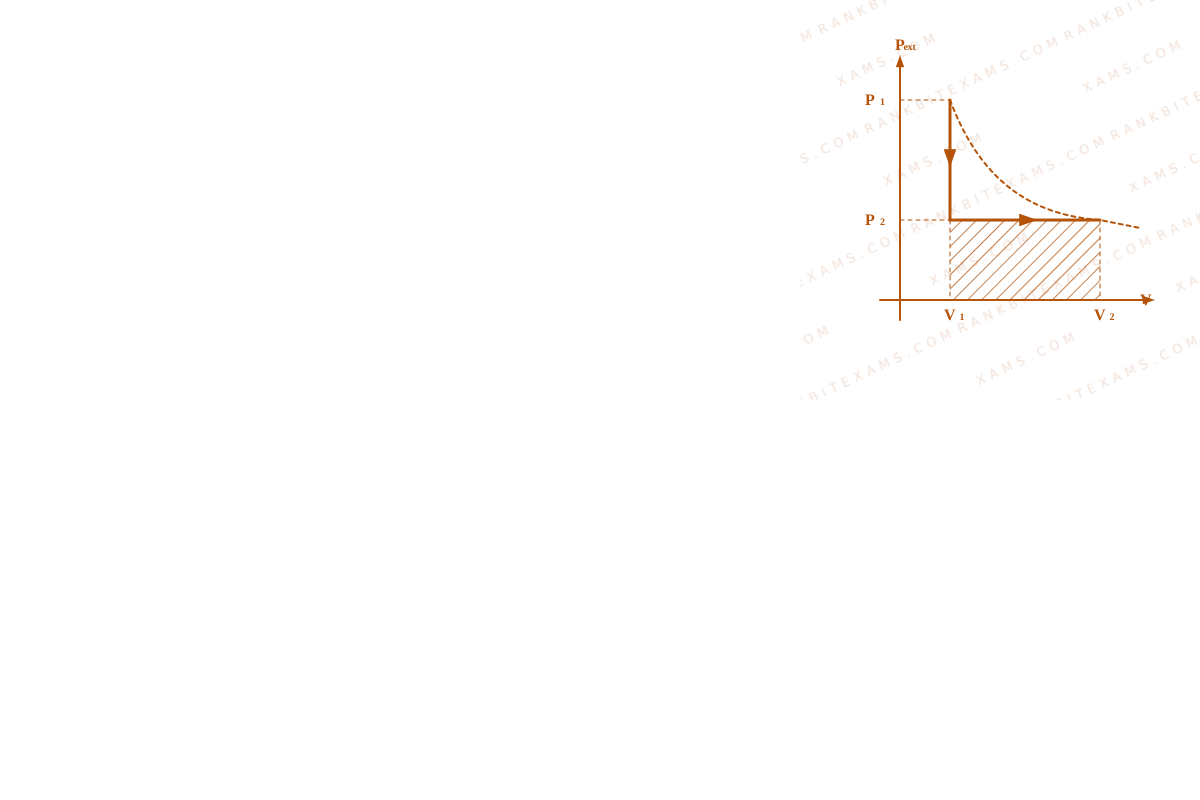
Arrange the following in order of magnitude of work done by the system / on the system at constant temperature : (a) |wreversible| for expansion in infinite stage. (b) |wirreversible| for expansion in single stage. (c) |wreversible| for compression in infinite stage. (d) |wirreversible| for compression in single stage. Choose the correct answer from the options given below:
  • A. a > b > c > d
  • B. d > c = a > b
  • C. c = a > d > b
  • D. a > c > b > d

Solution

Related Formula
wrev = -nRT ln( VfVᵢ) wirrev = -Pₑₓₜ (Vf - Vᵢ)
Core Logic

For isothermal reversible and irreversible steps:

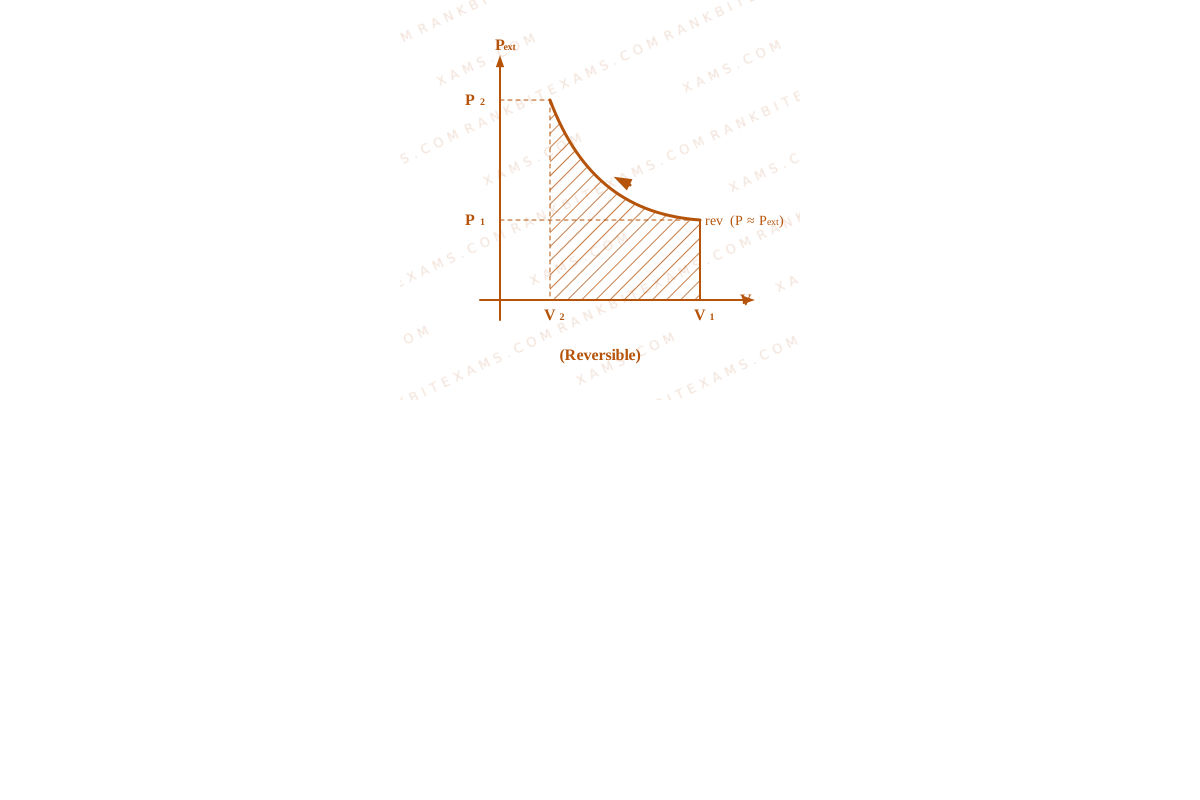
  • Reversible Path: Since a reversible compression path retraces the exact coordinates of the reversible expansion path, the magnitudes of work are equal:
|wrev, expansion| = |wrev, compression| a = c

P-V indicator diagrams comparing reversible and irreversible expansion/compression

  • Isothermal Expansion: Reversible work magnitude is the maximum possible work. Hence, for expansion:
|wrev, expansion| > |wirrev, expansion| a > b

P-V indicator diagrams comparing reversible and irreversible expansion/compression

  • Isothermal Compression: Irreversible compression requires more work than reversible compression because of sudden pressure adjustments against the surroundings:
|wirrev, compression| > |wrev, compression| d > c

P-V indicator diagrams comparing reversible and irreversible expansion/compression

Step 1: Combine the inequalities

Combining the results:

  • We have a = c
  • We have d > c
  • We have a > b
  • This leads to the strict inequality sequence:

    d > c = a > b

Pattern Recognition

Thermodynamics Principle: Reversible expansion is the most efficient (gives maximum work magnitude), whereas reversible compression is the most efficient (requires minimum work magnitude). Single-stage irreversible compression is always the least efficient, demanding the absolute highest work input.

Chapter Mix

Class 11 Chemistry: Chemical Thermodynamics

Q jee_main_2025_02_april_morning Ideal Gas Free Expansion
Two vessels A and B are connected via stopcock. The vessel A is filled with a gas at a certain pressure. The entire assembly is immersed in water and is allowed to come to thermal equilibrium with water. After opening the stopcock the gas from vessel A expands into vessel B and no change in temperature is observed in the thermometer. Which of the following statement is true?
Ideal Gas Free Expansion experimental setup diagram for Q31
The diagram displays a water bath calorimeter surrounding two interconnected glass flasks via a valve setup to demonstrate thermal expansion behavior.
  • A. (1) dw ≠ 0
  • B. (2) dq ≠ 0
  • C. (3) dU ≠ 0
  • D. (4) The pressure in the vessel B before opening the stopcock is zero.

Solution

Related Formula

First Law of Thermodynamics expression:

dU = dq + dw
Core Logic

The system parameters show an isothermal transformation layout with zero overall heat transfer step:

  • No change in temperature signifies dT = 0, hence internal energy change for an ideal gas satisfies:
dU = nCvdT = 0
  • Since it expands freely into an empty chamber (vessel B), external pressure Pₑₓₜ = 0, meaning work done is:
dw = -PₑₓₜdV = 0
  • Combining these parameters in the First Law gives dq = 0.
  • This classic situation of "free expansion" implies vessel B was completely evacuated initially.
Step 1: Statement Verification

Therefore, the pressure inside vessel B before opening the stopcock was precisely zero.

Pattern Recognition

Isothermal + expansion against no opposing force = Free Expansion. For free expansion of an ideal gas, always remember: w = 0, q = 0, and Δ U = 0 simultaneously.

Chapter Mix

Class 11 Chemistry: Chemical Thermodynamics

Q41 jee_main_2025_03_april_evening Latent Heat and Phase Equilibrium
Given below are two statements: Statement I: When a system containing ice in equilibrium with water (liquid) is heated, heat is absorbed by the system and there is no change in the temperature of the system until whole ice gets melted. Statement II: At melting point of ice, there is absorption of heat in order to overcome intermolecular forces of attraction within the molecules of water in ice and kinetic energy of molecules is not increased at melting point. In the light of the above statements, choose the correct answer from the options given below:
  • A. Statement I is true but Statement II is false
  • B. Both Statement I and Statement II are false
  • C. Both Statement I and Statement II are true
  • D. Statement I is false but Statement II is true

Solution

Related Formula

During phase transition, latent heat of fusion (Lf) is absorbed:

Q = m Lf

Temperature remains constant because the average kinetic energy of the molecules does not change; instead, potential energy changes during phase transition:

Temperature T ∝ Average Kinetic Energy of molecules
Core Logic

Statement I Analysis:

  • During a phase transition (such as ice melting at 0°C), any added heat is utilized as latent heat of fusion. The system remains at a constant temperature of 0°C as long as both solid and liquid phases coexist in equilibrium. Thus, Statement I is True.
Step 1: Analyze Statement II
  • Statement II explains why this happens: The thermal energy is spent entirely to break down the highly ordered crystalline hydrogen-bonded lattice of ice into liquid water. It does not increase the translational kinetic energy of the molecules. Since kinetic energy is constant, temperature remains constant. Thus, Statement II is True.
Step 2: Conclusion

Therefore, both Statement I and Statement II are True, matching Option (3).

Pattern Recognition

For any phase transition (melting, boiling, sublimation): Temperature stays flat. The added energy goes entirely into latent heat (potential energy change to overcome intermolecular forces), meaning average kinetic energy is constant.

Chapter Mix

Class 11 Chemistry: Thermodynamics Class 11 Physics: Thermal Properties of Matter
More Chemical Thermodynamics Questions — jee_main_2025_07_april_morning

Practice all Chemical Thermodynamics previous-year questions →

Rankbit System
JEE Physics: Waves (+15.5%) | Electrostatics: Concentric Shells (-29.7%) | Modern Physics: Photoelectric Clones (+34.2%) | Mathematics: Definite Integrals (+18.1%) | Chemistry: Coordination Splitting (-11.4%) | JEE Physics: Waves (+15.5%) | Electrostatics: Concentric Shells (-29.7%) | Modern Physics: Photoelectric Clones (+34.2%) | Mathematics: Definite Integrals (+18.1%) | Chemistry: Coordination Splitting (-11.4%)