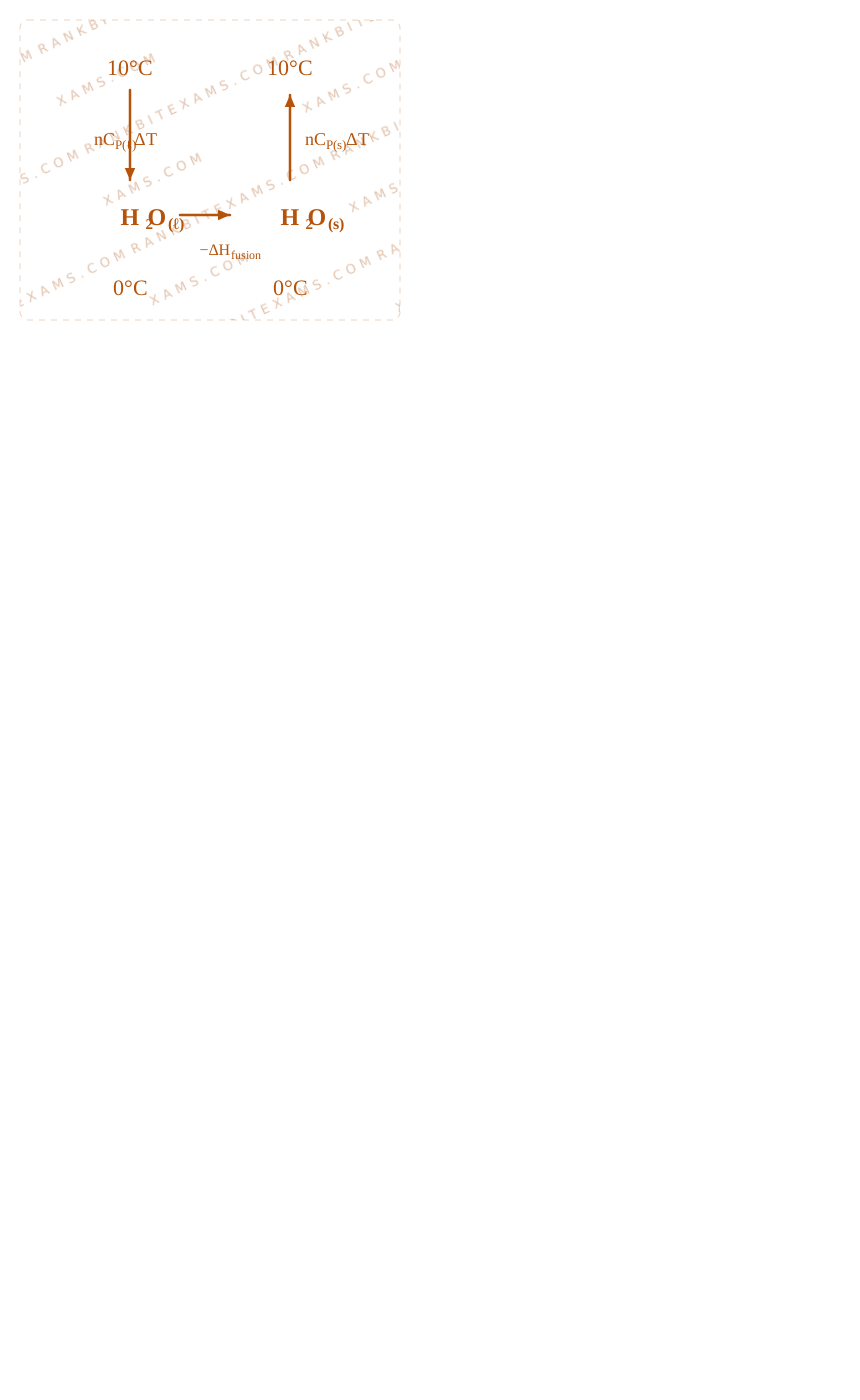
Total enthalpy change for freezing of 1 ~mol of water at 10° C to ice at -10° C is (Given: ΔfusH = x kJ/mol, Cₚ[H₂O( )] = y J mol⁻¹ K⁻¹, Cₚ[H₂O(s)] = z J mol⁻¹ K⁻¹)

Solution & Explanation

Related Formula
Δ Htotal = n Cp( ) Δ T₁ - nΔ Hfusion + n Cp(s) Δ T₂
Core Logic

We need to compute the enthalpy change for the pathway:

H₂O( , 10°C) arrow H₂O(s, -10°C)

This can be divided into three consecutive steps:

  • Cool liquid water from 10°C to 0°C:
Δ H₁ = n · Cₚ[H₂O( )] · (0 - 10) = 1 · y · (-10) = -10y J
  • Freeze water to ice at 0°C:
Δ H₂ = -n · ΔfusH = -1 · x kJ = -1000x J
  • Cool ice from 0°C to -10°C:
Δ H₃ = n · Cₚ[H₂O(s)] · (-10 - 0) = 1 · z · (-10) = -10z J

Thermodynamics enthalpy cycle for freezing Q29

Adding these three steps yields:

Δ Htotal = -10y - 1000x - 10z = -10(100x + y + z) Joule
Pattern Recognition

Freezing is an exothermic process, so all three steps (cooling water, freezing, and cooling ice) must carry a negative sign. Factoring out -10 cleanly yields the expression -10(100x+y+z).

Chapter Mix

Class 11 Chemistry: Chemical Thermodynamics

Reference Study Guides

More Chemical Thermodynamics Previous-Year Questions — Page 2

Q75 jee_main_2026_22_january_morning Gibbs Energy and Equilibrium Constant
Dissociation of a gas A₂ takes place according to the following chemical reactions. At equilibrium, the total pressure is 1 bar at 300K. A₂(g) leftharpoons 2A(g) The standard Gibbs energy of formation of the involved substances has been provided below:
SubstanceΔ Gf° / kJ mol⁻¹
A₂-100.00
A-50.832
The degree of dissociation of A₂(g) is given by (x × 10⁻²)1/2 where x = ____. (Nearest integer). [Given: R = 8 J mol⁻¹K⁻¹, 2 = 0.3010, 3 = 0.48]
Numerical Answer. Answer: 33 to 33

Solution

Related Formula
Δ G°reaction = Σ Δ G°f(products) - Σ Δ G°f(reactants) Δ G° = -RT ln Kₚ Kₚ = (4α² P₀)/(1 - α²)
Core Logic

First, find standard Gibbs free energy of the reaction:

Δ G°reaction = 2 × Δ G°f(A) - Δ G°f(A₂) Δ G° = 2(-50.832) - (-100.00) = -101.664 + 100.00 = -1.664 kJ mol⁻¹ Δ G° = -1664 J mol⁻¹

Use this to find Kₚ:

-1664 = -8 × 300 × ln Kₚ 1664 = 2400 ln Kₚ ln Kₚ = (1664)/(2400) = 0.6933

Since ln 2 ≈ 0.693, we have: Kₚ = 2

Step 1: Calculate Degree of Dissociation

For the reaction A₂ leftharpoons 2A, with initial moles 1 and degree of dissociation α: Moles at equilibrium: 1-α (for A₂) and 2α (for A). Total moles = 1+α.

Kₚ = (PA)²PA₂ = (((2α)/(1+α) P₀)²)/((1-α)/(1+α) P₀) = (4α² P₀)/(1 - α²)

Given total pressure P₀ = 1 bar and Kₚ = 2:

2 = (4α² (1))/(1 - α²) 2 - 2α² = 4α² 6α² = 2 α² = (1)/(3) α = 1√(3)
Step 2: Match to Given Format

We are given α = (x × 10⁻²)1/2. Squaring both sides:

α² = x × 10⁻² (1)/(3) = x × 10⁻² x = (100)/(3) = 33.33
Step 3: Rounding

Nearest integer is 33.

Pattern Recognition

Whenever Δ G° yields an RT ln Kₚ around 0.693, Kₚ is 2. The formula Kₚ = 4α²/(1-α²) for A₂ leftharpoons 2A at P=1 is standard and should be memorized.

Chapter Mix

Class 11 Chemistry: Thermodynamics Class 11 Chemistry: Equilibrium
Q72 jee_main_2026_22_january_evening Born-Haber Cycle and Lattice Enthalpy
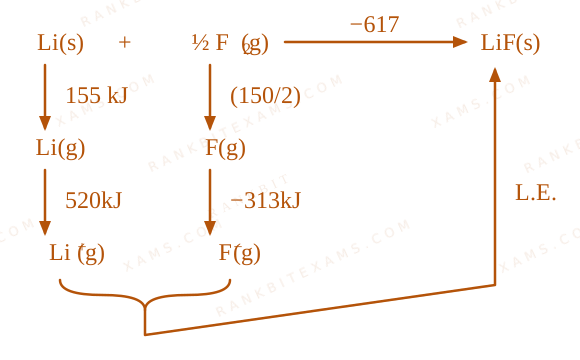
If the enthalpy of sublimation of Li is 155 kJ mol⁻¹, enthalpy of dissociation of F₂ is 150 kJ mol⁻¹, ionization enthalpy of Li is 520 kJ mol⁻¹, electron gain enthalpy of F is -313 kJ mol⁻¹, standard enthalpy of formation of LiF is -594 kJ mol⁻¹. The magnitude of lattice enthalpy of LiF is ____ kJ mol⁻¹ (Nearest integer).
Numerical Answer. Answer: 1031 to 1031

Solution

Related Formula
Δf H⁰ = Δsub H + IE + (1)/(2)Δbond H + Δeg H + L.E.
Core Logic

Step 1: Substitute given thermodynamic cycle values into Born-Haber equation:

-594 = 155 + 520 + (150)/(2) + (-313) + L.E. -594 = 155 + 520 + 75 - 313 + L.E. -594 = 437 + L.E. L.E. = -594 - 437 = -1031 kJ mol⁻¹

Step 2: Magnitude of lattice enthalpy is 1031 kJ mol⁻¹.

Born-Haber cycle diagram for LiF for Q72 - JEE Main 2026 Evening

Pattern Recognition

Sees: Born-Haber cycle parameters for ionic solid. Shortcut: Add sublimation, ionization, half-dissociation, and electron gain enthalpies, then subtract from formation enthalpy.

Chapter Mix

Class 11 Chemistry: Thermodynamics

Q58 jee_main_2026_23_january_morning First Law of Thermodynamics and Sign Conventions
A cup of water at 5°C (system) is placed in a microwave oven and the oven is turned on for one minute during which, the water begins to boil. Which of the following option is true?
  • A. q = +ve, w = 0, Δ U = -ve
  • B. q = +ve, w = -ve, Δ U = +ve
  • C. q = -ve, w = -ve, Δ U = -ve
  • D. q = +ve, w = -ve, Δ U = -ve

Solution

Related Formula
Δ U = q + w

where: Δ U = change in internal energy q = heat added to system w = work done on the system

Core Logic

Analyze the state changes step-by-step applying IUPAC sign conventions for thermodynamics.

First Law of Thermodynamics and Sign Conventions diagram for Q58 - JEE Main 2026 Morning

Step 1: Heat Transfer

Since heat is supplied by the microwave oven to the water (system), the system absorbs heat. Thus, q = +ve.

Step 2: Work Done

As water boils, it converts from liquid to vapor, which implies a massive volume expansion. Work is done by the system against the atmosphere. Thus, work done on the system is negative: w = -ve.

Step 3: Internal Energy Change

The temperature of water increases from 5^° C to 100^° C, and liquid converts to gas. The internal energy of steam at 100^° C is much greater than that of liquid water at 5^° C. Hence, Δ U = +ve.

Pattern Recognition

Heating + Boiling inherently means heat is entering (q > 0), expanding volume pushes outward doing work (w < 0), and increasing thermal energy raises the internal state function (Δ U > 0).

Chapter Mix

Class 11 Chemistry: Thermodynamics

Q63 jee_main_2026_24_january_morning Work Done in Isothermal Processes
Match the List-I with List-II
List-I (Isothermal process for ideal gas system)List-II Work done (Vf > Vᵢ)
A. Reversible expansionI. w = 0
B. Free expansionII. w = -nRT ln (Vf)/(Vᵢ)
C. Irreversible expansionIII. w = -pₑₓ(Vf - Vᵢ)
D. Irreversible compressionIV. w = -pₑₓ(Vᵢ - Vf)
Choose the correct answer from the options given below :
  • A. A-IV, B-I, C-III, D-II
  • B. A-IV, B-II, C-III, D-I
  • C. A-I, B-III, C-II, D-IV
  • D. A-II, B-I, C-III, D-IV

Solution

Related Formula
WRev = -∫ Pgas dV WIrrev = -Pₑₓₜ Δ V
Core Logic

(A) Reversible isothermal expansion:

WRev = -nRT ln [ (Vf)/(Vᵢ) ]

Matches with II.

(B) Free expansion (expansion into vacuum):

Pₑₓₜ = 0

W = 0 Matches with I.

(C) Irreversible expansion against constant external pressure:

Wirrev = -Pₑₓₜ Δ V Wirrev = -Pₑₓₜ (Vf - Vᵢ)

Matches with III.

(D) Irreversible compression: Same core formula but since it is a compression from Vf back to Vᵢ, the volume change term flips to Δ V = (Vᵢ - Vf), leading to:

Wirrev = -Pₑₓₜ (Vᵢ - Vf)

Matches with IV.

Work done expression mapping

Step 1: Final Conclusion

The correct matches are A-II, B-I, C-III, D-IV.

Pattern Recognition

Free expansion always implies zero work because Pₑₓₜ = 0. Reversible implies a continuous integration over volume resulting in the natural log formula.

Chapter Mix

Class 11 Chemistry: Thermodynamics

Q67 jee_main_2026_24_january_evening Enthalpy of Atomization and Bond Enthalpy
The heat of atomisation of methane and ethane are 'x' kJ mol ⁻¹ and 'y' kJ mol ⁻¹ respectively. The longest wavelength ( λ ) of light capable of breaking the C-C bond can be expressed in SI unit as:
  • A. hc1000( y-6x4)⁻¹
  • B. NAhc250(4y-6x)
  • C. NAhc250(y-6x)
  • D. NAhc(y-(6x)/(4))⁻¹

Solution

Related Formula
E = (hc)/(λ) λ = (hc)/(E)

Where E is the energy required to break one bond.

Core Logic

For Methane (CH₄): CH₄(g) arrow C(g) + 4H(g) ΔᵣH = x kJ / mole The energy is used to break 4 C-H bonds: 4 × εC-H = 1000x J / mole

For Ethane (C₂H₆): C₂H₆(g) arrow 2C(g) + 6H(g) ΔᵣH = y kJ / mole The energy is used to break 1 C-C bond and 6 C-H bonds: εC-C + 6 × εC-H = 1000y J / mole

Step 1: Extract C-C Bond Energy

From methane: εC-H = (1000x)/(4) = 250x J / mole Substitute into ethane equation: εC-C + 6 × (250x) = 1000y εC-C = 1000y - 1500x = [y - (3x)/(2)] × 1000 J / mole

Step 2: Wavelength Calculation

The energy calculated above is per mole. Energy required to break one C-C bond is: E = εC-CNA

Now, equating this to photon energy: εC-CNA = (hc)/(λ) λ = hc · NAεC-C

Substitute εC-C: λ = hc · NA[y - (3x)/(2)] × 1000 λ = hc · NA(2y - 3x)/(2) × 1000 λ = 2 · hc · NA1000(2y - 3x) = hc · NA500(2y - 3x) = hc · NA250(4y - 6x)

Pattern Recognition

Always convert molar quantities to per-bond (atomic scale) quantities by dividing by Avogadro's number (NA) when equating macroscopic enthalpy data to single photon quantum limits (hc/λ). Don't forget to multiply kJ to J by 1000 for standard SI unit consistency.

Chapter Mix

Class 11 Chemistry: Thermodynamics Class 11 Chemistry: Structure of Atom

More Chemical Thermodynamics Questions — jee_main_2025_07_april_morning

Practice all Chemical Thermodynamics previous-year questions →

Rankbit System
JEE Physics: Waves (+15.5%) | Electrostatics: Concentric Shells (-29.7%) | Modern Physics: Photoelectric Clones (+34.2%) | Mathematics: Definite Integrals (+18.1%) | Chemistry: Coordination Splitting (-11.4%) | JEE Physics: Waves (+15.5%) | Electrostatics: Concentric Shells (-29.7%) | Modern Physics: Photoelectric Clones (+34.2%) | Mathematics: Definite Integrals (+18.1%) | Chemistry: Coordination Splitting (-11.4%)
