Ice and water are placed in a closed container at a pressure of 1 atm and temperature 273.15K$273.15\mathrm{K}$ . If pressure of the system is increased 2 times, keeping temperature constant, then identify correct observation from following:
A.Volume of system increases.$\text{Volume of system increases.}$
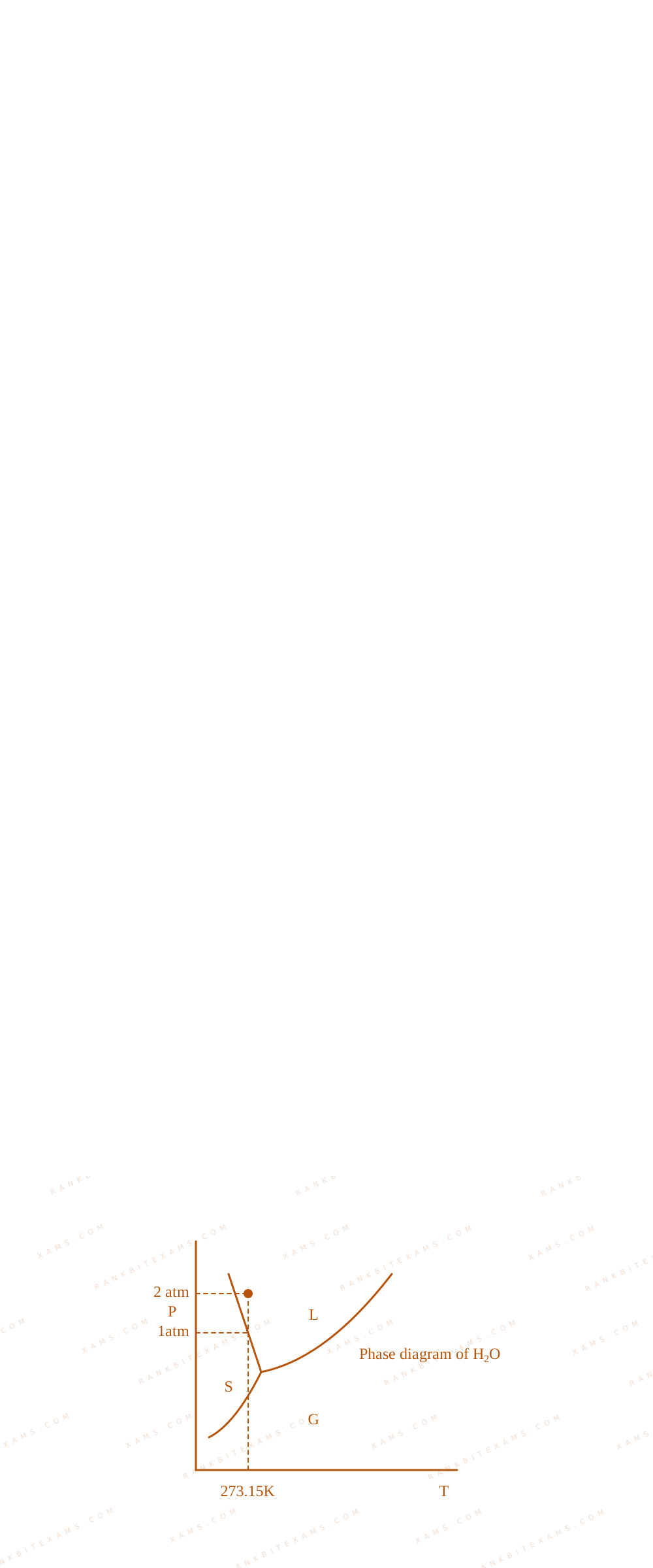
Water has a unique property where the density of the liquid phase is greater than the density of the solid phase (ice). Consequently, the molar volume of ice is larger than that of liquid water:
According to Le Chatelier's Principle, increasing the pressure favors the phase that occupies a smaller volume to alleviate the applied stress. Thus, shifting the system forward converts ice into liquid water:
Phase shift diagram for Q34 - JEE Main 2025 Morning
If the pressure is increased considerably (such as doubling it to 2 atm) at 273.15K$273.15\mathrm{K}$, the melting point decreases, causing the entire solid phase (ice) to disappear completely.
Pattern Recognition
Sees: Ice-water system under pressure change.
Trap: Assuming that an increase in pressure always favors the solid phase. Water has an anomalous phase curve with a negative slope.
Chapter Mix
Class 11 Chemistry: Chemical Thermodynamics
Keywords:#Ice and water are placed in a closed container#JEE Main 2025 Morning Q34#Thermodynamics JEE Main 2025#Phase Equilibrium JEE Main 2025
More Chemical Thermodynamics Previous-Year Questions
Q68jee_main_2026_21_jan_morningWork Done in PV Graph
Which of the following graphs between pressure ‘P’ versus volume ‘V’ represent the maximum work done?
A.Option 1$\text{Option 1}$
B.Option 2$\text{Option 2}$
C.Option 3$\text{Option 3}$
D.Option 4$\text{Option 4}$
Solution
Core Logic
The magnitude of work done by or on a gas is given by the area under the P-V curve projected onto the volume axis.
Graph 1: Cyclic process forming a triangle. Area is bounded, represents net work.
Graph 2: Isochoric drop (vertical line at V=22.4L$V=22.4L$). Area = 0, so work done is zero.
Graph 3: Expansion process forming a cycle. Area is enclosed in a convex shape.
Graph 4: Direct expansion from V=22.4$V=22.4$ to V=44.8$V=44.8$ at pressure P=1$P=1$ up to P=2$P=2$ (a rectangle combined with a triangle). The total area under the upper curve from V=22.4$V=22.4$ to V=44.8$V=44.8$ covers the entire shaded region under the path down to the V-axis.
Option (4) provides the largest total area under the curve extending down to the horizontal axis (maximum magnitude of work done).
Chapter Mix
Class 11 Chemistry: Thermodynamics
Q69jee_main_2026_21_jan_morningGibbs Free Energy and Equilibrium
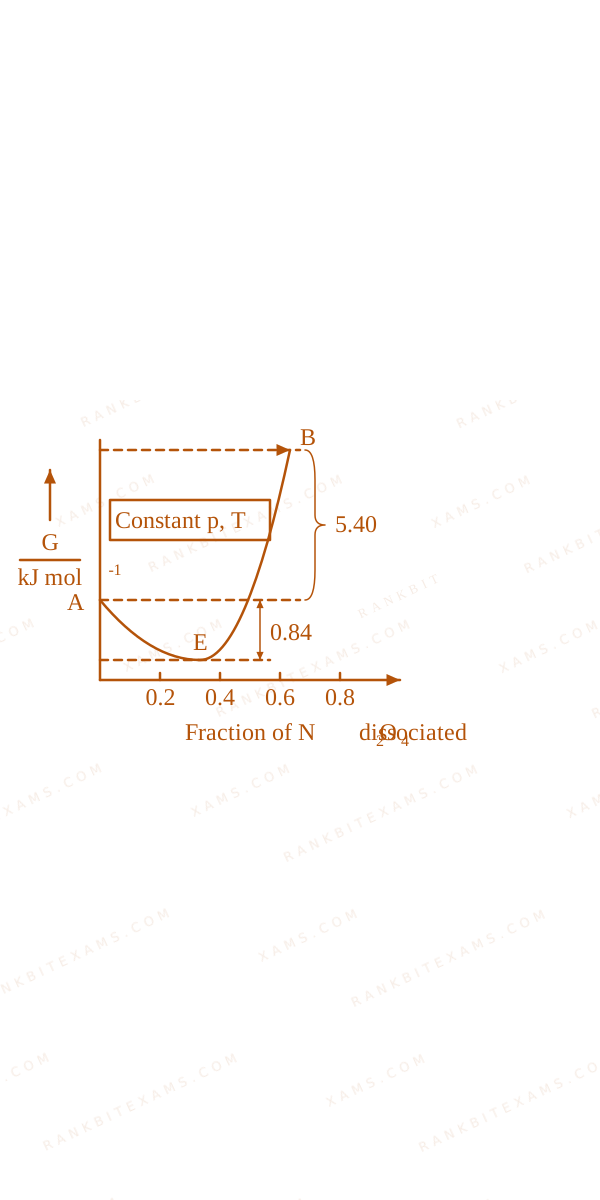
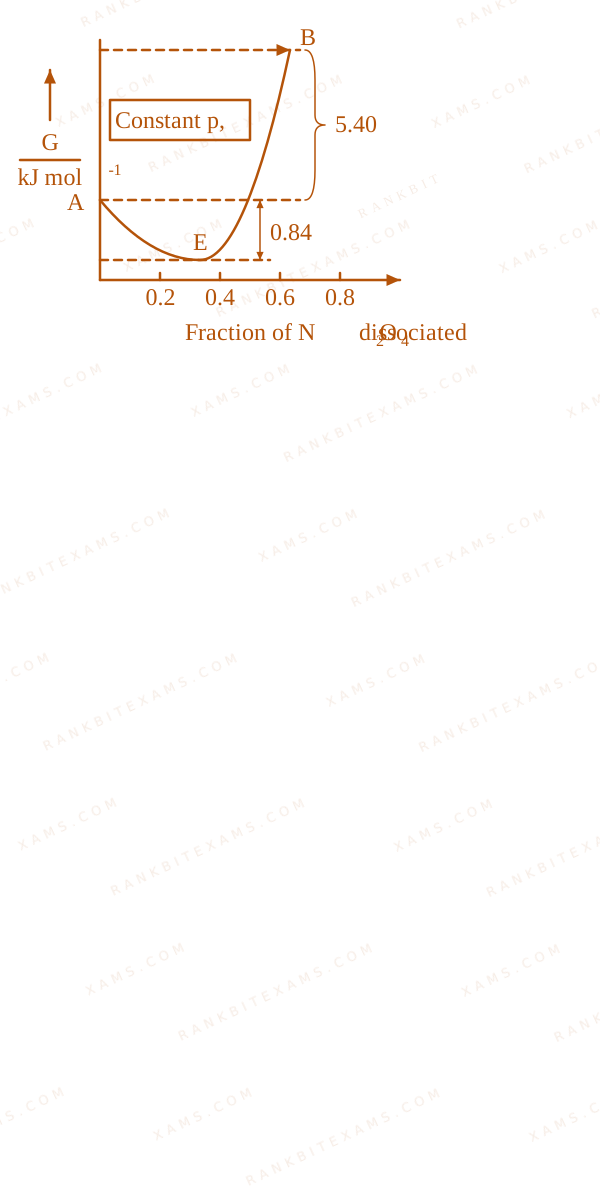
For the reaction, N₂O₄ leftharpoons 2NO₂$N_{2}O_{4} \rightleftharpoons 2NO_{2}$, graph is plotted as shown below. Identify correct statements.
A. Standard free energy change for the reaction is -5.40 kJ mol⁻¹$-5.40\text{ kJ mol}^{-1}$.
B. As Δ G$\Delta G^{\ominus}$ in graph is positive, N₂O₄$N_{2}O_{4}$ will not dissociate into NO₂$NO_{2}$ at all.
C. Reverse reaction will go to completion.
D. When 1 mole of N₂O₄$N_{2}O_{4}$ changes into equilibrium mixture, value of Δ G = -0.84 kJ mol⁻¹$\Delta G = -0.84\text{ kJ mol}^{-1}$.
E. When 2 mole of NO₂$NO_{2}$ changes into equilibrium mixture, Δ G$\Delta G$ for equilibrium mixture is -6.24 kJ mol⁻¹$-6.24\text{ kJ mol}^{-1}$.
A plot of Gibbs free energy against the fraction of N2O4 dissociated.
Choose the correct answer from the options given below :
A.D and E only$\text{D and E only}$
B.C and E only$\text{C and E only}$
C.A and D only$\text{A and D only}$
D.B and C only$\text{B and C only}$
Solution
Core Logic
Let's analyze the statements based on the given Gibbs free energy (G) vs. extent of reaction plot.
A plot of Gibbs free energy against the fraction of N2O4 dissociated.
A. Standard free energy change (Δᵣ G°$\Delta_r G^{\circ}$) is the difference between standard free energies of pure products (point B) and pure reactants (point A): Δᵣ G° = GB° - GA°$\Delta_r G^{\circ} = G_B^{\circ} - G_A^{\circ}$. Since B is higher than A, Δᵣ G°$\Delta_r G^{\circ}$ is positive, not -5.40 kJ mol⁻¹$-5.40\text{ kJ mol}^{-1}$. Statement A is false.
B. Even if Δᵣ G°$\Delta_r G^{\circ}$ is positive, the minimum of the curve (equilibrium state E) lies between the pure reactant and product states. Therefore, partial dissociation occurs to reach equilibrium. It is false to say it will not dissociate at all. Statement B is false.
C. The minimum E is not at fraction = 0 or 1, meaning an equilibrium mixture exists. Reverse reaction does not go to completion. Statement C is false.
D. From 1 mole of pure reactant (point A) to the equilibrium mixture (point E), the drop in Gibbs energy is 0.84 kJ mol⁻¹$0.84\text{ kJ mol}^{-1}$. Thus Δ G = -0.84 kJ mol⁻¹$\Delta G = -0.84\text{ kJ mol}^{-1}$ is correct. Statement D is true.
E. The difference from pure products (point B, equivalent to 2 moles NO₂$NO_2$) to equilibrium (E) is the entire vertical distance. The drop from B to A is 5.40$5.40$, and A to E is 0.84$0.84$. So drop from B to E is - (5.40 + 0.84) = -6.24 kJ mol⁻¹$- (5.40 + 0.84) = -6.24\text{ kJ mol}^{-1}$. Statement E is true.
Step 1: Final Conclusion
Only statements D and E are correct.
Pattern Recognition
The free energy of mixing creates a minimum 'dip' (Equilibrium) below both pure reactants and pure products, preventing either forward or reverse reactions from going absolutely to 100% completion.
Chapter Mix
Class 11 Chemistry: Thermodynamics
Class 11 Chemistry: Equilibrium
Q73jee_main_2026_21_jan_morningGibbs Free Energy and Equilibrium Constant
One mole each of A₂(g)$A_{2}(g)$ and B₂(g)$B_{2}(g)$ are taken in a 1L closed flask and allowed to establish the equilibrium at 500K.
A₂(g) + B₂(g) leftharpoons 2AB(g)$$A_{2}(g) + B_{2}(g) \rightleftharpoons 2AB(g)$$
The value of x (in kJ mol⁻¹$\text{kJ mol}^{-1}$) is .... (Nearest integer)
(Given: K=2.2, R=8.314 J K⁻¹ mol⁻¹$\log K=2.2, R=8.314\text{ J K}^{-1}\text{ mol}^{-1}$)
Class 11 Chemistry: Thermodynamics
Class 11 Chemistry: Equilibrium
Q56jee_main_2026_21_jan_eveningBond Enthalpy and Enthalpy of Atomization
Consider the following data:
Δf H(methane, g) = -X kJ mol⁻¹$\Delta_f H^{\ominus}(\text{methane, g}) = -X \text{ kJ mol}^{-1}$
Enthalpy of sublimation of graphite = Y kJ mol⁻¹$= Y \text{ kJ mol}^{-1}$
Dissociation enthalpy of H₂ = Z kJ mol⁻¹$\text{H}_2 = Z \text{ kJ mol}^{-1}$
The bond enthalpy of C-H$\text{C-H}$ bond is given by:
A.(1) (X + Y + 2Z)/(4)$(1) \ \frac{X + Y + 2Z}{4}$
B.(2) (X + Y + 4Z)/(2)$(2) \ \frac{X + Y + 4Z}{2}$
C.(3) X + Y + Z$(3) \ X + Y + Z$
D.(4) (-X + Y + Z)/(4)$(4) \ \frac{-X + Y + Z}{4}$
-X = (Δ Hsub of carbon) + 2 × (B.E. of H-H) - 4 × (B.E. of C-H)$-X = (\Delta H_{\text{sub}} \text{ of carbon}) + 2 \times (\text{B.E. of H-H}) - 4 \times (\text{B.E. of C-H})$
-X = Y + 2Z - 4(B.E. of C-H)$-X = Y + 2Z - 4(\text{B.E. of C-H})$
Step 1: Rearranging for Bond Enthalpy
Rearranging the equation for C-H bond enthalpy:
B.E. of C-H = (X + Y + 2Z)/(4)$$\text{B.E. of C-H} = \frac{X + Y + 2Z}{4}$$
Pattern Recognition
Sees: bond enthalpy derivation from heat of formation, sublimation, and dissociation.
Trap: Sign convention errors when substituting formation enthalpies.
Chapter Mix
Class 11 Chemistry: Chemical Thermodynamics
Q60jee_main_2026_22_january_morningWork and Internal Energy
A. Work done in reversible, isothermal expansion of 2 mol of ideal gas from 2 dm³$2\text{ dm}^{3}$ to 20 dm³$20\text{ dm}^{3}$ at 300 K.
I. 4
B. Work done in irreversible isothermal expansion of 1 mol ideal gas from 1 m³$1\text{ m}^{3}$ to 3 m³$3\text{ m}^{3}$ at 300 K against a constant pressure of 3kPa.
II. 11.5
C. Change in internal energy for adiabatic expansion of a 1 mol ideal gas with change of temperature = 320 K and Cv = (3)/(2)R$\overline{C}_{v} = \frac{3}{2}R$
III. 6
D. Change in enthalpy at constant pressure of 1 mole ideal gas with change of temperature = 337 K and Cₚ = (5)/(2)R$\overline{C}_{p} = \frac{5}{2}R$
IV. 7
Choose the correct answer from the option given below:
Practice past-year questions one chapter at a time. Pick an exam → subject → chapter and get every PYQ for that topic — pulled together from all past papers — with the chapter's key formulas alongside.