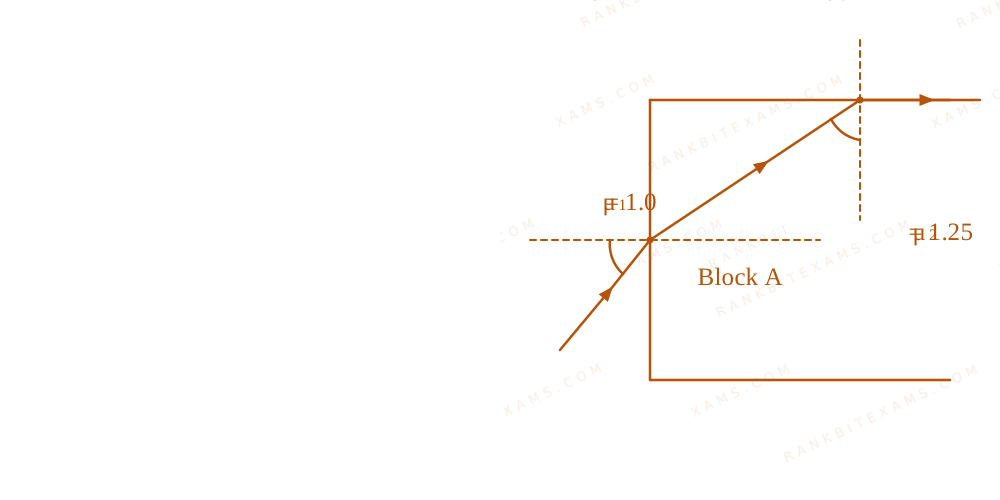
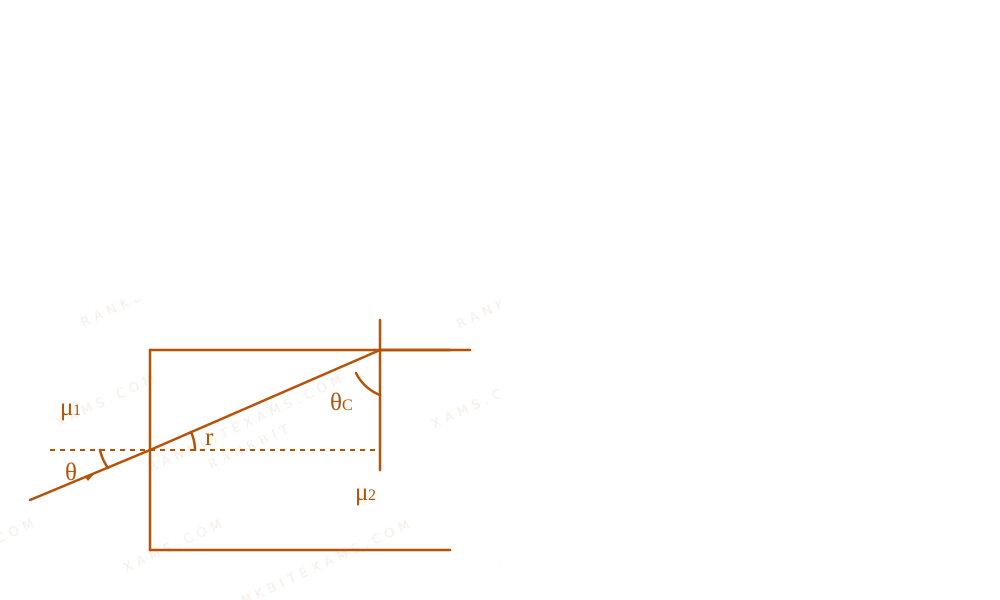
A transparent block A having refractive index μ=1.25$\mu=1.25$ is surrounded by another medium of refractive index μ=1.0$\mu=1.0$ as shown in figure. A light ray is incident on the flat face of the block with incident angle θ$\theta$ as shown in figure. What is the maximum value of θ$\theta$ for which light suffers total internal reflection at the top surface of the block?
The diagram displays a light ray entering a rectangular block from a medium of lower refractive index, hitting the top wall at the critical boundary angle. [cite: 169, 170, 171]
Maximum angle at the entry face ensures minimum angle of incidence at the subsequent wall[cite: 806, 807]. Setting that exact internal angle equal to the critical threshold condition values solves for the operational scanning range edge directly[cite: 808].
Chapter Mix
Class 12 Physics: Ray Optics and Optical Instruments
The diagram displays a light ray entering a rectangular block from a medium of lower refractive index, hitting the top wall at the critical boundary angle.
Keywords:#total internal reflection critical angle#JEE Main 2025 Evening Q20#block index entry angle refraction#Snell law trigonometric geometry#total internal reflection ray tracing#critical angle refraction block#incident angle boundaries Snell law#refractive index interfaces
More Ray Optics and Optical Instruments Previous-Year Questions — Page 2
Q48jee_main_2026_22_january_morningRefraction at Spherical Surfaces
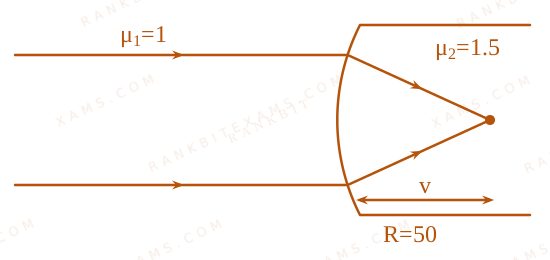
A parallel beam of light travelling in air (refractive index 1.0) is incident on a convex spherical glass surface of radius of curvature 50 cm. Refractive index of glass is 1.5. The rays converge to a point at a distance x cm from the centre of the curvature of the spherical surface. The value of x is \_\_\_\_ cm.
x = v - R = 150 - 50 = 100 cm$$x = v - R = 150 - 50 = 100 \text{ cm}$$
Pattern Recognition
Sees: Refraction at convex spherical surface with parallel incident beam.
Shortcut: Apply spherical surface refraction formula with u=∞$u=\infty$.
Check: Numerical answer is 100 cm. ✓
Chapter Mix
Class 12 Physics: Ray Optics and Optical Instruments
To locate an image using the optical bench parallax method, a real image must be formed in space in front of the mirror so that an optical pin can be aligned with it.
For a concave mirror, real images are formed only when the object is located beyond the principal focus (u > f$u > f$). If placed between pole and focus, a virtual image is formed behind the mirror, preventing parallax removal using standard optical pins.
Step 1: Final Conclusion
Hence, the object can be placed at any point beyond the focus (F) of the mirror.
Pattern Recognition
Experimental optics rule: Parallax method requires real image formation $\implies$ object must be placed beyond focus (u > f$u > f$).
Chapter Mix
Class 12 Physics: Ray Optics and Optical Instruments
Q26jee_main_2026_23_january_morningDispersion by a Prism
A thin prism with angle 5°$5^{\circ}$ of refractive index 1.72 is combined with another prism of refractive index 1.9 to produce dispersion without deviation. The angle of second prism is
For a combination of two prisms producing dispersion without deviation, the net angular deviation must be zero. The opposing orientations mean their deviations will cancel out algebraically.
Consider light travelling from a medium A to medium B separated by a plane interface. If the light undergoes total internal reflection during its travel from medium A to B and the speed of light in media A and B are 2.4 × 10⁸ m/s$2.4 \times 10^{8}\text{ m/s}$ and 2.7 × 10⁸ m/s$2.7 \times 10^{8}\text{ m/s}$ respectively, then the value of critical angle is:
μA c = μB 90°$$\mu_{A} \sin c = \mu_{B} \sin 90^{\circ}$$μ = (c)/(v)$$\mu = \frac{c}{v}$$
Core Logic
For total internal reflection at the critical angle, the angle of refraction is 90°$90^{\circ}$. Snell's law gives c = μB/μA$\sin c = \mu_{B}/\mu_{A}$. Since refractive index is inversely proportional to velocity, this ratio is equal to the ratio of velocities vA/vB$v_{A}/v_{B}$.
Step 1: Velocity Ratio to Sine
c = vAvB$$\sin c = \frac{v_{A}}{v_{B}}$$c = 2.4 × 10⁸2.7 × 10⁸ = (24)/(27) = (8)/(9)$$\sin c = \frac{2.4 \times 10^{8}}{2.7 \times 10^{8}} = \frac{24}{27} = \frac{8}{9}$$
Step 2: Triangle Mapping to Tangent
We need the answer in terms of ⁻¹$\tan^{-1}$ based on the options. From a right triangle with Opposite = 8, Hypotenuse = 9:
Sees: "total internal reflection" + "speeds given" → skip calculating refractive indices, directly jump to c = vdenser / vᵣₐᵣₑᵣ$\sin c = v_{\text{denser}} / v_{\text{rarer}}$. Use Pythagorean identity if options differ in trigonometric function.
Chapter Mix
Class 12 Physics: Ray Optics and Optical Instruments
Q40jee_main_2026_23_january_eveningPrism and Total Internal Reflection
A prism of angle 75°$75^{\circ}$ and refractive index √(3)$\sqrt{3}$ is coated with thin film of refractive index 1.5 only at the back exit surface. To have total internal reflection at the back exit surface the incident angle must be ____. (15° = 0.25$\sin 15^{\circ} = 0.25$ and 25° = 0.43$\sin 25^{\circ} = 0.43$)
A.between 15° and 20°$\text{between } 15^{\circ} \text{ and } 20^{\circ}$
B.15°$15^{\circ}$
C.> 25°$> 25^{\circ}$
D.< 15°$< 15^{\circ}$
Solution
Related Formula
r₁ + r₂ = A$r_1 + r_2 = A$
Snell's Law: μ₁ i = μ₂ r$\mu_1 \sin i = \mu_2 \sin r$
Condition for TIR: θ > θC$\theta > \theta_C$, where θC = μᵣₐᵣₑᵣμdenser$\sin \theta_C = \frac{\mu_{\text{rarer}}}{\mu_{\text{denser}}}$
Core Logic
Prism and Total Internal Reflection diagram for Q40 - JEE Main 2026 Evening
Given prism angle A = 75°$A = 75^{\circ}$.
For TIR at the back surface, light travels from prism (μ = √(3)$\mu = \sqrt{3}$) to film (μ = 1.5$\mu = 1.5$).
r₁ + r₂ = 75°$$r_1 + r_2 = 75^{\circ}$$
Step 1: Critical Angle for TIR
Applying Snell's Law for critical angle at the back surface:
We know 25° = 0.43$\sin 25^{\circ} = 0.43$. Thus 0.433$0.433$ is roughly 25°$\sin 25^{\circ}$.
So i ≤ 25°$i \le 25^{\circ}$ is required. Any angle less than 25°$25^{\circ}$ ensures r₁ ≤ 15°$r_1 \le 15^{\circ}$ and thus r₂ ≥ 60°$r_2 \ge 60^{\circ}$.
Step 4: Analyze Options
Any angle i < 25°$i < 25^{\circ}$ guarantees TIR.
Option (1): between 15°$15^{\circ}$ and 20°$20^{\circ}$ (Valid)
Option (2): 15°$15^{\circ}$ (Valid)
Option (4): < 15°$< 15^{\circ}$ (Valid)
Since this is an MCQ frame inherently reflecting all suitable subsets, (1), (2), and (4) are all physically sufficient.
Pattern Recognition
In prism TIR problems, trace backward from the critical surface constraint. Maximum r₂$r_2$ means minimum r₁$r_1$, which dictates maximum i$i$. If imax = 25°$i_{\text{max}} = 25^{\circ}$, any choice strictly bounded below 25°$25^{\circ}$ is physically correct.
Chapter Mix
Class 12 Physics: Ray Optics and Optical Instruments
More Ray Optics and Optical Instruments Questions — jee_main_2025_07_april_evening
Practice past-year questions one chapter at a time. Pick an exam → subject → chapter and get every PYQ for that topic — pulled together from all past papers — with the chapter's key formulas alongside.