Given below are two statements: one is labelled as Assertion (A) and the other is labelled as Reason (R).
Assertion (A): The radius vector from the Sun to a planet sweeps out equal areas in equal intervals of time and thus areal velocity of planet is constant. [cite: 55]
Reason (R) For a central force field the angular momentum is a constant. [cite: 56]
In the light of the above statements, choose the most appropriate answer from the options given below: [cite: 57]
A.Both (A) and (R) are correct and (R) is the correct explanation of (A) [cite: 63]
B.Both (A) and (R) are correct but (R) is not the correct explanation of (A) [cite: 65]
Kepler's Second Law state that the areal velocity (dA)/(dt)$\frac{dA}{dt}$ is directly proportional to the angular momentum L$L$ of the planet[cite: 55, 684]. Because the gravitational force between the Sun and the planet acts strictly along the line joining their centers (a central force field), its torque τ = r × F = 0$\vec{\tau} = \vec{r} \times \vec{F} = 0$[cite: 56, 686]. Since torque is zero, the angular momentum L$L$ remains completely constant over time[cite: 686]. As a consequence, (dA)/(dt) = constant$\frac{dA}{dt} = \text{constant}$[cite: 55, 684]. Both statements are true and (R) is the correct explanation of (A)[cite: 63].
Pattern Recognition
Areal velocity constancy is a direct geometric manifestation of the conservation of angular momentum under any central force field[cite: 55, 56, 686].
Keywords:#Kepler second law angular momentum#JEE Main 2025 Evening Q6#central force field torque zero#areal velocity of planets
More Gravitation Previous-Year Questions — Page 5
Q46jee_main_2024_31_jan_eveningEscape Velocity
The mass of the moon is 1/144$1/144$ times the mass of a planet and its diameter 1/16$1/16$ times the diameter of a planet. If the escape velocity on the planet is v, the escape velocity on the moon will be:
For the planet: v = √((2GMₚ)/(Rₚ))$v = \sqrt{\frac{2GM_p}{R_p}}$
For the moon: Mm = (Mₚ)/(144)$M_m = \frac{M_p}{144}$ and Rm = (Rₚ)/(16)$R_m = \frac{R_p}{16}$.
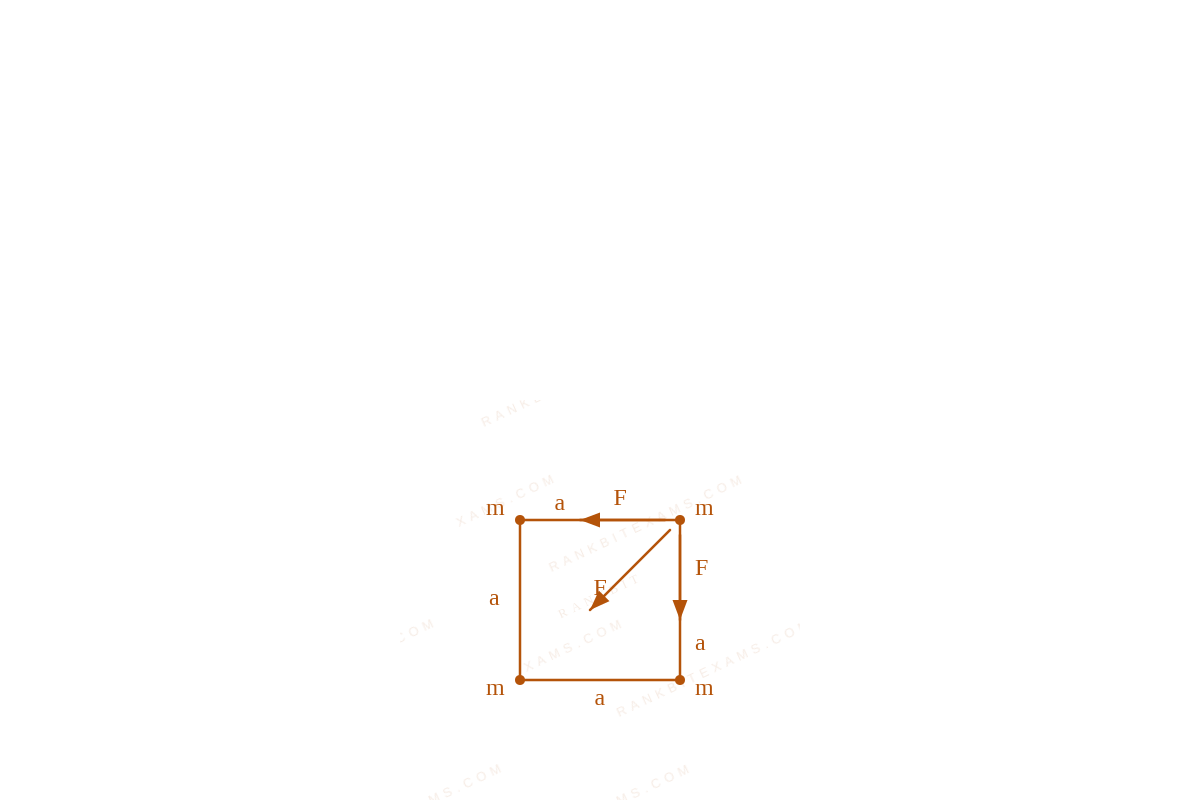
Four identical particles of mass m$m$ are kept at the four corners of a square. If the gravitational force exerted on one of the masses by the other masses is ( 2√(2) + 132) Gm²L²$\left(\frac{2\sqrt{2} + 1}{32}\right)\frac{\mathrm{Gm}^2}{\mathrm{L}^2}$, the length of the sides of the square is
A.L2$\frac{\mathrm{L}}{2}$
B.4 L$4 L$
C.3L$3L$
D.2 L$2 L$
Solution
Related Formula
F = (G m₁ m₂)/(r²)$$F = \frac{G m_1 m_2}{r^2}$$
Core Logic
Superposition Principle diagram for Q37 - JEE Main 2024 Morning
Let the side length of the square be a$a$. Considering one corner mass, it experiences forces from the adjacent two masses (distance a$a$) and the diagonally opposite mass (distance √(2)a$\sqrt{2}a$).
The forces from the two adjacent masses are at 90^°$90^\circ$ to each other:
F = (Gm²)/(a²)$$F = \frac{Gm^2}{a^2}$$
The resultant of these two is √(2)F = √(2) (Gm²)/(a²)$\sqrt{2}F = \sqrt{2} \frac{Gm^2}{a^2}$, directed along the diagonal.
Step 2: Total Force Equation
The force from the diagonal mass is:
F' = Gm²(√(2)a)² = (Gm²)/(2a²)$$F' = \frac{Gm^2}{(\sqrt{2}a)^2} = \frac{Gm^2}{2a^2}$$
Total resultant force Fₙₑₜ = √(2)F + F'$F_{\text{net}} = \sqrt{2}F + F'$:
Practice past-year questions one chapter at a time. Pick an exam → subject → chapter and get every PYQ for that topic — pulled together from all past papers — with the chapter's key formulas alongside.