Rankbit System
JEE Physics: Waves (+15.5%) | Electrostatics: Concentric Shells (-29.7%) | Modern Physics: Photoelectric Clones (+34.2%) | Mathematics: Definite Integrals (+18.1%) | Chemistry: Coordination Splitting (-11.4%) | JEE Physics: Waves (+15.5%) | Electrostatics: Concentric Shells (-29.7%) | Modern Physics: Photoelectric Clones (+34.2%) | Mathematics: Definite Integrals (+18.1%) | Chemistry: Coordination Splitting (-11.4%)

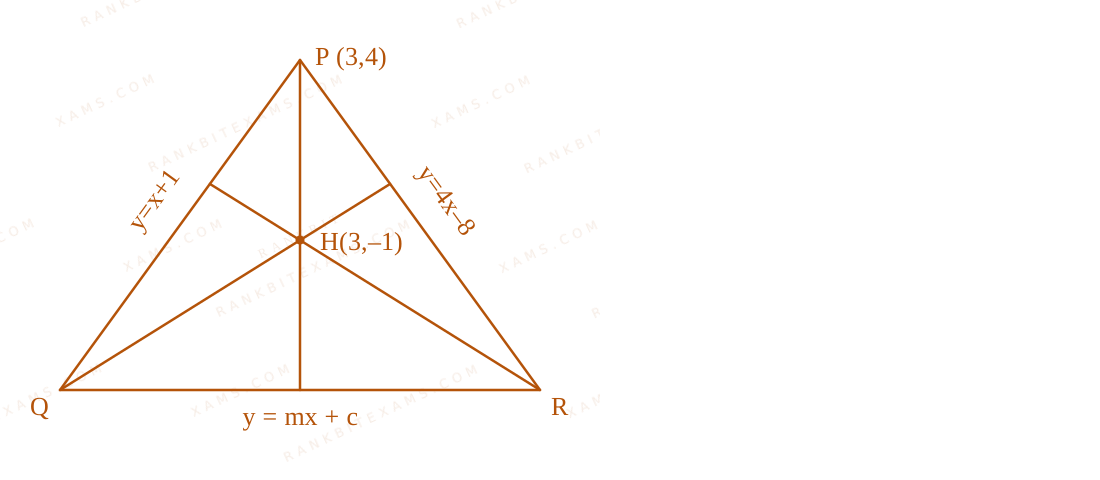
If the orthocentre of the triangle formed by the lines y = x + 1, y = 4x - 8 and y = mx + c is at (3, -1), then m - c is:

Solution & Explanation

### Related Formula The product of slopes of two mutually perpendicular lines is always equal to -1: m_1 cdot m_2 = -1 ### Core Logic Let the vertices of the triangle be P, Q, and R. The lines given are: 1) y = x + 1 2) y = 4x - 8 3) y = mx + c Solving lines y = x + 1 and y = 4x - 8 gives the vertex P(3, 4). The orthocentre is given as H(3, -1). Notice that the x-coordinate of P and H are identical (x = 3). This implies that the altitude from vertex P to the base line y = mx + c is a vertical line along x = 3.
Orthocentre of a Triangle diagram for Q51 - JEE Main 2025 Evening
### Step 1: Determine the Slopes Since the altitude from P is vertical, the side opposite to it (which lies on y = mx + c) must be a horizontal line. Therefore, the slope of the line y = mx + c must be zero: m = 0 ### Step 2: Solve for c Let's find point Q by intersecting y = x + 1 and y = mx + c. Since m = 0, y = c, we get Q(c-1, c). Using the property that the line segment connecting Q to the opposite side's altitude is perpendicular to line PR (y = 4x - 8): textSlope of QH cdot textSlope of PR = -1 frac-1 - c3 - (c - 1) cdot 4 = -1 frac-4(c + 1)4 - c = -1 implies 4c + 4 = 4 - c implies 5c = 0 implies c = 0 ### Step 3: Evaluate m - c Substituting the values of m and c: m - c = 0 - 0 = 0 ### Pattern Recognition When the x-coordinate of a vertex matches the x-coordinate of the orthocentre, the altitude is vertical, forcing the opposite base to be purely horizontal (m=0). This observation cuts down calculation time completely. ### Evaluation Rubric / Model Answer null ### Chapter Mix Class 11 Mathematics: Straight Lines
Reference Study Guides

More Straight Lines Previous-Year Questions — Page 3

Q69 2025 Concurrency of Straight Lines
Let the lines 3x - 4y - alpha = 0, 8x - 11y - 33 = 0, and 2x - 3y + lambda = 0 be concurrent. If the image of the point (1, 2) in the line 2x - 3y + lambda = 0 is left(frac5713,frac-4013 ight) , then |alpha lambda| is equal to :
  • A. 84
  • B. 91
  • C. 113
  • D. 101

Solution

### Related Formula The midpoint between a point and its reflection image must lie exactly on the line mirror equation. ### Core Logic Find the midpoint M between point P(1, 2) and its given reflection image Qleft(frac5713, frac-4013right): M = left( frac1 + frac57132, \, frac2 - frac40132 right) = left( frac7026, \, frac-1426 right) = left( frac3513, \, frac-713 right) Since M lies on the reflecting line 2x - 3y + lambda = 0: 2left(frac3513right) - 3left(frac-713right) + lambda = 0 frac7013 + frac2113 + lambda = 0 implies frac9113 + lambda = 0 implies 7 + lambda = 0 implies lambda = -7 ### Step 1: Apply Concurrency Determinant For three straight lines to intersect at a single concurrent point, the determinant of their linear coefficients must equal zero: left| beginmatrix 3 & -4 & -alpha \\ 8 & -11 & -33 \\ 2 & -3 & -7 endmatrix right| = 0 Expand the determinant along the first row: 3left[ (-11)(-7) - (-33)(-3) right] - (-4)left[ (8)(-7) - (-33)(2) right] - alpha left[ (8)(-3) - (-11)(2) right] = 0 3[77 - 99] + 4[-56 + 66] - alpha[-24 + 22] = 0 3[-22] + 4[10] - alpha[-2] = 0 -66 + 40 + 2alpha = 0 implies 2alpha = 26 implies alpha = 13 ### Step 2: Compute Final Product Target Multiply the absolute values of the determined parameters together: |alpha lambda| = |13 cdot (-7)| = |-91| = 91 ### Pattern Recognition Using the midpoint property to evaluate unknown line parameters from reflection images is often much faster than using full distance formulas. ### Evaluation Rubric / Model Answer null ### Chapter Mix Class 11 Mathematics: Straight Lines
Q67 2025 Angle Between Lines
Two equal sides of an isosceles triangle are along -x+2y=4 and x+y=4. If m is the slope of its third side, then the sum, of all possible distinct values of m, is:
  • A. -6
  • B. 12
  • C. 6
  • D. -2sqrt10

Solution

### Related Formula Angle theta between two lines with slopes m_1 and m_2: tantheta = left| fracm_1 - m_21 + m_1 m_2 right| ### Core Logic Given lines for the equal sides: 1) -x + 2y = 4 implies y = frac12x + 2 implies m_1 = frac12 2) x + y = 4 implies y = -x + 4 implies m_2 = -1 In an isosceles triangle, the third side makes equal angles theta with both equal sides. Let the slope of the third side be m: left| fracm - 1/21 + m/2 right| = left| fracm - (-1)1 + m(-1) right| left| frac2m - 12 + m right| = left| fracm + 11 - m right| ### Step 1: Solve the Slope Equation Case 1 (Same sign): frac2m - 12 + m = fracm + 11 - m (2m - 1)(1 - m) = (m + 1)(2 + m) 2m - 2m^2 - 1 + m = m^2 + 3m + 2 -2m^2 + 3m - 1 = m^2 + 3m + 2 3m^2 + 3 = 0 implies m^2 = -1 quad (textNo real roots) Case 2 (Opposite sign): frac2m - 12 + m = -fracm + 11 - m = fracm + 1m - 1 (2m - 1)(m - 1) = (2 + m)(m + 1) 2m^2 - 3m + 1 = m^2 + 3m + 2 m^2 - 6m - 1 = 0 ### Step 2: Sum of Roots The quadratic equation for m is m^2 - 6m - 1 = 0. The sum of possible distinct values of m is given by the sum of roots of this quadratic: textSum of roots = -frac-61 = 6 ### Pattern Recognition Instead of solving for the explicit values of the slopes (which involve radicals), using Vieta's relations directly on the quadratic equation m^2 - 6m - 1 = 0 gives the final answer instantly. ### Evaluation Rubric / Model Answer null ### Chapter Mix Class 11 Mathematics: Straight Lines

Q54 2025 Centroid and Image of a Point
Let ABC be a triangle formed by the lines 7mathrmx - 6mathrmy + 3 = 0, mathrmx + 2mathrmy - 31 = 0 and 9mathrmx - 2mathrmy - 19 = 0 . Let the point (mathrmh,mathrmk) be the image of the centroid of Delta ABC in the line 3mathrmx + 6mathrmy - 53 = 0 . Then \mathrm{h}^2 + \mathrm{k}^2 + \mathrm{hk} is equal to
  • A. 37
  • B. 47
  • C. 40
  • D. 36

Solution

### Related Formula textCentroid G = left(fracx_1+x_2+x_33, fracy_1+y_2+y_33right) textImage of (x_1, y_1) text in line ax+by+c=0: fracx-x_1a = fracy-y_1b = -2fracax_1+by_1+ca^2+b^2 ### Core Logic First, find the vertices A, B, C by solving the lines pairwise. Solving 7x - 6y + 3 = 0 and x + 2y - 31 = 0 gives A(9,11). Solving 7x - 6y + 3 = 0 and 9x - 2y - 19 = 0 gives B(3,4). Solving x + 2y - 31 = 0 and 9x - 2y - 19 = 0 gives C(5,13).
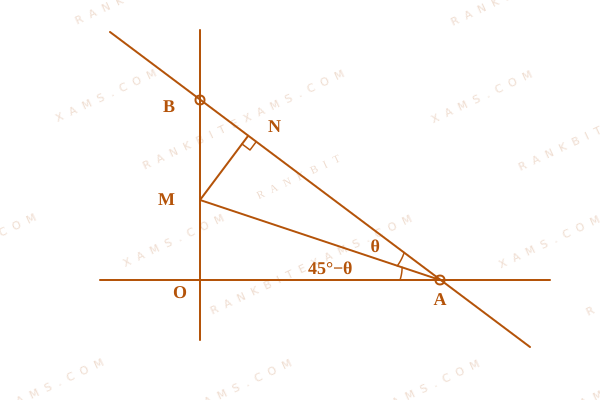
Centroid diagram for Q54 - JEE Main 2025 Morning
### Step 1: Determine the Centroid G = left(frac9 + 3 + 53, frac11 + 4 + 133right) = left(frac173, frac283right) ### Step 2: Find the Image (h, k) Using the line 3x + 6y - 53 = 0: frach - frac1733 = frack - frac2836 = -2 frac3left(frac173right) + 6left(frac283right) - 533^2 + 6^2 frach - frac1733 = frack - frac2836 = -2 frac17 + 56 - 5345 = -2 frac2045 = -frac89 Solving for h and k yields: h = 3, quad k = 4
Centroid diagram for Q54 - JEE Main 2025 Morning
### Step 3: Compute final algebraic target h^2 + k^2 + hk = 3^2 + 4^2 + (3)(4) = 9 + 16 + 12 = 37 ### Pattern Recognition Instead of solving fractions endlessly, substitute potential integer coordinates early into the slope relationship (k - y_G)/(h - x_G) = -1/m to accelerate competitive solving time. ### Evaluation Rubric / Model Answer null ### Chapter Mix Class 11 Mathematics: Straight Lines

More Straight Lines Questions — jee_main_2025_07_april_evening

Practice all Straight Lines previous-year questions →

YOUR FIRST PREP STEP STARTS HERE

We Map Every Repeating Question in Competitive Exams.

Say goodbye to generic mock test fatigue. RankBit uses smart analysis to group past exam questions into their foundational Repeating Question Types. Find chapter weightage, track repeating questions, and score higher with targeted practice.

Select Your Target Exam

Choose an exam track below to find formulas per chapter and patterns.

Syncing Exam Intelligence

Mapping formulas and patterns across all tracks…

PATH A — FULL LENGTH PRACTICE

Full Mock Test Hub

Simulate real NTA exam conditions with fully tracked mocks. Time yourself against past papers.

Under Development
PATH B — TARGETED PRACTICE

Topic-wise Practice Hub

Practice past-year questions one chapter at a time. Pick an exam → subject → chapter and get every PYQ for that topic — pulled together from all past papers — with the chapter's key formulas alongside.

Loading Questions... Browse Topics
Latest from the Blog
View all →

Loading articles...