Organic Chemistry - Some Basic Principles and Techniques appeared 101 times across 3 years — 11.7% of Chemistry.
This question is from Separation Techniques.
Mixture of 1 g$1\text{ g}$ each of chlorobenzene, aniline and benzoic acid is dissolved in 50 mL$50\text{ mL}$ ethyl acetate and placed in a separating funnel, 5 M NaOH$5\text{ M NaOH}$ (30 mL$30\text{ mL}$) was added in the same funnel. The funnel was shaken vigorously and then kept aside. The ethyl acetate layer in the funnel contains:
A.benzoic acid$\text{benzoic acid}$
B.benzoic acid and aniline$\text{benzoic acid and aniline}$
C.benzoic acid and chlorobenzene$\text{benzoic acid and chlorobenzene}$
D.chlorobenzene and aniline$\text{chlorobenzene and aniline}$
When aqueous NaOH$\text{NaOH}$ is added to the mixture:
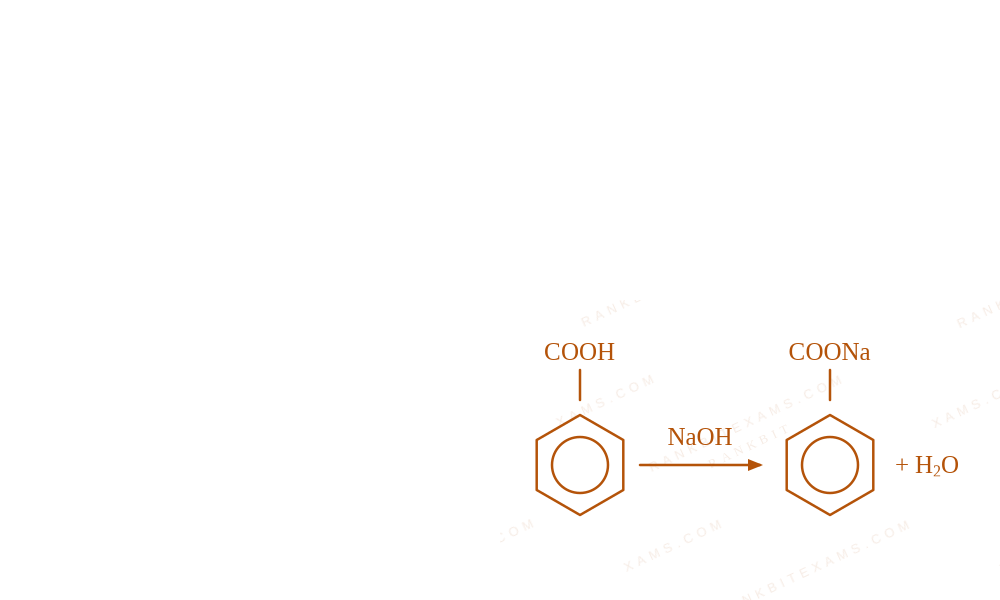
Benzoic acid (Ph-COOH$\text{Ph-COOH}$) reacts to form sodium benzoate (Ph-COONa$\text{Ph-COONa}$), which is highly water-soluble and moves completely into the aqueous layer.
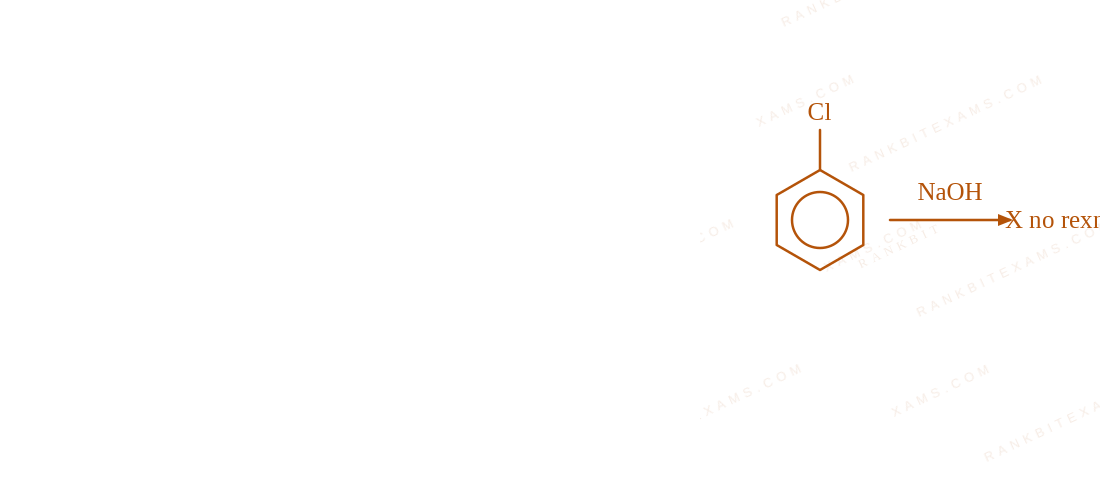
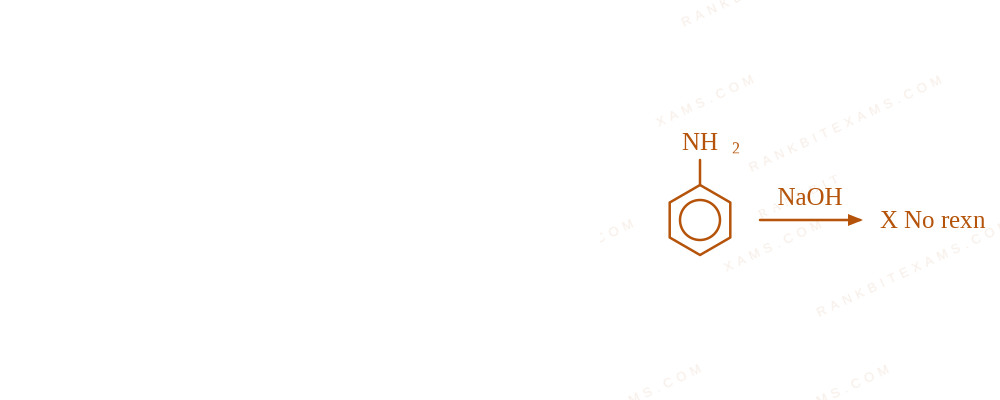
Chlorobenzene (Ph-Cl$\text{Ph-Cl}$) and aniline (Ph-NH₂$\text{Ph-NH}_2$) are organic compounds that do not react with aqueous NaOH$\text{NaOH}$ under normal conditions.
Therefore, they remain unreacted in the organic layer (ethyl acetate).
Step 1: Visual Reaction Progress
The separation steps can be visualized tracking the structural components:
Separation Techniques diagram for Q27 - JEE Main 2025 Evening
Separation Techniques diagram for Q27 - JEE Main 2025 Evening
Separation Techniques diagram for Q27 - JEE Main 2025 Evening
Thus, the ethyl acetate layer strictly contains chlorobenzene and aniline.
Pattern Recognition
Acid-base separation shortcut: Strong bases (NaOH$\text{NaOH}$) pull organic acids into the aqueous phase as salts. Neutral compounds and basic amines stay behind in the organic layer unless a strong acid is added.
Chapter Mix
Class 11 Chemistry: Organic Chemistry - Some Basic Principles and Techniques
Class 12 Chemistry: Aldehydes, Ketones and Carboxylic Acids
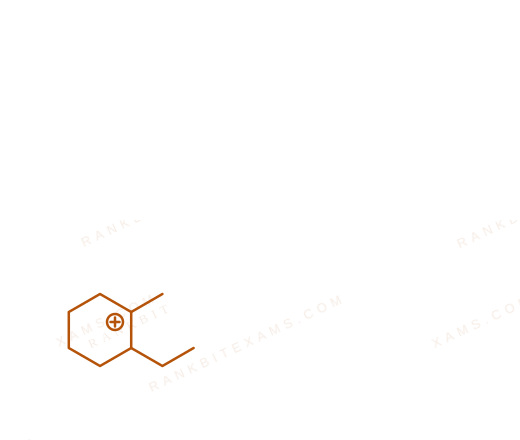
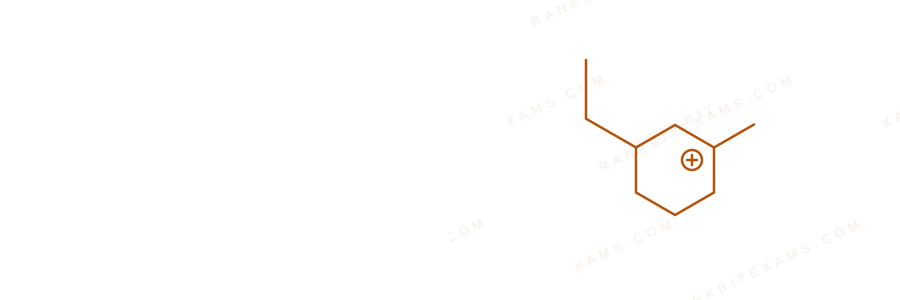
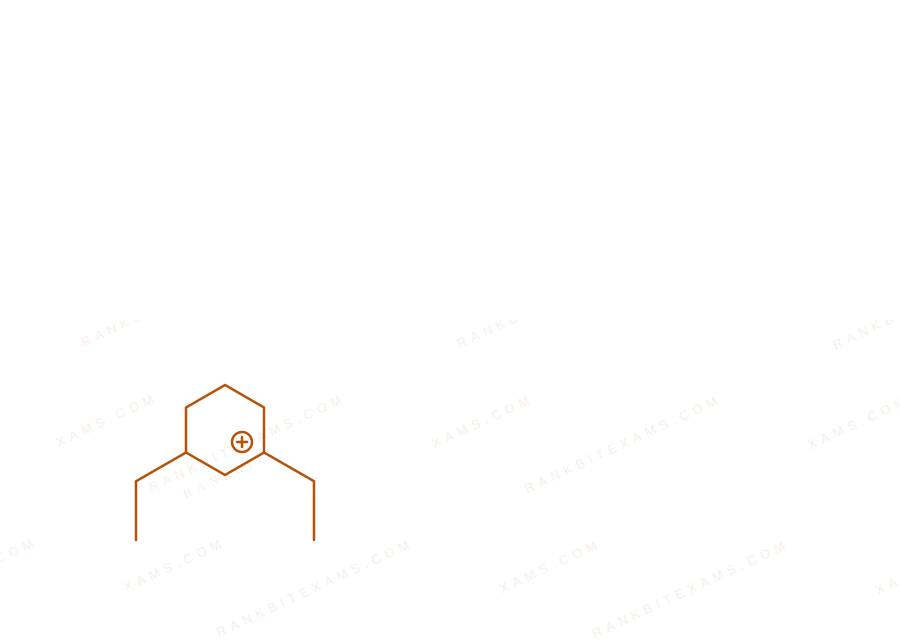
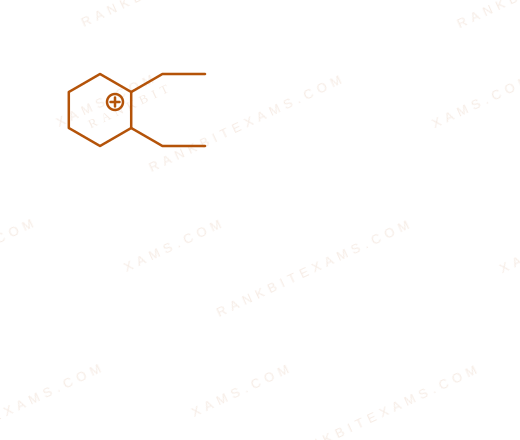
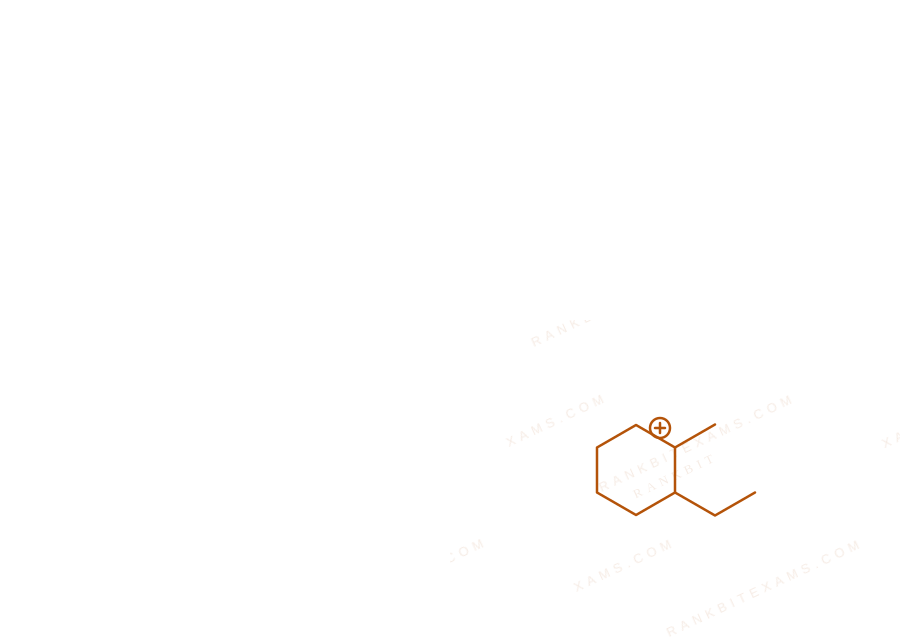
The cyclic cations having the same number of hyperconjugation are :
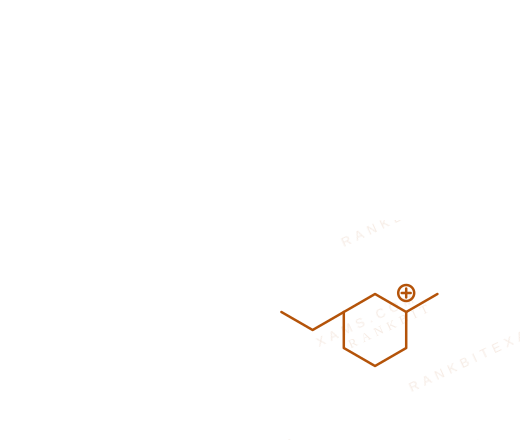
A. Hyperconjugation
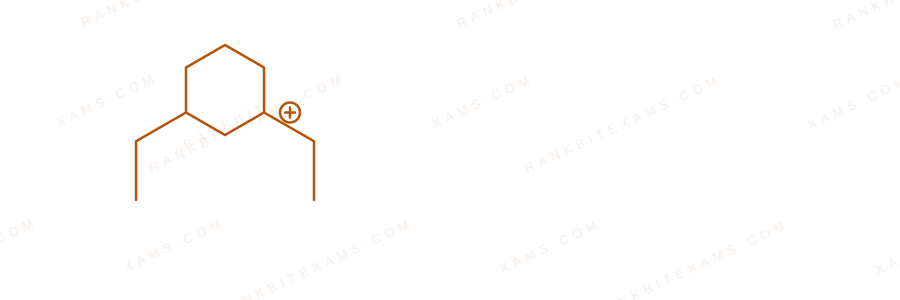
B. Hyperconjugation
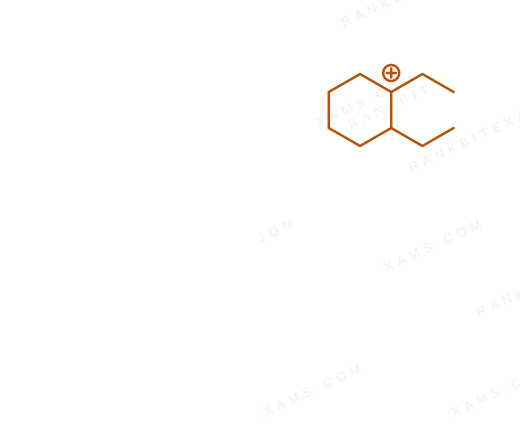
C. Hyperconjugation
D. Hyperconjugation
Choose the correct answer from the options given below :
A.(1) A and C Only$(1)\text{ A and C Only}$
B.(2) B and C Only$(2)\text{ B and C Only}$
C.(3) A and B Only$(3)\text{ A and B Only}$
D.(4) A, C and D only$(4)\text{ A, C and D only}$
Solution
Core Logic
Count the number of alpha hydrogens (α-H$\alpha-H$) adjacent to the carbocation in each structure.
(A) Hyperconjugationα-H = 6$\alpha-H = 6$
(B) Hyperconjugationα-H = 7$\alpha-H = 7$
(C) Hyperconjugationα-H = 6$\alpha-H = 6$
(D) Hyperconjugationα-H = 5$\alpha-H = 5$
Step 1: Final Conclusion
Both cations (A) and (C) have 6 α$\alpha$-hydrogens, meaning they share the same number of hyperconjugative structures.
Pattern Recognition
Hyperconjugation count corresponds strictly to the number of C-H$C-H$ bonds on the carbon atoms immediately adjacent (sp³$sp^3$) to the positive center.
Chapter Mix
Class 11 Chemistry: Organic Chemistry - Some Basic Principles and Techniques
Q70jee_main_2026_28_january_eveningQuantitative Analysis Of Elements
A student has been given 0.314 g$0.314\text{ g}$ of an organic compound and asked to estimate Sulphur. During the experiment, the student has obtained 0.4813 g$0.4813\text{ g}$ of barium sulphate. The percentage of sulphur present in the compound is
(Given Molar mass in g mol⁻¹$\text{g mol}^{-1}$S:32$S:32$, BaSO₄:233$BaSO_{4}:233$)
A.(1) 42.10%$(1)\text{ 42.10\%}$
B.(2) 63.15%$(2)\text{ 63.15\%}$
C.(3) 21.05%$(3)\text{ 21.05\%}$
D.(4) 48.24%$(4)\text{ 48.24\%}$
Solution
Related Formula
% of S = (32)/(233) × Mass of BaSO₄Mass of organic compound × 100$$\%\text{ of S} = \frac{32}{233} \times \frac{\text{Mass of } BaSO_4}{\text{Mass of organic compound}} \times 100$$
Core Logic
Mass of organic compound = 0.314 g$0.314\text{ g}$
Mass of BaSO₄$BaSO_4$ formed = 0.4813 g$0.4813\text{ g}$
Substituting the values:
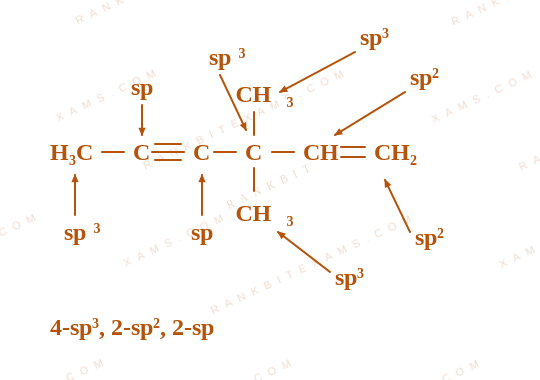
We count the sigma (σ$\sigma$) bonds or pi (π$\pi$) bonds on each carbon:
C₁$\mathrm{C}_1$: Involved in a double bond (CH₂ =$\mathrm{CH_2 =}$) sp²$\implies \mathrm{sp^2}$
C₂$\mathrm{C}_2$: Involved in a double bond (=CH-$=\mathrm{CH-}$) sp²$\implies \mathrm{sp^2}$
C₃$\mathrm{C}_3$: Single bonds only (bonded to C₂$\mathrm{C}_2$, C₄$\mathrm{C}_4$, and two methyl carbons) sp³$\implies \mathrm{sp^3}$
Two methyl carbons attached to C₃$\mathrm{C}_3$: Single bonds only 2 × sp³$\implies 2 \times \mathrm{sp^3}$
C₄$\mathrm{C}_4$: Involved in a triple bond (-C ≡$-\mathrm{C} \equiv$) sp$\implies \mathrm{sp}$
C₅$\mathrm{C}_5$: Involved in a triple bond (≡ C-$\equiv \mathrm{C}-$) sp$\implies \mathrm{sp}$
C₆$\mathrm{C}_6$: Single bonds only (-CH₃$-\mathrm{CH_3}$) sp³$\implies \mathrm{sp^3}$
Step 2: Calculate the Count
Summing the hybridization counts:
sp³$\mathrm{sp^3}$ carbons: C₃$\mathrm{C}_3$, C₆$\mathrm{C}_6$, and 2 × CH₃$2 \times \mathrm{CH_3}$ on C₃$\mathrm{C}_3$= 4$= 4$ carbon atoms
sp²$\mathrm{sp^2}$ carbons: C₁$\mathrm{C}_1$ and C₂$\mathrm{C}_2$= 2$= 2$ carbon atoms
sp$\mathrm{sp}$ carbons: C₄$\mathrm{C}_4$ and C₅$\mathrm{C}_5$= 2$= 2$ carbon atoms
Thus, the number of sp³$\mathrm{sp^3}$, sp²$\mathrm{sp^2}$ and sp$\mathrm{sp}$ hybridized carbons is 4, 2, 2$4, 2, 2$ respectively.
Pattern Recognition
Quick Tip: Always draw side substituents (like methyl groups) explicitly. A common mistake is to skip counting the methyl substituent carbons as sp³$\mathrm{sp^3}$.
Chapter Mix
Class 11 Chemistry: Organic Chemistry - Some Basic Principles and Techniques
Qjee_main_2025_02_april_eveningMethods of Purification of Organic Compounds
Let's align each purification technique to its designated mixtures based on NCERT guidelines:
(A) Simple distillation: Used for liquids having a significant difference in their boiling points (>30~K$>30~\mathrm{K}$ or 30^$30^\circ\mathrm{C}$). Chloroform (b.p. 334~K$334~\mathrm{K}$) and aniline (b.p. 457~K$457~\mathrm{K}$) are separated easily using simple distillation arrow$\rightarrow$(III).
(B) Fractional distillation: Used if boiling point differences of the components are very close (less than 25~K$25~\mathrm{K}$). Separation of petrochemical fractions such as diesel and petrol uses this technique arrow$\rightarrow$(I).
(C) Distillation under reduced pressure: Used for liquids that tend to decompose at or below their normal boiling points. Glycerol is separated from spent-lye in soap manufacturing industry using this vacuum method to prevent glycerol decomposition arrow$\rightarrow$(IV).
(D) Steam distillation: Applied to substances which are steam-volatile and completely immiscible in water. Aniline and water are separated using this technique arrow$\rightarrow$(II).
Step 1: Conclusion
Thus, the correct match is:
(A)-(III), (B)-(I), (C)-(IV), (D)-(II)
This corresponds perfectly to option (4).
Pattern Recognition
Glycerol from spent-lye is a highly tested practical chemistry concept. Remember that vacuum distillation lowers the boiling point, permitting evaporation without decomposition.
Chapter Mix
Class 11 Chemistry: Organic Chemistry - Some Basic Principles and Techniques
In Dumas' method for estimation of nitrogen, 0.5 gram of an organic compound gave 60~mL$60~\mathrm{mL}$ of nitrogen collected at 300K$300\mathrm{K}$ temperature and 715~mmHg$715~\mathrm{mmHg}$ pressure. The percentage composition of nitrogen in the compound (Aqueous tension at 300K = 15~mmHg$300\mathrm{K} = 15~\mathrm{mmHg}$) is
A. 1.257
B. 20.87
C. 18.67
D. 12.57
Solution
Related Formula
pN₂ = ptotal - paq$$p_{\mathrm{N_2}} = p_{\text{total}} - p_{\text{aq}}$$nN₂ = pN₂ VR T$$n_{\mathrm{N_2}} = \frac{p_{\mathrm{N_2}} V}{R T}$$% N = Mass of nitrogenMass of organic compound × 100$$\% \mathrm{N} = \frac{\text{Mass of nitrogen}}{\text{Mass of organic compound}} \times 100$$
Core Logic
Dumas' method estimates nitrogen by collecting dry nitrogen gas (N₂$N_2$). We must subtract the aqueous tension (vapor pressure of water) to find the pressure exerted solely by the dry nitrogen gas.
Using the ideal gas law with R = 0.0821~ L~atm~mol⁻¹~K⁻¹$R = 0.0821~\mathrm{L~atm~mol^{-1}~K^{-1}}$, T = 300~K$T = 300~\mathrm{K}$, and V = 60~mL = 60 × 10⁻³~L$V = 60~\mathrm{mL} = 60 \times 10^{-3}~\mathrm{L}$:
Watch out! Always subtract the aqueous tension from the wet gas pressure first to find the dry gas pressure. Forgetting this step is the most common source of error in Dumas calculations.
Chapter Mix
Class 11 Chemistry: Organic Chemistry - Some Basic Principles and Techniques
More Organic Chemistry - Some Basic Principles and Techniques Questions — jee_main_2025_07_april_evening
Practice past-year questions one chapter at a time. Pick an exam → subject → chapter and get every PYQ for that topic — pulled together from all past papers — with the chapter's key formulas alongside.