Mixture of 1text g$1\text{ g}$ each of chlorobenzene, aniline and benzoic acid is dissolved in 50text mL$50\text{ mL}$ ethyl acetate and placed in a separating funnel, 5text M NaOH$5\text{ M NaOH}$ (30text mL$30\text{ mL}$) was added in the same funnel. The funnel was shaken vigorously and then kept aside. The ethyl acetate layer in the funnel contains:
A.textbenzoic acid$\text{benzoic acid}$
B.textbenzoic acid and aniline$\text{benzoic acid and aniline}$
C.textbenzoic acid and chlorobenzene$\text{benzoic acid and chlorobenzene}$
D.textchlorobenzene and aniline$\text{chlorobenzene and aniline}$
Solution & Explanation
### Related Formula
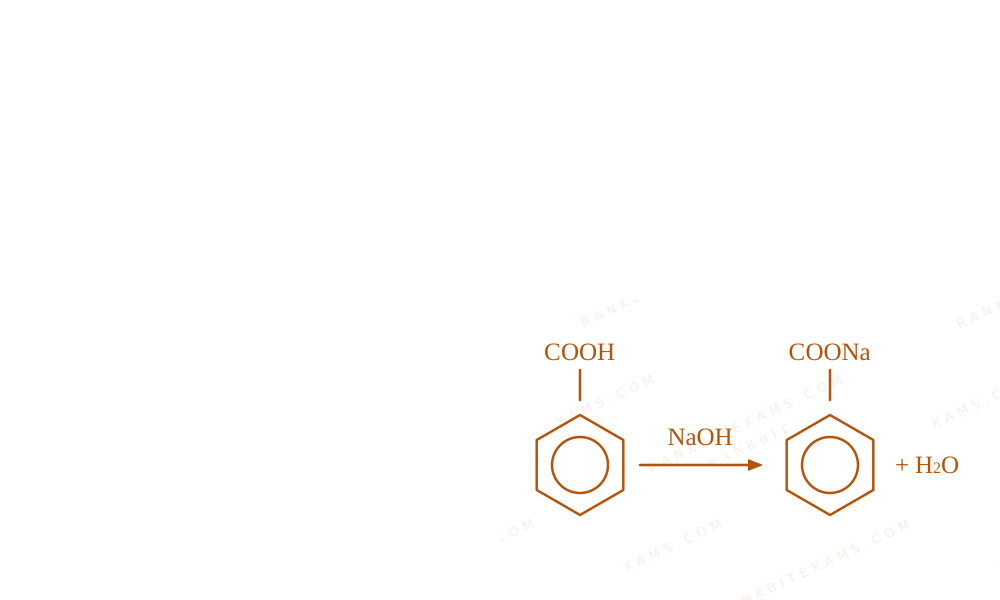
textPh-COOH + textNaOH
ightarrow textPh-COO^-textNa^+ text (Water soluble salt) [cite: 884, 885]$$\text{Ph-COOH} + \text{NaOH}
ightarrow \text{Ph-COO}^-\text{Na}^+ \text{ (Water soluble salt)} [cite: 884, 885]$$
### Core Logic
When aqueous textNaOH$\text{NaOH}$ is added to the mixture:
1. Benzoic acid (textPh-COOH$\text{Ph-COOH}$) reacts to form sodium benzoate (textPh-COONa$\text{Ph-COONa}$), which is highly water-soluble and moves completely into the aqueous layer.
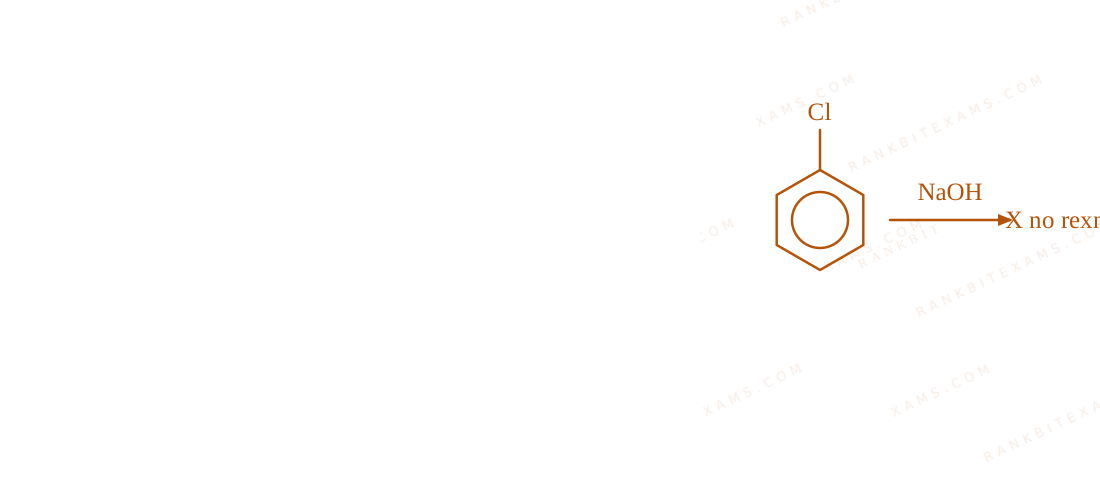
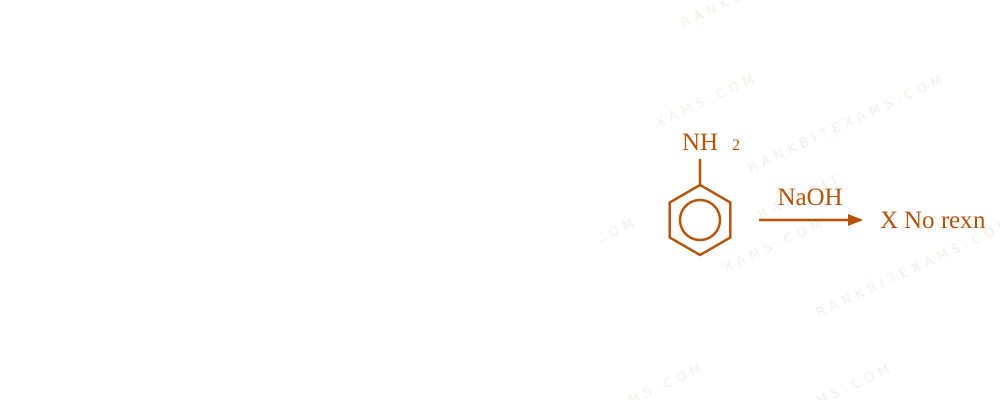
2. Chlorobenzene (textPh-Cl$\text{Ph-Cl}$) and aniline (textPh-NH_2$\text{Ph-NH}_2$) are organic compounds that do not react with aqueous textNaOH$\text{NaOH}$ under normal conditions.
Therefore, they remain unreacted in the organic layer (ethyl acetate).
### Step 1: Visual Reaction Progress
The separation steps can be visualized tracking the structural components:
Separation Techniques diagram for Q27 - JEE Main 2025 EveningSeparation Techniques diagram for Q27 - JEE Main 2025 EveningSeparation Techniques diagram for Q27 - JEE Main 2025 Evening
Thus, the ethyl acetate layer strictly contains chlorobenzene and aniline.
### Pattern Recognition
Acid-base separation shortcut: Strong bases (textNaOH$\text{NaOH}$) pull organic acids into the aqueous phase as salts. Neutral compounds and basic amines stay behind in the organic layer unless a strong acid is added.
### Evaluation Rubric / Model Answer
null
### Chapter Mix
Class 11 Chemistry: Organic Chemistry - Some Basic Principles and Techniques
Class 12 Chemistry: Aldehydes, Ketones and Carboxylic Acids
'Adsorption' principle is used for which of the following purification method?
A.textExtraction$\text{Extraction}$
B.textChromatography$\text{Chromatography}$
C.textDistillation$\text{Distillation}$
D.textSublimation$\text{Sublimation}$
Solution
### Core Logic
The fundamental principle used in chromatography (such as column chromatography or thin-layer chromatography) is adsorption. Different components of a mixture are adsorbed to different extents on an adsorbent stationary phase.
### Evaluation Rubric / Model Answer
null
### Chapter Mix
Class 11 Chemistry: Organic Chemistry - Some Basic Principles and Techniques
### Core Logic
(A) Simple distillation is used to separate a mixture of miscible liquids with a sufficiently large difference in their boiling points, such as chloroform and aniline. (A rightarrow$\rightarrow$ IV)
(B) Fractional distillation is used to separate crude oil fractions. (B rightarrow$\rightarrow$ III)
(C) Steam distillation is used to separate steam-volatile substances that are immiscible with water, like an aniline-water mixture. (C rightarrow$\rightarrow$ II)
(D) Distillation under reduced pressure is used for liquids that decompose at or below their normal boiling points, like separating glycerol from spent lye. (D rightarrow$\rightarrow$ I)
### Evaluation Rubric / Model Answer
null
### Chapter Mix
Class 11 Chemistry: Organic Chemistry - Some Basic Principles and Techniques
More Organic Chemistry - Some Basic Principles and Techniques Questions — jee_main_2025_07_april_evening
We Map Every Repeating Question in Competitive Exams.
Say goodbye to generic mock test fatigue. RankBit uses smart analysis to group past exam questions into their foundational Repeating Question Types. Find chapter weightage, track repeating questions, and score higher with targeted practice.
Select Your Target Exam
Choose an exam track below to find formulas per chapter and patterns.
Syncing Exam Intelligence
Mapping formulas and patterns across all tracks…
PATH A — FULL LENGTH PRACTICE
Full Mock Test Hub
Simulate real NTA exam conditions with fully tracked mocks. Time yourself against past papers.
Practice past-year questions one chapter at a time. Pick an exam → subject → chapter and get every PYQ for that topic — pulled together from all past papers — with the chapter's key formulas alongside.