In Dumas' method 292text mg of an organic compound released 50text mL of nitrogen gas (textN_2) at 300text K temperature and 715text mm Hg pressure. [cite: 435, 451] The percentage composition of 'N' in the organic compound is dots % (Nearest integer) [cite: 452, 455] (Aqueous tension at 300text K = 15text mm Hg)

Numerical Answer Type:
Enter a numerical value Answer: 17.5 to 18.5 +4 marks

Solution & Explanation

### Related Formula P_textdry textN_2 = P_texttotal - textAqueous Tension PV = nRT implies n = fracPVRT \%textN = fractextMass of NitrogentextMass of organic compound times 100 ### Core Logic First, isolate the pressure contribution of the dry nitrogen gas: P_textdry textN2 = 715 - 15 = 700text mm Hg = frac700760text atm Using the ideal gas parameters: - V = 50text mL = 0.050text L [cite: 1073, 1076] - T = 300text K - R = 0.0821text L atm mol^-1textK^-1 ### Step 1: Compute Moles and Mass Calculate total moles of textN_2 molecules collected: ntextN2 = fracleft(frac700760 ight) times 0.0500.0821 times 300 approx 1.868 times 10^-3text mol Compute corresponding mass of atomic Nitrogen elements (2 times 14 = 28text g/mol): [cite: 1016, 1017] textMass of N = ntextN2 times 28 = 1.868 times 10^-3 times 28 approx 0.0523text g = 52.3text mg ### Step 2: Calculate Percentage Composition Applying the fraction formulation against total sample mass: [cite: 1021, 1022] \%textN = frac52.3text mg292text mg times 100 approx 17.91\% approx 18\% ### Pattern Recognition Dumas analysis safety check: Always strip away the vapor pressure of water (aqueous tension) from the measured barometric value before computing the chemical molar counts. For standard conditions shortcuts, remember that 1text mole = 22400text mL at STP can act as an alternate path if values are normalized. ### Evaluation Rubric / Model Answer null ### Chapter Mix Class 11 Chemistry: Organic Chemistry - Some Basic Principles and Techniques
Reference Study Guides

More Organic Chemistry - Some Basic Principles and Techniques Previous-Year Questions — Page 8

Q43 jee_main_2025_04_april_morning Resonance Effect and Dipole Moment
Given below are two statements. Statement I: The dipole moment of overset4CH_3-overset3CH=overset2CH-overset1CH=O is greater than CH_3-CH_2-CH_2-CH=O. Statement II: C_1-C_2 bond length of CH_3-CH=CH-CH=O is greater than C_1-C_2 bond length of CH_3-CH_2-CH_2-CH=O. In the light of the above statements, choose the correct answer from the options given below:
  • A. textStatement I is false but Statement II is true
  • B. textBoth Statement I and Statement II are false
  • C. textStatement I is true but Statement II is false
  • D. textBoth Statement I and Statement II are true

Solution

### Core Logic * **Statement I is true:** In the conjugated system (CH_3-CH=CH-CH=O), extended resonance delocalization occurs, shifting electron density toward the carbonyl oxygen: CH_3-oversetoplusCH-CH=CH-oversetominusO This configuration increases both the partial charge separation q and the dipole distance d, resulting in a significantly larger net dipole moment mu = q times d compared to the non-conjugated saturated aldehyde. * **Statement II is false:** Due to resonance conjugation, the single bond between C_1 and C_2 acquires partial double-bond character. This double-bond character shortens the bond length, making it smaller than the standard single bond found in CH_3-CH_2-CH_2-CH=O. ### Pattern Recognition Conjugation spreads partial charges across a longer carbon chain, expanding the charge separation distance to drive up the overall dipole moment mu. ### Evaluation Rubric / Model Answer null ### Chapter Mix Class 11 Chemistry: Organic Chemistry - Some Basic Principles and Techniques
Q46 jee_main_2025_04_april_morning Quantitative Analysis
In Dumas' method for estimation of nitrogen, 1mathrm~g of an organic compound gave 150mathrm~mL of nitrogen collected at 300mathrm~K temperature and 900mathrm~mmHg pressure. The percentage composition of nitrogen in the compound is _______ % (nearest integer). (Aqueous tension at 300mathrm~K = 15mathrm~mmHg)
Numerical Answer. Answer: 20 to 20

Solution

### Related Formula P_textdry N_2 = P_texttotal - P_textaqueous tension PV = nRT implies n = fracPVRT \% N = fractextMass of NitrogentextMass of Organic Compound times 100 ### Core Logic First, calculate the actual pressure exerted by the dry nitrogen gas: P_N_2 = 900 - 15 = 885mathrm~mmHg = frac885760mathrm~atm Convert volume data to liters: V = 150mathrm~mL = 0.15mathrm~L. Using the ideal gas law to determine the moles of N_2 collected: n = fracleft(frac885760right) times 0.150.0821 times 300 = frac1.1645 times 0.1524.63 approx 0.0071mathrm~moles Calculate the total mass of the liberated nitrogen gas: textMass = n times M_textmolar = 0.0071 times 28 = 0.1988mathrm~g Determine the percentage composition relative to the initial 1mathrm~g sample size: \% N = frac0.19881 times 100 = 19.88\% approx 20\% ### Pattern Recognition Always remember to subtract the aqueous tension value first. Failing to correct for water vapor pressure is the most common pitfall in Dumas' method calculations. ### Evaluation Rubric / Model Answer null ### Chapter Mix Class 11 Chemistry: Organic Chemistry - Some Basic Principles and Techniques
Q27 jee_main_2025_07_april_evening Separation Techniques
Mixture of 1text g each of chlorobenzene, aniline and benzoic acid is dissolved in 50text mL ethyl acetate and placed in a separating funnel, 5text M NaOH (30text mL) was added in the same funnel. The funnel was shaken vigorously and then kept aside. The ethyl acetate layer in the funnel contains:
  • A. textbenzoic acid
  • B. textbenzoic acid and aniline
  • C. textbenzoic acid and chlorobenzene
  • D. textchlorobenzene and aniline

Solution

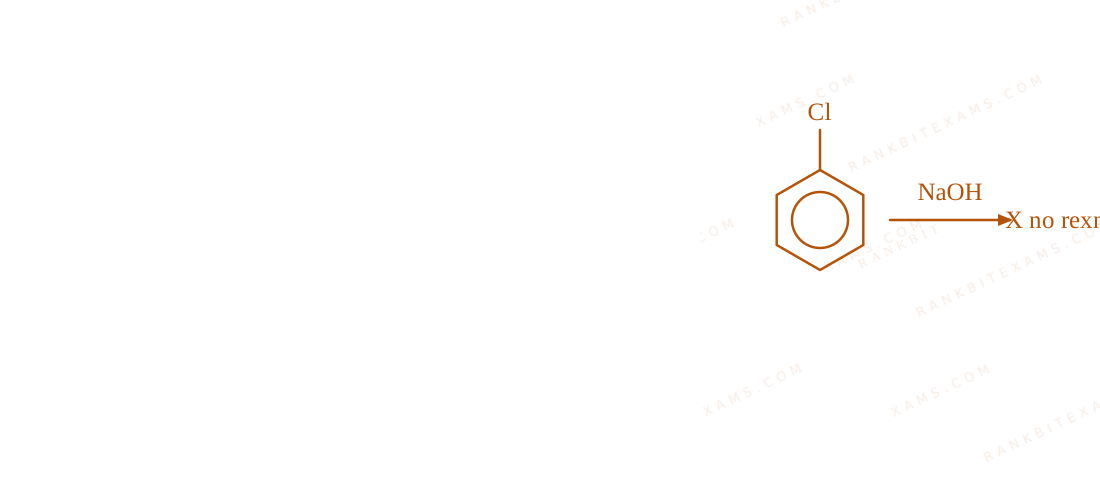
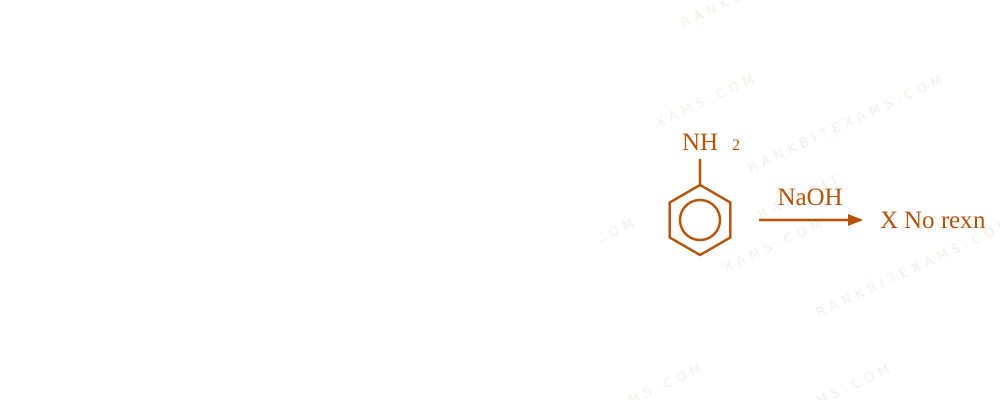
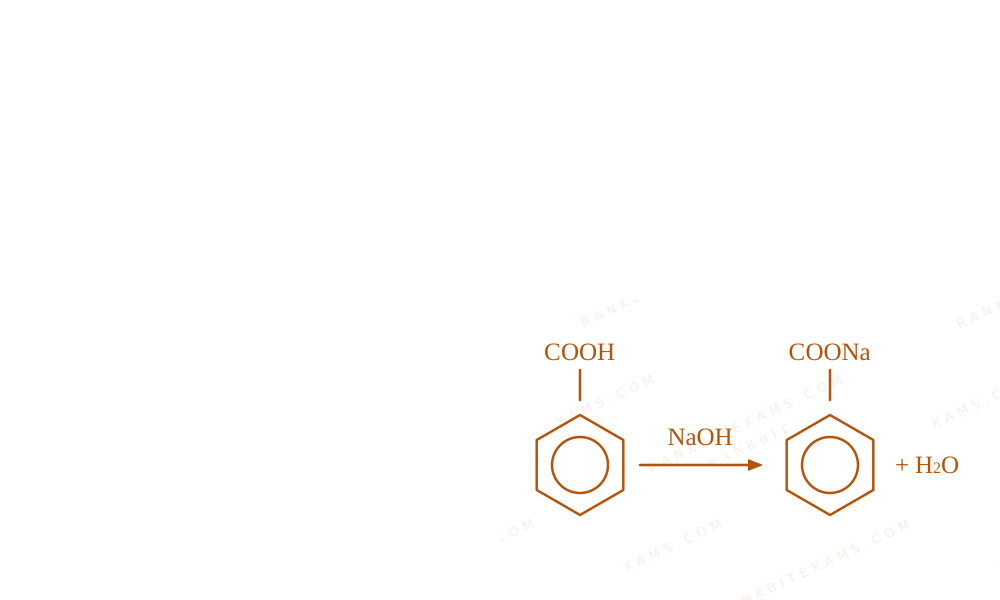
### Related Formula textPh-COOH + textNaOH ightarrow textPh-COO^-textNa^+ text (Water soluble salt) [cite: 884, 885] ### Core Logic When aqueous textNaOH is added to the mixture: 1. Benzoic acid (textPh-COOH) reacts to form sodium benzoate (textPh-COONa), which is highly water-soluble and moves completely into the aqueous layer. 2. Chlorobenzene (textPh-Cl) and aniline (textPh-NH_2) are organic compounds that do not react with aqueous textNaOH under normal conditions. Therefore, they remain unreacted in the organic layer (ethyl acetate). ### Step 1: Visual Reaction Progress The separation steps can be visualized tracking the structural components:
Separation Techniques diagram for Q27 - JEE Main 2025 Evening
Thus, the ethyl acetate layer strictly contains chlorobenzene and aniline. ### Pattern Recognition Acid-base separation shortcut: Strong bases (textNaOH) pull organic acids into the aqueous phase as salts. Neutral compounds and basic amines stay behind in the organic layer unless a strong acid is added. ### Evaluation Rubric / Model Answer null ### Chapter Mix Class 11 Chemistry: Organic Chemistry - Some Basic Principles and Techniques Class 12 Chemistry: Aldehydes, Ketones and Carboxylic Acids
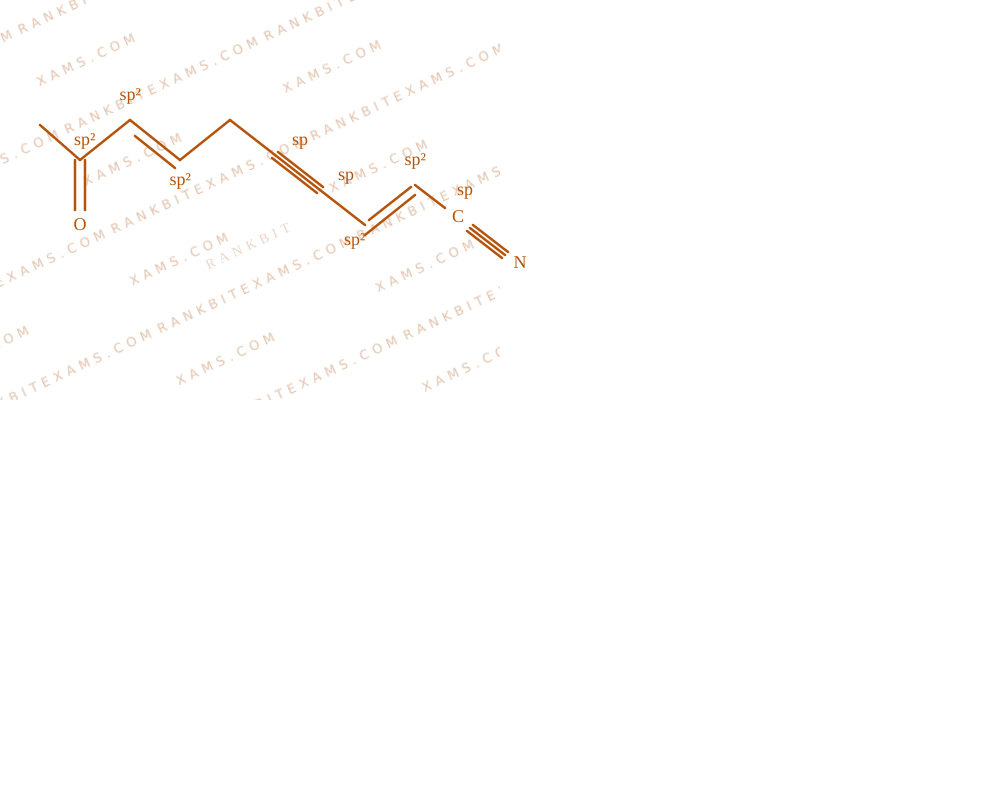
Q30 jee_main_2025_24_jan_evening Hybridization of Carbon
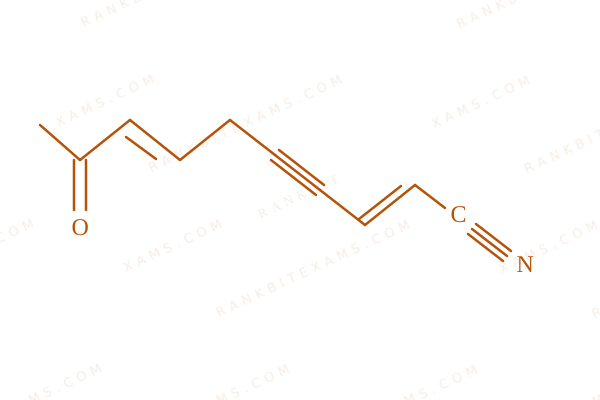
In the given structure, number of sp and sp^2 hybridized carbon atoms present respectively are :
Hybridization of Carbon diagram for Q30 - JEE Main 2025 Evening
The skeletal molecular diagram presents a chain containing carbonyl, double bonds, a triple bond, and a nitrile terminal functional grouping.
  • A. \text{3 and 6}
  • B. \text{3 and 5}
  • C. \text{4 and 6}
  • D. \text{4 and 5}

Solution

### Core Logic To determine carbon atom hybridization within skeletal networks, evaluate the count of steric components (sigma-bonds attached to each carbon): * 4 text sigmatext-bonds ightarrow sp^3 * 3 text sigmatext-bonds ightarrow sp^2 (typically carbons forming one double bond like mathrmC=O or mathrmC=C) * 2 text sigmatext-bonds ightarrow sp (typically carbons forming a triple bond like -mathrmCequiv C- or -mathrmCequiv N) ### Step 1: Specific Atom Assignment Let's perform an audit across the skeletal sequence:
Hybridization of Carbon solution diagram for Q30 - JEE Main 2025 Evening
The skeletal molecular diagram presents a chain containing carbonyl, double bonds, a triple bond, and a nitrile terminal functional grouping.
* sp^2 Carbons: 1. Carbonyl carbon (mathrmC=O) 2. Carbons sharing the first alkene motif (2 atoms) 3. Carbons sharing the second alkene motif (2 atoms) Total sp^2 carbons = 1 + 2 + 2 = 5 * sp Carbons: 1. Carbons bound in the central alkyne group (-mathrmCequiv C-) (2 atoms) 2. Terminal nitrile carbon (-mathrmCequiv N) (1 atom) Total sp carbons = 2 + 1 = 3 ### Pattern Recognition Count all carbons involved in triple bonds (alkynes, nitriles) to find sp items. Count all double-bonded carbons (alkenes, ketones) to quickly isolate the sp^2 population. ### Evaluation Rubric / Model Answer null ### Chapter Mix Class 11 Chemistry: Organic Chemistry - Some Basic Principles and Techniques
More Organic Chemistry - Some Basic Principles and Techniques Questions — jee_main_2025_07_april_evening

Practice all Organic Chemistry - Some Basic Principles and Techniques previous-year questions →

Rankbit System
JEE Physics: Waves (+15.5%) | Electrostatics: Concentric Shells (-29.7%) | Modern Physics: Photoelectric Clones (+34.2%) | Mathematics: Definite Integrals (+18.1%) | Chemistry: Coordination Splitting (-11.4%) | JEE Physics: Waves (+15.5%) | Electrostatics: Concentric Shells (-29.7%) | Modern Physics: Photoelectric Clones (+34.2%) | Mathematics: Definite Integrals (+18.1%) | Chemistry: Coordination Splitting (-11.4%)