In Dumas' method 292text mg of an organic compound released 50text mL of nitrogen gas (textN_2) at 300text K temperature and 715text mm Hg pressure. [cite: 435, 451] The percentage composition of 'N' in the organic compound is dots % (Nearest integer) [cite: 452, 455] (Aqueous tension at 300text K = 15text mm Hg)

Numerical Answer Type:
Enter a numerical value Answer: 17.5 to 18.5 +4 marks

Solution & Explanation

### Related Formula P_textdry textN_2 = P_texttotal - textAqueous Tension PV = nRT implies n = fracPVRT \%textN = fractextMass of NitrogentextMass of organic compound times 100 ### Core Logic First, isolate the pressure contribution of the dry nitrogen gas: P_textdry textN2 = 715 - 15 = 700text mm Hg = frac700760text atm Using the ideal gas parameters: - V = 50text mL = 0.050text L [cite: 1073, 1076] - T = 300text K - R = 0.0821text L atm mol^-1textK^-1 ### Step 1: Compute Moles and Mass Calculate total moles of textN_2 molecules collected: ntextN2 = fracleft(frac700760 ight) times 0.0500.0821 times 300 approx 1.868 times 10^-3text mol Compute corresponding mass of atomic Nitrogen elements (2 times 14 = 28text g/mol): [cite: 1016, 1017] textMass of N = ntextN2 times 28 = 1.868 times 10^-3 times 28 approx 0.0523text g = 52.3text mg ### Step 2: Calculate Percentage Composition Applying the fraction formulation against total sample mass: [cite: 1021, 1022] \%textN = frac52.3text mg292text mg times 100 approx 17.91\% approx 18\% ### Pattern Recognition Dumas analysis safety check: Always strip away the vapor pressure of water (aqueous tension) from the measured barometric value before computing the chemical molar counts. For standard conditions shortcuts, remember that 1text mole = 22400text mL at STP can act as an alternate path if values are normalized. ### Evaluation Rubric / Model Answer null ### Chapter Mix Class 11 Chemistry: Organic Chemistry - Some Basic Principles and Techniques

Reference Study Guides

More Organic Chemistry - Some Basic Principles and Techniques Previous-Year Questions — Page 5

Q42 jee_main_2025_08_april_evening Qualitative Analysis of Functional Groups
Match the reagents in LIST-I with the corresponding chemical functional groups they detect in LIST-II:
LIST-I (Reagent)LIST-II (Functional Group detected)
A. Sodium bicarbonate solutionI. double bond / unsaturation
B. Neutral ferric chlorideII. carboxylic acid
C. Ceric ammonium nitrateIII. phenolic - OH
D. Alkaline textKMnO_4IV. alcoholic - OH
Choose the correct answer from the options given below:
  • A. textA-II, B-III, C-IV, D-I
  • B. textA-II, B-III, C-I, D-IV
  • C. textA-III, B-II, C-IV, D-I
  • D. textA-II, B-IV, C-III, D-I

Solution

### Core Logic Let us review the chemical basis for each qualitative test: * **A. Sodium bicarbonate (textNaHCO_3) solution**: Carboxylic acids are sufficiently acidic to decompose textNaHCO_3, liberating carbon dioxide gas observed as vigorous effervescence. Therefore, textA rightarrow textII. * **B. Neutral ferric chloride (textFeCl_3)**: Phenols react with neutral textFeCl_3 solution to form characteristic deeply colored violet coordination complexes. Therefore, textB rightarrow textIII. * **C. Ceric ammonium nitrate (CAN)**: Alcohols react with CAN reagent to cause a distinct color shift to deep dark red due to complexation. Therefore, textC rightarrow textIV. * **D. Alkaline textKMnO_4 (Baeyer's Reagent)**: Reacts readily via syn-hydroxylation across carbon-carbon double/triple bonds, resulting in decolored solutions alongside brown textMnO_2 precipitates. This detects unsaturation. Therefore, textD rightarrow textI. ### Step 1: Assembly Combining the validated relationships gives: textA-II, B-III, C-IV, D-I This maps perfectly to Option (1). ### Pattern Recognition Baeyer's test (alkaline textKMnO_4) always tests for alkenes/alkynes. textNaHCO_3 is unique for acidic groups like carboxylic acids. Matching these two reliable pairs isolates the correct option without needing to review the entire table. ### Evaluation Rubric / Model Answer null ### Chapter Mix Class 11 Chemistry: Organic Chemistry - Some Basic Principles and Techniques Class 12 Chemistry: Alcohols, Phenols and Ethers

Q28 jee_main_2025_29_jan_evening Chromatographic Techniques
Given below are two statements: Statement (I): In partition chromatography, stationary phase is thin film of liquid present in the inert support. Statement (II): In paper chromatography, the material of paper acts as a stationary phase. In the light of the above statements, choose the correct answer from the options given below:
  • A. Both Statement I and Statement II are false
  • B. Statement I is true but Statement II is false
  • C. Both Statement I and Statement II are true
  • D. Statement I is false but Statement II is true

Solution

### Core Logic Statement I is true: In partition chromatography, the stationary phase is indeed a thin film of liquid held on the surface of an inert solid support. Statement II is false: In paper chromatography, the water molecules trapped inside the cellulose network of the paper act as the stationary phase, not the paper material itself. ### Pattern Recognition Remember that paper chromatography is a type of partition chromatography where moisture content (water) adsorbed on the paper serves as the stationary liquid phase. ### Evaluation Rubric / Model Answer null ### Chapter Mix Class 11 Chemistry: Organic Chemistry - Some Basic Principles and Techniques
Q38 jee_main_2025_29_jan_evening Sigma and Pi Bond Counting
Total number of sigma (sigma) and pi(pi) bonds respectively present in hex-1-en-4-yne are:
  • A. 13 and 3
  • B. 11 and 3
  • C. 3 and 13
  • D. 14 and 3

Solution

### Core Logic The structural formula of hex-1-en-4-yne is given by: CH_2 = CH - CH_2 - C equiv C - CH_3 Let's count the chemical bonds chronologically: * Number of C-H sigma bonds = 2 + 1 + 2 + 3 = 8 * Number of C-C sigma bonds = 5 Total sigma bonds = 8 + 5 = 13.
Sigma and Pi Bond Counting diagram for Q38 - JEE Main 2025 Evening
* Number of pi bonds: 1 from double bond + 2 from triple bond = 3 pi bonds. ### Pattern Recognition Every single bond is 1sigma, every double bond contains 1sigma + 1pi, and every triple bond contains 1sigma + 2pi. ### Evaluation Rubric / Model Answer null ### Chapter Mix Class 11 Chemistry: Organic Chemistry - Some Basic Principles and Techniques
Q49 jee_main_2025_29_jan_evening Quantitative Estimation of Sulphur
In the sulphur estimation, 0.20text g of a pure organic compound gave 0.40text g of barium sulphate. The percentage of sulphur in the compound is x times 10^-1\%, where x = ________. (Molar mass: O=16, S=32, Ba=137text in g mol^-1)
Numerical Answer. Answer: 275 to 275

Solution

### Related Formula %S = frac32233 times fractextMass of BaSO_4textMass of organic compound times 100 ### Core Logic Let's substitute the given values into the formula: textMass of BaSO_4 = 0.40text g textMass of organic compound = 0.20text g textMolar mass of BaSO_4 = 137 + 32 + (4 times 16) = 233text g/mol %S = frac32233 times frac0.400.20 times 100 = frac32 times 2 times 100233 approx 27.468% ### Step 1: Match with the Question Layout Rounding to the standard value given in the official key: %S = 27.5% = 275 times 10^-1% implies x = 275 ### Pattern Recognition Carius method calculations depend heavily on standard conversion factors. The constant factor for sulphur gravimetry is frac32233. ### Evaluation Rubric / Model Answer null ### Chapter Mix Class 11 Chemistry: Organic Chemistry - Some Basic Principles and Techniques
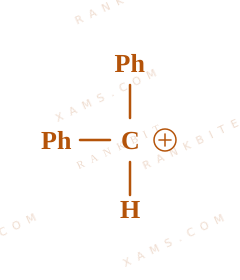
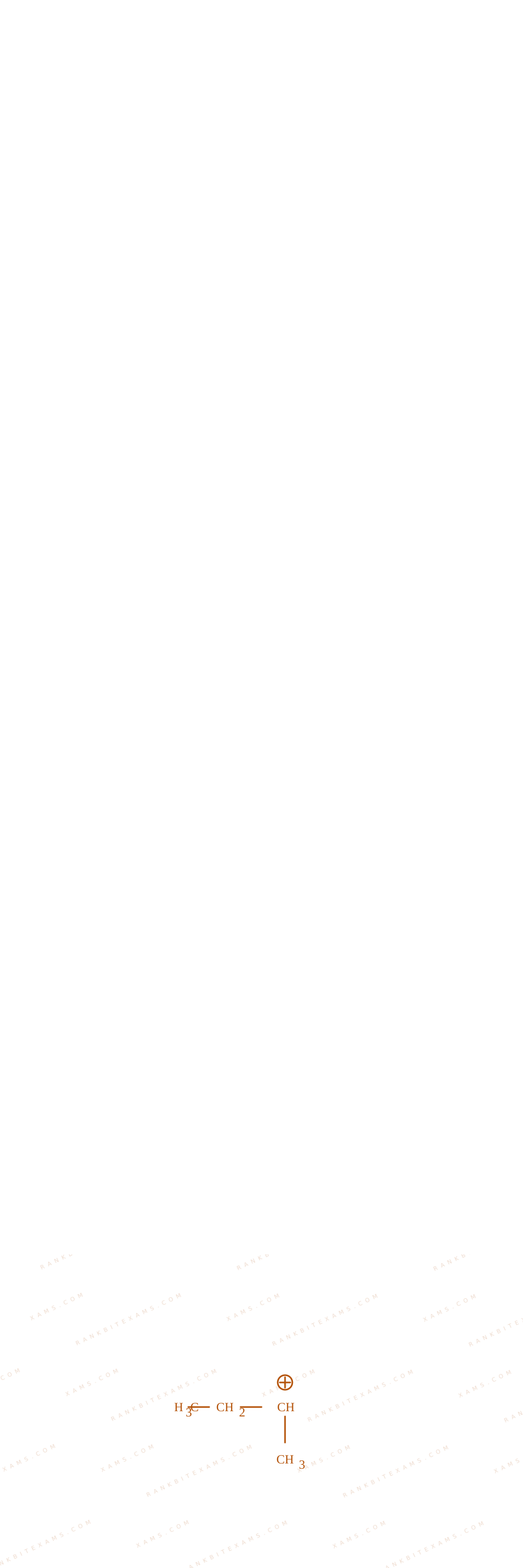
Q42 jee_main_2025_28_jan_morning Carbocation Stability
The correct order of stability of following carbocations is :
Carbocation structures for Q42 - JEE Main 2025 Morning
The images show different structural models labeled A, B, C, and D for evaluating stability variations.
A
Carbocation structures for Q42 - JEE Main 2025 Morning
The images show different structural models labeled A, B, C, and D for evaluating stability variations.
B
Carbocation structures for Q42 - JEE Main 2025 Morning
The images show different structural models labeled A, B, C, and D for evaluating stability variations.
C
Carbocation structures for Q42 - JEE Main 2025 Morning
The images show different structural models labeled A, B, C, and D for evaluating stability variations.
D
  • A. mathrmA > mathrmB > mathrmC > mathrmD
  • B. mathrmB > mathrmC > mathrmA > mathrmD
  • C. mathrmC > mathrmB > mathrmA > mathrmD
  • D. mathrmC > mathrmA > mathrmB > mathrmD

Solution

### Core Logic To evaluate carbocation stability, apply the priority rules: Aromaticity > Resonance > Hyperconjugation. - **C:** Represents a cyclopropenyl cation derivative which achieves full aromatic stabilization due to its planar cyclic conjugated system satisfying Huckel's rule (2pi electrons). This makes it the most stable. - **A:** Stabilized by extended resonance from multiple phenyl groups. - **B:** Contains fewer phenyl rings participating in active cross-conjugation relative to A. - **D:** Stabilized solely by simple aliphatic hyperconjugation, making it the least stable. Visual alignment chart:
Stability ranking structural chart for Q42 - JEE Main 2025 Morning
The images show different structural models labeled A, B, C, and D for evaluating stability variations.
Hence, the correct stability hierarchy is: mathrmC > mathrmA > mathrmB > mathrmD ### Pattern Recognition Sees: Mixed aromatic, benzylic, and aliphatic carbocations. Shortcut: Isolate the cyclopropenyl system as an aromatic champion to confidently lead the sequence. ### Evaluation Rubric / Model Answer null ### Chapter Mix Class 11 Chemistry: Organic Chemistry - Some Basic Principles and Techniques

More Organic Chemistry - Some Basic Principles and Techniques Questions — jee_main_2025_07_april_evening

Practice all Organic Chemistry - Some Basic Principles and Techniques previous-year questions →

Rankbit System
JEE Physics: Waves (+15.5%) | Electrostatics: Concentric Shells (-29.7%) | Modern Physics: Photoelectric Clones (+34.2%) | Mathematics: Definite Integrals (+18.1%) | Chemistry: Coordination Splitting (-11.4%) | JEE Physics: Waves (+15.5%) | Electrostatics: Concentric Shells (-29.7%) | Modern Physics: Photoelectric Clones (+34.2%) | Mathematics: Definite Integrals (+18.1%) | Chemistry: Coordination Splitting (-11.4%)