Rate of SNAr ∝ Number of electron-withdrawing groups (-I, -M) at ortho/para positions$$\text{Rate of } S_N\text{Ar} \propto \text{Number of electron-withdrawing groups (-I, -M) at ortho/para positions} $$
Core Logic
Aryl halides are generally unreactive towards nucleophilic substitution due to resonance stabilization of the C-Cl$\text{C-Cl}$ bond. However, the presence of strong electron-withdrawing groups (-NO₂$-\text{NO}_2$) at ortho and para positions dramatically increases reactivity by stabilizing the intermediate carbanion:
- (A) Chlorobenzene: Needs extreme conditions: NaOH at 623 K, 300 atm$\text{NaOH at } 623\text{ K, } 300\text{ atm}$ (Dow's Process) arrow$\rightarrow$ (IV)
- (B) p-Nitrochlorobenzene: One para -NO₂$-\text{NO}_2$ group softens required temperature to 443 K$443\text{ K}$arrow$\rightarrow$ (III)
- (C) 2,4-Dinitrochlorobenzene: Two electron-withdrawing groups lower needed temperature further to 368 K$368\text{ K}$arrow$\rightarrow$ (II)
- (D) 2,4,6-Trinitrochlorobenzene: Highly activated picryl chloride hydrolyzes smoothly with just warm water arrow$\rightarrow$ (I)
The more -NO₂$-\text{NO}_2$ groups present on the ring, the less aggressive the reagent/temperature setup required. Count -NO₂$-\text{NO}_2$ groups: 0 arrow 623K$0 \rightarrow 623\text{K}$, 1 arrow 443K$1 \rightarrow 443\text{K}$, 2 arrow 368K$2 \rightarrow 368\text{K}$, 3 arrow warm water$3 \rightarrow \text{warm water}$.
Keywords:#Dows process chlorobenzene#JEE Main 2025 Evening Q32#nucleophilic aromatic substitution kinetics#picryl chloride hydrolysis
More Haloalkanes and Haloarenes Previous-Year Questions — Page 2
Q69jee_main_2026_22_january_morningProperties of Halides
As compared with chlorocyclohexane, which of the following statements correctly apply to chlorobenzene?
A. The magnitude of negative charge is more on chlorine atoms
B. The C – Cl bond has partial double bond character
C. C – Cl bond is less polar
D. C – Cl bond is longer due to repulsion between delocalised electrons of the aromatic ring and lone pairs of electrons of chlorine.
E. The C–Cl bond is formed using sp²$sp^{2}$ hybridised orbital of carbon.
Choose the correct answer from the options given below:
A.A, C and E only$\text{A, C and E only}$
B.B, C and D only$\text{B, C and D only}$
C.A, D and E only$\text{A, D and E only}$
D.B, C and E only$\text{B, C and E only}$
Solution
Core Logic
Let's analyze each statement regarding chlorobenzene vs. chlorocyclohexane:
A. Magnitude of negative charge: In chlorobenzene, the lone pair of Cl undergoes +M resonance with the ring. This delocalizes electron density into the ring, reducing the net negative charge on chlorine compared to the purely -I withdrawing Cl in chlorocyclohexane. (False)
B. C-Cl double bond character: The +M effect (resonance) imparts partial double bond character to the C-Cl bond in chlorobenzene. (True)
C. Less polar bond: Because resonance acts opposite to the inductive (-I) effect, the net dipole moment of chlorobenzene (1.5 - 1.6 D) is lower than that of chlorocyclohexane (approx 2.1 D). So the bond is less polar. (True)
D. C-Cl bond is longer: Because of the partial double bond character, the C-Cl bond in chlorobenzene is actually shorter (169 pm) than in chlorocyclohexane (177 pm). (False)
E. Hybridization: The carbon bonded to Cl in chlorobenzene is sp²$sp^2$ hybridized, while in chlorocyclohexane it is sp³$sp^3$ hybridized. (True)
Step 1: Conclusion
The correct statements are B, C, and E only.
Pattern Recognition
Resonance decreases bond length and decreases polarity in aryl halides compared to alkyl halides.
Chapter Mix
Class 12 Chemistry: Haloalkanes and Haloarenes
Q70jee_main_2026_22_january_eveningDibromo Alkylation and Qualitative Tests
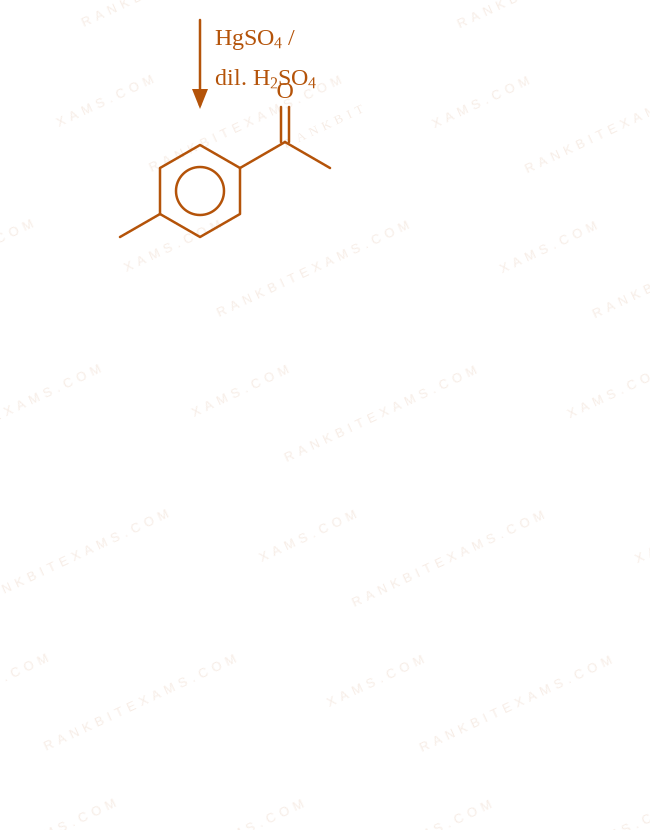
The dibromo compound [P] (molecular formula: C₉H₁₀Br₂$\text{C}_9\text{H}_{10}\text{Br}_2$) when heated with excess sodamide followed by treatment with dilute HCl gives [Q]. On warming [Q] with mercuric sulphate and dilute sulphuric acid yield [R] which gives positive Iodoform test but negative Tollen's test. The compound [P] is:
Step 1: Compound [R] gives positive Iodoform test and negative Tollen's test $\implies$ [R] is a methyl ketone (acetophenone derivative, Ph-CO-CH₃$\text{Ph-CO-CH}_3$).
Step 2: Hydration of alkyne [Q] gives methyl ketone [R] $\implies$ [Q] is phenylacetylene (Ph-C$\text{Ph-C}\equiv\text{CH}$).
Step 3: Double elimination of [P] using excess NaNH₂$\text{NaNH}_2$ gives phenylacetylene [Q] $\implies$ [P] is geminal dibromide 1,1-dibromo-1-phenylethane (Ph-C(Br)₂CH₃$\text{Ph-C(Br)}_2\text{CH}_3$).
Reaction flow of dibromo compound to methyl ketone for Q70 - JEE Main 2026 Evening
Class 12 Chemistry: Haloalkanes and Haloarenes
Class 12 Chemistry: Aldehydes, Ketones and Carboxylic Acids
Q74jee_main_2026_23_january_morningStructural Isomerism and Optical Activity
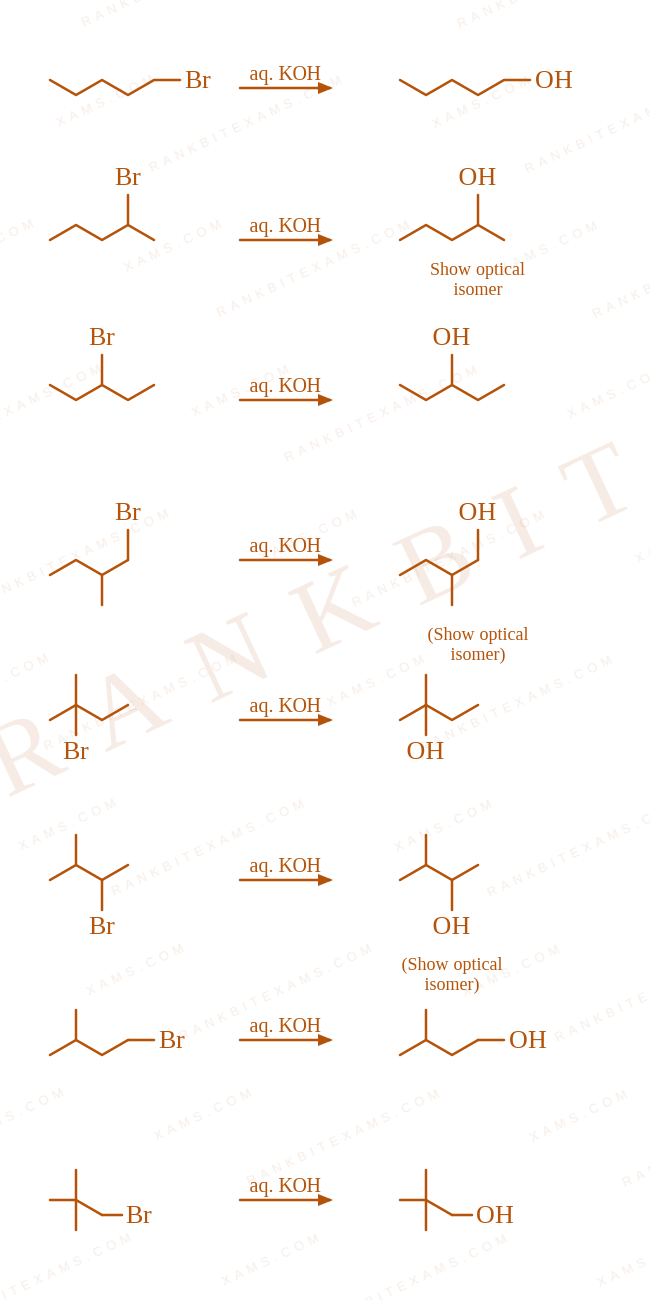
Consider all the structural isomers with molecular formula C₅H₁₁Br$C_{5}H_{11}Br$ are separately treated with KOH (aq) to give respective substitution products, without any rearrangement. The number of products which can exhibit optical isomerism from these is ____.
Numerical Answer.Answer: 3 to 3
Solution
Core Logic
First, identify all structural isomers of C₅H₁₁Br$C_5H_{11}Br$. Aqueous KOH will simply replace the -Br$-Br$ with an -OH$-OH$ group via nucleophilic substitution without rearrangement.
Then, check which of the resulting C₅H₁₁OH$C_5H_{11}OH$ products possess a chiral center.
Structural Isomerism and Optical Activity diagram for Q74 - JEE Main 2026 Morning
Total structurally distinct products exhibiting optical isomerism is 3.
Pattern Recognition
To quickly spot a chiral center in a standard alkane chain, look for a carbon bonded to -OH$-OH$, -H$-H$, a methyl group, and a longer alkyl chain. Any symmetry kills chirality (like 3-pentanol).
Chapter Mix
Class 12 Chemistry: Haloalkanes and Haloarenes
Class 12 Chemistry: Alcohols Phenols and Ethers
Class 11 Chemistry: Organic Chemistry Some Basic Principles and Techniques
Q61jee_main_2026_24_january_morningNomenclature of Haloalkanes
(A) Vinyl Chloride is a haloalkene where chlorine is directly attached to the sp²$sp^2$ carbon of a double bond: CH₂=CHCl$CH_2=CHCl$. So, A matches with III.
(B) Benzyl chloride is a compound where chlorine is attached to an sp³$sp^3$ hybridized carbon directly linked to a benzene ring (C₆H₅CH₂Cl$C_6H_5CH_2Cl$). Structure IV represents this. So, B matches with IV.
(C) Alkyl chloride represents a standard saturated aliphatic chain attached to a chlorine atom, such as isopropyl chloride: CH₃-CH(Cl)CH₃$CH_3-CH(Cl)CH_3$. So, C matches with II.
(D) Allyl chloride features a chlorine attached to an sp³$sp^3$ carbon that is adjacent to a carbon-carbon double bond: CH₂=CH-CH₂Cl$CH_2=CH-CH_2Cl$. So, D matches with I.
Step 1: Final Conclusion
The correctly matched pairs are A-III, B-IV, C-II, D-I.
Pattern Recognition
Vinyl = directly on double bond. Allyl = one carbon away from double bond. Benzyl = one carbon away from phenyl ring.
Chapter Mix
Class 12 Chemistry: Haloalkanes and Haloarenes
Q67jee_main_2026_24_january_morningStereochemistry and Bond Strength
Given below are two statements:
Statement I : C-Cl$\text{C-Cl}$ bond is stronger in CH₂=CH-Cl$CH_2=CH-Cl$ than CH₃-CH₂-Cl$CH_3-CH_2-Cl$
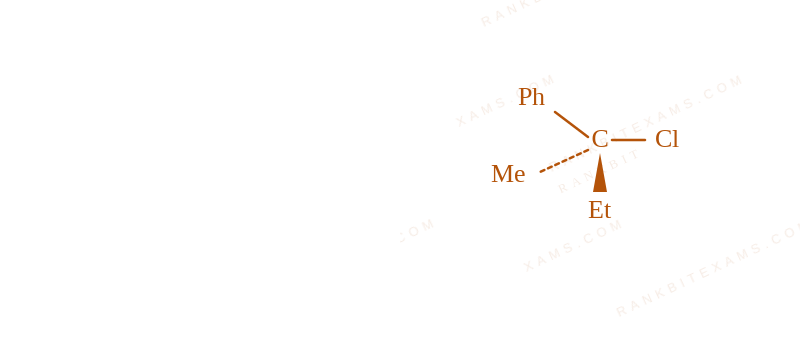
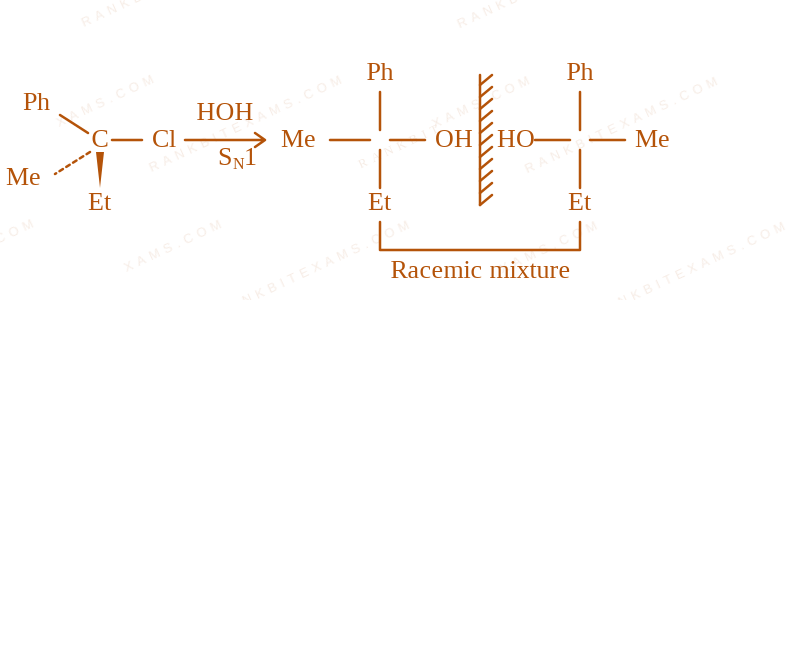
Statement II : The given optically active molecule,
A chiral tertiary alkyl chloride with Phenyl, Methyl, Ethyl and Chloro groups attached to the central carbon.
on hydrolysis gives a solution that can rotate the plane polarized light.
In the light of the above statements, choose the correct answer from the options given below
A.Statement I is false but Statement II is true$\text{Statement I is false but Statement II is true}$
B.Both Statement I and Statement II are true$\text{Both Statement I and Statement II are true}$
C.Both Statement I and Statement II are false$\text{Both Statement I and Statement II are false}$
D.Statement I is true but Statement II is false$\text{Statement I is true but Statement II is false}$
Solution
Core Logic
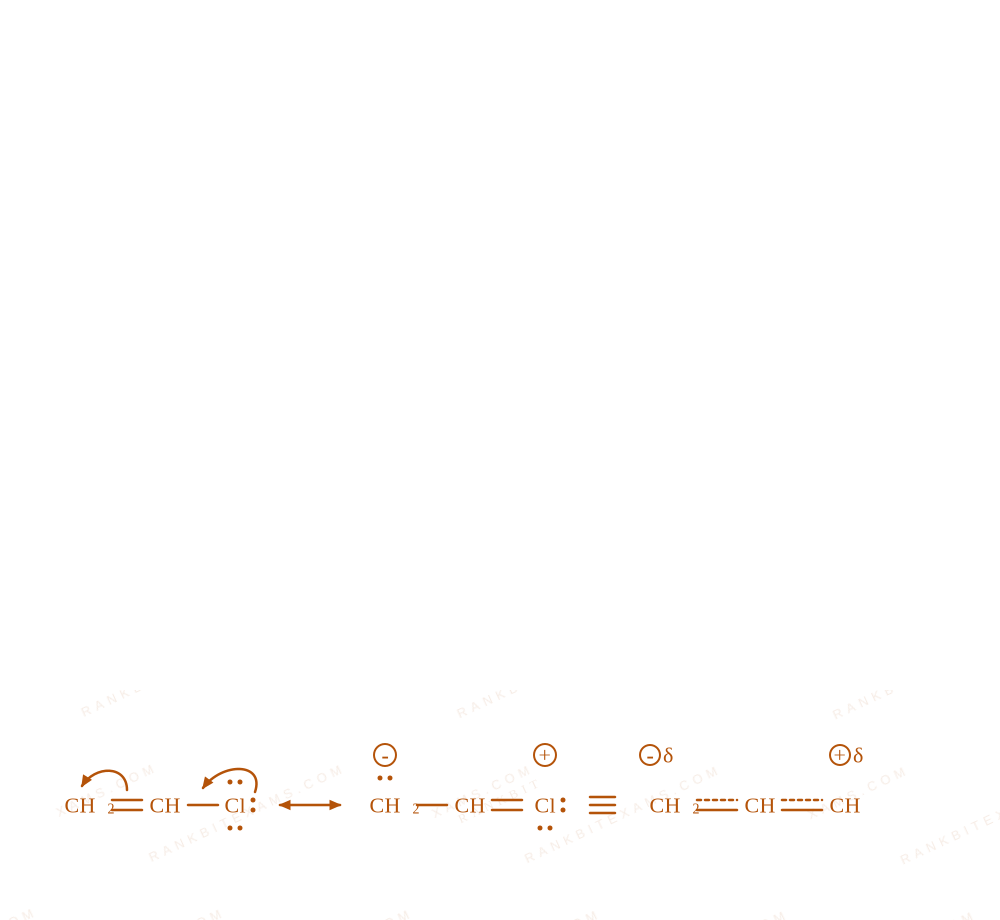
Statement I: CH₂=CH-Cl$CH_2=CH-Cl$ is vinyl chloride. The lone pair on chlorine participates in resonance with the adjacent double bond. This imparts a partial double bond character to the C-Cl$\text{C-Cl}$ bond, making it shorter and stronger than the pure single C-Cl$\text{C-Cl}$ bond in CH₃-CH₂-Cl$CH_3-CH_2-Cl$ (ethyl chloride).
A chiral tertiary alkyl chloride with Phenyl, Methyl, Ethyl and Chloro groups attached to the central carbon.
Thus, Statement I is true.
Statement II: The given molecule is a chiral, tertiary alkyl chloride. When it undergoes hydrolysis, it follows an SN1$S_N1$ mechanism because the resulting tertiary carbocation (stabilized by resonance from the phenyl ring and hyperconjugation) is very stable. An SN1$S_N1$ reaction proceeds through a planar carbocation intermediate. Attack by water occurs from both faces with near equal probability, resulting in a racemic mixture.
A chiral tertiary alkyl chloride with Phenyl, Methyl, Ethyl and Chloro groups attached to the central carbon.
A racemic mixture is optically inactive; it cannot rotate plane-polarized light. Therefore, Statement II is false.
Step 1: Final Conclusion
Statement I is true but Statement II is false.
Pattern Recognition
Vinyl and aryl halides have partial double bond character due to resonance. SN1$S_N1$ at a chiral center leads to racemization (optically inactive product mix).
Chapter Mix
Class 12 Chemistry: Haloalkanes and Haloarenes
Class 11 Chemistry: Organic Chemistry - Some Basic Principles and Techniques
More Haloalkanes and Haloarenes Questions — jee_main_2025_07_april_evening
Practice past-year questions one chapter at a time. Pick an exam → subject → chapter and get every PYQ for that topic — pulled together from all past papers — with the chapter's key formulas alongside.