Given below are two statements:
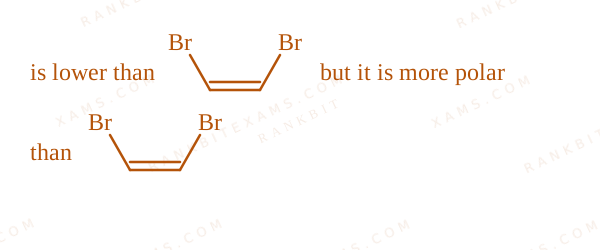
Statement (I): The structural layouts show ortho and para halobenzene isomers (1,2-dichlorobenzene vs 1,2-dibromobenzene, and para-dibromobenzene). is more polar than The structural layouts show ortho and para halobenzene isomers (1,2-dichlorobenzene vs 1,2-dibromobenzene, and para-dibromobenzene)..
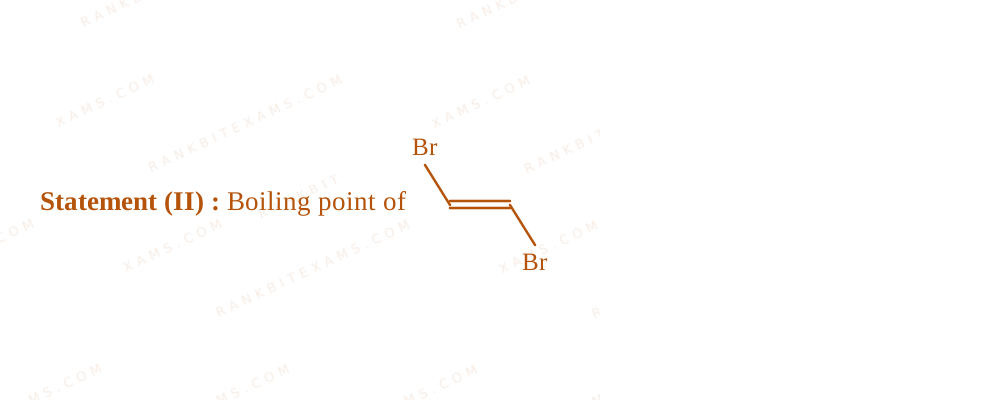
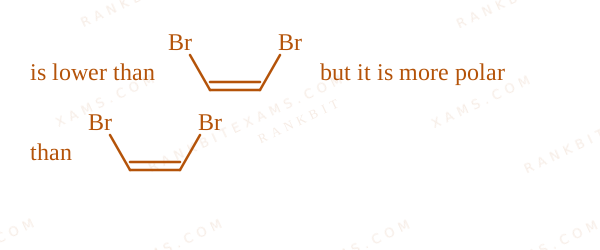
Statement (II): Boiling point of The structural layouts show ortho and para halobenzene isomers (1,2-dichlorobenzene vs 1,2-dibromobenzene, and para-dibromobenzene). is lower than the ortho-isomer, but it is more polar than the meta-isomer.
In the light of the above statements, choose the most appropriate answer from the options given below:
A.Statement I is correct but statement II is incorrect$\text{Statement I is correct but statement II is incorrect}$
B.Statement I is incorrect but statement II is correct$\text{Statement I is incorrect but statement II is correct}$
C.Both statement I and statement II are incorrect$\text{Both statement I and statement II are incorrect}$
D.Both statement I and statement II are correct$\text{Both statement I and statement II are correct}$
Solution & Explanation
Related Formula
μnet = √(μ₁² + μ₂² + 2μ₁μ₂ θ)$$\mu{\text{net}} = \sqrt{\mu_1^2 + \mu_2^2 + 2\mu_1\mu_2\cos\theta} $$Boiling point ∝ Dipole-dipole interactions + Van der Waals forces$$\text{Boiling point} \propto \text{Dipole-dipole interactions} + \text{Van der Waals forces}$$
Core Logic
Let's analyze the visual structures alongside their scientific orientations:
Statement (I) compares 1,2-dichlorobenzene and 1,2-dibromobenzene. Chlorine has a higher electronegativity than bromine, creating a larger bond dipole. The vacant d-orbital interactions do not invert this baseline dipole trend. Thus, 1,2-dichlorobenzene is more polar, making Statement I correct.
Statement (II) evaluates dihalobenzene isomers. For the para-isomer, individual bond dipoles are oriented at 180°$180^{\circ}$, cancelling out completely:
μpara = 0$$\mu{\text{para}} = 0 $$
Since μmeta > 0$\mu_{\text{meta}} > 0$, the para-isomer is less polar than the meta-isomer. This directly falsifies Statement II.
Step 1: Spatial Alignments
The geometric configurations map out as follows:
The structural layouts show ortho and para halobenzene isomers (1,2-dichlorobenzene vs 1,2-dibromobenzene, and para-dibromobenzene).
Hence, Statement I is correct, but Statement II is incorrect.
Pattern Recognition
Dipole tracking rule: Para-substituted benzenes with identical groups possess a structural center of inversion, guaranteeing a net dipole moment of exactly zero (μ = 0$\mu = 0$). They can never be more polar than any asymmetric ortho or meta structural isomer.
Keywords:#dipole moment of dihalobenzene#JEE Main 2025 Evening Q42#boiling point trends isomers#para isomer symmetry cancellation#ortho-isomer#para-isomer#dipole moment structural field
More Haloalkanes and Haloarenes Previous-Year Questions — Page 8
Q74jee_main_2024_30_jan_morningClassification
Given below are two statement one is labeled as Assertion (A) and the other is labeled as Reason (R).
Assertion (A): CH₂=CH-CH₂-Cl$CH_2=CH-CH_2-Cl$ is an example of allyl halide
Reason (R): Allyl halides are the compounds in which the halogen atom is attached to sp²$sp^2$ hybridised carbon atom.
In the light of the two above statements, choose the most appropriate answer from the options given below:
A.(A) is true but (R) is false$\text{(A) is true but (R) is false}$
B.Both (A) and (R) are true but (R) is not the correct explanation of (A)$\text{Both (A) and (R) are true but (R) is not the correct explanation of (A)}$
C.(A) is false but (R) is true$\text{(A) is false but (R) is true}$
D.Both (A) and (R) are true and (R) is the correct explanation of (A)$\text{Both (A) and (R) are true and (R) is the correct explanation of (A)}$
Solution
Core Logic
Assertion (A): CH₂=CH-CH₂-Cl$CH_2=CH-CH_2-Cl$ is an allyl halide. This statement is True. The halogen is attached to the carbon adjacent to the double bond (allylic position).
Reason (R): Allyl halides are compounds in which the halogen atom is attached to an sp²$sp^2$ hybridized carbon atom. This statement is False. In allyl halides, the halogen is attached to an sp³$sp^3$ hybridized carbon atom which is next to an sp²$sp^2$ hybridized carbon (C=C double bond).
Step 1: Conclusion
Therefore, (A) is true but (R) is false.
Pattern Recognition
Allylic = sp³$sp^3$ C adjacent to C=C.
Vinylic = sp²$sp^2$ C of the C=C itself.
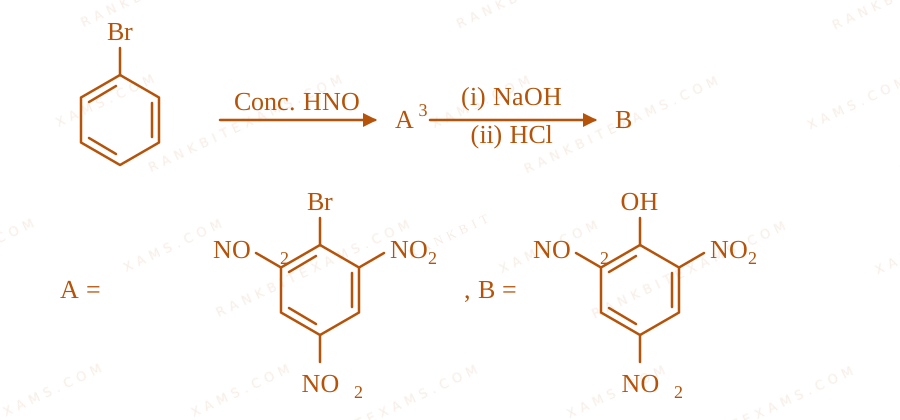
Identify A and B in the following reaction sequence.
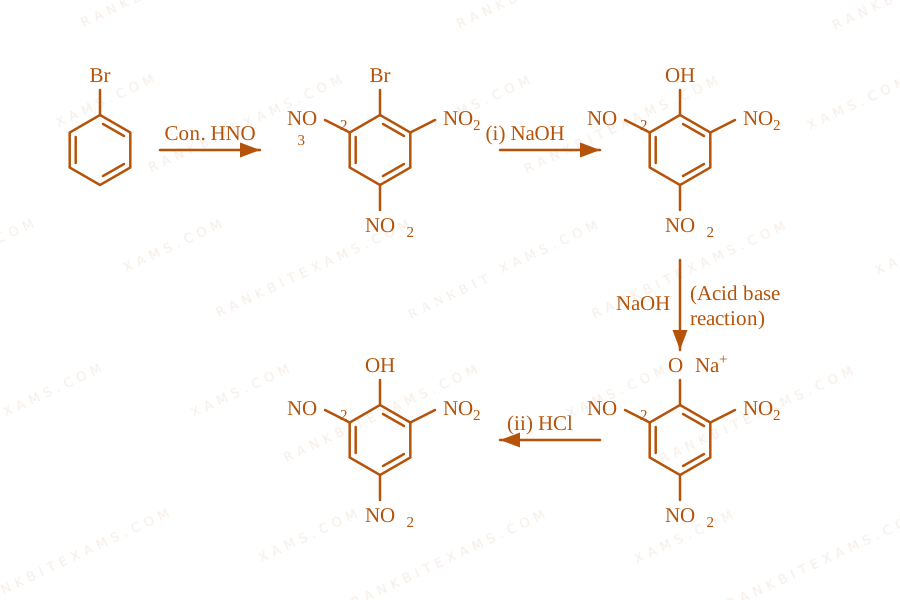
The image shows a reaction scheme starting from bromobenzene undergoing nitration followed by substitution.
A.
B.
C.
D.
Solution
Core Logic
When bromobenzene reacts with concentrated HNO₃$HNO_3$ (nitration), the bromine atom is ortho/para directing. However, under drastic conditions with excess concentrated nitrating mixture, 1-bromo-2,4,6-trinitrobenzene is formed (Compound A).
When 1-bromo-2,4,6-trinitrobenzene (Compound A) is treated with NaOH$NaOH$, the presence of three strong electron-withdrawing -NO₂$-NO_2$ groups activates the aromatic ring toward Nucleophilic Aromatic Substitution (SNAr$S_NAr$). The -Br$-Br$ is easily replaced by -OH$-OH$ to form 2,4,6-trinitrophenol (picric acid).
Subsequent acidification with HCl$HCl$ yields the neutral picric acid (Compound B).
The image shows a reaction scheme starting from bromobenzene undergoing nitration followed by substitution.
Pattern Recognition
Multiple NO₂$NO_2$ groups drastically increase the susceptibility of halobenzenes to SNAr$S_NAr$. Bromine is replaced completely by OH^-$OH^-$ under alkaline conditions.
Chapter Mix
Class 12 Chemistry: Haloalkanes and Haloarenes
Class 12 Chemistry: Alcohols, Phenols and Ethers
Qjee_main_2024_31_jan_eveningIUPAC Nomenclature of Haloalkanes
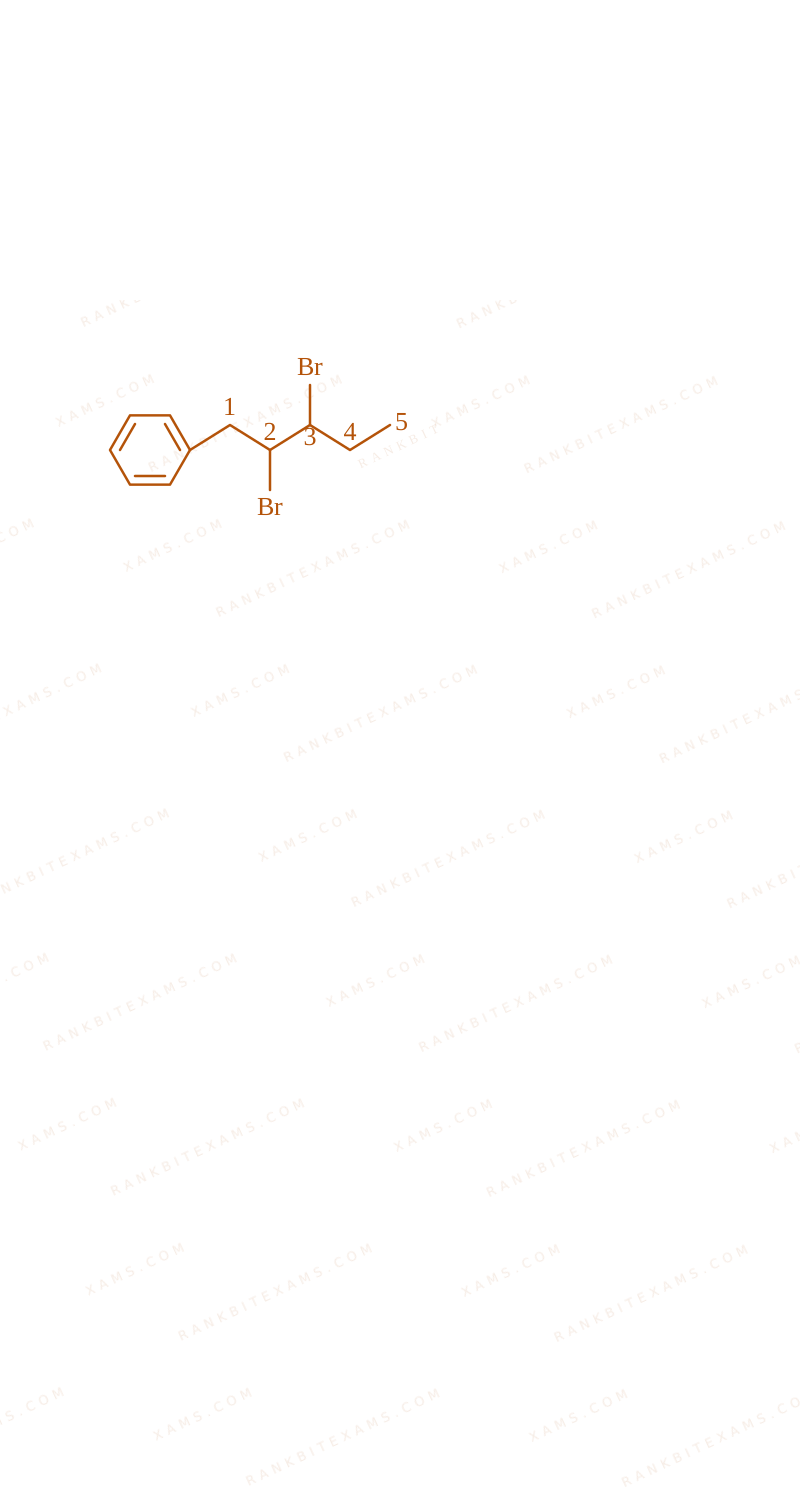
Identify structure of 2,3-dibromo-1-phenylpentane.
A.
B.
C.
D.
Solution
Core Logic
Decode the IUPAC name: 2,3-dibromo-1-phenylpentane.
Parent chain is pentane (5 carbon chain: C1-C2-C3-C4-C5).
Substituents:
Phenyl group at position 1.
Bromo groups at positions 2 and 3.
Option (3) correctly displays a 5-carbon straight chain. The first carbon attaches to the benzene ring (phenyl group), and the second and third carbons each hold a bromine atom.
IUPAC Nomenclature of Haloalkanes diagram for Q67 - JEE Main 2024 Evening
Chapter Mix
Class 12 Chemistry: Haloalkanes and Haloarenes
Qjee_main_2024_31_jan_morningElimination and Addition Reactions
The product (C) in the below mentioned reaction is:
CH₃-CH₂-CH₂-Br [Δ]KOH(alc) A [Δ]HBr B [Δ]KOH(aq) C$$CH_3-CH_2-CH_2-Br \xrightarrow[\Delta]{KOH_{(alc)}} A \xrightarrow[\Delta]{HBr} B \xrightarrow[\Delta]{KOH_{(aq)}} C$$
Q86jee_main_2024_31_jan_morningElimination and Substitution
CH₃CH₂Br + NaOH arrow Product A$$CH_3CH_2Br + NaOH \rightarrow \text{Product A}$$CH₃CH₂Br + NaOH / H₂O arrow Product B$$CH_3CH_2Br + NaOH / H_2O \rightarrow \text{Product B}$$
The total number of hydrogen atoms in product A and product B is
Numerical Answer.Answer: 10 to 10
Solution
Core Logic
Reaction 1:
If the reagent is alcoholic NaOH (implied due to formation of a distinct product A to contrast B), elimination occurs:
Practice past-year questions one chapter at a time. Pick an exam → subject → chapter and get every PYQ for that topic — pulled together from all past papers — with the chapter's key formulas alongside.