Given below are two statements:
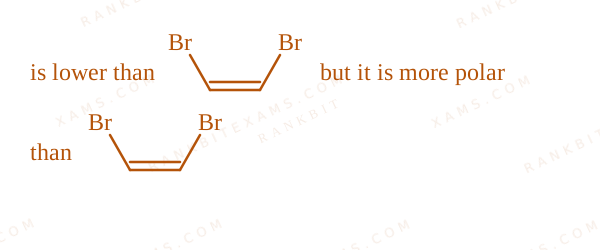
Statement (I): The structural layouts show ortho and para halobenzene isomers (1,2-dichlorobenzene vs 1,2-dibromobenzene, and para-dibromobenzene). is more polar than The structural layouts show ortho and para halobenzene isomers (1,2-dichlorobenzene vs 1,2-dibromobenzene, and para-dibromobenzene)..
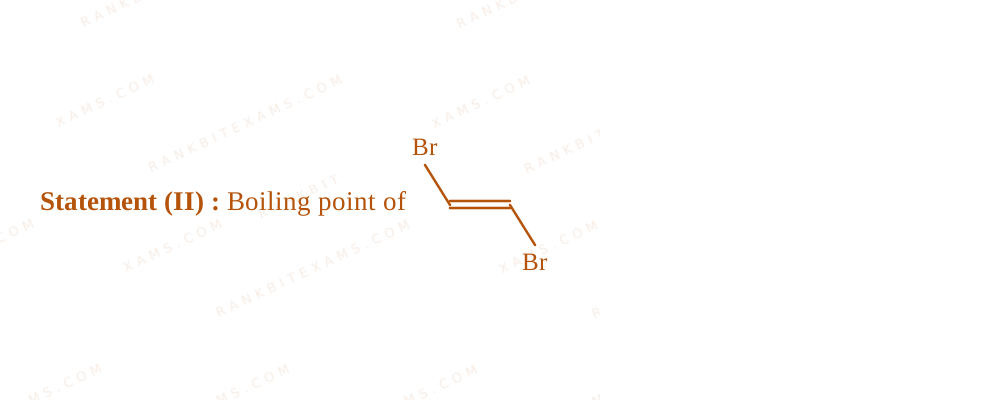
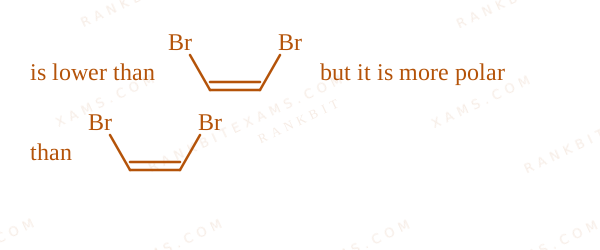
Statement (II): Boiling point of The structural layouts show ortho and para halobenzene isomers (1,2-dichlorobenzene vs 1,2-dibromobenzene, and para-dibromobenzene). is lower than the ortho-isomer, but it is more polar than the meta-isomer.
In the light of the above statements, choose the most appropriate answer from the options given below:
A.Statement I is correct but statement II is incorrect$\text{Statement I is correct but statement II is incorrect}$
B.Statement I is incorrect but statement II is correct$\text{Statement I is incorrect but statement II is correct}$
C.Both statement I and statement II are incorrect$\text{Both statement I and statement II are incorrect}$
D.Both statement I and statement II are correct$\text{Both statement I and statement II are correct}$
Solution & Explanation
Related Formula
μnet = √(μ₁² + μ₂² + 2μ₁μ₂ θ)$$\mu{\text{net}} = \sqrt{\mu_1^2 + \mu_2^2 + 2\mu_1\mu_2\cos\theta} $$Boiling point ∝ Dipole-dipole interactions + Van der Waals forces$$\text{Boiling point} \propto \text{Dipole-dipole interactions} + \text{Van der Waals forces}$$
Core Logic
Let's analyze the visual structures alongside their scientific orientations:
Statement (I) compares 1,2-dichlorobenzene and 1,2-dibromobenzene. Chlorine has a higher electronegativity than bromine, creating a larger bond dipole. The vacant d-orbital interactions do not invert this baseline dipole trend. Thus, 1,2-dichlorobenzene is more polar, making Statement I correct.
Statement (II) evaluates dihalobenzene isomers. For the para-isomer, individual bond dipoles are oriented at 180°$180^{\circ}$, cancelling out completely:
μpara = 0$$\mu{\text{para}} = 0 $$
Since μmeta > 0$\mu_{\text{meta}} > 0$, the para-isomer is less polar than the meta-isomer. This directly falsifies Statement II.
Step 1: Spatial Alignments
The geometric configurations map out as follows:
The structural layouts show ortho and para halobenzene isomers (1,2-dichlorobenzene vs 1,2-dibromobenzene, and para-dibromobenzene).
The structural layouts show ortho and para halobenzene isomers (1,2-dichlorobenzene vs 1,2-dibromobenzene, and para-dibromobenzene).
The structural layouts show ortho and para halobenzene isomers (1,2-dichlorobenzene vs 1,2-dibromobenzene, and para-dibromobenzene).
Hence, Statement I is correct, but Statement II is incorrect.
Pattern Recognition
Dipole tracking rule: Para-substituted benzenes with identical groups possess a structural center of inversion, guaranteeing a net dipole moment of exactly zero (μ = 0$\mu = 0$). They can never be more polar than any asymmetric ortho or meta structural isomer.
Keywords:#dipole moment of dihalobenzene#JEE Main 2025 Evening Q42#boiling point trends isomers#para isomer symmetry cancellation#ortho-isomer#para-isomer#dipole moment structural field
More Haloalkanes and Haloarenes Previous-Year Questions — Page 7
The correct statement regarding nucleophilic substitution reaction in a chiral alkyl halide is;
A. Retention occurs in SN1$S_N1$ reaction and inversion occurs in SN2$S_N2$ reaction.
B. Racemisation occurs in SN1$S_N1$ reaction and retention occurs in SN2$S_N2$ reaction.
C. Racemisation occurs in both SN1$S_N1$ and SN2$S_N2$ reactions.
D. Racemisation occurs in SN1$S_N1$ reaction and inversion occurs in SN2$S_N2$ reaction.
Solution
Core Logic
In an SN1$\text{S}_\text{N}1$ pathway, a planar carbocation intermediate is produced. Attack by the nucleophile can take place with equal probability from either side, resulting in complete/partial racemisation.
In an SN2$\text{S}_\text{N}2$ pathway, the nucleophile attacks exclusively from the backside opposite the leaving group, causing an absolute structural inversion (Walden inversion).
Qjee_main_2024_29_jan_morningPreparation of Haloarenes
Given below are two statements : one is labelled as Assertion A and the other is labelled as Reason R :
Assertion A : Aryl halides cannot be prepared by replacement of hydroxyl group of phenol by halogen atom.
Reason R : Phenols react with halogen acids violently.
In the light of the above statements, choose the most appropriate from the options given below:
A.Both A and R are true but R is NOT the correct explanation of A$\text{Both A and R are true but R is NOT the correct explanation of A}$
B.A is false but R is true$\text{A is false but R is true}$
C.A is true but R is false$\text{A is true but R is false}$
D.Both A and R are true and R is the correct explanation of A$\text{Both A and R are true and R is the correct explanation of A}$
Solution
Core Logic
Assertion (A): In phenols, the C-O$C-O$ bond possesses partial double bond character due to resonance (the lone pair of oxygen delocalizes into the benzene ring). Because of this strong C-O$C-O$ bond, nucleophilic substitution reactions where a halide ion would replace the hydroxyl group do not occur under normal conditions. Thus, aryl halides cannot be prepared directly from phenols by reaction with HX$HX$. The statement is True.
Reason (R): Phenols do NOT react violently with halogen acids. In fact, they practically do not react with halogen acids (HX$HX$) to form aryl halides because the C-O$C-O$ bond is difficult to break. The statement is False.
Step 1: Visualization
Preparation of Haloarenes diagram for Q70 - JEE Main 2024 Morning
Given reason is false.
Step 2: Conclusion
Assertion (A) is correct but Reason (R) is false.
Chapter Mix
Class 12 Chemistry: Haloalkanes and Haloarenes
Class 12 Chemistry: Alcohols Phenols and Ethers
Qjee_main_2024_30_january_eveningStereochemistry of Halogenation
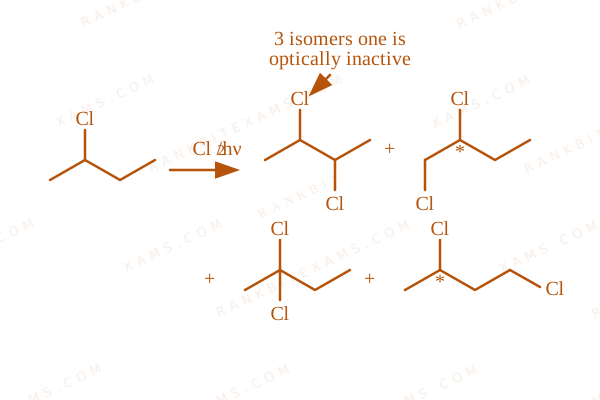
2-chlorobutane + Cl₂ arrow C₄H₈Cl₂ (isomers)$\text{2-chlorobutane} + Cl_2 \rightarrow C_4H_8Cl_2 \text{ (isomers)}$
Total number of optically active isomers shown by C₄H₈Cl₂$C_4H_8Cl_2$, obtained in the above reaction is
Numerical Answer.Answer: 6 to 6
Solution
Core Logic
Free radical chlorination of 2-chlorobutane yields different constitutional isomers of dichlorobutane, each potentially existing as various stereoisomers.
Substrate: CH₃-CH(Cl)-CH₂-CH₃$CH_3-CH(Cl)-CH_2-CH_3$ (exists as 2 enantiomers: d$d$ and l$l$)
Chlorination can occur at 4 different carbons:
At C1: CH₂(Cl)-CH(Cl)-CH₂-CH₃$CH_2(Cl)-CH(Cl)-CH_2-CH_3$ (1,2-dichlorobutane) arrow$\rightarrow$ Two chiral centers, unsymmetrical. Forms 4 optically active isomers (2 pairs of enantiomers).
At C2: CH₃-C(Cl)₂-CH₂-CH₃$CH_3-C(Cl)_2-CH_2-CH_3$ (2,2-dichlorobutane) arrow$\rightarrow$ No chiral center. Achiral (0 optically active).
At C3: CH₃-CH(Cl)-CH(Cl)-CH₃$CH_3-CH(Cl)-CH(Cl)-CH_3$ (2,3-dichlorobutane) arrow$\rightarrow$ Symmetrical with 2 chiral centers. Forms 3 stereoisomers: 1 meso (achiral) and 2 optically active (1 enantiomeric pair).
At C4: CH₃-CH(Cl)-CH₂-CH₂(Cl)$CH_3-CH(Cl)-CH_2-CH_2(Cl)$ (1,3-dichlorobutane, numbering from other end) arrow$\rightarrow$ One chiral center. Forms 2 optically active isomers (1 enantiomeric pair).
Optically active isomers of dichlorobutane diagram for Q89 - JEE Main 2024 Evening
Step 1: Sum the Optically Active Isomers
Total optically active isomers = 4 (from 1,2-dichloro) + 2 (from 2,3-dichloro) + 2 (from 1,3-dichloro) = 8.
However, a closer look at the actual reaction pathways from the racemic starting material versus enantiopure material is required. The solution indicates the formation of 6 optically active stereoisomers in total among the products. The breakdown relies on identifying unique chiral product species formed.
Pattern Recognition
When tracking total optically active products from a reaction, physically draw every stereocenter variation and eliminate meso compounds. Meso compounds have a plane of symmetry and are optically inactive.
Chapter Mix
Class 12 Chemistry: Haloalkanes and Haloarenes
Class 11 Chemistry: Organic Chemistry Some Basic Principles and Techniques
Given below are two statements:
Statement I: High concentration of strong nucleophilic reagent with secondary alkyl halides which do not have bulky substituents will follow SN2$S_N2$ mechanism.
Statement II: A secondary alkyl halide when treated with a large excess of ethanol follows SN1$S_N1$ mechanism.
In the light of the above statements, choose the most appropriate from the questions given below:
A.Statement I is true but Statement II is false.$\text{Statement I is true but Statement II is false.}$
B.Statement I is false but Statement II is true.$\text{Statement I is false but Statement II is true.}$
C.Both statement I and Statement II are false.$\text{Both statement I and Statement II are false.}$
D.Both statement I and Statement II are true.$\text{Both statement I and Statement II are true.}$
Solution
Core Logic
Statement I: Rate of SN2 ∝ [R-X][Nu^-]$S_N2 \propto [R-X][Nu^-]$. Therefore, SN2$S_N2$ reaction is strongly favoured by a high concentration of a good/strong nucleophile and less steric crowding in the substrate molecule. Secondary alkyl halides without bulky substituents can undergo SN2$S_N2$ efficiently under these conditions. Thus, Statement I is true.
Statement II: Ethanol is a weak nucleophile and a polar protic solvent. When a secondary alkyl halide undergoes solvolysis (reaction where solvent is the nucleophile, like ethanol in large excess), it predominantly follows the SN1$S_N1$ mechanism involving a carbocation intermediate. Thus, Statement II is also true.
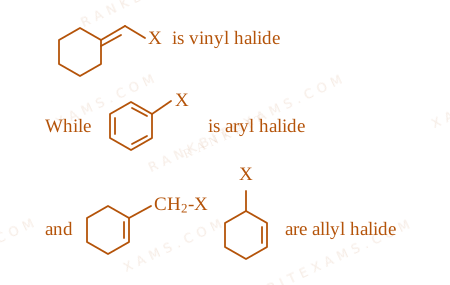
A vinylic halide is a compound where the halogen atom is directly bonded to an sp²$sp^2$ hybridized carbon of an aliphatic double bond (C=C).
Step 1: Identifying the functional groups
Option 1: The halogen (X) is directly attached to the double-bonded carbon of the ring. This is a vinyl halide.
Classification solution diagram for Q69 - JEE Main 2024 Morning
Option 2: The halogen is attached to an aromatic ring directly. This is an aryl halide.
Classification solution diagram for Q69 - JEE Main 2024 Morning
Options 3 & 4: The halogen is attached to an sp³$sp^3$ hybridized carbon adjacent to a C=C double bond. These are allylic halides.
Classification solution diagram for Q69 - JEE Main 2024 Morning
Chapter Mix
Class 12 Chemistry: Haloalkanes and Haloarenes
More Haloalkanes and Haloarenes Questions — jee_main_2025_07_april_evening
Practice past-year questions one chapter at a time. Pick an exam → subject → chapter and get every PYQ for that topic — pulled together from all past papers — with the chapter's key formulas alongside.
 "ortho-isomer, para-isomer, dipole moment structural field")
 "ortho-isomer, para-isomer, dipole moment structural field")
 "ortho-isomer, para-isomer, dipole moment structural field")