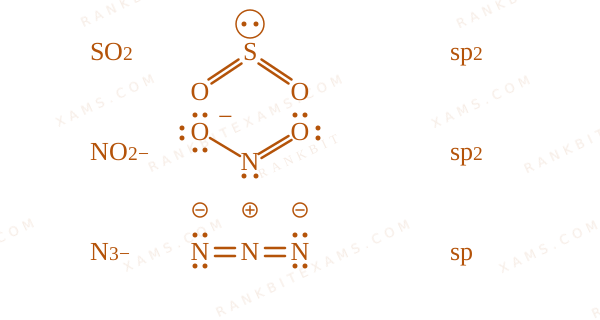
In SO₂$\text{SO}_2$, NO₂^-$\text{NO}_2^-$ and N₃^-$\text{N}_3^-$ the hybridizations at the central atom are respectively:
A.sp², sp² and sp$sp^2\text{, } sp^2 \text{ and } sp$
B.sp², sp and sp$sp^2\text{, } sp \text{ and } sp$
C.sp², sp² and sp²$sp^2\text{, } sp^2 \text{ and } sp^2$
D.sp, sp² and sp$sp\text{, } sp^2 \text{ and } sp$
Solution & Explanation
Related Formula
Steric Number (Steric count) = Number of lone pairs on central atom + Number of σ-bonds$$\text{Steric Number (Steric count)} = \text{Number of lone pairs on central atom} + \text{Number of } \sigma\text{-bonds}$$
Core Logic
Let's perform steric calculations for each species:
SO₂$\text{SO}_2$: Central sulfur atom has 6 valence electrons, forms 2 σ$2\,\sigma$-bonds (and 2 π$2\,\pi$-bonds) with oxygen, leaving 1 lone pair. Steric number = 2 + 1 = 3 sp²$= 2 + 1 = 3 \implies sp^2$.
NO₂^-$\text{NO}_2^-$: Central nitrogen atom has 5 valence electrons + 1$+ 1$ from negative charge = 6$= 6$. It forms 2 σ$2\,\sigma$-bonds, leaving 1 lone pair. Steric number = 2 + 1 = 3 sp²$= 2 + 1 = 3 \implies sp^2$.
N₃^-$\text{N}_3^-$ (Azide ion): Linear configuration structure can be drawn as:
The central nitrogen has 2 σ$2\,\sigma$-bonds and 0 lone pairs. Steric number = 2 + 0 = 2 sp$= 2 + 0 = 2 \implies sp$.
Step 1: Geometry Outlines
The individual orbital fields are represented visually:
Hybridization diagram for Q39 - JEE Main 2025 Evening
Hence, hybridizations follow the order: sp²$sp^2$, sp²$sp^2$, and sp$sp$.
Pattern Recognition
Steric short tracking: Species with linear structures like CO₂, N₂O, N₃^-$\text{CO}_2, \text{N}_2O, \text{N}_3^-$ possess central atoms that are always sp$sp$ hybridized due to the requirement of two opposing σ$\sigma$-bonds.
Chapter Mix
Class 11 Chemistry: Chemical Bonding and Molecular Structure
Keywords:#hybridization of azide ion#JEE Main 2025 Evening Q39#SO2 steric number calculation#chemical bonding molecular geometry
More Chemical Bonding and Molecular Structure Previous-Year Questions — Page 7
Q89jee_main_2024_27_jan_morningMolecular Orbital Theory
Sum of bond order of CO$\text{CO}$ and NO^+$\text{NO}^+$ is $\text{\quad\quad}$.
Numerical Answer.Answer: 6 to 6
Solution
Step 1: Determine the bond order of CO$\text{CO}$
Carbon monoxide (CO$\text{CO}$) contains 6 + 8 = 14$6 + 8 = 14$ total electrons.
Its structural representation is C$\text{C}\equiv\text{O}$, matching a bond order value of 3.
Step 2: Determine the bond order of NO^+$\text{NO}^+$
The nitrosonium ion (NO^+$\text{NO}^+$) contains 7 + 8 - 1 = 14$7 + 8 - 1 = 14$ total electrons.
Since it is isoelectronic with N₂$\text{N}_2$ and CO$\text{CO}$ (14 electrons$14\text{ electrons}$), its corresponding bond order value is also 3.
Step 3: Sum the results
Sum = 3 + 3 = 6$$\text{Sum} = 3 + 3 = 6$$
Pattern Recognition
Isoelectronic species possessing 14 total electrons consistently demonstrate a bond order value of 3.
Chapter Mix
Class 11 Chemistry: Chemical Bonding and Molecular Structure
Q81jee_main_2024_29_jan_morningVSEPR Theory
Number of compounds with one lone pair of electrons on central atom amongst following is
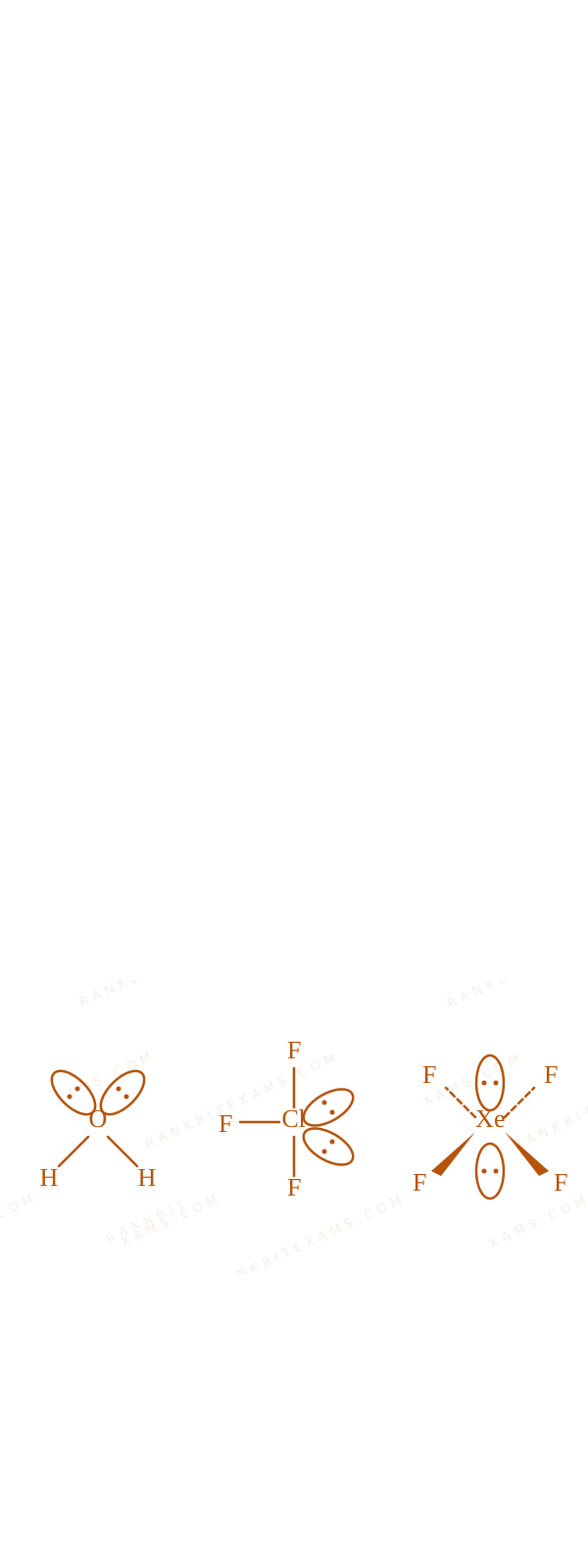
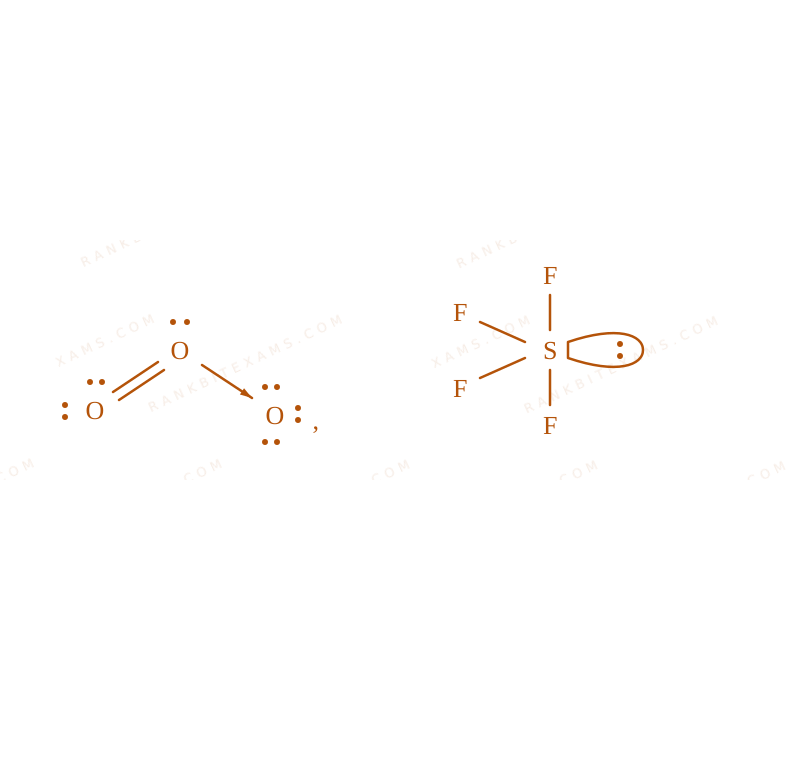
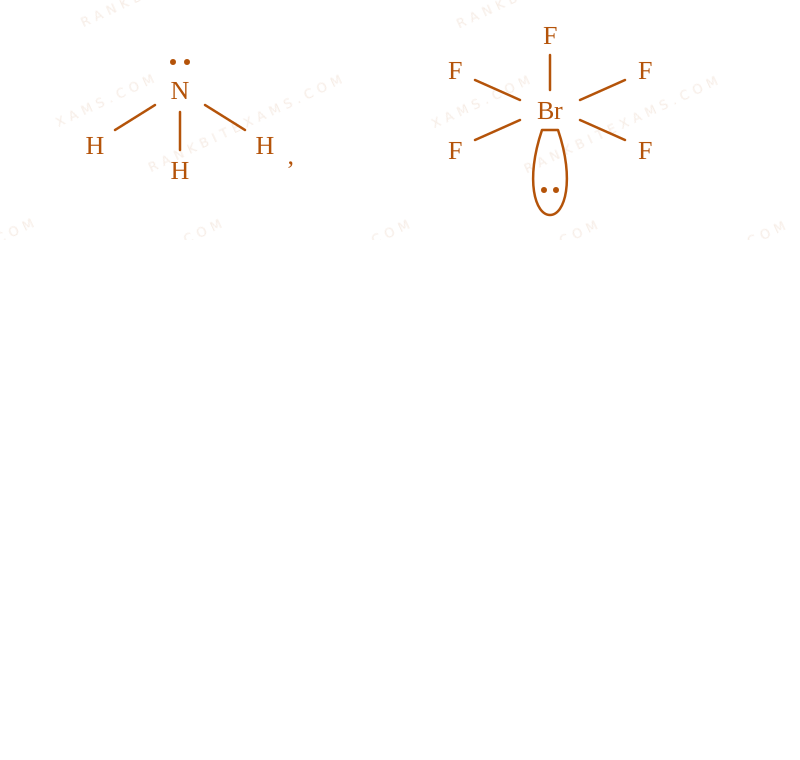
O₃$O_3$, H₂O$H_2O$, SF₄$SF_4$, ClF₃$ClF_3$, NH₃$NH_3$, BrF₅$BrF_5$, XeF₄$XeF_4$
Numerical Answer.Answer: 4 to 4
Solution
Core Logic
Let us determine the steric number (Z$Z$) and number of lone pairs (LP$LP$) for the central atom in each given molecule.
Formula: Z = (1)/(2) (V + M - C + A)$Z = \frac{1}{2} (V + M - C + A)$
Where V$V$ = valence electrons on central atom, M$M$ = number of monovalent atoms, C$C$ = cationic charge, A$A$ = anionic charge.
LP = Z - Bond Pairs (B.P.)$LP = Z - \text{Bond Pairs (B.P.)}$
O₃$O_3$: Central atom O (V=6$V=6$). It forms one double bond and one dative bond. It has 1 lone pair remaining.
H₂O$H_2O$: Central atom O (V=6$V=6$). Z = (1)/(2)(6 + 2) = 4$Z = \frac{1}{2}(6 + 2) = 4$. LP = 4 - 2 = 2$LP = 4 - 2 = 2$.
SF₄$SF_4$: Central atom S (V=6$V=6$). Z = (1)/(2)(6 + 4) = 5$Z = \frac{1}{2}(6 + 4) = 5$. LP = 5 - 4 = 1$LP = 5 - 4 = 1$ (See-saw shape).
VSEPR Theory diagram for Q81 - JEE Main 2024 MorningVSEPR Theory diagram for Q81 - JEE Main 2024 MorningVSEPR Theory diagram for Q81 - JEE Main 2024 Morning
The compounds containing exactly ONE lone pair on the central atom are O₃$O_3$, SF₄$SF_4$, NH₃$NH_3$, and BrF₅$BrF_5$.
Total count = 4.
Chapter Mix
Class 11 Chemistry: Chemical Bonding and Molecular Structure
Q88jee_main_2024_29_jan_morningMolecular Orbital Theory
The number of species from the following which are paramagnetic and with bond order equal to one is
H₂, He₂^+, O₂^+, N₂²⁻, O₂²⁻, F₂, Ne₂^+, B₂$$\mathrm {H}_2, \mathrm{He}_2^+, \mathrm{O}_2^+, \mathrm{N}_2^{2-}, \mathrm{O}_2^{2-}, \mathrm{F}_2, \mathrm{Ne}_2^+, \mathrm{B}_2$$
Numerical Answer.Answer: 1 to 1
Solution
Core Logic
Using Molecular Orbital (MO) Theory, we evaluate the bond order (BO = (Nb - Nₐ)/(2)$BO = \frac{N_b - N_a}{2}$) and magnetic nature (unpaired electrons = paramagnetic, all paired = diamagnetic) for each species:
Species
Magnetic behaviour
Bond order
H₂$H_2$
Diamagnetic
1
He₂^+$He_2^+$
Paramagnetic
0.5
O₂^+$O_2^+$
Paramagnetic
2.5
N₂²⁻$N_2^{2-}$
Paramagnetic
2
O₂²⁻$O_2^{2-}$
Diamagnetic
1
F₂$F_2$
Diamagnetic
1
Ne₂^+$Ne_2^+$
Paramagnetic
0.5
B₂$B_2$
Paramagnetic
1
Step 1: Final Selection
We need the species that satisfies BOTH conditions:
Paramagnetic
Bond Order = 1
Looking at the table, B₂$B_2$ is the only molecule that is paramagnetic (it has 2 unpaired electrons in degenerate π₂ₚ$\pi_{2p}$ orbitals) and has a bond order of 1.
Total number of such species = 1.
Pattern Recognition
B₂$B_2$ (10 electrons) and O₂$O_2$ (16 electrons) are the classic exceptions in MO theory that are paramagnetic despite having an even number of electrons. B₂$B_2$ has BO = 1, and O₂$O_2$ has BO = 2.
Chapter Mix
Class 11 Chemistry: Chemical Bonding and Molecular Structure
Qjee_main_2024_30_january_eveningVSEPR Theory and Molecular Shapes
PCl₅$PCl_5$: sp³d$sp^3d$ hybridization with 0 lone pairs arrow$\rightarrow$ Trigonal Bipyramidal.
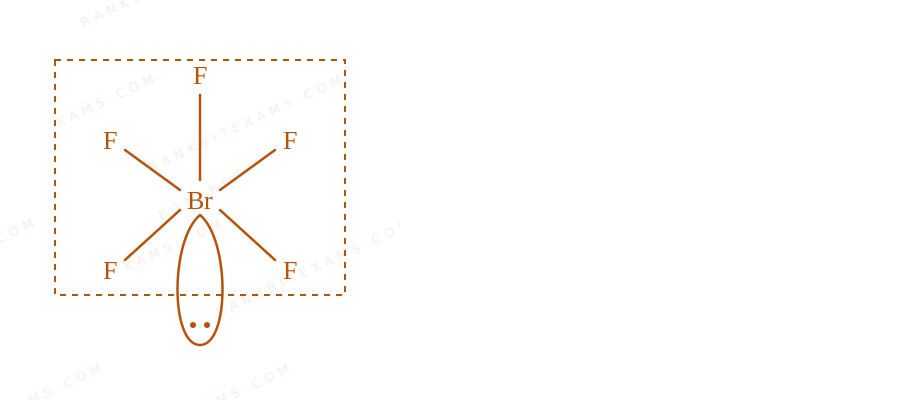
BrF₅$BrF_5$: Bromine has 7 valence electrons. It forms 5 single bonds with Fluorine, leaving 1 lone pair. sp³d²$sp^3d^2$ hybridization arrow$\rightarrow$ geometry is octahedral, but shape is Square Pyramidal.
PF₅$PF_5$: sp³d$sp^3d$ hybridization with 0 lone pairs arrow$\rightarrow$ Trigonal Bipyramidal.
Square Pyramidal structure of BrF5 diagram for Q69 - JEE Main 2024 Evening
Pattern Recognition
AX₅E₁$AX_5E_1$ configuration (5 bond pairs + 1 lone pair) typically yields a Square Pyramidal shape.
Chapter Mix
Class 11 Chemistry: Chemical Bonding and Molecular Structure
Class 12 Chemistry: Coordination Compounds
Qjee_main_2024_30_january_eveningDipole Moment
Given below are two statements:
Statement-I: Since fluorine is more electronegative than nitrogen, the net dipole moment of NF₃$NF_3$ is greater than NH₃$NH_3$.
Statement-II: In NH₃$NH_3$, the orbital dipole due to lone pair and the dipole moment of NH bonds are in opposite direction, but in NF₃$NF_3$ the orbital dipole due to lone pair and dipole moments of N-F bonds are in same direction.
In the light of the above statements. Choose the most appropriate from the options given below.
A.Statement I is true but Statement II is false.$\text{Statement I is true but Statement II is false.}$
B.Both Statement I and Statement II are false.$\text{Both Statement I and Statement II are false.}$
C.Both statement I and Statement II is are true.$\text{Both statement I and Statement II is are true.}$
D.Statement I is false but Statement II is are true.$\text{Statement I is false but Statement II is are true.}$
Solution
Core Logic
Statement I: The net dipole moment of NH₃$NH_3$ (1.47 D$1.47\, D$) is actually greater than that of NF₃$NF_3$ (0.23 D$0.23\, D$). Therefore, Statement I is false.
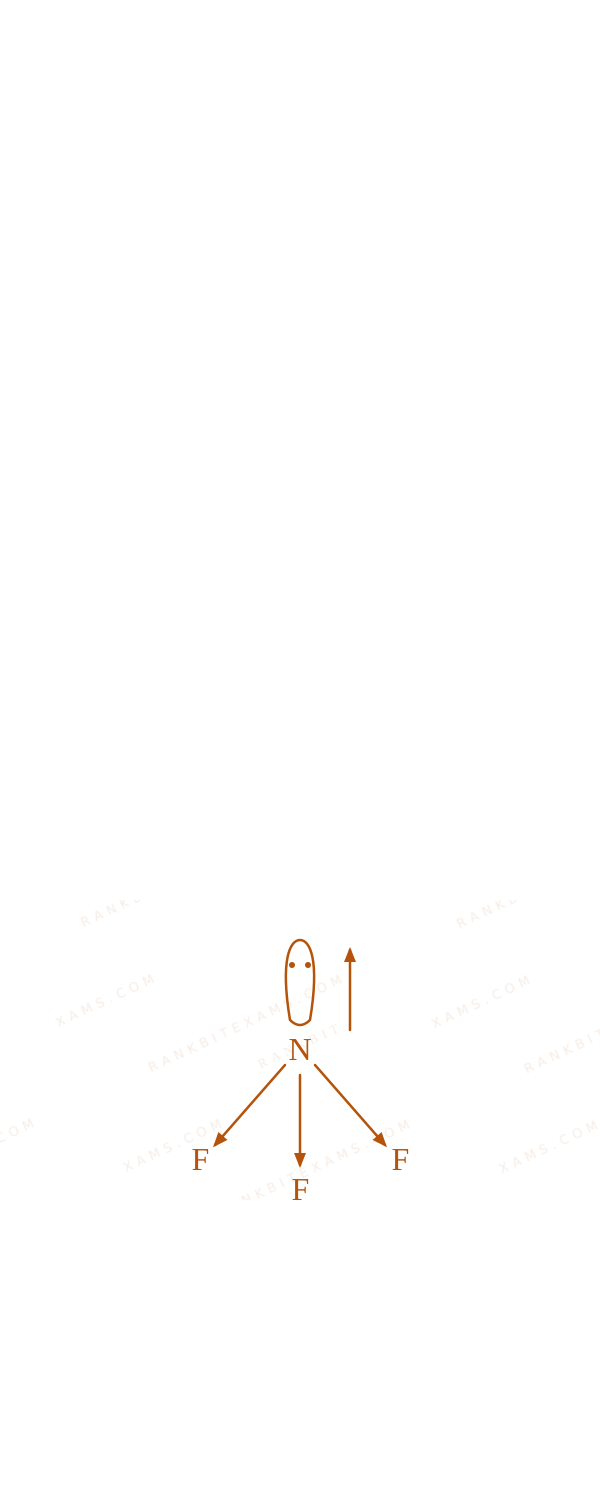
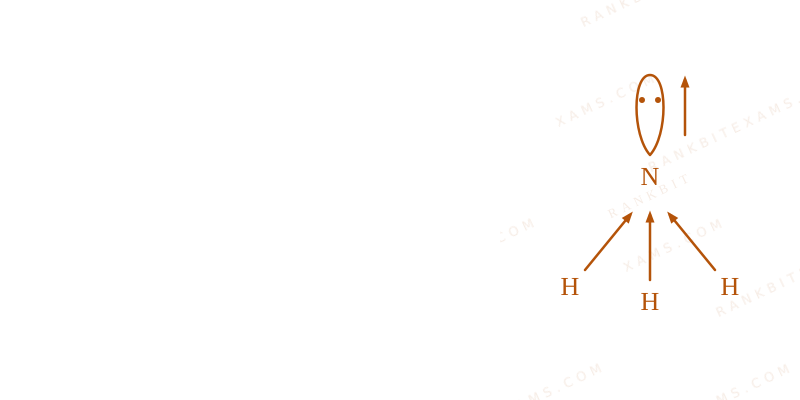
Statement II: In NH₃$NH_3$, the N-H$N-H$ bond dipole moments (pointing towards the more electronegative N) reinforce the orbital dipole moment of the lone pair. In NF₃$NF_3$, the N-F$N-F$ bond dipole moments point away from N (towards the more electronegative F), opposing the orbital dipole moment of the lone pair. This partial cancellation in NF₃$NF_3$ makes its net dipole moment lower. Therefore, Statement II is also false, as it reverses the correct orientations.
Dipole moments in NH3 and NF3 diagram for Q75 - JEE Main 2024 Evening
Step 1: Final Conclusion
Since both statements assert the opposite of established facts regarding NH₃$NH_3$ and NF₃$NF_3$, both are false.
Chapter Mix
Class 11 Chemistry: Chemical Bonding and Molecular Structure
More Chemical Bonding and Molecular Structure Questions — jee_main_2025_07_april_evening
Practice past-year questions one chapter at a time. Pick an exam → subject → chapter and get every PYQ for that topic — pulled together from all past papers — with the chapter's key formulas alongside.
