JEE Main · Chemistry ↓ Falling

Biomolecules appeared 35 times across 3 years — 4.1% of Chemistry. This question is from Proteins and Amino Acids.

Year 2026 2025 2024 Total
Questions 9 18 8 35

Given below are two statements: Statement (I): On hydrolysis, oligo peptides give rise to fewer number of α-amino acids while proteins give rise to a large number of β-amino acids. Statement (II): Natural proteins are denatured by acids which convert the water soluble form of fibrous proteins to their water insoluble form. In the light of the above statements, choose the most appropriate answer from the options given below:

Solution & Explanation

Related Formula
Protein Hydrolysis Peptides Hydrolysis α-amino acids
Core Logic

Statement (I) is incorrect because the complete hydrolysis of both oligopeptides and proteins yields α-amino acids, not β-amino acids.

Statement (II) is incorrect because fibrous proteins are inherently water-insoluble structural materials. Denaturation typically disrupts the tertiary and secondary structures of water-soluble globular proteins, making them insoluble.

Step 1: Final Conclusion

Since both Statement I and Statement II are false, option (3) is the correct choice.

Pattern Recognition

All naturally occurring proteins are polymers of α-amino acids, so any statement mentioning β-amino acids as direct translation products can be confidently ruled out. Fibrous proteins (like keratin or collagen) are structural and always insoluble, unlike globular proteins.

Chapter Mix

Class 12 Chemistry: Biomolecules

Reference Study Guides

More Biomolecules Previous-Year Questions — Page 4

Q jee_main_2025_08_april_evening Amino Acids
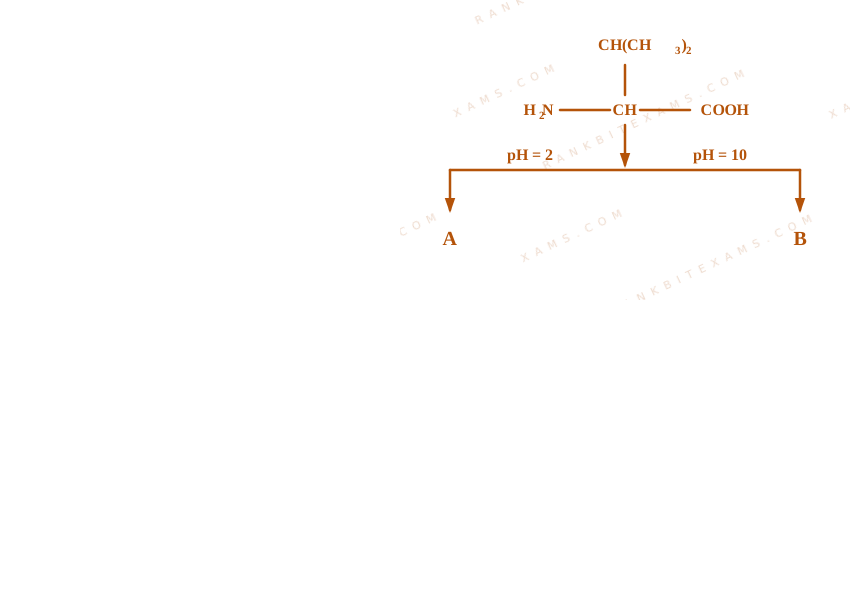
The chemical structure of the amino acid Valine is monitored across different environments: Choose the correct option depicting the structures of products A and B under pH = 2 and pH = 10 conditions respectively.
Valine pH equilibrium conversion layout for Q39
The flowchart maps the structural modifications of Valine when treated at strongly acidic (pH = 2) versus basic (pH = 10) conditions.
Valine pH equilibrium conversion layout for Q39
The flowchart maps the structural modifications of Valine when treated at strongly acidic (pH = 2) versus basic (pH = 10) conditions.
  • A.
  • B.
  • C.
  • D.

Solution

Core Logic

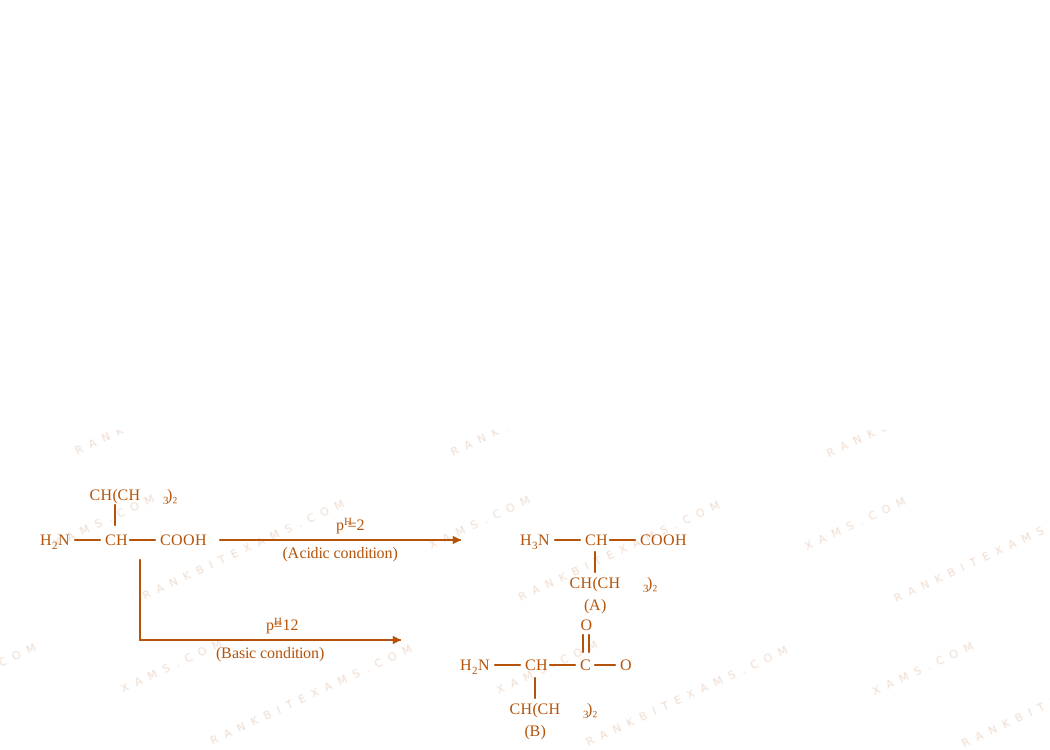
Amino acids exhibit amphoteric behavior due to the simultaneously present basic amino (-NH₂) and acidic carboxyl (-COOH) functional groups:

  • At pH = 2 (Highly Acidic Medium):
  • The abundant concentration of hydronium ions (H^+) protonates the carboxylate ion back into its non-ionized acid state (-COO^- arrow -COOH), while the amine group remains securely protonated as an ammonium ion (-NH₃^+). Hence, product A exists purely as a cation.

  • At pH = 10 (Highly Basic Medium):
  • The high concentration of hydroxide ions (OH^-) abstracts protons from the system, deprotonating the carboxyl group into a carboxylate anion (-COO^-) and neutralizing the ammonium group back into a free amine fraction (-NH₂). Hence, product B exists purely as an anion.
    Protonation state structures of Valine across the pH spectrum
    The flowchart maps the structural modifications of Valine when treated at strongly acidic (pH = 2) versus basic (pH = 10) conditions.

Pattern Recognition

Acidic environments (low pH) force positive overall charges onto amino structures (cation form). Basic environments (high pH) drive a net negative structure (anion form). This simple rule makes picking Option (1) immediate.

Chapter Mix

Class 12 Chemistry: Biomolecules

Q29 jee_main_2025_29_jan_evening Amino Acids and Proteins
Identify the essential amino acids from below: (A) Valine (B) Proline (C) Lysine (D) Threonine (E) Tyrosine Choose the correct answer from the options given below:
  • A. (A), (C) and (D) only
  • B. (A), (C) and (E) only
  • C. (B), (C) and (E) only
  • D. (C), (D) and (E) only

Solution

Core Logic

Essential amino acids cannot be synthesized by the body and must be obtained from diet. From the given choices:

  • Valine (Essential)
  • Proline (Non-essential)
  • Lysine (Essential)
  • Threonine (Essential)
  • Tyrosine (Non-essential)
  • Hence, (A), (C), and (D) are the essential amino acids.

Pattern Recognition

Mnemonic for essential amino acids: TV TILL PM MALL (Threonine, Valine, Tryptophan, Isoleucine, Leucine, Lysine, Phenylalanine, Methionine, Arginine, Histidine).

Chapter Mix

Class 12 Chemistry: Biomolecules

Q45 jee_main_2025_28_jan_morning Reactions of Glucose and Starch
Given below are two statements : Statement I : D-glucose pentaacetate reacts with 2, 4-dinitrophenylhydrazine. Statement II : Starch, on heating with concentrated sulfuric acid at 100°C and 2-3 atmosphere pressure produces glucose. In the light of the above statements, choose the correct answer from the options given below
  • A. Both Statement I and Statement II are false
  • B. Statement I is false but Statement II is true.
  • C. Statement I is true but Statement II is false.
  • D. Both Statement I and Statement II are true.

Solution

Core Logic

Statement I is false because glucose pentaacetate fixes the cyclic hemiacetal system structure securely into an unreactive ester configuration. As a result, it cannot revert to an open-chain form containing a free aldehyde group, meaning it does not react with carbonyl reagents like 2,4-DNP.

Statement II is true because starch, a polysaccharide composed of glucose monomer blocks, undergoes acid-catalyzed hydrolysis to yield glucose when heated under pressure.

Pattern Recognition

Sees: Pentacetate reactivity vs polysaccharide hydrolysis. Shortcut: Acetylation locks the cyclic structure of glucose, preventing reactions that require an open-chain carbonyl group (like 2,4-DNP).

Chapter Mix

Class 12 Chemistry: Biomolecules

Q jee_main_2025_04_april_evening Amino Acids and Peptides
A dipeptide, "x" on complete hydrolysis gives "y" and "z". "y" on treatment with aq. HNO₂ produces lactic acid. On the other hand "z" on heating gives the following cyclic molecule. Based on the information given, the dipeptide X is:
Cyclic molecule from dipeptide residue heating for Q29 - JEE Main 2025 Evening
The image shows a heterocyclic six-membered cyclic molecule containing amide groups, formed by heating amino acid residue z.
Cyclic molecule from dipeptide residue heating for Q29 - JEE Main 2025 Evening
The image shows a heterocyclic six-membered cyclic molecule containing amide groups, formed by heating amino acid residue z.
  • A. valine-glycine
  • B. alanine-glycine
  • C. valine-leucine
  • D. alanine-alanine

Solution

Related Formula
Dipeptide X Hydrolysis Amino Acid y + Amino Acid z
Core Logic
  • Since y reacts with nitrous acid (HNO₂) to give lactic acid (CH₃-CH(OH)-COOH), y must be alanine (CH₃-CH(NH₂)-COOH).
  • When glycine (NH₂-CH₂-COOH) is heated, two molecules undergo intermolecular cyclization to produce a six-membered diketopiperazine ring as shown in the problem diagram. Therefore, z is glycine.
  • Hence, combining residue y (alanine) and z (glycine), the dipeptide X is alanine-glycine.

Step 1: Stepwise Degradation Overview

Reaction scheme:

  • Alanine-Glycine linkage arrow Alanine + Glycine
  • Alanine + HNO₂ arrow Lactic acid + N₂ + H₂O
  • 2 × Glycine Δ Cyclic diketopiperazine + 2H₂O
Pattern Recognition

Lactic acid generation from alpha-amino acids via nitrous acid deamination is a definitive chemical fingerprint for alanine. The unsubstituted cyclic diketopiperazine product confirms glycine as the second component.

Chapter Mix

Class 12 Chemistry: Biomolecules

Q39 jee_main_2025_04_april_morning Proteins and Amino Acids
Identify the pair of reactants that upon reaction, with elimination of HCl will give rise to the dipeptide Gly-Ala.
  • A. NH₂-CH₂-COCl and NH₂-CH(CH₃)-COOH
  • B. NH₂-CH₂-COCl and NH₃-CH(CH₃)-COCl
  • C. NH₂-CH₂-COOH and NH₂-CH(CH₃)-COCl
  • D. NH₂-CH₂-COOH and NH₂-CH(CH₃)-COOH

Solution

Core Logic

A dipeptide sequence is parsed strictly from the N-terminus to the C-terminus. Therefore, in Gly-Ala:

  • Glycine (Gly) must supply its carbonyl end for coupling.
  • Alanine (Ala) must provide its free amine end.
  • To drive peptide bond formation via the explicit elimination of HCl, the carboxyl group of glycine must be pre-activated as an acyl chloride variant: NH₂-CH₂-COCl.

    This reacts smoothly with the unsubstituted amine terminus of alanine, NH₂-CH(CH₃)-COOH, liberating HCl to form the amide bridge linkage: NH₂-CH₂-CONH-CH(CH₃)-COOH.

Pattern Recognition

peptide naming structure sequence convention dictates: First name = N-terminus acyl donor, Second name = C-terminus amine acceptor.

Chapter Mix

Class 12 Chemistry: Biomolecules

More Biomolecules Questions — jee_main_2025_07_april_evening

Practice all Biomolecules previous-year questions →

Rankbit System
JEE Physics: Waves (+15.5%) | Electrostatics: Concentric Shells (-29.7%) | Modern Physics: Photoelectric Clones (+34.2%) | Mathematics: Definite Integrals (+18.1%) | Chemistry: Coordination Splitting (-11.4%) | JEE Physics: Waves (+15.5%) | Electrostatics: Concentric Shells (-29.7%) | Modern Physics: Photoelectric Clones (+34.2%) | Mathematics: Definite Integrals (+18.1%) | Chemistry: Coordination Splitting (-11.4%)
