Given below are two statements:
Statement (I): On hydrolysis, oligo peptides give rise to fewer number of α$\alpha$-amino acids while proteins give rise to a large number of β$\beta$-amino acids.
Statement (II): Natural proteins are denatured by acids which convert the water soluble form of fibrous proteins to their water insoluble form.
In the light of the above statements, choose the most appropriate answer from the options given below:
A.Both statement I and statement II are correct$\text{Both statement I and statement II are correct}$
B.Statement I is incorrect but Statement II is correct$\text{Statement I is incorrect but Statement II is correct}$
C.Both statement I and statement II are incorrect$\text{Both statement I and statement II are incorrect}$
D.Statement I is correct but Statement II is incorrect$\text{Statement I is correct but Statement II is incorrect}$
Statement (I) is incorrect because the complete hydrolysis of both oligopeptides and proteins yields α$\alpha$-amino acids, not β$\beta$-amino acids.
Statement (II) is incorrect because fibrous proteins are inherently water-insoluble structural materials. Denaturation typically disrupts the tertiary and secondary structures of water-soluble globular proteins, making them insoluble.
Step 1: Final Conclusion
Since both Statement I and Statement II are false, option (3) is the correct choice.
Pattern Recognition
All naturally occurring proteins are polymers of α$\alpha$-amino acids, so any statement mentioning β$\beta$-amino acids as direct translation products can be confidently ruled out. Fibrous proteins (like keratin or collagen) are structural and always insoluble, unlike globular proteins.
Keywords:#hydrolysis of oligopeptides and proteins#JEE Main 2025 Evening Q26#Biomolecules JEE Main 2025#Denaturation of natural proteins
More Biomolecules Previous-Year Questions — Page 3
Qjee_main_2025_02_april_morningMolar Mass Calculations
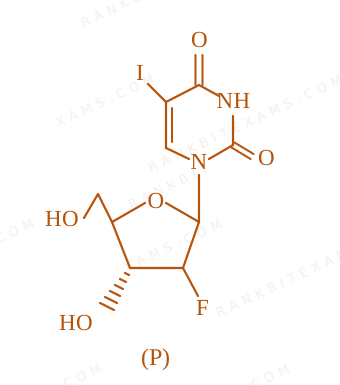
0.1~mol$0.1\mathrm{~mol}$ of the following given antiviral compound (P) will weigh × 10⁻¹~g$\times 10^{-1}\mathrm{~g}$The diagram displays the full multi-cyclic skeletal structure of an antiviral nucleoside molecule featuring explicit iodine and fluorine atomic positions.
(Given : molar mass in g · mol⁻¹$\mathrm{g \cdot mol}^{-1}$ H: 1, C: 12, N: 14, O: 16, F: 19, I: 127)
Numerical Answer.Answer: 372 to 372
Solution
Related Formula
Standard molecular weight calculation formula system:
The diagram displays the full multi-cyclic skeletal structure of an antiviral nucleoside molecule featuring explicit iodine and fluorine atomic positions.
Step 1: Final Mass Scaling
Find the mass of 0.1~mol$0.1\mathrm{~mol}$ of the sample:
Hence, the integer value for the blank box is 372.
Pattern Recognition
When counting atoms in nucleoside structures, remember that each vertex in the ribose sugar ring represents a fully saturated carbon component unless double bonds or heteroatoms are explicitly drawn.
Chapter Mix
Class 12 Chemistry: Biomolecules
Class 11 Chemistry: Some Basic Concepts of Chemistry
Identify the correct statement among the following:
A.(1) All naturally occurring amino acids except glycine contain one chiral centre.$(1)\ \text{All naturally occurring amino acids except glycine contain one chiral centre.}$
B.(2) All naturally occurring amino acids are optically active.$(2)\ \text{All naturally occurring amino acids are optically active.}$
C.(3) Glutamic acid is the only amino acid that contains a -COOH group at the side chain.$(3)\ \text{Glutamic acid is the only amino acid that contains a -COOH group at the side chain.}$
D.(4) Amino acid, cysteine easily undergo dimerization due to the presence of free SH group.$(4)\ \text{Amino acid, cysteine easily undergo dimerization due to the presence of free SH group.}$
Solution
Related Formula
Dimerization of thiol pairs yields a disulfide linkage via an oxidation mechanism:
Let's review each choice item factually layout-by-row:
Option 1 is inaccurate: Isoleucine and threonine contain two distinct chiral centers.
Option 2 is inaccurate: Glycine lacks a asymmetric center, rendering it optically inactive.
Option 3 is inaccurate: Aspartic acid similarly contains a carboxylic acid functional group along its side chain.
Option 4 is correct: Cysteine contains a highly active free functional -SH$-\mathrm{SH}$ group that easily dimerizes to form Cystine through a disulfide loop matrix.
Pattern Recognition
Disulfide bridges formed by cysteine play a crucial role in maintaining the tertiary and quaternary structural configurations of complex protein folds.
Fat soluble vitamins are:
A. Vitamin B₁$\mathrm{B}_1$
B. Vitamin C$\mathrm{C}$
C. Vitamin E$\mathrm{E}$
D. Vitamin B₁₂$\mathrm{B}_{12}$
E. Vitamin K$\mathrm{K}$
Choose the correct answer from the options given below :
A. C & D Only
B. A & B Only
C. B & C Only
D. C & E Only
Solution
Related Formula
Vitamins are classified into two categories based on solubility:
Only C (Vitamin E$\mathrm{E}$) and E (Vitamin K$\mathrm{K}$) are fat-soluble. Thus, the correct option is (4).
Pattern Recognition
Use the mnemonic 'ADEK' to remember the fat-soluble vitamins. All other vitamins (mainly B-complex and C) are water-soluble.
Chapter Mix
Class 12 Chemistry: Biomolecules
Qjee_main_2025_07_april_morningHormones Structure
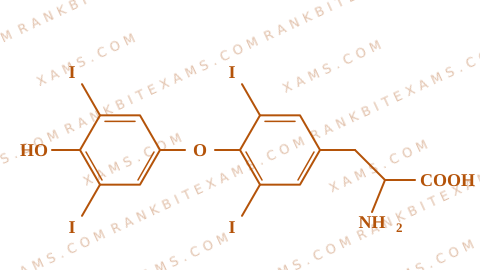
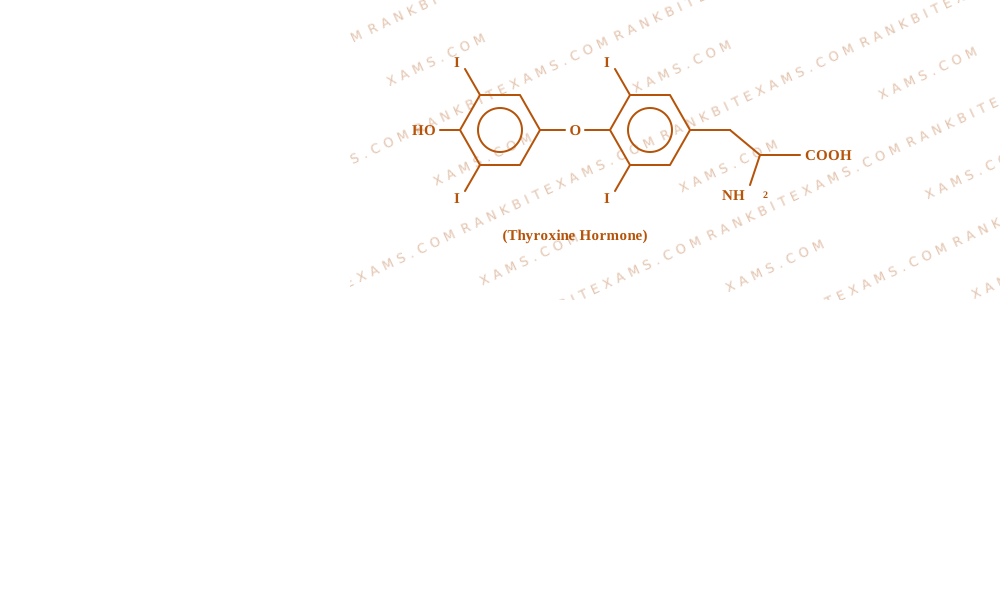
Thyroxine, the hormone has the structure given below:
The structural formula of Thyroxine shows four iodine atoms attached to the aromatic benzene rings.
The percentage of iodine in thyroxine is ______ %. (nearest integer)
(Given molar mass in g mol⁻¹$\mathrm{g\ mol}^{-1}$ of C: 12$\mathrm{C}: 12$, H: 1$\mathrm{H}: 1$, O: 16$\mathrm{O}: 16$, N: 14$\mathrm{N}: 14$, I: 127$\mathrm{I}: 127$)
Hence, the percentage of iodine in thyroxine is 65$65$.
Pattern Recognition
Thyroxine molecular mass (777$777$) is composed mostly of Iodine (508$508$), making up approximately 508/777 ≈ 65%$508/777 \approx 65\%$ of its entire mass. Always carefully account for the four phenyl-bound iodines.
Evaluation Rubric / Model Answer
Accurate molecular weight summation leading to 65%$65\%$ nearest integer Iodine composition.
Chapter Mix
Class 12 Chemistry: Biomolecules
Class 12 Chemistry: Organic Chemistry - Oxygen containing compounds
Q43jee_main_2025_07_april_morningHydrolysis of Sucrose
Given below are two statements:
Statement I: D-(+)-glucose + D-(+)-fructose -H₂O sucrose sucrose Hydrolysis D-(+)-glucose + D-(+)-fructose$\text{D-(+)-glucose} + \text{D-(+)-fructose} \xrightarrow{-\mathrm{H}_2\mathrm{O}} \text{sucrose} \qquad \text{sucrose} \xrightarrow{\text{Hydrolysis}} \text{D-(+)-glucose} + \text{D-(+)-fructose}$
Statement II: Invert sugar is formed during sucrose hydrolysis.
In the light of given statements, choose the correct answer from the options given below:
A.Both Statement I and Statement II are true.$\text{Both Statement I and Statement II are true.}$
B.Statement I is false but Statement II is true.$\text{Statement I is false but Statement II is true.}$
C.Statement I is true but Statement II is false.$\text{Statement I is true but Statement II is false.}$
D.Both Statement I and Statement II are false.$\text{Both Statement I and Statement II are false.}$
Solution
Core Logic
Statement I: Sucrose is formed by condensation of D-(+)-glucose$\text{D-(+)-glucose}$ and D-(-)-fructose$\text{D-(-)-fructose}$ (levorotatory fructose, not dextrorotatory as claimed). Hydrolysis of sucrose yields D-(+)-glucose$\text{D-(+)-glucose}$ and D-(-)-fructose$\text{D-(-)-fructose}$. Thus, Statement I is false.
Statement II: Hydrolysis of dextrorotatory sucrose (+66.5°$+66.5^{\circ}$) yields a mixture of dextrorotatory glucose (+52.5°$+52.5^{\circ}$) and highly levorotatory fructose (-92.4°$-92.4^{\circ}$). Because the overall specific rotation of the mixture becomes levorotatory (-39.9°$-39.9^{\circ}$), the hydrolyzed mixture is called invert sugar. Thus, Statement II is true.
Pattern Recognition
Natural fructose is always levorotatory, D-(-)-fructose$\text{D-(-)-fructose}$. Dextrorotatory fructose mentioned in Statement I is an immediate giveaway that the statement is false.
Chapter Mix
Class 12 Chemistry: Biomolecules
More Biomolecules Questions — jee_main_2025_07_april_evening
Practice past-year questions one chapter at a time. Pick an exam → subject → chapter and get every PYQ for that topic — pulled together from all past papers — with the chapter's key formulas alongside.
.svg "nucleoside derivative ring, iodinated pyrimidine core, chemical structure mass tracking")