JEE Main · Physics ↓ Falling

Gravitation appeared 22 times across 3 years — 2.5% of Physics. This question is from Escape Velocity and Potential Energy.

Year 2026 2025 2024 Total
Questions 5 9 8 22

Given below are two statements: one is labelled as Assertion A and the other is labelled as Reason R. Assertion A: The kinetic energy needed to project a body of mass m from earth surface to infinity is (1)/(2)mgR, where R is the radius of earth. Reason R: The maximum potential energy of a body is zero when it is projected to infinity from earth surface. In the light of the above statements, choose the correct answer from the option given below

Solution & Explanation

Related Formula

Escape kinetic energy requirement formulation:

KEescape = (GMm)/(R) = mgR

Gravitational potential energy field definition:

U = -(GMm)/(r)

At r → ∞, Umax = 0.

Core Logic
  • Assertion Check: The minimum work required to project an object from Earth's surface (r = R) to infinity (r → ∞) equals the change in gravitational potential energy:
Δ U = U(∞) - U(R) = 0 - (-(GMm)/(R)) = (GMm)/(R) = mgR

Therefore, the required kinetic energy is mgR. The statement asserts it is (1)/(2)mgR (which corresponds to orbital kinetic energy near Earth's surface). Hence, Assertion A is false.

  • Reason Check: Since the gravitational force is attractive, potential energy is negative everywhere in the field and reaches its maximum value asymptotically at infinity (Umax = 0). Hence, Reason R is true.
Pattern Recognition

Escape energy from the surface is mgR, while circular orbital kinetic energy near the surface is (1)/(2)mgR. Because gravitational potential energy is defined with zero at infinity, every bound state has U < 0, making zero the absolute maximum potential energy.

Evaluation Rubric / Model Answer

Option A: A is false but R is true

Chapter Mix

Class 11 Physics: Gravitation

More Gravitation Previous-Year Questions — Page 5

Q46 jee_main_2024_31_jan_evening Escape Velocity
The mass of the moon is 1/144 times the mass of a planet and its diameter 1/16 times the diameter of a planet. If the escape velocity on the planet is v, the escape velocity on the moon will be:
  • A. (v)/(3)
  • B. (v)/(4)
  • C. (v)/(12)
  • D. (v)/(6)

Solution

Related Formula
vescape = √((2GM)/(R))
Core Logic

For the planet: v = √((2GMₚ)/(Rₚ)) For the moon: Mm = (Mₚ)/(144) and Rm = (Rₚ)/(16).

Step 1: Setup the Ratio
vm = √((2G Mm)/(Rm)) vm = √((2G ((Mₚ)/(144)))/(((Rₚ)/(16)))) vm = √((2G Mₚ)/(Rₚ) × (16)/(144))
Step 2: Simplification
vm = √((2G Mₚ)/(Rₚ)) × √((1)/(9)) vm = v × (1)/(3) = (v)/(3)
Pattern Recognition

Escape velocity scales as √(M/R). If M scales by x and R scales by y, velocity scales by √(x/y). Here, √((1/144)/(1/16)) = √(16/144) = √(1/9) = 1/3.

Chapter Mix

Class 11 Physics: Gravitation
Q jee_main_2024_31_jan_morning Superposition Principle
Four identical particles of mass m are kept at the four corners of a square. If the gravitational force exerted on one of the masses by the other masses is ( 2√(2) + 132) Gm²L², the length of the sides of the square is
  • A. L2
  • B. 4 L
  • C. 3L
  • D. 2 L

Solution

Related Formula
F = (G m₁ m₂)/(r²)
Core Logic

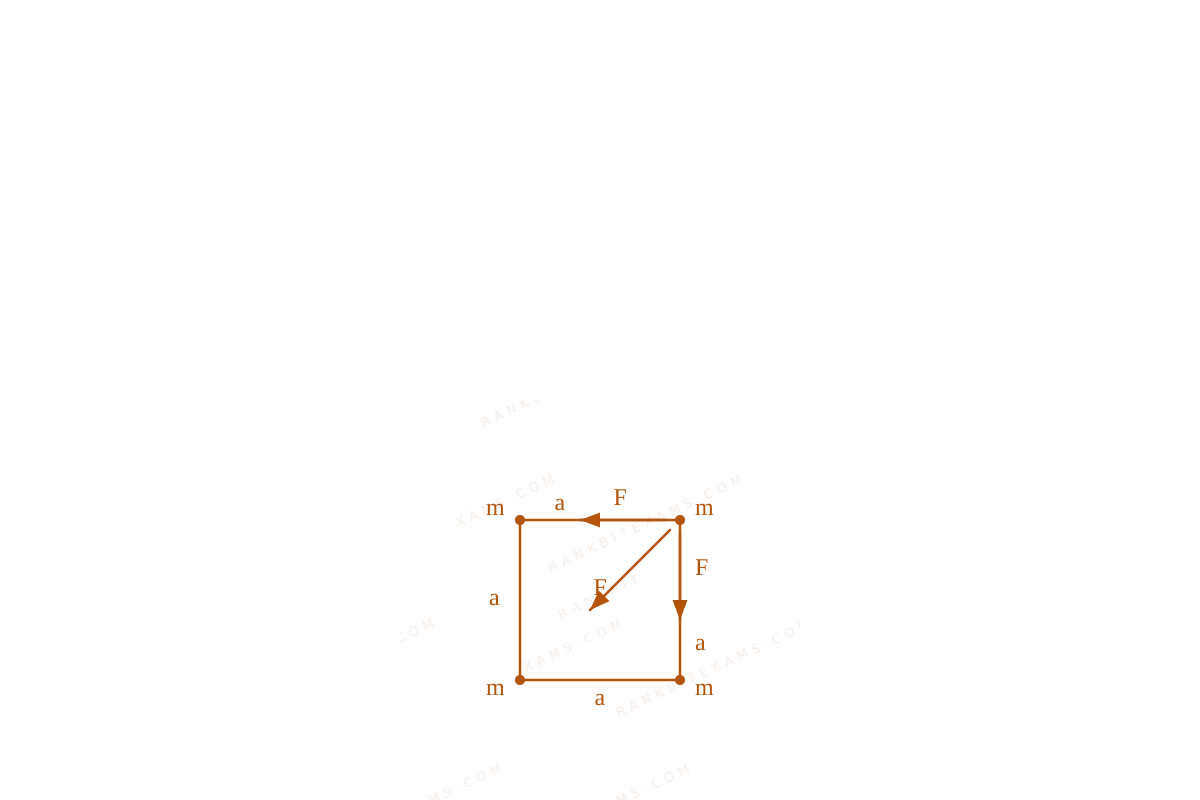
Superposition Principle diagram for Q37 - JEE Main 2024 Morning

Let the side length of the square be a. Considering one corner mass, it experiences forces from the adjacent two masses (distance a) and the diagonally opposite mass (distance √(2)a).

The forces from the two adjacent masses are at 90^° to each other:

F = (Gm²)/(a²)

The resultant of these two is √(2)F = √(2) (Gm²)/(a²), directed along the diagonal.

Step 2: Total Force Equation

The force from the diagonal mass is:

F' = Gm²(√(2)a)² = (Gm²)/(2a²)

Total resultant force Fₙₑₜ = √(2)F + F':

Fₙₑₜ = √(2) (Gm²)/(a²) + (Gm²)/(2a²) = (Gm²)/(a²) ( √(2) + (1)/(2) ) Fₙₑₜ = (Gm²)/(a²) ( 2√(2) + 12 )

Equating this to the given force value:

( 2√(2) + 132)(Gm²)/(L²) = (Gm²)/(a²) ( 2√(2) + 12 ) (1)/(32 L²) = (1)/(2 a²)

a² = 16 L² a = 4L

Chapter Mix

Class 11 Physics: Gravitation

More Gravitation Questions — jee_main_2025_04_april_morning

Practice all Gravitation previous-year questions →

Rankbit System
JEE Physics: Waves (+15.5%) | Electrostatics: Concentric Shells (-29.7%) | Modern Physics: Photoelectric Clones (+34.2%) | Mathematics: Definite Integrals (+18.1%) | Chemistry: Coordination Splitting (-11.4%) | JEE Physics: Waves (+15.5%) | Electrostatics: Concentric Shells (-29.7%) | Modern Physics: Photoelectric Clones (+34.2%) | Mathematics: Definite Integrals (+18.1%) | Chemistry: Coordination Splitting (-11.4%)