JEE Main · Mathematics ↑ Rising

Quadratic Equations appeared 26 times across 3 years — 3% of Mathematics. This question is from Nature of Roots.

Year 2026 2025 2024 Total
Questions 11 10 5 26

Consider the equation x² + 4x - n = 0, where n in [20, 100] is a natural number. Then the number of all distinct values of n, for which the given equation has integral roots, is equal to

Solution & Explanation

Related Formula

For quadratic equations with integer coefficients to have integral roots, the discriminant D = b² - 4ac must be a perfect square.

Core Logic

Rewrite using perfect square completing methods:

x² + 4x + 4 = n + 4 (x + 2)² = n + 4 x = -2 ± √(n + 4)

For x to be an integer, n + 4 must be a perfect square. Given range constraint 20 ≤ n ≤ 100:

24 ≤ n + 4 ≤ 104
Step 1: Identify Perfect Squares in Range

Find perfect squares between 24 and 104: 5² = 25 6² = 36 7² = 49 8² = 64 9² = 81 10² = 100

This gives exactly 6 distinct valid perfect squares.

Step 2: Conclusion

Thus, there are exactly 6 distinct integer values for n.

Pattern Recognition

Completing the square provides intuitive bounds quicker than running full discriminant inequalities. Match integer root sets directly to explicit numerical sequence counts.

Chapter Mix

Class 10 Mathematics: Quadratic Equations Class 11 Mathematics: Complex Numbers and Quadratic Equations

Reference Study Guides

More Quadratic Equations Previous-Year Questions — Page 2

Q8 jee_main_2026_23_january_morning Roots of Equations
If α and β (α < β) are the roots of the equation (- 2 + √(3)) (| √(x) - 3 |) + (x - 6 √(x)) + (9 - 2 √(3)) = 0, x ≥ 0, then √((β)/(α)) + √(αβ) is equal to:
  • A. 8
  • B. 9
  • C. 10
  • D. 11

Solution

Core Logic

Restructure the equation to form a quadratic in |√(x) - 3|. Notice that (x - 6√(x) + 9) = (√(x) - 3)² = |√(x) - 3|². Rewrite the given equation:

(x - 6√(x) + 9) - (2 - √(3))|√(x) - 3| - 2√(3) = 0 |√(x) - 3|² - (2 - √(3))|√(x) - 3| - 2√(3) = 0
Step 1: Solve the Quadratic

Let u = |√(x) - 3|. The equation is u² - (2 - √(3))u - 2√(3) = 0. Factorizing gives:

(u - 2)(u + √(3)) = 0

So, u = 2 or u = -√(3). Since u = |√(x) - 3| cannot be negative, we reject u = -√(3). Thus, |√(x) - 3| = 2.

Step 2: Find x (Roots)

Solve |√(x) - 3| = 2:

√(x) - 3 = 2 or √(x) - 3 = -2 √(x) = 5 or √(x) = 1

Squaring gives x = 25 or x = 1. Given α < β, we have α = 1 and β = 25.

Step 3: Evaluate Target Expression

Now compute √((β)/(α)) + √(αβ):

= √((25)/(1)) + √(1 · 25) = 5 + 5 = 10
Pattern Recognition

Grouping algebraic terms (like x - 6√(x)) and a lone constant (+9) to form perfect squares is a hallmark of radical equations disguised as quadratics.

Chapter Mix

Class 11 Maths: Quadratic Equations
Q19 jee_main_2026_23_january_morning Time and Work
A building construction work can be completed by two masons A and B together in 22.5 days. Mason A alone can complete the construction work in 24 days less than mason B alone. Then mason A alone will complete the construction work in:
  • A. 24 days
  • B. 42 days
  • C. 30 days
  • D. 36 days

Solution

Core Logic

Let the time taken by mason A alone to complete the work be x days. Mason B takes x + 24 days. Work done by A in 1 day = (1)/(x) Work done by B in 1 day = (1)/(x + 24)

Step 1: Set up the Rate Equation

Since together they finish in 22.5 days, their combined work in 1 day is (1)/(22.5) = (1)/(45/2) = (2)/(45). So, (1)/(x) + (1)/(x + 24) = (2)/(45)

Step 2: Solve the Quadratic

Multiply to clear denominators:

(x + 24 + x)/(x(x + 24)) = (2)/(45) 45(2x + 24) = 2(x² + 24x) 90x + 1080 = 2x² + 48x 2x² - 42x - 1080 = 0 x² - 21x - 540 = 0

Factorizing:

(x - 36)(x + 15) = 0

Since time cannot be negative, we reject x = -15. So, x = 36 days.

Pattern Recognition

Standard "Time & Work" reciprocal addition resolves purely to a clean factorizable quadratic. Setting the faster worker to x prevents dealing with negative bounds in factors.

Chapter Mix

Class 11 Maths: Basic Mathematics

Q7 jee_main_2026_23_january_evening Logarithmic Equations
The sum of all the real solutions of the equation (x+3)(6x²+28x+30)=5-2 (6x+10)(x²+6x+9) is equal to:
  • A. 2
  • B. 1
  • C. 0
  • D. 4

Solution

Related Formula
ₐ(bc) = ₐ b + ₐ c b(aⁿ) = n b a ₐ b = (1)/( b a)
Core Logic

Factor the arguments in the logarithmic equation: 6x² + 28x + 30 = (x+3)(6x+10) x² + 6x + 9 = (x+3)²

Substitute these into the equation:

(x+3)[(x+3)(6x+10)] = 5 - 2 (6x+10)(x+3)² 1 + (x+3)(6x+10) = 5 - 4 (6x+10)(x+3)
Step 1: Variable Substitution

Let A = (x+3)(6x+10). The equation transforms to:

1 + A = 5 - (4)/(A) A + (4)/(A) = 4 A² - 4A + 4 = 0 (A - 2)² = 0 A = 2

Substitute A = 2 back:

(x+3)(6x+10) = 2 6x + 10 = (x+3)² 6x + 10 = x² + 6x + 9 x² = 1 x = ± 1
Step 2: Checking Domain Validity

For x = 1: Base x+3 = 4 > 0, ≠ 1. Base 6x+10 = 16 > 0, ≠ 1. Valid solution.

For x = -1: Base x+3 = 2 > 0, ≠ 1. Base 6x+10 = 4 > 0, ≠ 1. Valid solution.

Sum of all real roots = 1 + (-1) = 0.

Pattern Recognition

When dealing with logarithms containing polynomial bases and arguments, always check if they are directly factorable into each other. A substitution like A + B/A = C will often emerge.

Chapter Mix

Class 11 Maths: Quadratic Equations Class 11 Maths: Functions

Q20 jee_main_2026_24_january_morning Absolute Value Equations
The number of the real solutions of the equation : x|x+3|+|x-1|-2=0 is
  • A. 3
  • B. 2
  • C. 5
  • D. 4

Solution

Related Formula
|f(x)| = cases f(x), & f(x) ≥ 0 -f(x), & f(x) < 0 cases
Core Logic

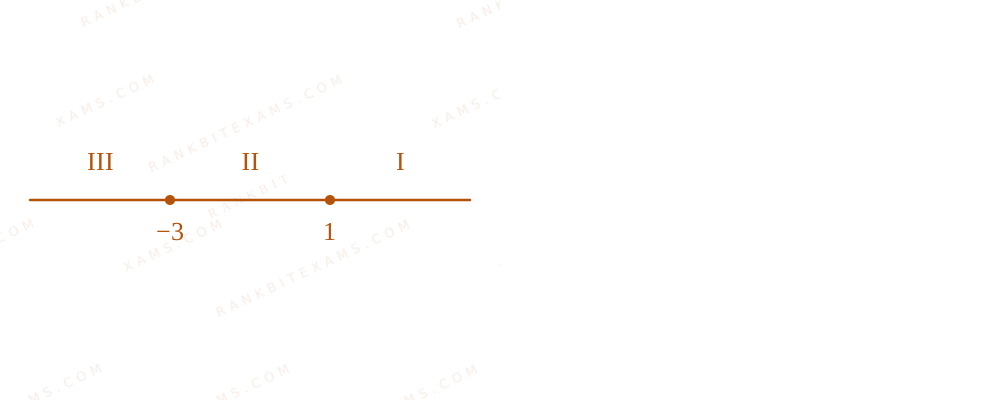
Modulus critical points visualization
Critical points are x = -3 and x = 1. The real number line is split into three cases.

Step 1: Case 1 (x > 1)

For x > 1: x(x+3) + (x-1) - 2 = 0 x² + 3x + x - 3 = 0 ⇒ x² + 4x - 3 = 0 x = -4 ± √(16 + 12)2 = -2 ± √(7) Since √(7) ≈ 2.64, x = -2 + 2.64 = 0.64, which is not > 1. Both rejected.

Step 2: Case 2 (-3 <= x <= 1)

For -3 ≤ x ≤ 1: x(x+3) - (x-1) - 2 = 0 x² + 3x - x + 1 - 2 = 0 ⇒ x² + 2x - 1 = 0 x = -2 ± √(4 + 4)2 = -1 ± √(2) √(2) ≈ 1.41. x = -1 + 1.41 = 0.41 (Accepted) x = -1 - 1.41 = -2.41 (Accepted) (2 solutions)

Step 3: Case 3 (x < -3)

For x < -3: x(-x-3) - (x-1) - 2 = 0 -x² - 3x - x + 1 - 2 = 0 ⇒ -x² - 4x - 1 = 0 ⇒ x² + 4x + 1 = 0 x = -4 ± √(16 - 4)2 = -2 ± √(3) x = -2 + 1.732 = -0.268 (Rejected, not < -3) x = -2 - 1.732 = -3.732 (Accepted, < -3) (1 solution) Total valid real solutions = 2 + 1 = 3.

Pattern Recognition

Modulus equations involving polynomials are best resolved by strictly zoning the number line via critical points, verifying root validity against the respective zone boundaries.

Chapter Mix

Class 11 Maths: Complex Numbers and Quadratic Equations

Q18 jee_main_2026_24_january_evening Location of Roots
The smallest positive integral value of a, for which all the roots of x⁴ - ax² + 9 = 0 are real and distinct, is equal to
  • A. 9
  • B. 3
  • C. 4
  • D. 7

Solution

Related Formula
For a quadratic At² + Bt + C = 0 to have distinct positive roots: D > 0, -(B)/(2A) > 0, (C)/(A) > 0
Core Logic

Substitute x² = t. The equation becomes a quadratic in t:

t² - at + 9 = 0 (2)

For the original quartic equation x⁴ - ax² + 9 = 0 to have 4 real and distinct roots, the quadratic equation in t must have 2 distinct positive real roots (since x = ± √(t) requires t > 0).

Step 1: Discriminant Condition

Condition 1: Roots must be real and distinct (D > 0)

D = a² - 4(1)(9) > 0

a² - 36 > 0

a in (-∞, -6) (6, ∞)
Step 2: Location of Roots Condition

Condition 2: Sum of roots must be positive (since both roots are positive)

-(-a)/(1) > 0 a > 0

Condition 3: Product of roots must be positive

f(0) > 0 9 > 0 (This is always true, a in R)
Step 3: Intersection and Conclusion

Taking the intersection of all conditions: a in (-∞, -6) (6, ∞) AND a > 0.

Intersection yields: a in (6, ∞).

The smallest positive integral value in this interval is 7.

Pattern Recognition

Bi-quadratic equations x⁴ + Bx² + C = 0 map cleanly to t² + Bt + C = 0. The nature of x roots depends entirely on the signs of t roots. 4 real distinct x roots ≡ 2 positive distinct t roots.

Chapter Mix

Class 11 Maths: Quadratic Equations

More Quadratic Equations Questions — jee_main_2025_04_april_morning

Practice all Quadratic Equations previous-year questions →

Rankbit System
JEE Physics: Waves (+15.5%) | Electrostatics: Concentric Shells (-29.7%) | Modern Physics: Photoelectric Clones (+34.2%) | Mathematics: Definite Integrals (+18.1%) | Chemistry: Coordination Splitting (-11.4%) | JEE Physics: Waves (+15.5%) | Electrostatics: Concentric Shells (-29.7%) | Modern Physics: Photoelectric Clones (+34.2%) | Mathematics: Definite Integrals (+18.1%) | Chemistry: Coordination Splitting (-11.4%)