In Dumas' method for estimation of nitrogen, 1mathrm~g$1\mathrm{~g}$ of an organic compound gave 150mathrm~mL$150\mathrm{~mL}$ of nitrogen collected at 300mathrm~K$300\mathrm{~K}$ temperature and 900mathrm~mmHg$900\mathrm{~mmHg}$ pressure. The percentage composition of nitrogen in the compound is _______ %$%$ (nearest integer).
(Aqueous tension at 300mathrm~K = 15mathrm~mmHg$300\mathrm{~K} = 15\mathrm{~mmHg}$)
Numerical Answer Type:
Enter a numerical valueAnswer: 20 to 20+4 marks
Solution & Explanation
### Related Formula
P_textdry N_2 = P_texttotal - P_textaqueous tension$$P_{\text{dry } N_2} = P_{\text{total}} - P_{\text{aqueous tension}}$$PV = nRT implies n = fracPVRT$$PV = nRT \implies n = \frac{PV}{RT}$$\% N = fractextMass of NitrogentextMass of Organic Compound times 100$$\% N = \frac{\text{Mass of Nitrogen}}{\text{Mass of Organic Compound}} \times 100$$
### Core Logic
First, calculate the actual pressure exerted by the dry nitrogen gas:
P_N_2 = 900 - 15 = 885mathrm~mmHg = frac885760mathrm~atm$$P_{N_2} = 900 - 15 = 885\mathrm{~mmHg} = \frac{885}{760}\mathrm{~atm}$$
Convert volume data to liters: V = 150mathrm~mL = 0.15mathrm~L$V = 150\mathrm{~mL} = 0.15\mathrm{~L}$.
Using the ideal gas law to determine the moles of N_2$N_2$ collected:
n = fracleft(frac885760right) times 0.150.0821 times 300 = frac1.1645 times 0.1524.63 approx 0.0071mathrm~moles$$n = \frac{\left(\frac{885}{760}\right) \times 0.15}{0.0821 \times 300} = \frac{1.1645 \times 0.15}{24.63} \approx 0.0071\mathrm{~moles}$$
Calculate the total mass of the liberated nitrogen gas:
textMass = n times M_textmolar = 0.0071 times 28 = 0.1988mathrm~g$$\text{Mass} = n \times M_{\text{molar}} = 0.0071 \times 28 = 0.1988\mathrm{~g}$$
Determine the percentage composition relative to the initial 1mathrm~g$1\mathrm{~g}$ sample size:
\% N = frac0.19881 times 100 = 19.88\% approx 20\%$$\% N = \frac{0.1988}{1} \times 100 = 19.88\% \approx 20\%$$
### Pattern Recognition
Always remember to subtract the aqueous tension value first. Failing to correct for water vapor pressure is the most common pitfall in Dumas' method calculations.
### Evaluation Rubric / Model Answer
null
### Chapter Mix
Class 11 Chemistry: Organic Chemistry - Some Basic Principles and Techniques
Keywords:#Dumas method nitrogen estimation#JEE Main 2025 Morning Q46#aqueous tension gas correction#quantitative organic analysis
More Organic Chemistry - Some Basic Principles and Techniques Previous-Year Questions — Page 11
Qjee_main_2025_29_jan_morningPurification of Organic Compounds - Steam Distillation
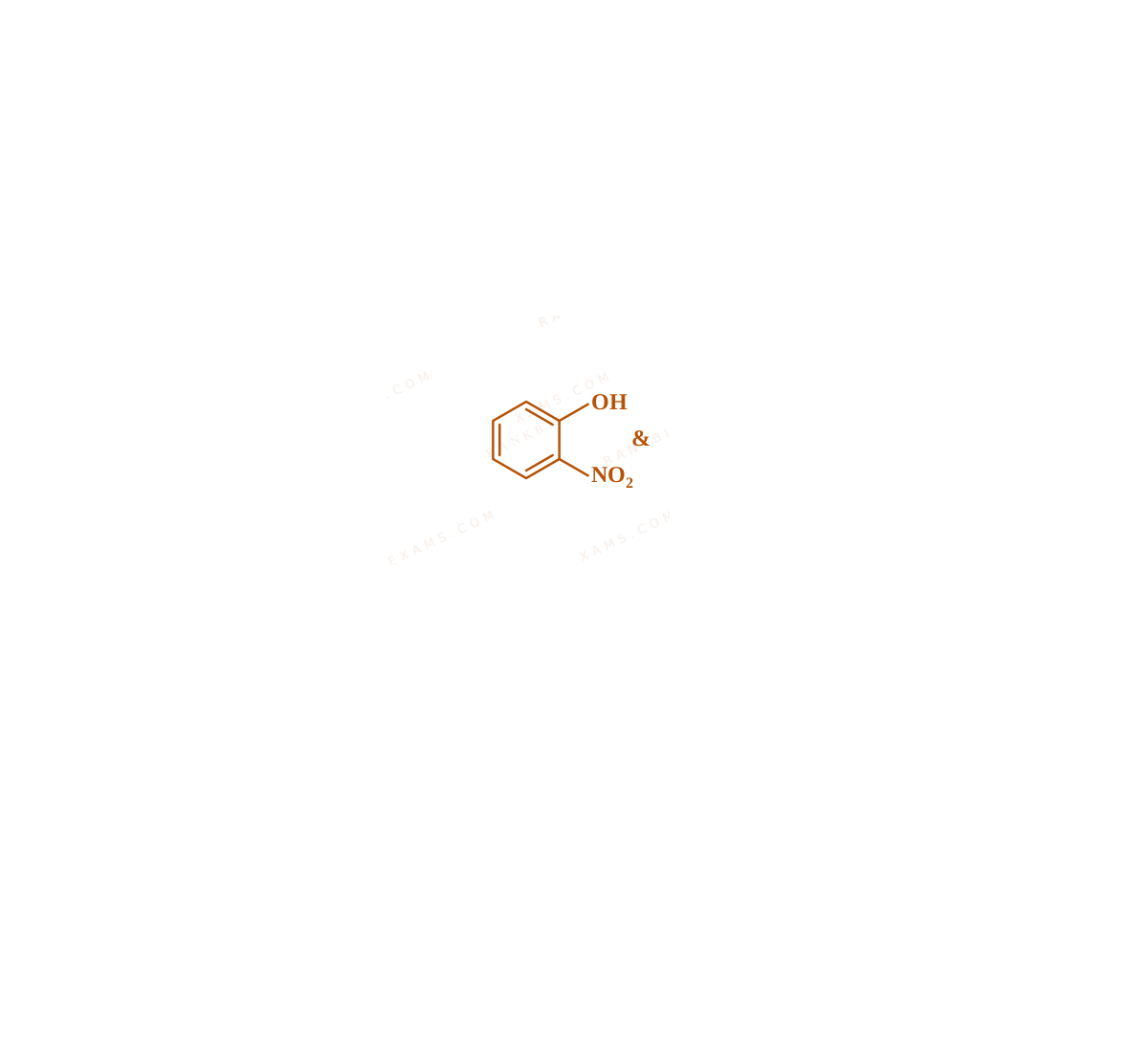
The steam volatile compounds among the following are:
Choose the correct answer from the options given below:
Four different disubstituted benzene structures are indexed to show spatial isomer distributions.
A. (B) and (D) only
B. (A) and (C) only
C. (A) and (B) only
D. (A), (B) and (C) only
Solution
### Related Formula
textIntramolecular H-bonding implies textLower boiling point implies textSteam Volatile$$\text{Intramolecular H-bonding} \implies \text{Lower boiling point} \implies \text{Steam Volatile}$$
### Core Logic
Purification via steam distillation requires a high relative vapor pressure at the boiling point of water. Let us assess the isomers :
* (A) o-Nitrophenol contains an -mathrmOH$-\mathrm{OH}$ group right next to an -mathrmNO_2$-\mathrm{NO}_2$ group, allowing for strong intramolecular hydrogen bonding. This minimizes external interactions, lowering the boiling point and making it steam volatile .
* (B) o-Nitroaniline similarly stabilizes itself via internal intramolecular hydrogen bonding between the amine and nitro components, making it steam volatile .
* (C) & (D) The para isomers form extensive intermolecular networks with neighboring molecules, which significantly elevates their boiling points and prevents steam volatility .
Four different disubstituted benzene structures are indexed to show spatial isomer distributions.Four different disubstituted benzene structures are indexed to show spatial isomer distributions.
Hence, compounds (A) and (B) are steam volatile, matching option (3).
### Pattern Recognition
ortho-substituted functional networks form self-contained internal loops through hydrogen bonding, preventing external pairing and maximizing volatility.
### Evaluation Rubric / Model Answer
null
### Chapter Mix
Class 11 Chemistry: Organic Chemistry - Some Basic Principles and Techniques
Class 11 Chemistry: Chemical Bonding and Molecular Structure
Qjee_main_2025_29_jan_morningSigma and Pi Bonds
The sum of sigma (sigma)$(\sigma)$ and mathrmpi(pi)$\mathrm{\pi}(\pi)$ bonds in Hex-1,3-dien-5-yne is ________.
Numerical Answer.Answer: 15 to 15
Solution
### Related Formula
textSingle bond = 1sigma, quad textDouble bond = 1sigma + 1pi, quad textTriple bond = 1sigma + 2pi$$\text{Single bond} = 1\sigma, \quad \text{Double bond} = 1\sigma + 1\pi, \quad \text{Triple bond} = 1\sigma + 2\pi$$
### Core Logic
Let us map out the complete structural bond geometry of Hex-1,3-dien-5-yne :
mathrmH_2C=CH-CH=CH-Cequiv CH$$\mathrm{H_2C=CH-CH=CH-C\equiv CH}$$
Counting the individual bonds :
* Carbon-Hydrogen (mathrmC-H$\mathrm{C-H}$) single bonds = 2 + 1 + 1 + 1 + 1 = 6 \, sigma$= 2 + 1 + 1 + 1 + 1 = 6 \, \sigma$ bonds
* Carbon-Carbon single, double, and triple linkages:
* mathrmC_1=mathrmC_2
ightarrow 1sigma + 1pi$\mathrm{C}_1=\mathrm{C}_2
ightarrow 1\sigma + 1\pi$
* mathrmC_2-mathrmC_3
ightarrow 1sigma$\mathrm{C}_2-\mathrm{C}_3
ightarrow 1\sigma$
* mathrmC_3=mathrmC_4
ightarrow 1sigma + 1pi$\mathrm{C}_3=\mathrm{C}_4
ightarrow 1\sigma + 1\pi$
* mathrmC_4-mathrmC_5
ightarrow 1sigma$\mathrm{C}_4-\mathrm{C}_5
ightarrow 1\sigma$
* mathrmC_5equivmathrmC_6
ightarrow 1sigma + 2pi$\mathrm{C}_5\equiv\mathrm{C}_6
ightarrow 1\sigma + 2\pi$
Total values :
textTotal sigma text bonds = 6 + 5 = 11$$\text{Total } \sigma \text{ bonds} = 6 + 5 = 11$$textTotal pi text bonds = 1 + 1 + 2 = 4$$\text{Total } \pi \text{ bonds} = 1 + 1 + 2 = 4$$textSum (sigma + pi) = 11 + 4 = 15$$\text{Sum } (\sigma + \pi) = 11 + 4 = 15$$
### Pattern Recognition
Do not skip implicit mathrmC-H$\mathrm{C-H}$ single bonds when scanning skeletal formulas, as each counts as a full sigma$\sigma$ bond.
### Evaluation Rubric / Model Answer
null
### Chapter Mix
Class 11 Chemistry: Organic Chemistry - Some Basic Principles and Techniques
Q73jee_main_2024_01_february_morningFission of a Covalent Bond
Ionic reactions with organic compounds proceed through:
(A) Homolytic bond cleavage
(B) Heterolytic bond cleavage
(C) Free radical formation
(D) Primary free radical
(E) Secondary free radical
Choose the correct answer from the options given below:
A.text(A) only$\text{(A) only}$
B.text(C) only$\text{(C) only}$
C.text(B) only$\text{(B) only}$
D.text(D) and (E) only$\text{(D) and (E) only}$
Solution
### Core Logic
Bond fission in organic chemistry can happen in two ways:
1. Homolytic cleavage: The shared pair of electrons gets distributed equally, leading to free radical formation.
2. Heterolytic cleavage: The shared pair of electrons goes completely to one of the bonded atoms, leading to the formation of positive (cation) and negative (anion) ions.
### Step 1: Match Definition
Since ionic reactions involve ions, they inherently proceed through heterolytic bond cleavage where ionic intermediates (carbocations, carbanions, or leaving groups) are formed.
### Pattern Recognition
Ionic reactions rightarrow$\rightarrow$ Ions formed rightarrow$\rightarrow$ Heterolytic cleavage.
Radical reactions rightarrow$\rightarrow$ Free radicals formed rightarrow$\rightarrow$ Homolytic cleavage.
### Evaluation Rubric / Model Answer
null
### Chapter Mix
Class 11 Chemistry: Organic Chemistry Some Basic Principles and Techniques
In Kjeldahl's method for estimation of nitrogen, CuSO_4$CuSO_4$ acts as:
A. Reducing agent
B. Catalytic agent
C. Hydrolysis agent
D. Oxidising agent
Solution
### Core Logic
Kjeldahl's method is used for the quantitative estimation of Nitrogen in organic compounds.
The organic compound is heated with concentrated H_2SO_4$H_2SO_4$ to convert nitrogen into ammonium sulfate.
In this digestion step, a catalyst is required to speed up the decomposition and oxidation of the organic matter.
### Step 1: Identify Role of Reagent
CuSO_4$CuSO_4$ (or sometimes Mercury/Selenium) is added to the digestion mixture. It acts solely as a catalytic agent to increase the rate of digestion (breakdown of organic material).
### Pattern Recognition
In Kjeldahl's digestion: H_2SO_4$H_2SO_4$ = oxidizing agent / reactant, K_2SO_4$K_2SO_4$ = raises boiling point, CuSO_4$CuSO_4$ = catalyst.
### Evaluation Rubric / Model Answer
null
### Chapter Mix
Class 11 Chemistry: Organic Chemistry Some Basic Principles and Techniques
Total number of deactivating groups in aromatic electrophilic substitution reaction among the following is
The image shows five substituents that can attach to a benzene ring.
Numerical Answer.Answer: 2 to 2
Solution
### Core Logic
Deactivating groups pull electron density away from the aromatic ring, making it less reactive towards electrophilic substitution. These groups generally have a strong -M (mesomeric/resonance) effect or a very strong -I (inductive) effect without compensating +M.
Let's evaluate each group from the image:
1. -CO-CH_3$-CO-CH_3$ (Acetyl group): Has a carbonyl double bond directly attached to the ring. Shows -M and -I effect. rightarrow$\rightarrow$ Deactivating.
2. -OCH_3$-OCH_3$ (Methoxy group): Oxygen has a lone pair. Shows strong +M effect which dominates its -I effect. rightarrow$\rightarrow$ Activating.
3. -NH-CH_3$-NH-CH_3$ (N-Methylamino group): Nitrogen has a lone pair. Shows strong +M effect. rightarrow$\rightarrow$ Activating.
4. -Cequiv N$-C\equiv N$ (Cyano group): Triple bond directly attached, nitrogen is highly electronegative. Shows strong -M and -I effect. rightarrow$\rightarrow$ Deactivating.
5. Wait, looking closely at the solution image for the 5 groups:
The groups presented are:
(1) -CO-CH_3$-CO-CH_3$ (-M group, deactivating)
(2) -OCH_3$-OCH_3$ (+M group, activating)
(3) -NH-CH_3$-NH-CH_3$ (+M group, activating)
(4) -Cequiv N$-C\equiv N$ (-M group, deactivating)
(Wait, the fifth group in the question image is not explicitly named here but the solution labels show 4 groups in the block? Ah, the question image actually has 5 structural parts or the text just lists them. The solution states: "-C=N, -OCH3" and labels (-M group), (+M group). It counts exactly 2 deactivating groups.)
Let's analyze the groups labeled as (-M) in the solution: -CO-CH_3$-CO-CH_3$ and -Cequiv N$-C\equiv N$.
### Step 1: Count Deactivating Groups
Deactivating groups (-M effect):
1. -CO-CH_3$-CO-CH_3$
2. -Cequiv N$-C\equiv N$
Total number = 2.
The image shows five substituents that can attach to a benzene ring.
### Pattern Recognition
If the atom directly attached to the benzene ring has a multiple bond to a more electronegative atom (like C=O$C=O$, Cequiv N$C\equiv N$, N=O$N=O$, S=O$S=O$), the group is deactivating (-M).
### Evaluation Rubric / Model Answer
null
### Chapter Mix
Class 11 Chemistry: Organic Chemistry Some Basic Principles and Techniques
More Organic Chemistry - Some Basic Principles and Techniques Questions — jee_main_2025_04_april_morning
We Map Every Repeating Question in Competitive Exams.
Say goodbye to generic mock test fatigue. RankBit uses smart analysis to group past exam questions into their foundational Repeating Question Types. Find chapter weightage, track repeating questions, and score higher with targeted practice.
Select Your Target Exam
Choose an exam track below to find formulas per chapter and patterns.
Syncing Exam Intelligence
Mapping formulas and patterns across all tracks…
PATH A — FULL LENGTH PRACTICE
Full Mock Test Hub
Simulate real NTA exam conditions with fully tracked mocks. Time yourself against past papers.
Practice past-year questions one chapter at a time. Pick an exam → subject → chapter and get every PYQ for that topic — pulled together from all past papers — with the chapter's key formulas alongside.
.svg "Intramolecular Hydrogen Bonding, Steam Volatility, Purification Patterns")