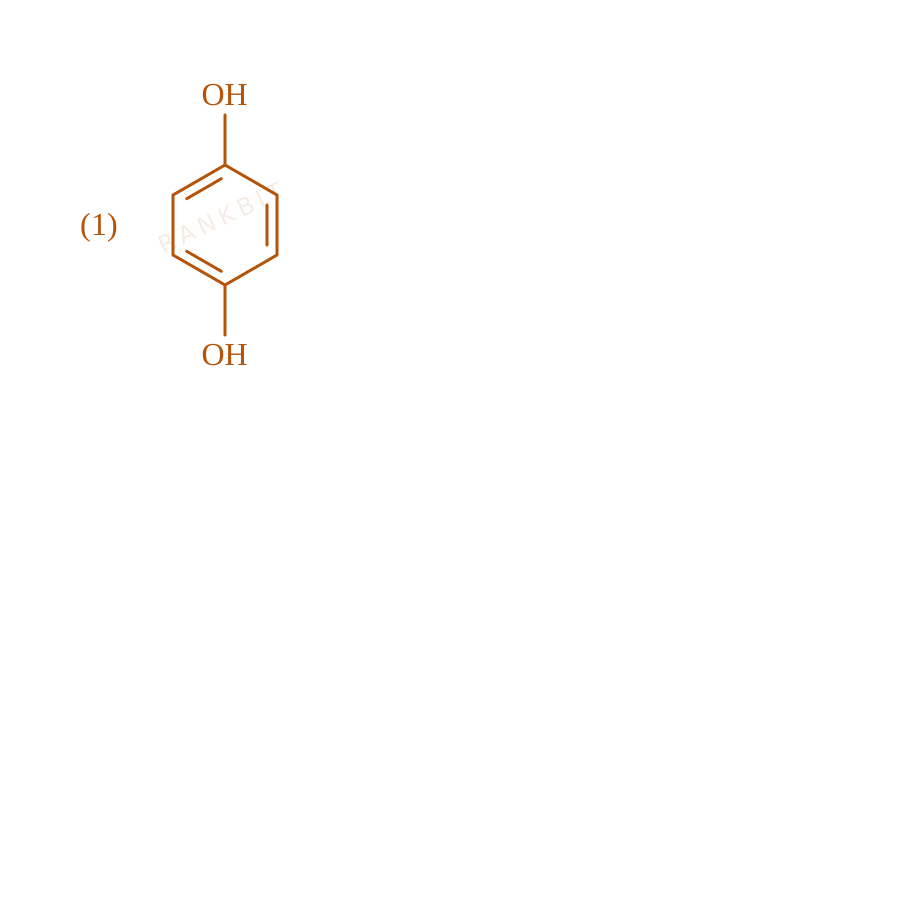
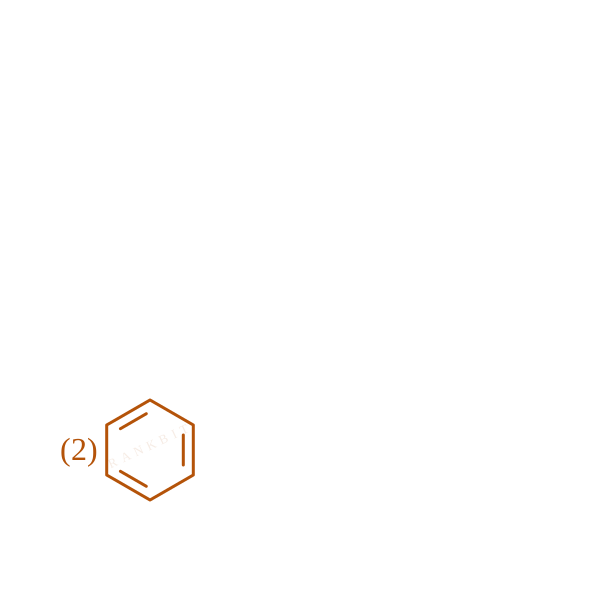
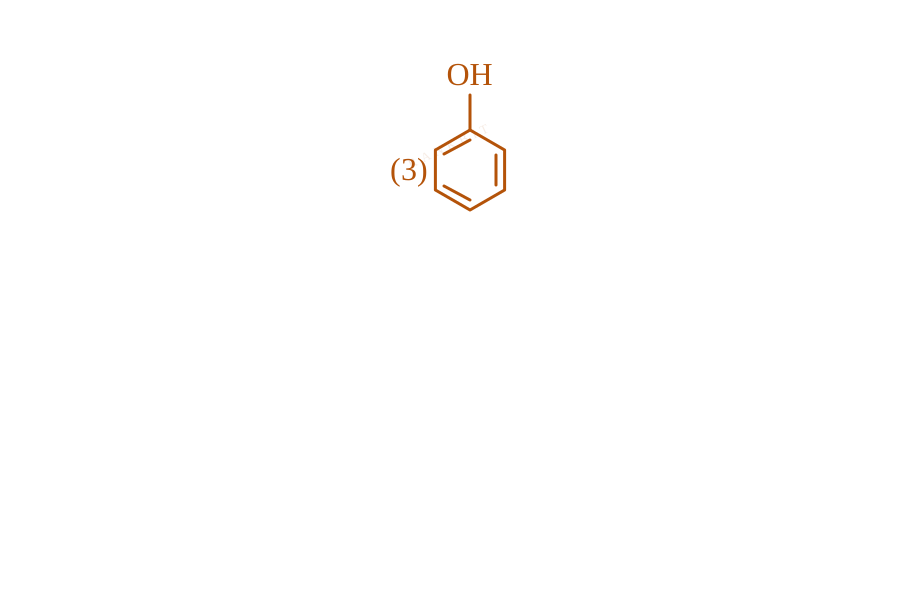
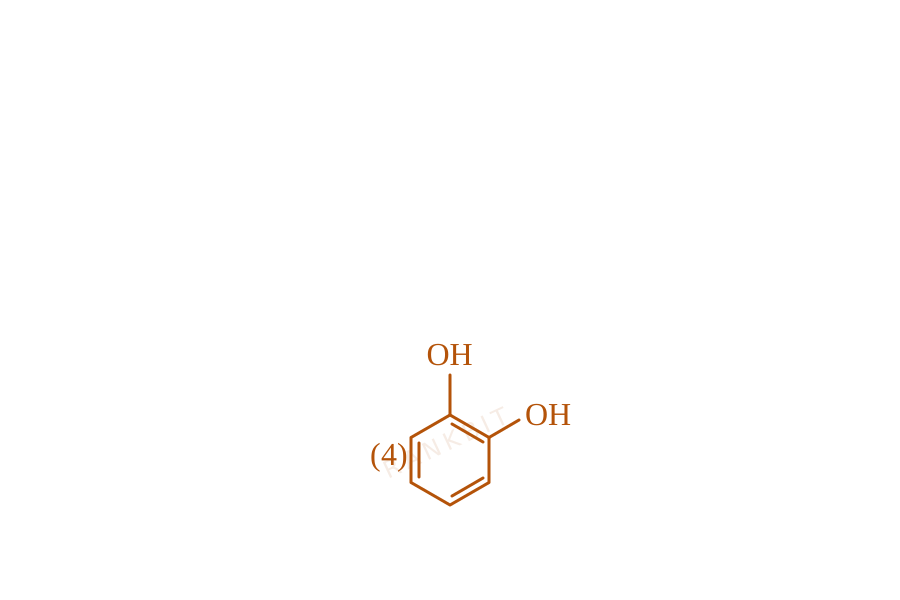
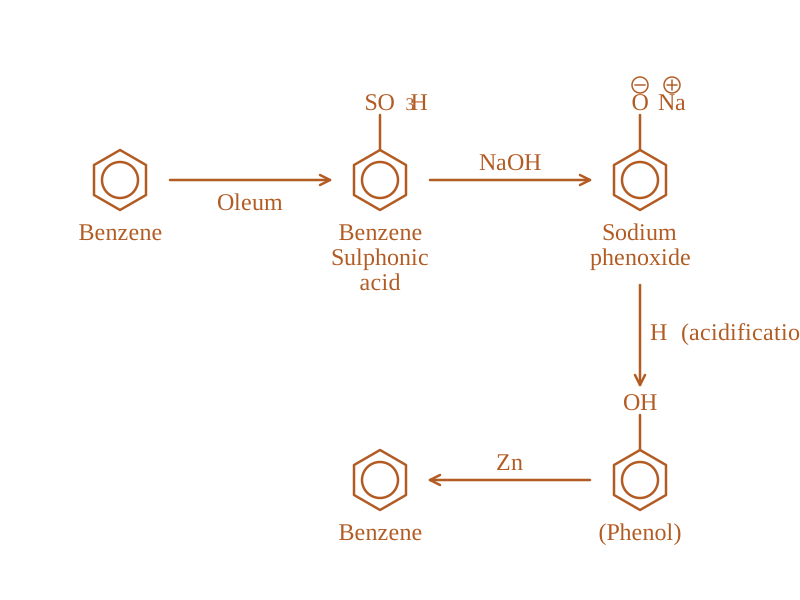
Benzene is treated with oleum to produce compound (X) which when further heated with molten sodium hydroxide followed by acidification produces compound (Y). The compound Y is treated with zinc metal to produce compound (Z). Identify the structure of compound (Z) from the following options:
A.textStructure 1$\text{Structure 1}$
Properties of Benzene
B.textStructure 2$\text{Structure 2}$
Properties of Benzene
C.textStructure 3$\text{Structure 3}$
Properties of Benzene
D.textStructure 4$\text{Structure 4}$
Properties of Benzene
Solution & Explanation
### Core Logic
Let's map out this complete aromatic synthesis pathway:
1. **Benzene + Oleum:** Sulfonation steps take place to form Benzene Sulfonic Acid (C_6H_5SO_3H$C_6H_5SO_3H$, Compound X).
2. **Fusion with molten NaOH$NaOH$ followed by H^+$H^+$ activation:** The sulfonic group is displaced, passing through a sodium phenoxide intermediate to yield Phenol (C_6H_5OH$C_6H_5OH$, Compound Y).
3. **Phenol + Zinc dust distillation:** Phenol undergoes clean deoxygenation reduction when heated with Zinc metal, stripping the hydroxyl group away to reform **Benzene** (Compound Z).
### Pattern Recognition
Zinc dust distillation is a highly reliable reduction tool designed explicitly to strip phenolic hydroxyl groups away, leaving a clean unsubstituted aromatic ring behind.
### Evaluation Rubric / Model Answer
null
### Chapter Mix
Class 11 Chemistry: Hydrocarbons
Class 12 Chemistry: Alcohols, Phenols and Ethers
Complete aromatic conversion scheme layout for Q38
More Hydrocarbons Previous-Year Questions — Page 5
Q84jee_main_2024_31_jan_eveningHalogenation of Alkanes (Isomers)
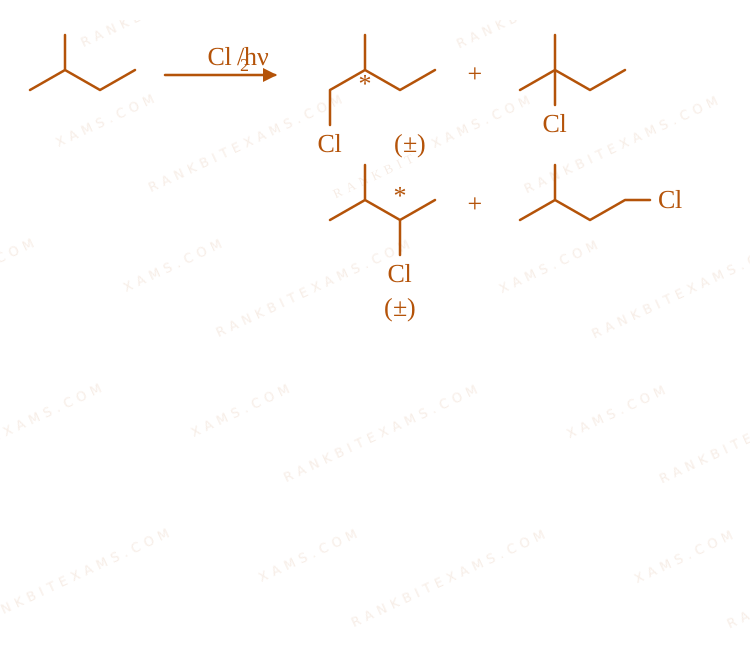
Number of isomeric products formed by mono-chlorination of 2-methylbutane in presence of sunlight is ________
Numerical Answer.Answer: 6 to 6
Solution
### Core Logic
The structure of 2-methylbutane is CH_3-CH(CH_3)-CH_2-CH_3$CH_3-CH(CH_3)-CH_2-CH_3$. It has four different types of hydrogen atoms, which can be substituted to form structural isomers:
1) 1-chloro-2-methylbutane: Chlorination at terminal CH_3$CH_3$ near branch. Yields a chiral center at C2 (2 enantiomers).
2) 2-chloro-2-methylbutane: Chlorination at the tertiary carbon (1 achiral product).
3) 2-chloro-3-methylbutane: Chlorination at the CH_2$CH_2$ group. Yields a chiral center at C2 (2 enantiomers).
4) 1-chloro-3-methylbutane: Chlorination at the far terminal CH_3$CH_3$. No chiral center (1 achiral product).
Halogenation of Alkanes (Isomers) diagram for Q84 - JEE Main 2024 Evening
### Step 1: Counting Stereoisomers
Total isomeric products = 2 (from 1st) + 1 (from 2nd) + 2 (from 3rd) + 1 (from 4th) = 6$2 (from 1st) + 1 (from 2nd) + 2 (from 3rd) + 1 (from 4th) = 6$.
### Pattern Recognition
When asked for "isomeric products" in halogenation without specifying "structural isomers", you must count stereoisomers (enantiomers) as well.
### Evaluation Rubric / Model Answer
null
### Chapter Mix
Class 11 Chemistry: Hydrocarbons
Class 12 Chemistry: Haloalkanes and Haloarenes
Number of alkanes obtained on electrolysis of a mixture of CH_3COONa$CH_3COONa$ and C_2H_5COONa$C_2H_5COONa$ is
Numerical Answer.Answer: 3 to 3
Solution
### Core Logic
Kolbe's electrolytic method generates free radicals at the anode, which then combine to form alkanes.
The given mixture yields two types of carboxylate radicals which decarboxylate to form alkyl radicals:
CH_3COONa rightarrow dotCH_3$CH_3COONa \rightarrow \dot{C}H_3$C_2H_5COONa rightarrow dotC_2H_5$C_2H_5COONa \rightarrow \dot{C}_2H_5$
These radicals can couple in three different ways:
1. Cross coupling: dotCH_3 + dotC_2H_5 rightarrow CH_3-CH_2-CH_3$\dot{C}H_3 + \dot{C}_2H_5 \rightarrow CH_3-CH_2-CH_3$ (Propane)
2. Self-coupling 1: dotCH_3 + dotCH_3 rightarrow CH_3-CH_3$\dot{C}H_3 + \dot{C}H_3 \rightarrow CH_3-CH_3$ (Ethane)
3. Self-coupling 2: dotC_2H_5 + dotC_2H_5 rightarrow CH_3-CH_2-CH_2-CH_3$\dot{C}_2H_5 + \dot{C}_2H_5 \rightarrow CH_3-CH_2-CH_2-CH_3$ (Butane)
Thus, a total of 3 different alkanes are formed.
### Evaluation Rubric / Model Answer
null
### Chapter Mix
Class 11 Chemistry: Hydrocarbons
More Hydrocarbons Questions — jee_main_2025_04_april_morning
We Map Every Repeating Question in Competitive Exams.
Say goodbye to generic mock test fatigue. RankBit uses smart analysis to group past exam questions into their foundational Repeating Question Types. Find chapter weightage, track repeating questions, and score higher with targeted practice.
Select Your Target Exam
Choose an exam track below to find formulas per chapter and patterns.
Syncing Exam Intelligence
Mapping formulas and patterns across all tracks…
PATH A — FULL LENGTH PRACTICE
Full Mock Test Hub
Simulate real NTA exam conditions with fully tracked mocks. Time yourself against past papers.
Practice past-year questions one chapter at a time. Pick an exam → subject → chapter and get every PYQ for that topic — pulled together from all past papers — with the chapter's key formulas alongside.