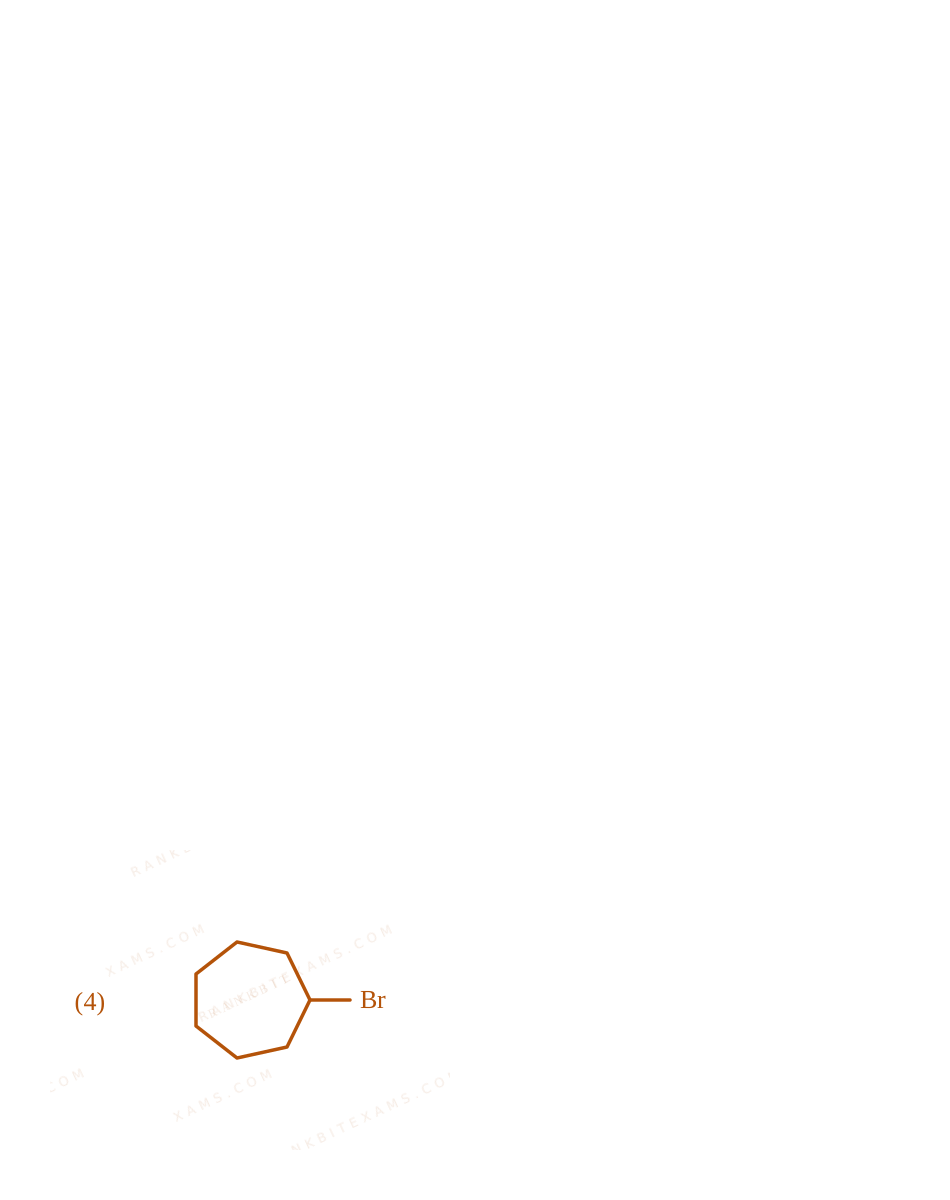
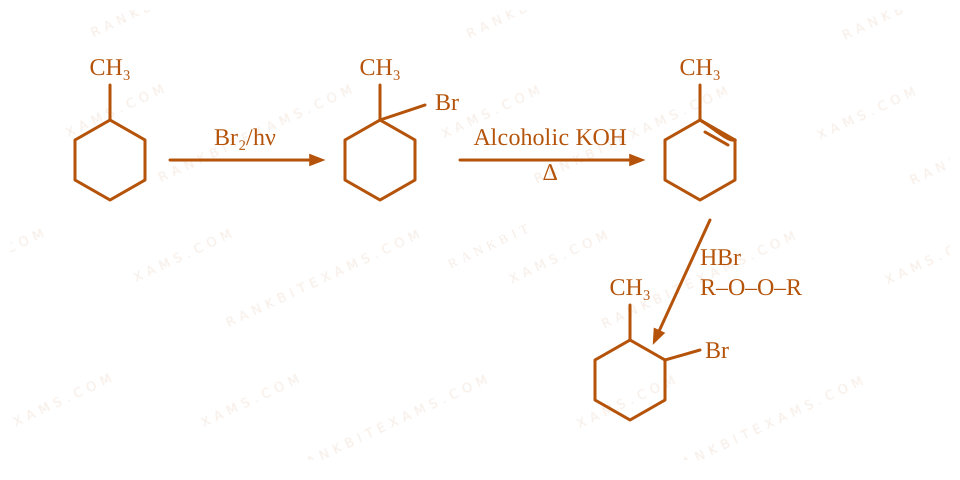
Predict the major product of the following reaction sequence:
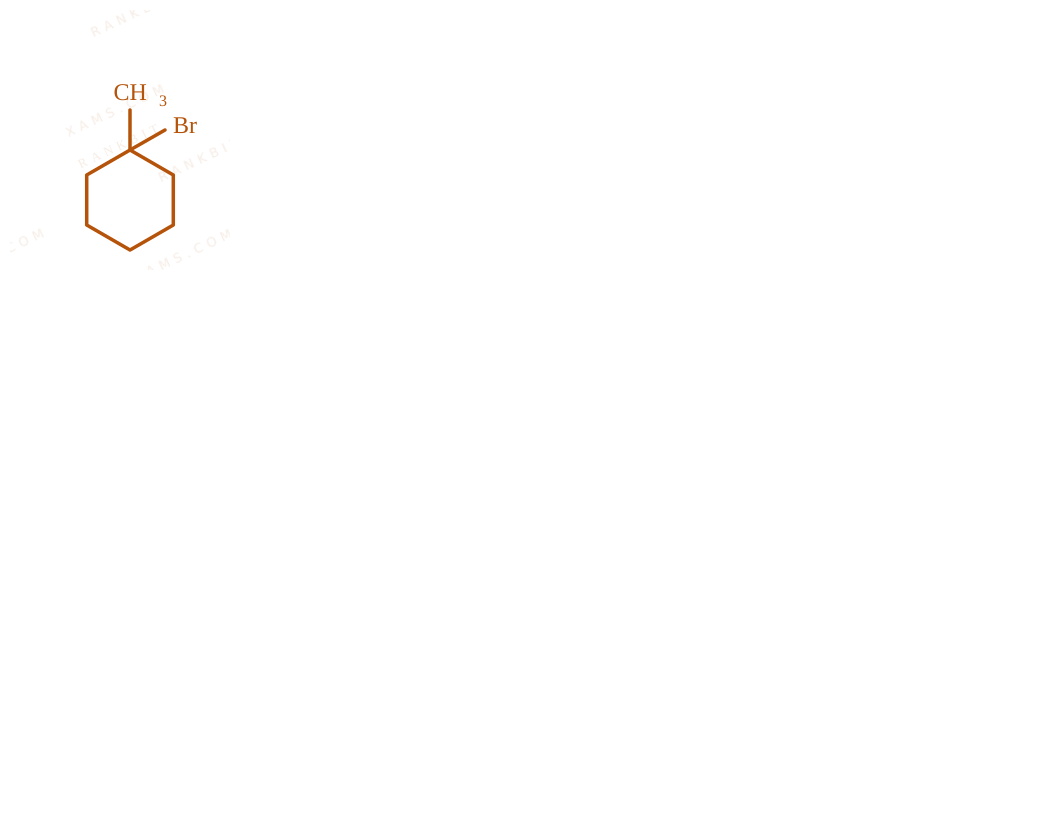
The sequence pathways specify Br2/hv free radical substitution, alcoholic KOH elimination, and HBr/peroxide addition.
A.textProduct 1$\text{Product 1}$
The sequence pathways specify Br2/hv free radical substitution, alcoholic KOH elimination, and HBr/peroxide addition.
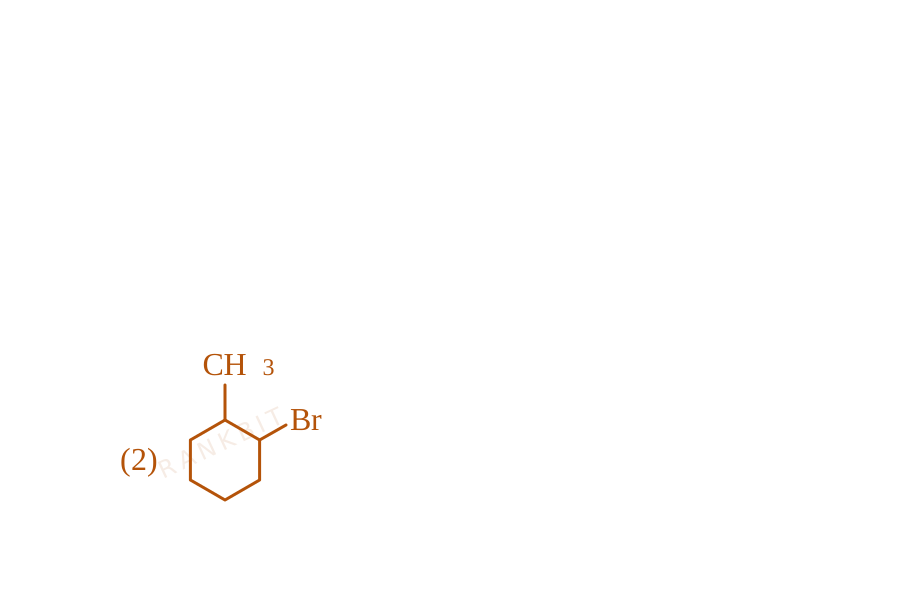
B.textProduct 2$\text{Product 2}$
The sequence pathways specify Br2/hv free radical substitution, alcoholic KOH elimination, and HBr/peroxide addition.
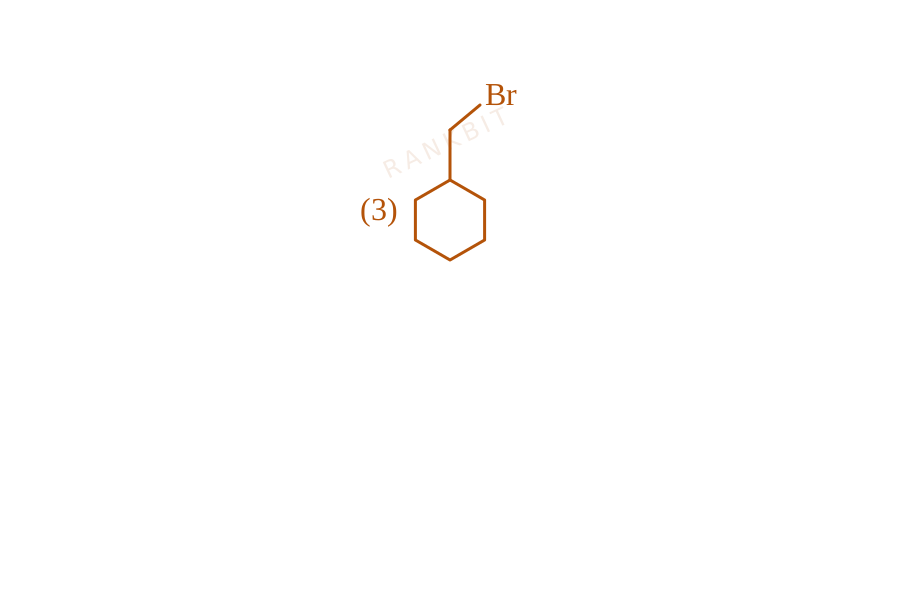
C.textProduct 3$\text{Product 3}$
The sequence pathways specify Br2/hv free radical substitution, alcoholic KOH elimination, and HBr/peroxide addition.
D.textProduct 4$\text{Product 4}$
The sequence pathways specify Br2/hv free radical substitution, alcoholic KOH elimination, and HBr/peroxide addition.
Solution & Explanation
### Core Logic
Let's analyze the steps of the reaction sequence:
1. **Step 1 (Br_2 / hnu$Br_2 / h\nu$):** Light-induced free radical substitution targeted at the most stable tertiary position, producing 1-bromo-1-methylcyclohexane.
2. **Step 2 (Alcoholic KOH, Delta$KOH, \Delta$):** Dehydrohalogenation occurs via an E2 mechanism. Following Saytzeff's rule, elimination favors the formation of the more highly substituted, stable alkene: 1-methylcyclohexene.
3. **Step 3 (HBr / R-O-O-R, hnu$HBr / R-O-O-R, h\nu$):** Radical hydrobromination across the unsymmetrical alkene. The presence of peroxide shifts addition toward the **Anti-Markovnikov** path, placing the bromine atom cleanly at the less-substituted secondary carbon to yield **1-bromo-2-methylcyclohexane**.
### Pattern Recognition
Combining Saytzeff elimination with a peroxide-promoted HBr$HBr$ addition allows you to reposition functional groups from highly substituted tertiary carbons to adjacent secondary positions.
### Evaluation Rubric / Model Answer
null
### Chapter Mix
Class 11 Chemistry: Hydrocarbons
Class 12 Chemistry: Haloalkanes and Haloarenes
The sequence pathways specify Br2/hv free radical substitution, alcoholic KOH elimination, and HBr/peroxide addition.
Qjee_main_2026_21_jan_morningAlkenes Oxidation and Reduction
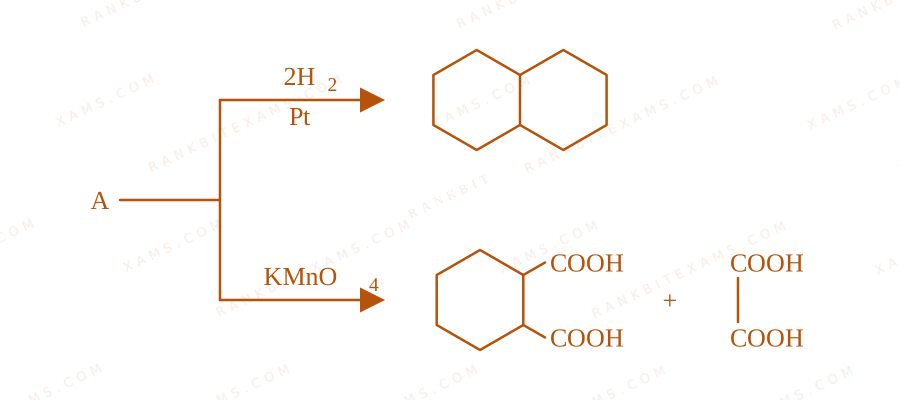
Identify A in the following reaction.
A chemical reaction scheme converting an unknown compound A into different cyclic structures using specific reagents.
A.
B.
C.
D.
Solution
### Core Logic
Let's analyze the given reaction sequences.
1. Reaction with 2H_2 / Pt$2H_2 / Pt$: Compound A undergoes hydrogenation with 2 moles of hydrogen, suggesting the presence of two double bonds.
2. Reaction with mathrmKMnO_4 / Delta$\mathrm{KMnO_4} / \Delta$: Compound A undergoes oxidative cleavage to give a substituted dicarboxylic acid (cyclohexane-1,2-dicarboxylic acid) and oxalic acid (HOOC-COOH$HOOC-COOH$).
The structure of A must have a diene system that, when cleaved completely at the double bonds, yields these specific acid fragments.
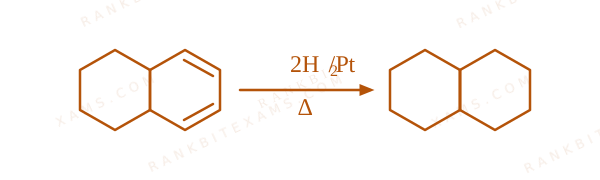
A chemical reaction scheme converting an unknown compound A into different cyclic structures using specific reagents.
By matching the cleavage points, compound A is identified as 1,2,3,4,4a,5,8,8a-octahydronaphthalene derivative with two isolated double bonds in the ring.
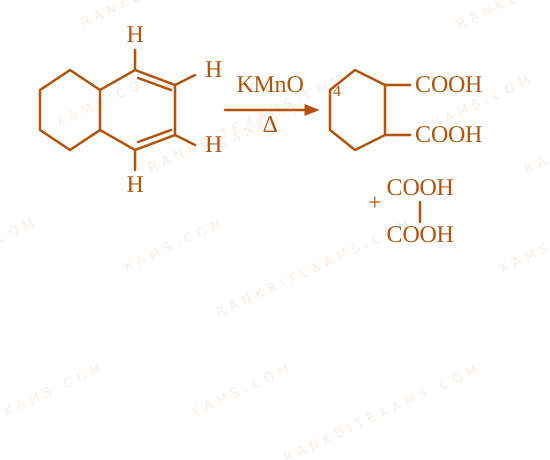
A chemical reaction scheme converting an unknown compound A into different cyclic structures using specific reagents.
### Pattern Recognition
Hot KMnO_4$KMnO_4$ cleaves double bonds entirely, converting =C-H$=C-H$ into -COOH$-COOH$. The formation of oxalic acid indicates a -CH=CH-$-CH=CH-$ fragment caught between two cleavable double bonds in a ring system.
### Evaluation Rubric / Model Answer
null
### Chapter Mix
Class 11 Chemistry: Hydrocarbons
Qjee_main_2025_02_april_eveningAlkanes and Physical Properties
Given below are two statements:
Statement (I): Neopentane forms only one monosubstituted derivative.
Statement (II): Melting point of neopentane is higher than n-pentane
In the light of the above statements, choose the most appropriate answer from the options given below:
A.textStatement I is correct but Statement II is incorrect$\text{Statement I is correct but Statement II is incorrect}$
B.textBoth Statement I and Statement II are correct$\text{Both Statement I and Statement II are correct}$
C.textBoth Statement I and Statement II are incorrect$\text{Both Statement I and Statement II are incorrect}$
D.textStatement I is incorrect but Statement II is correct$\text{Statement I is incorrect but Statement II is correct}$
Solution
### Related Formula
textSymmetric Structure propto textMelting Point (Packing efficiency)$$\text{Symmetric Structure} \propto \text{Melting Point (Packing efficiency)}$$
### Core Logic
**Statement (I) is correct**: Neopentane (2,2-dimethylpropane) contains a quaternary carbon bonded to four methyl groups. There are 12 hydrogen atoms, all of which are primary and chemically equivalent. Halogenation yields exactly one monosubstituted derivative:
mathrm(CH_3)_4C + X_2 xrightarrowhnu (CH_3)_3C-CH_2X + HX$$\mathrm{(CH_3)_4C + X_2 \xrightarrow{h\nu} (CH_3)_3C-CH_2X + HX}$$
Statement (II) is correct: Neopentane has a compact, symmetrical, nearly spherical molecular structure. In the solid crystal lattice, these spherical molecules pack much more efficiently compared to the floppy, linear n-pentane. This robust crystalline packing dramatically increases its melting point (256.4~mathrmK$256.4~\mathrm{K}$) compared to that of n-pentane (143.4~mathrmK$143.4~\mathrm{K}$).
### Step 1: Final Verification
Since both statements are theoretically and experimentally correct, the correct option is (2).
Alkanes and Physical Properties
### Pattern Recognition
While branching *decreases* the boiling point (due to decreased surface area and weaker van der Waals forces), branching that creates a highly symmetric structure *increases* the melting point because of close-packing efficiency in the solid phase.
### Evaluation Rubric / Model Answer
null
### Chapter Mix
Class 11 Chemistry: Hydrocarbons
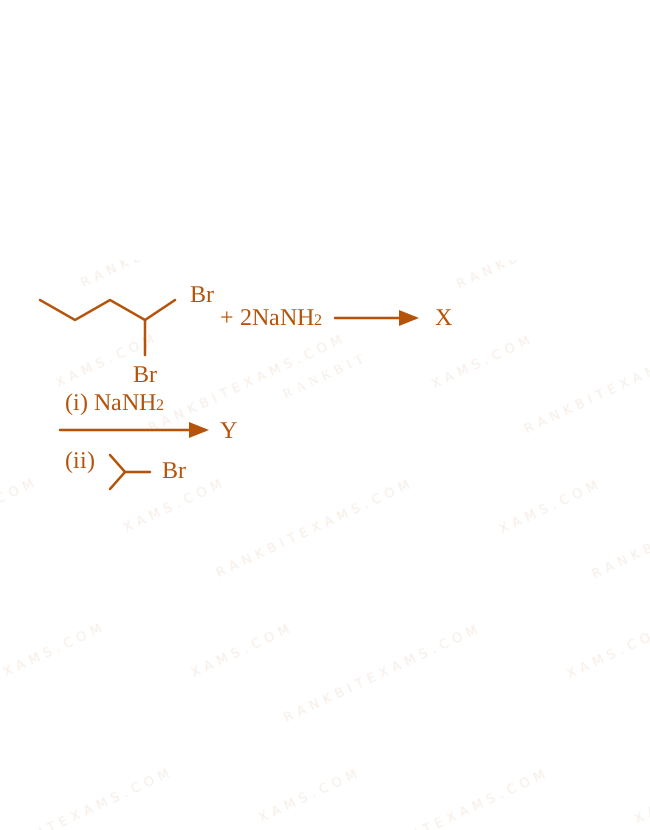
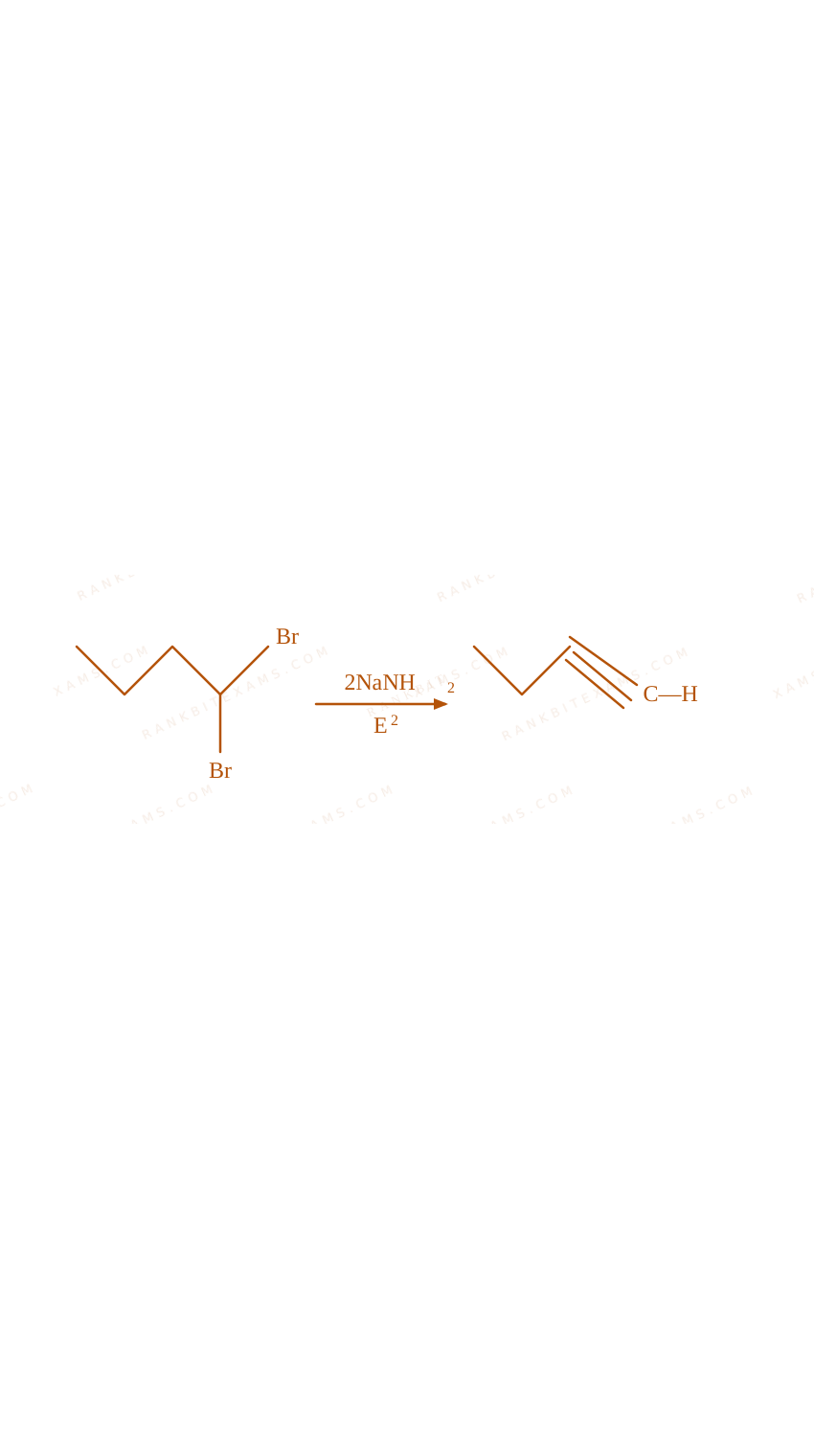
In the following series of reactions identify the major products A & B respectively:
Electrophilic Aromatic Substitution
A.
B.
C.
D.
Solution
### Related Formula
Orienting effects in electrophilic aromatic substitution:
- Bromine (-Br$-Br$) is ortho/para-directing (para-dominated due to steric hindrance).
- Sulfonic acid group (-SO_3H$-SO_3H$) is a strong deactivating, meta-directing group.
Electrophilic Aromatic Substitution
### Core Logic
Analyzing the first step:
- Sulfonation of bromobenzene with mathrmSO_3/mathrmH_2mathrmSO_4$\mathrm{SO}_3/\mathrm{H}_2\mathrm{SO}_4$ yields 4-bromobenzenesulfonic acid as the major product (A) due to steric hindrance at the ortho-position.
### Step 1: Determine orientation for the second step
In 4-bromobenzenesulfonic acid, we have two substituents:
- -Br$-Br$ (ortho/para director)
- -SO_3H$-SO_3H$ (meta director)
The positions meta to the deactivating -SO_3H$-SO_3H$ group correspond to the positions ortho to the -Br$-Br$ group. Both directing effects align on the same position (carbon-3/carbon-5). Since -Br$-Br$ is activating relative to -SO_3H$-SO_3H$, it controls the orientation.
### Step 2: Identify Product B
Halogenation with mathrmBr_2/mathrmFe$\mathrm{Br}_2/\mathrm{Fe}$ introduces a bromine atom ortho to the existing bromine atom (meta to -SO_3H$-SO_3H$):
textProduct B = text3,4-dibromobenzenesulfonic acid$$\text{Product B} = \text{3,4-dibromobenzenesulfonic acid}$$
This matches Option (2).
### Pattern Recognition
When an activating group (-Br$-Br$) and a deactivating group (-SO_3H$-SO_3H$) compete on a benzene ring, the orienting influence of the activating group wins. Position ortho to the bromine atom is favored over meta positions of the sulfonic acid group.
### Evaluation Rubric / Model Answer
null
### Chapter Mix
Class 11 Chemistry: Hydrocarbons
Class 12 Chemistry: Haloalkanes and Haloarenes
Q26jee_main_2025_07_april_morningOzonolysis of Alkenes
Given below are two statements:
Statement I: Ozonolysis followed by treatment with mathrmZn$\mathrm{Zn}$, mathrmH_2mathrmO$\mathrm{H}_2\mathrm{O}$ of cis-2-butene gives ethanal.
Statement II: The product obtained by ozonolysis followed by treatment with mathrmZn$\mathrm{Zn}$, mathrmH_2mathrmO$\mathrm{H}_2\mathrm{O}$ of 3,6-dimethyloct-4-ene has no chiral carbon atom.
In the light of the above statements, choose the correct answer from the options given below:
A.textBoth Statement I and Statement II are true$\text{Both Statement I and Statement II are true}$
B.textStatement I is false but Statement II is true$\text{Statement I is false but Statement II is true}$
C.textStatement I is true but Statement II is false$\text{Statement I is true but Statement II is false}$
D.textBoth Statement I and Statement II are false$\text{Both Statement I and Statement II are false}$
Solution
### Related Formula
textR_1-textCH=textCH-textR_2 xrightarrow[text(ii) Zn, H_2textO]text(i) O_3 textR_1-textCHO + textR_2-textCHO$$\text{R}_1-\text{CH}=\text{CH}-\text{R}_2 \xrightarrow[\text{(ii) Zn, H}_2\text{O}]{\text{(i) O}_3} \text{R}_1-\text{CHO} + \text{R}_2-\text{CHO}$$
### Core Logic
Statement I: Cis-2-butene (CH_3-CH=CH-CH_3$CH_3-CH=CH-CH_3$) undergoes reductive ozonolysis to cleave the double bond and yield two molecules of acetaldehyde (ethanal, CH_3CHO$CH_3CHO$). This statement is true.
Statement II: 3,6-dimethyloct-4-ene (CH_3-CH_2-CH(CH_3)-CH=CH-CH(CH_3)-CH_2-CH_3$CH_3-CH_2-CH(CH_3)-CH=CH-CH(CH_3)-CH_2-CH_3$) undergoes reductive ozonolysis to yield 2-methylbutanal (CH_3-CH_2-CH(CH_3)-CHO$CH_3-CH_2-CH(CH_3)-CHO$). This product contains a chiral carbon atom (the C2$C2$ carbon bonded to -H$-H$, -CH_3$-CH_3$, -CHO$-CHO$, and -C_2H_5$-C_2H_5$). Thus, the statement that it has no chiral carbon atom is false.
### Pattern Recognition
To check chirality after ozonolysis, draw the cleaved fragment structure first. Any carbon with four different groups is chiral. 2-methylbutanal has four unique groups attached to C2$C2$, making Statement II clearly false.
### Evaluation Rubric / Model Answer
null
### Chapter Mix
Class 11 Chemistry: Hydrocarbons
Class 12 Chemistry: Organic Chemistry - Some Basic Principles and Techniques
Given below are two statements :
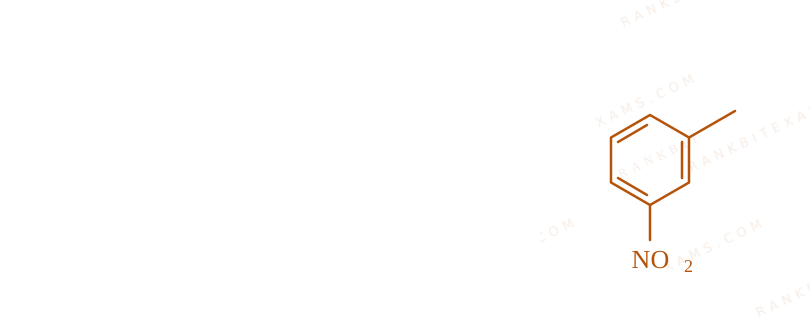
Statement (I): On nitration of m-xylene with HNO_3$HNO_{3}$, H_2SO_4$H_{2}SO_{4}$ followed by oxidation, 4-nitrobenzene-1, 3-dicarboxylic acid is obtained as the major product.
Statement (II) : CH_3$CH_{3}$ group is o/p-directing while -NO_2$-NO_{2}$ group is m-directing group.
In the light of the above statements, choose the correct answer from the options given below :
A. Both Statement I and Statement II are false
B. Statement I is false but Statement II is true
C. Both Statement I and Statement II are true
D. Statement I is true but Statement II is false
Solution
### Core Logic
Statement I is true: In m-xylene, both methyl groups direct incoming electrophiles to position 4 (synergistic ortho/para effect). Nitration gives 4-nitro-m-xylene. Subsequent strong oxidation of both -CH_3$-CH_3$ groups yields 4-nitrobenzene-1,3-dicarboxylic acid.
Aromatic Electrophilic Substitution diagram for Q33 - JEE Main 2025 Evening
Statement II is true: Alkyl groups (-CH_3$-CH_3$) act as ortho/para directors via hyperconjugation, whereas nitro groups (-NO_2$-NO_2$) are strongly deactivating meta directors.
### Pattern Recognition
When evaluating multi-substituted benzenes, identify whether directors reinforce the same positions. In m-xylene, position 4 is ortho to one methyl and para to the other.
### Evaluation Rubric / Model Answer
null
### Chapter Mix
Class 11 Chemistry: Hydrocarbons
More Hydrocarbons Questions — jee_main_2025_04_april_morning
We Map Every Repeating Question in Competitive Exams.
Say goodbye to generic mock test fatigue. RankBit uses smart analysis to group past exam questions into their foundational Repeating Question Types. Find chapter weightage, track repeating questions, and score higher with targeted practice.
Select Your Target Exam
Choose an exam track below to find formulas per chapter and patterns.
Syncing Exam Intelligence
Mapping formulas and patterns across all tracks…
PATH A — FULL LENGTH PRACTICE
Full Mock Test Hub
Simulate real NTA exam conditions with fully tracked mocks. Time yourself against past papers.
Practice past-year questions one chapter at a time. Pick an exam → subject → chapter and get every PYQ for that topic — pulled together from all past papers — with the chapter's key formulas alongside.