Rankbit System
JEE Physics: Waves (+15.5%) | Electrostatics: Concentric Shells (-29.7%) | Modern Physics: Photoelectric Clones (+34.2%) | Mathematics: Definite Integrals (+18.1%) | Chemistry: Coordination Splitting (-11.4%) | JEE Physics: Waves (+15.5%) | Electrostatics: Concentric Shells (-29.7%) | Modern Physics: Photoelectric Clones (+34.2%) | Mathematics: Definite Integrals (+18.1%) | Chemistry: Coordination Splitting (-11.4%)

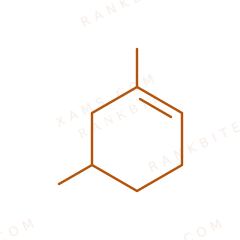
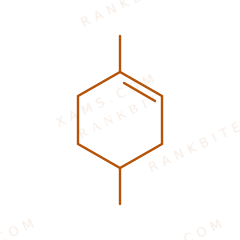
Which compound would give 3-methyl-6-oxoheptanal upon ozonolysis ?

Solution & Explanation

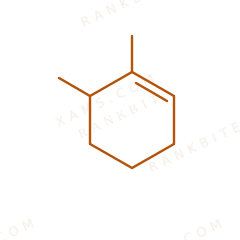
### Core Logic Let us reconstruct the original alkene from the given ozonolysis product fragments. Write down the line-structure formula for 3-methyl-6-oxoheptanal: textO=textCH-textCH2-textCH(CH*3)-textCH*2-textCH*2-textC(O)-textCH*3 Remove both carbonyl oxygen atoms and link carbon-1 directly to carbon-6 with a double bond. This cyclizes into a 6-membered ring structure: 1,4-dimethylcyclohexene.
Alkene cyclization path for Q42 - JEE Main 2025 Morning
### Step 1: Ozonolysis Verification Performing reductive ozonolysis (O_3 / Zn, H_2O) cleaves the internal endocyclic double bond of 1,4-dimethylcyclohexene, perfectly regenerating the acyclic keto-aldehyde compound. ### Pattern Recognition Shortcut: Count the carbons in the main chain product (7text carbons total). Ozonolysis of option (2) creates an open chain containing a terminal aldehyde group on one end and a methyl ketone group on the other. ### Evaluation Rubric / Model Answer null ### Chapter Mix Class 11 Chemistry: Hydrocarbons
Reference Study Guides

More Hydrocarbons Previous-Year Questions

Q 2025 Alkanes and Physical Properties
Given below are two statements: Statement (I): Neopentane forms only one monosubstituted derivative. Statement (II): Melting point of neopentane is higher than n-pentane In the light of the above statements, choose the most appropriate answer from the options given below:
  • A. textStatement I is correct but Statement II is incorrect
  • B. textBoth Statement I and Statement II are correct
  • C. textBoth Statement I and Statement II are incorrect
  • D. textStatement I is incorrect but Statement II is correct

Solution

### Related Formula textSymmetric Structure propto textMelting Point (Packing efficiency) ### Core Logic **Statement (I) is correct**: Neopentane (2,2-dimethylpropane) contains a quaternary carbon bonded to four methyl groups. There are 12 hydrogen atoms, all of which are primary and chemically equivalent. Halogenation yields exactly one monosubstituted derivative: mathrm(CH_3)_4C + X_2 xrightarrowhnu (CH_3)_3C-CH_2X + HX Statement (II) is correct: Neopentane has a compact, symmetrical, nearly spherical molecular structure. In the solid crystal lattice, these spherical molecules pack much more efficiently compared to the floppy, linear n-pentane. This robust crystalline packing dramatically increases its melting point (256.4~mathrmK) compared to that of n-pentane (143.4~mathrmK). ### Step 1: Final Verification Since both statements are theoretically and experimentally correct, the correct option is (2).
Alkanes and Physical Properties
### Pattern Recognition While branching *decreases* the boiling point (due to decreased surface area and weaker van der Waals forces), branching that creates a highly symmetric structure *increases* the melting point because of close-packing efficiency in the solid phase. ### Evaluation Rubric / Model Answer null ### Chapter Mix Class 11 Chemistry: Hydrocarbons
Q 2025 Electrophilic Aromatic Substitution
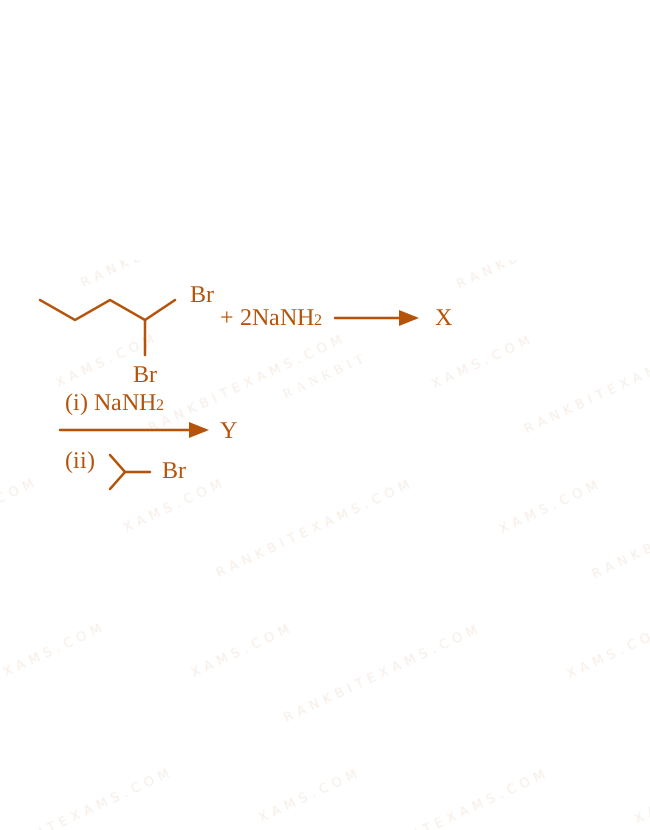
In the following series of reactions identify the major products A & B respectively:
Electrophilic Aromatic Substitution
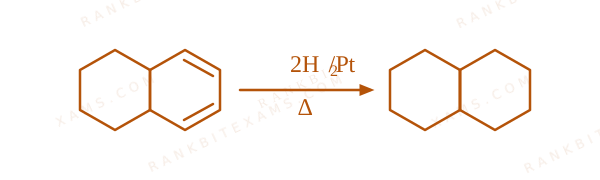
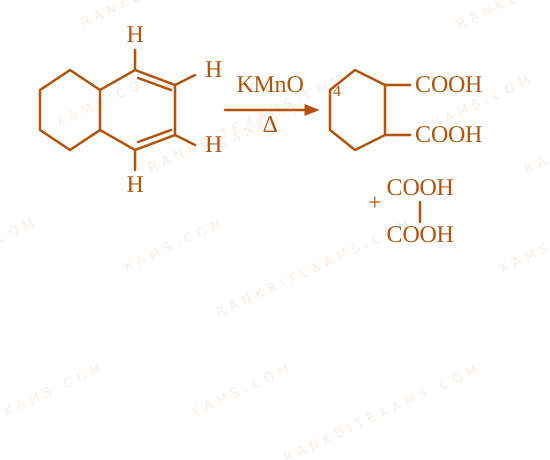
  • A.
  • B.
  • C.
  • D.

Solution

### Related Formula Orienting effects in electrophilic aromatic substitution: - Bromine (-Br) is ortho/para-directing (para-dominated due to steric hindrance). - Sulfonic acid group (-SO_3H) is a strong deactivating, meta-directing group.
Electrophilic Aromatic Substitution
### Core Logic Analyzing the first step: - Sulfonation of bromobenzene with mathrmSO_3/mathrmH_2mathrmSO_4 yields 4-bromobenzenesulfonic acid as the major product (A) due to steric hindrance at the ortho-position. ### Step 1: Determine orientation for the second step In 4-bromobenzenesulfonic acid, we have two substituents: - -Br (ortho/para director) - -SO_3H (meta director) The positions meta to the deactivating -SO_3H group correspond to the positions ortho to the -Br group. Both directing effects align on the same position (carbon-3/carbon-5). Since -Br is activating relative to -SO_3H, it controls the orientation. ### Step 2: Identify Product B Halogenation with mathrmBr_2/mathrmFe introduces a bromine atom ortho to the existing bromine atom (meta to -SO_3H): textProduct B = text3,4-dibromobenzenesulfonic acid This matches Option (2). ### Pattern Recognition When an activating group (-Br) and a deactivating group (-SO_3H) compete on a benzene ring, the orienting influence of the activating group wins. Position ortho to the bromine atom is favored over meta positions of the sulfonic acid group. ### Evaluation Rubric / Model Answer null ### Chapter Mix Class 11 Chemistry: Hydrocarbons Class 12 Chemistry: Haloalkanes and Haloarenes
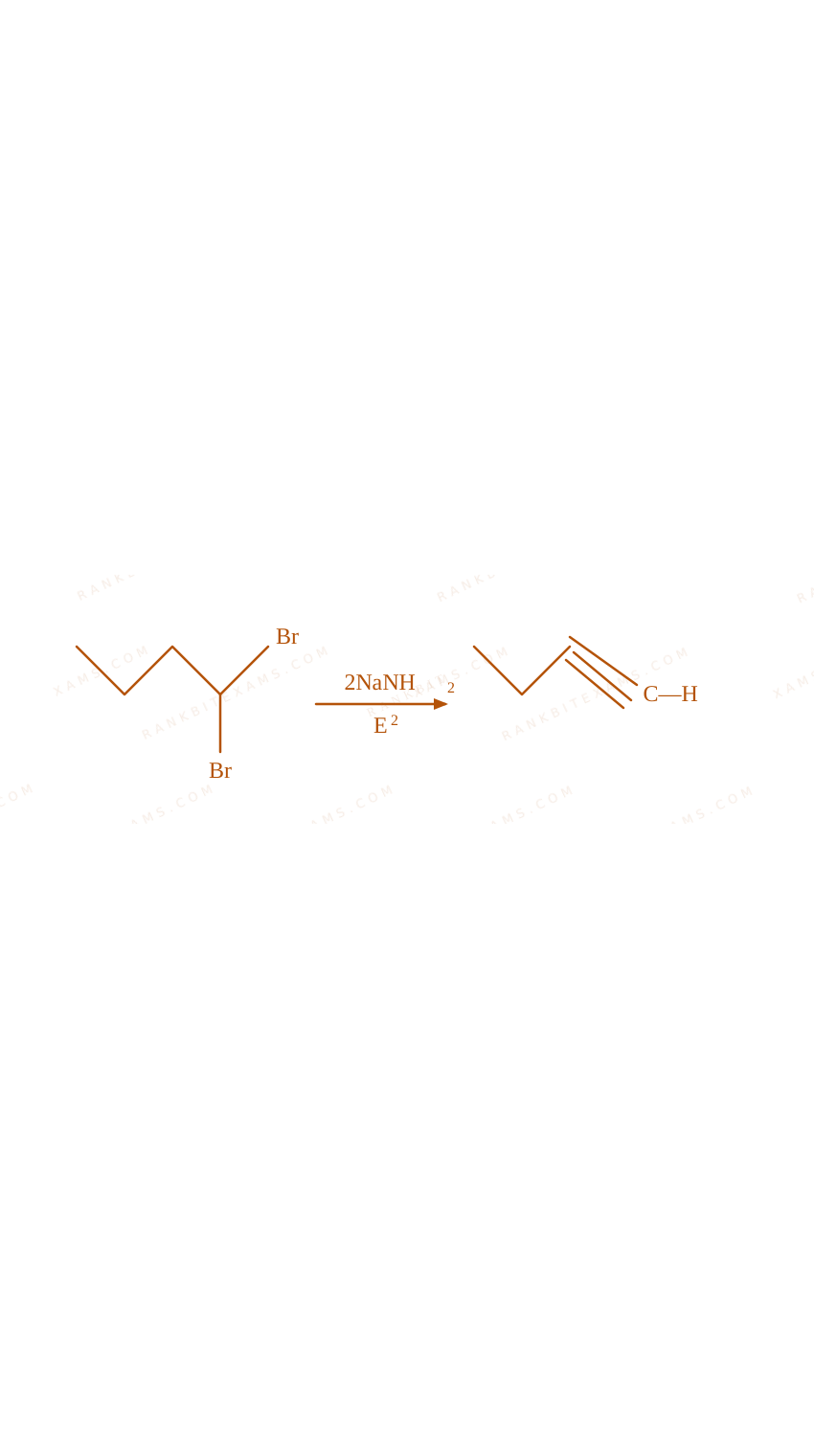
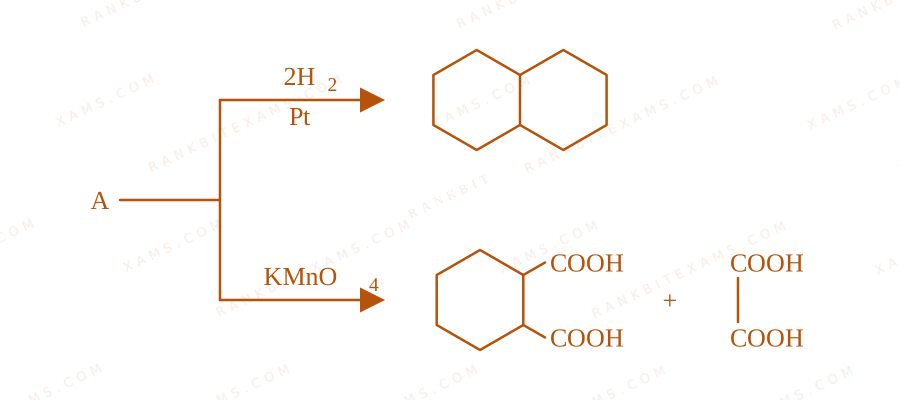
Q26 2025 Ozonolysis of Alkenes
Given below are two statements: Statement I: Ozonolysis followed by treatment with mathrmZn, mathrmH_2mathrmO of cis-2-butene gives ethanal. Statement II: The product obtained by ozonolysis followed by treatment with mathrmZn, mathrmH_2mathrmO of 3,6-dimethyloct-4-ene has no chiral carbon atom. In the light of the above statements, choose the correct answer from the options given below:
  • A. textBoth Statement I and Statement II are true
  • B. textStatement I is false but Statement II is true
  • C. textStatement I is true but Statement II is false
  • D. textBoth Statement I and Statement II are false

Solution

### Related Formula textR_1-textCH=textCH-textR_2 xrightarrow[text(ii) Zn, H_2textO]text(i) O_3 textR_1-textCHO + textR_2-textCHO ### Core Logic Statement I: Cis-2-butene (CH_3-CH=CH-CH_3) undergoes reductive ozonolysis to cleave the double bond and yield two molecules of acetaldehyde (ethanal, CH_3CHO). This statement is true. Statement II: 3,6-dimethyloct-4-ene (CH_3-CH_2-CH(CH_3)-CH=CH-CH(CH_3)-CH_2-CH_3) undergoes reductive ozonolysis to yield 2-methylbutanal (CH_3-CH_2-CH(CH_3)-CHO). This product contains a chiral carbon atom (the C2 carbon bonded to -H, -CH_3, -CHO, and -C_2H_5). Thus, the statement that it has no chiral carbon atom is false. ### Pattern Recognition To check chirality after ozonolysis, draw the cleaved fragment structure first. Any carbon with four different groups is chiral. 2-methylbutanal has four unique groups attached to C2, making Statement II clearly false. ### Evaluation Rubric / Model Answer null ### Chapter Mix Class 11 Chemistry: Hydrocarbons Class 12 Chemistry: Organic Chemistry - Some Basic Principles and Techniques
Q33 2025 Aromatic Electrophilic Substitution
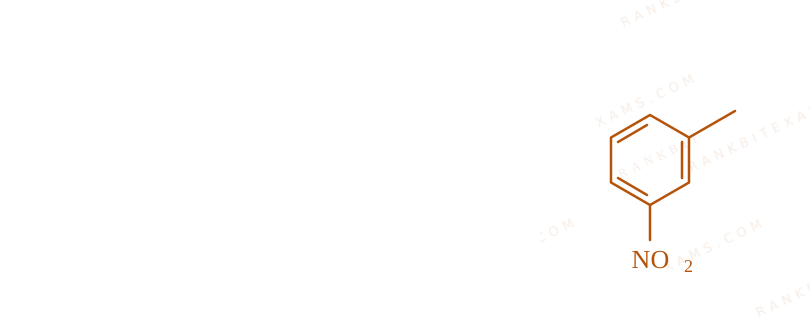
Given below are two statements : Statement (I): On nitration of m-xylene with HNO_3, H_2SO_4 followed by oxidation, 4-nitrobenzene-1, 3-dicarboxylic acid is obtained as the major product. Statement (II) : CH_3 group is o/p-directing while -NO_2 group is m-directing group. In the light of the above statements, choose the correct answer from the options given below :
  • A. Both Statement I and Statement II are false
  • B. Statement I is false but Statement II is true
  • C. Both Statement I and Statement II are true
  • D. Statement I is true but Statement II is false

Solution

### Core Logic Statement I is true: In m-xylene, both methyl groups direct incoming electrophiles to position 4 (synergistic ortho/para effect). Nitration gives 4-nitro-m-xylene. Subsequent strong oxidation of both -CH_3 groups yields 4-nitrobenzene-1,3-dicarboxylic acid.
Aromatic Electrophilic Substitution diagram for Q33 - JEE Main 2025 Evening
Statement II is true: Alkyl groups (-CH_3) act as ortho/para directors via hyperconjugation, whereas nitro groups (-NO_2) are strongly deactivating meta directors. ### Pattern Recognition When evaluating multi-substituted benzenes, identify whether directors reinforce the same positions. In m-xylene, position 4 is ortho to one methyl and para to the other. ### Evaluation Rubric / Model Answer null ### Chapter Mix Class 11 Chemistry: Hydrocarbons
Q47 2025 Aromatic Hydrocarbons and Isomerism
Isomeric hydrocarbons giving negative Baeyer's test have the molecular formula C_9H_12. The total number of isomers from above with exactly four different non-aliphatic substitution sites is ________.
Numerical Answer. Answer: 2 to 2

Solution

### Core Logic A negative Baeyer's test confirms that the hydrocarbon structural isomers contain no aliphatic alkene or alkyne unsaturations, establishing that they are purely aromatic benzene derivatives with side alkyl chains.
Aromatic Hydrocarbons and Isomerism diagram for Q47 - JEE Main 2025 Evening
To find structures possessing four distinct ring positions available for electrophilic substitution, we examine the symmetries of specific tri-substituted configurations. There are exactly 2 such structural isomers satisfying these spatial conditions. ### Pattern Recognition Negative test = aromatic ring constraint. Calculate positional substitution patterns meticulously to ensure ring symmetry matches the required counts. ### Evaluation Rubric / Model Answer null ### Chapter Mix Class 11 Chemistry: Hydrocarbons
More Hydrocarbons Questions — jee_main_2025_03_april_morning

Practice all Hydrocarbons previous-year questions →

YOUR FIRST PREP STEP STARTS HERE

We Map Every Repeating Question in Competitive Exams.

Say goodbye to generic mock test fatigue. RankBit uses smart analysis to group past exam questions into their foundational Repeating Question Types. Find chapter weightage, track repeating questions, and score higher with targeted practice.

Select Your Target Exam

Choose an exam track below to find formulas per chapter and patterns.

Syncing Exam Intelligence

Mapping formulas and patterns across all tracks…

PATH A — FULL LENGTH PRACTICE

Full Mock Test Hub

Simulate real NTA exam conditions with fully tracked mocks. Time yourself against past papers.

Under Development
PATH B — TARGETED PRACTICE

Topic-wise Practice Hub

Practice past-year questions one chapter at a time. Pick an exam → subject → chapter and get every PYQ for that topic — pulled together from all past papers — with the chapter's key formulas alongside.

Loading Questions... Browse Topics
Latest from the Blog
View all →

Loading articles...