JEE Main · Physics ↑ Rising

Thermal Properties of Matter appeared 13 times across 3 years — 1.5% of Physics. This question is from Thermal Expansion.

Year 2026 2025 2024 Total
Questions 5 7 1 13

Consider a rectangular sheet of solid material of length =9 cm and width d=4 cm. The coefficient of linear expansion is α=3.1×10⁻⁵ K⁻¹ at room temperature and one atmospheric pressure. The mass of sheet m=0.1 kg and the specific heat capacity Cv=900 J kg⁻¹K⁻¹. If the amount of heat supplied to the material is 8.1×10² J then change in area of the rectangular sheet is :-

Solution & Explanation

Related Formula
Δ Q = m Cv Δ T Δ A = A₀ β Δ T = A₀ (2α) Δ T
Core Logic

First, calculate the temperature change using heat supplied:

Δ T = (Δ Q)/(m Cv)

Substituting the values:

Δ T = (8.1 × 10²)/(0.1 × 900) = (810)/(90) = 9 K
Step 1: Calculate Change in Area

Initial area A₀ = × d = 9 cm × 4 cm = 36 cm² = 36 × 10⁻⁴ m². Now, substitute into the area expansion formula:

Δ A = 36 × 10⁻⁴ × 2 × (3.1 × 10⁻⁵) × 9 Δ A = 36 × 18 × 3.1 × 10⁻⁹ = 2008.8 × 10⁻⁹ m² ≈ 2.0 × 10⁻⁶ m²
Pattern Recognition

Always remember that areal expansion coefficient β = 2α. Convert geometry dimensions to standard units (1 cm² = 10⁻⁴ m²) cleanly before concluding arithmetic.

Chapter Mix

Class 11 Physics: Thermal Properties of Matter

Reference Study Guides

More Thermal Properties of Matter Previous-Year Questions — Page 3

Q10 jee_main_2025_24_jan_evening Temperature Scales
Which of the following figure represents the relation between Celsius and Fahrenheit temperatures?
  • A. Graph (1)
  • B. Graph (2)
  • C. Graph (3)
  • D. Graph (4)

Solution

Related Formula
(C)/(5) = (F - 32)/(9)
Core Logic

Rearranging the conversion identity to express C as a function of F:

C = (5)/(9)F - (160)/(9)

This is a straight line equation y = mx + c with:

  • Positive slope m = (5)/(9)
  • Negative y-intercept c = -(160)/(9) (at F=0, C ≈ -17.8°C)
  • Positive x-intercept at C=0, F=32
  • This completely matches the layout shown in Graph (2).
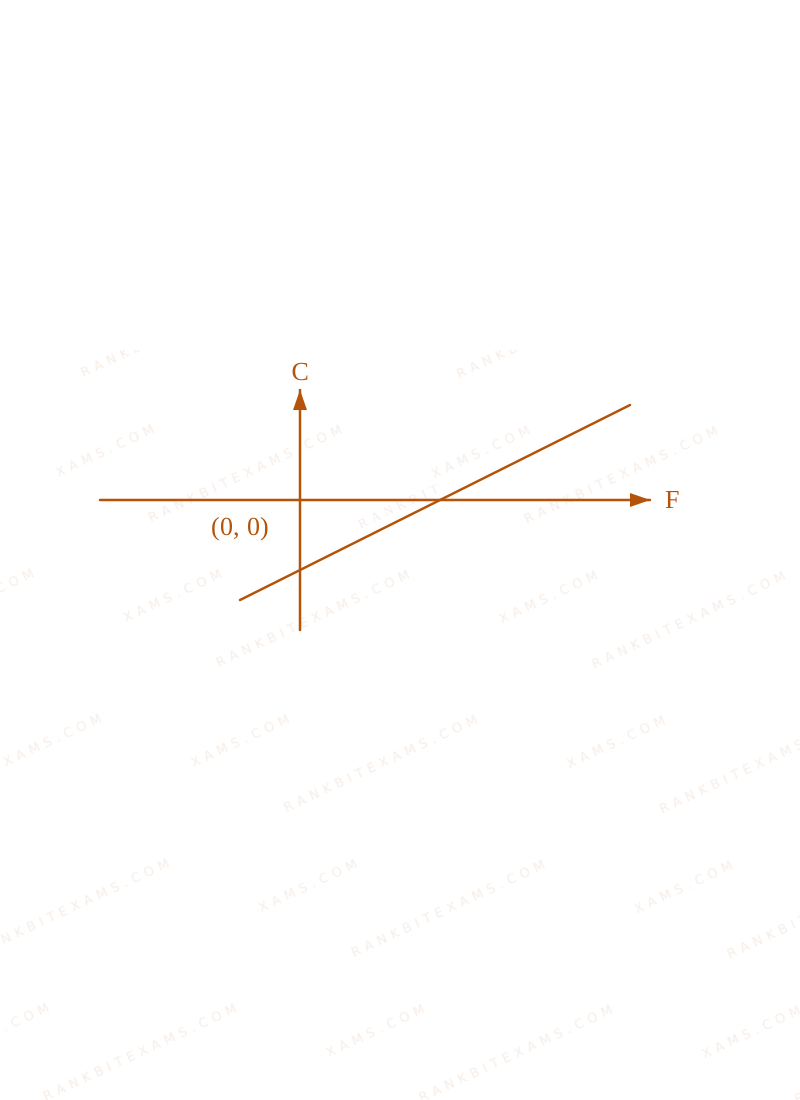
    Correct linear plot for Celsius vs Fahrenheit conversion Q10
    celsius fahrenheit graph, temperature conversion line, linear scaling

Pattern Recognition

0°C = 32°F. Therefore, the line must cross the positive side of the horizontal F axis when C=0.

Chapter Mix

Class 11 Physics: Thermal Properties of Matter

Q16 jee_main_2025_24_jan_evening Newton's Law of Cooling
The temperature of a body in air falls from 40°C to 24°C in 4 minutes. The temperature of the air is 16°C. The temperature of the body in the next 4 minutes will be:
  • A. (14)/(3)°C
  • B. (28)/(3)°C
  • C. (56)/(3)°C
  • D. (42)/(3)°C

Solution

Related Formula
(T₁ - T₂)/(t) = K[(T₁ + T₂)/(2) - Tₛ]
Core Logic

For the first interval (40°C to 24°C in 4 with Tₛ = 16°C):

(40 - 24)/(4) = K[(40 + 24)/(2) - 16] (16)/(4) = K[32 - 16] 4 = 16K K = (1)/(4)

For the next 4 minutes, let the final temperature be T:

(24 - T)/(4) = (1)/(4)[(24 + T)/(2) - 16] 24 - T = (24 + T)/(2) - 16 40 - T = (24 + T)/(2) 80 - 2T = 24 + T 3T = 56 T = (56)/(3)°C
Pattern Recognition

Newton's law of cooling approximation works beautifully when temperature differences are small. Always compute K from the first step and substitute directly into the second.

Chapter Mix

Class 11 Physics: Thermal Properties of Matter

Q jee_main_2024_30_january_evening Heating Curve of Water
A block of ice at -10°C is slowly heated and converted to steam at 100°C. Which of the following curves represent the phenomenon qualitatively:
  • A.
  • B.
  • C.
  • D.

Solution

Core Logic

The heating curve traces temperature vs heat supplied. Stage 1: Ice at -10°C is heated to 0°C (Temperature rises, solid phase). Stage 2: Ice melts at 0°C into water (Temperature remains constant until all ice melts). This is a horizontal plateau. Stage 3: Water is heated from 0°C to 100°C (Temperature rises, liquid phase). Stage 4: Water boils at 100°C into steam (Temperature remains constant). This is a second horizontal plateau.

Option (4) correctly shows this sequential step-like graph.

Pattern Recognition

Heating curves always exhibit horizontal segments during phase changes (latent heat) where temperature remains constant. The slopes of the inclined regions depend on the specific heat capacities of the respective phases.

Chapter Mix

Class 11 Physics: Thermal Properties of Matter

More Thermal Properties of Matter Questions — jee_main_2025_04_april_evening

Practice all Thermal Properties of Matter previous-year questions →

Rankbit System
JEE Physics: Waves (+15.5%) | Electrostatics: Concentric Shells (-29.7%) | Modern Physics: Photoelectric Clones (+34.2%) | Mathematics: Definite Integrals (+18.1%) | Chemistry: Coordination Splitting (-11.4%) | JEE Physics: Waves (+15.5%) | Electrostatics: Concentric Shells (-29.7%) | Modern Physics: Photoelectric Clones (+34.2%) | Mathematics: Definite Integrals (+18.1%) | Chemistry: Coordination Splitting (-11.4%)