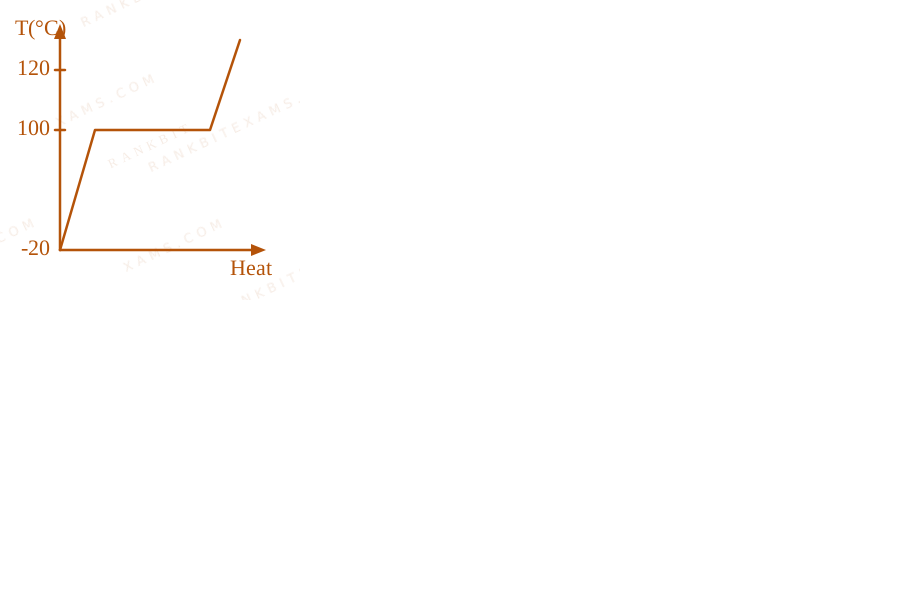
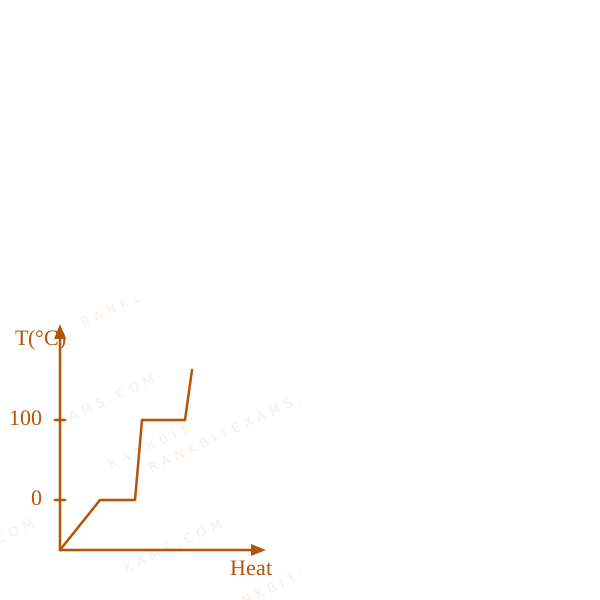
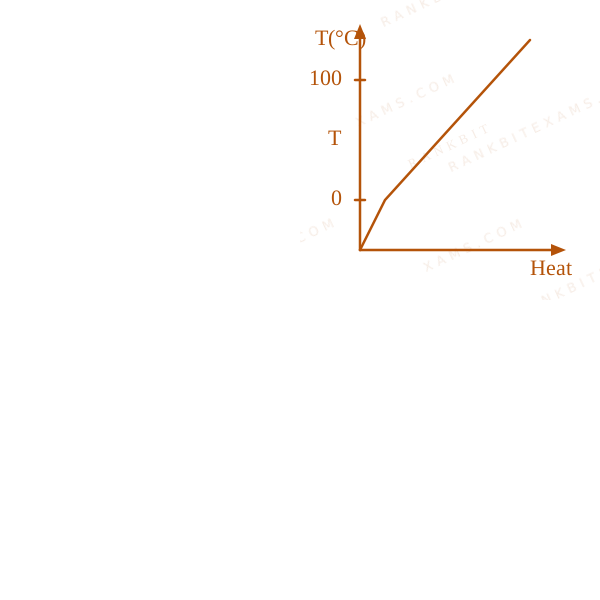
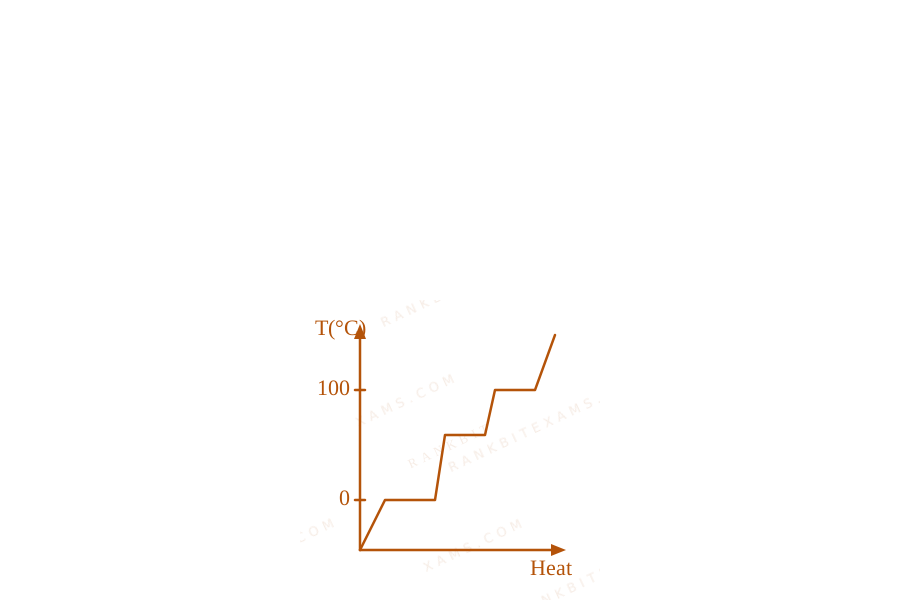
Which of the following best represents the temperature versus heat supplied graph for water, in the range of -20^circmathrmC$-20^{\circ}\mathrm{C}$ to 120^circmathrmC$120^{\circ}\mathrm{C}$ ?
A.Graph 1
Calorimetry and Heat Transfer
B.Graph 2
Calorimetry and Heat Transfer
C.Graph 3
Calorimetry and Heat Transfer
D.Graph 4
Calorimetry and Heat Transfer
Solution & Explanation
### Related Formula
Q = mcDelta T$Q = mc\Delta T$Q = mL$Q = mL$
### Core Logic
When heat is supplied steadily:
1. Ice warms from -20^circmathrmC$-20^{\circ}\mathrm{C}$ to 0^circmathrmC$0^{\circ}\mathrm{C}$ (slope = 1/(m cdot c_textice)$1/(m \cdot c_{\text{ice}})$).
2. Ice melts at 0^circmathrmC$0^{\circ}\mathrm{C}$ (temperature constant, flat horizontal line).
3. Water warms from 0^circmathrmC$0^{\circ}\mathrm{C}$ to 100^circmathrmC$100^{\circ}\mathrm{C}$ (slope = 1/(m cdot c_textwater)$1/(m \cdot c_{\text{water}})$).
4. Water boils at 100^circmathrmC$100^{\circ}\mathrm{C}$ (temperature constant, longer flat horizontal line because L_v > L_f$L_v > L_f$).
5. Steam warms from 100^circmathrmC$100^{\circ}\mathrm{C}$ to 120^circmathrmC$120^{\circ}\mathrm{C}$.
### Step 1: Identifying Graph Features
The graph must have two flat plateaus corresponding to phase changes at 0^circmathrmC$0^{\circ}\mathrm{C}$ and 100^circmathrmC$100^{\circ}\mathrm{C}$.
The heating curves (slanted lines) should show the temperature rising.
Option (2) perfectly matches these distinct segments.
### Pattern Recognition
Look for the horizontal phase-change steps precisely at 0 and 100 degrees Celsius for standard pressure mathrmH_2O$\mathrm{H_2O}$.
### Evaluation Rubric / Model Answer
null
### Chapter Mix
Class 11 Physics: Thermal Properties of Matter
Keywords:#temperature versus heat supplied graph#JEE Main 2026 Morning Q33#Thermal Properties of Matter JEE Main 2026#Calorimetry and Heat Transfer JEE Main 2026
More Thermal Properties of Matter Previous-Year Questions
Q27jee_main_2026_21_jan_morningCalorimetry
A gas based geyser heats water flowing at the rate of 5.0$5.0$ litres per minute from 27^circtextC$27^{\circ}\text{C}$ to 87^circtextC$87^{\circ}\text{C}$.
The rate of consumption of the gas is ____ g/s.
(Take heat of combustion of gas = 5.0 times 10^4$5.0 \times 10^{4}$ J/g, specific heat capacity of water = 4200text J/kg.^circtextC$4200\text{ J/kg.}^{\circ}\text{C}$)
A. 2.1
B. 4.2
C. 0.42
D. 0.21
Solution
### Related Formula
P = fracdmdt S Delta T$$P = \frac{dm}{dt} S \Delta T$$P_textheater = textRate of combustion times textHeat of combustion$$P_{\text{heater}} = \text{Rate of combustion} \times \text{Heat of combustion}$$
### Core Logic
Water flow rate = 5text l/min = frac560text kg/s = frac112text kg/s$5\text{ l/min} = \frac{5}{60}\text{ kg/s} = \frac{1}{12}\text{ kg/s}$.
The power required to heat the water is:
P_textheater = left(fracdmdtright)_textwater cdot S cdot Delta T$$P_{\text{heater}} = \left(\frac{dm}{dt}\right)_{\text{water}} \cdot S \cdot \Delta T$$P_textheater = frac112 times 4200 times (87 - 27) = frac112 times 4200 times 60text W$$P_{\text{heater}} = \frac{1}{12} \times 4200 \times (87 - 27) = \frac{1}{12} \times 4200 \times 60\text{ W}$$
### Step 1: Solving for Gas Consumption
Let the rate of consumption of gas be xtext g/s$x\text{ g/s}$.
Heat generated by the gas per second must equal the power required to heat the water:
x times 5.0 times 10^4 = frac112 times 4200 times 60$$x \times 5.0 \times 10^{4} = \frac{1}{12} \times 4200 \times 60$$x times 5.0 times 10^4 = 4200 times 5$$x \times 5.0 \times 10^{4} = 4200 \times 5$$x = frac4200 times 55 times 10^4 = 4200 times 10^-4$$x = \frac{4200 \times 5}{5 \times 10^{4}} = 4200 \times 10^{-4}$$x = 0.42text g/s$$x = 0.42\text{ g/s}$$Calorimetry diagram for Q27 - JEE Main 2026 Morning
### Pattern Recognition
Equate the thermal power absorbed by fluid (dm/dt cdot c cdot Delta T$dm/dt \cdot c \cdot \Delta T$) with the power output of fuel (dm_textfuel/dt cdot L_textcombustion$dm_{\text{fuel}}/dt \cdot L_{\text{combustion}}$).
### Evaluation Rubric / Model Answer
null
### Chapter Mix
Class 11 Physics: Thermal Properties of Matter
Q40jee_main_2026_21_jan_morningThermal Expansion
An aluminium and steel rods having same lengths and cross-sections are joined to make total length of 120 cm at 30°C. The coefficient of linear expansion of aluminium and steel are 24 times 10^-6/^circmathrmC$24 \times 10^{-6}/^{\circ}\mathrm{C}$ and 1.2 times 10^-5/^circmathrmC$1.2 \times 10^{-5}/^{\circ}\mathrm{C}$, respectively. The length of this composite rod when its temperature is raised to 100°C, is ____ cm.
A. 120.20
B. 120.15
C. 120.03
D. 120.06
Solution
### Related Formula
Delta l = l_0 alpha Delta T$$\Delta l = l_0 \alpha \Delta T$$l_textfinal = l_1 + l_2 + Delta l_1 + Delta l_2$$l_{\text{final}} = l_1 + l_2 + \Delta l_1 + \Delta l_2$$
### Core Logic
Let the original lengths be l_0A$l_{0A}$ (aluminium) and l_0S$l_{0S}$ (steel).
They have same length, so l_0A = l_0S = 60text cm$l_{0A} = l_{0S} = 60\text{ cm}$.
Change in temperature Delta T = 100^circtextC - 30^circtextC = 70^circtextC$\Delta T = 100^{\circ}\text{C} - 30^{\circ}\text{C} = 70^{\circ}\text{C}$.
Expansion of Aluminium: Delta l_A = l_0 alpha_A Delta T$\Delta l_A = l_0 \alpha_A \Delta T$
Expansion of Steel: Delta l_S = l_0 alpha_S Delta T$\Delta l_S = l_0 \alpha_S \Delta T$
### Step 1: Calculate Final Length
l_textfinal = l_0(1 + alpha_A Delta T) + l_0(1 + alpha_S Delta T)$$l_{\text{final}} = l_0(1 + \alpha_A \Delta T) + l_0(1 + \alpha_S \Delta T)$$l_textfinal = l_0 [2 + (alpha_A + alpha_S)Delta T]$$l_{\text{final}} = l_0 [2 + (\alpha_A + \alpha_S)\Delta T]$$l_textfinal = 60 left[ 2 + (24 times 10^-6 + 12 times 10^-6) times 70 right]$$l_{\text{final}} = 60 \left[ 2 + (24 \times 10^{-6} + 12 \times 10^{-6}) \times 70 \right]$$l_textfinal = 60 left[ 2 + (36 times 10^-6) times 70 right]$$l_{\text{final}} = 60 \left[ 2 + (36 \times 10^{-6}) \times 70 \right]$$l_textfinal = 60 [2 + 0.00252] = 120 + 60(0.00252) = 120 + 0.1512 = 120.15text cm$$l_{\text{final}} = 60 [2 + 0.00252] = 120 + 60(0.00252) = 120 + 0.1512 = 120.15\text{ cm}$$Thermal Expansion diagram for Q40 - JEE Main 2026 Morning
### Pattern Recognition
For composite rods connected end-to-end, expansions simply add up. Convert 1.2 times 10^-5$1.2 \times 10^{-5}$ to 12 times 10^-6$12 \times 10^{-6}$ immediately for easy mental addition.
### Evaluation Rubric / Model Answer
null
### Chapter Mix
Class 11 Physics: Thermal Properties of Matter
Q38jee_main_2026_22_january_morningThermal Conduction in Composite Rods
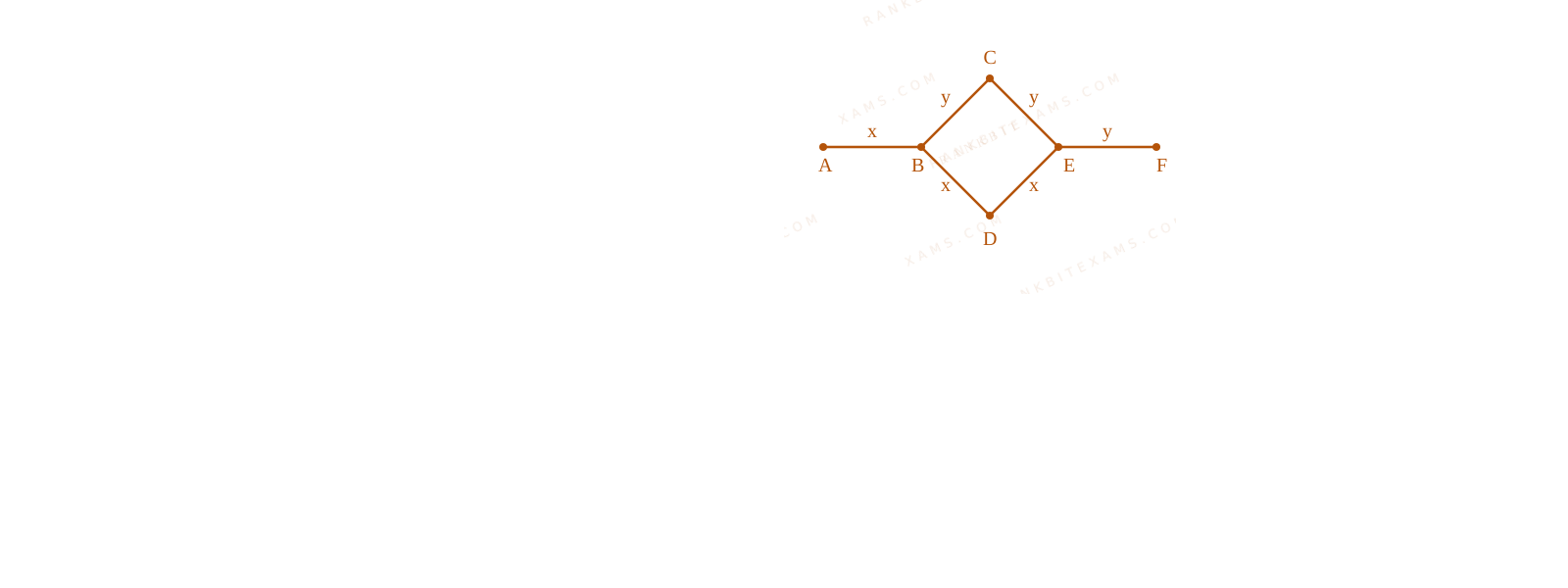
Rods x and y of equal dimensions but of different materials are joined as shown in figure. Temperatures of end points A and F are maintained at 100^circtextC$100^{circ}\text{C}$ and 40^circtextC$40^{circ}\text{C}$ respectively. Given the thermal conductivity of rod x is three times of that of rod y, the temperature at junction points B and E are (close to):
Composite rods x and y joined end-to-end with temperature endpoints.
A.89^circtextC$89^{circ}\text{C}$ and 73^circtextC$73^{circ}\text{C}$ respectively
B.80^circtextC$80^{circ}\text{C}$ and 60^circtextC$60^{circ}\text{C}$ respectively
C.80^circtextC$80^{circ}\text{C}$ and 70^circtextC$70^{circ}\text{C}$ respectively
D.60^circtextC$60^{circ}\text{C}$ and 45^circtextC$45^{circ}\text{C}$ respectively
Solution
### Related Formula
H = fracDelta TR_texteq, quad R = fraclKA$$H = \frac{\Delta T}{R_{\text{eq}}}, \quad R = \frac{l}{KA}$$
### Core Logic
Composite rods x and y joined end-to-end with temperature endpoints.
Let thermal resistance of rod y be 3R$3R$ and rod x be R$R$ (since K_x = 3K_y$K_x = 3K_y$).
Using thermal current equations:
H = frac100 - 40frac11R2$$H = \frac{100 - 40}{\frac{11R}{2}}$$H = frac100 - T_BR, quad H = fracT_E - 403R$$H = \frac{100 - T_B}{R}, \quad H = \frac{T_E - 40}{3R}$$
Solving yields T_B = 89^circtextC$T_B = 89^{circ}\text{C}$ and T_E = 73^circtextC$T_E = 73^{circ}\text{C}$.
### Pattern Recognition
Sees: Composite thermal conduction network with series/parallel segments.
Shortcut: Calculate equivalent thermal resistances and equate heat currents across junctions.
Check: Matches option (1). ✓
### Chapter Mix
Class 11 Physics: Thermal Properties of Matter
Q26jee_main_2026_28_january_morningCalorimetry and Heat Transfer
10 kg of ice at -10^circmathrmC$-10^{\circ}\mathrm{C}$ is added to 100mathrmkg$100\mathrm{kg}$ of water to lower its temperature from 25^circmathrmC$25^{\circ}\mathrm{C}$ . Consider no heat exchange to surroundings. The decrement to the temperature of water is ____ °C.
(specific heat of ice = 2100 mathrm~J/Kg.^circC$2100 \mathrm{~J/Kg.^{\circ}C}$, specific heat of water = 4200 mathrm~J/Kg.^circC$4200 \mathrm{~J/Kg.^{\circ}C}$, latent heat of fusion of ice = 3.36 times 10^5 mathrm~J/Kg$3.36 \times 10^{5} \mathrm{~J/Kg}$)
A.10$10$
B.15$15$
C.6.67$6.67$
D.11.6$11.6$
Solution
### Related Formula
Q = mcDelta T$Q = mc\Delta T$Q = mL$Q = mL$
### Core Logic
Heat gained by ice to reach final temperature T$T$ must equal the heat lost by the water to reach temperature T$T$.
### Step 1: Energy Balance Equation
Let T$T$ be the final temperature of the mixture.
Heat gained by ice to reach 0^circmathrmC$0^{\circ}\mathrm{C}$ + Heat to melt + Heat to reach T$T$ = Heat lost by water.
10 times 3.36 times 10^5 + 10 times 2100 times 10 + 10 times 4200 times (T - 0) = 100 times 4200 times (25 - T)$$10 \times 3.36 \times 10^{5} + 10 \times 2100 \times 10 + 10 \times 4200 \times (T - 0) = 100 \times 4200 \times (25 - T)$$
### Step 2: Solving for Final Temperature
3.36 times 10^6 + 2.1 times 10^5 + 4.2 times 10^4 T = 1.05 times 10^7 - 4.2 times 10^5 T$$3.36 \times 10^{6} + 2.1 \times 10^{5} + 4.2 \times 10^{4} T = 1.05 \times 10^{7} - 4.2 \times 10^{5} T$$3.57 times 10^6 + 4.2 times 10^4 T = 1.05 times 10^7 - 4.2 times 10^5 T$$3.57 \times 10^{6} + 4.2 \times 10^{4} T = 1.05 \times 10^{7} - 4.2 \times 10^{5} T$$
Solving for T$T$:
4.62 times 10^5 T = 6.93 times 10^6$$4.62 \times 10^{5} T = 6.93 \times 10^{6}$$T = 15^circmathrmC$$T = 15^{\circ}\mathrm{C}$$
### Step 3: Calculating Decrement
The decrement in the temperature of water is:
Delta T = 25 - 15 = 10^circmathrmC$$\Delta T = 25 - 15 = 10^{\circ}\mathrm{C}$$
### Pattern Recognition
When mixing ice and water, track the 3 stages for ice (warm to 0, melt, warm to T). Equate total heat gained to heat lost by water. Always solve for T first, then check what the question actually asks (decrement).
### Evaluation Rubric / Model Answer
null
### Chapter Mix
Class 11 Physics: Thermal Properties of Matter
More Thermal Properties of Matter Questions — jee_main_2026_28_january_morning
We Map Every Repeating Question in Competitive Exams.
Say goodbye to generic mock test fatigue. RankBit uses smart analysis to group past exam questions into their foundational Repeating Question Types. Find chapter weightage, track repeating questions, and score higher with targeted practice.
Select Your Target Exam
Choose an exam track below to find formulas per chapter and patterns.
Syncing Exam Intelligence
Mapping formulas and patterns across all tracks…
PATH A — FULL LENGTH PRACTICE
Full Mock Test Hub
Simulate real NTA exam conditions with fully tracked mocks. Time yourself against past papers.
Practice past-year questions one chapter at a time. Pick an exam → subject → chapter and get every PYQ for that topic — pulled together from all past papers — with the chapter's key formulas alongside.