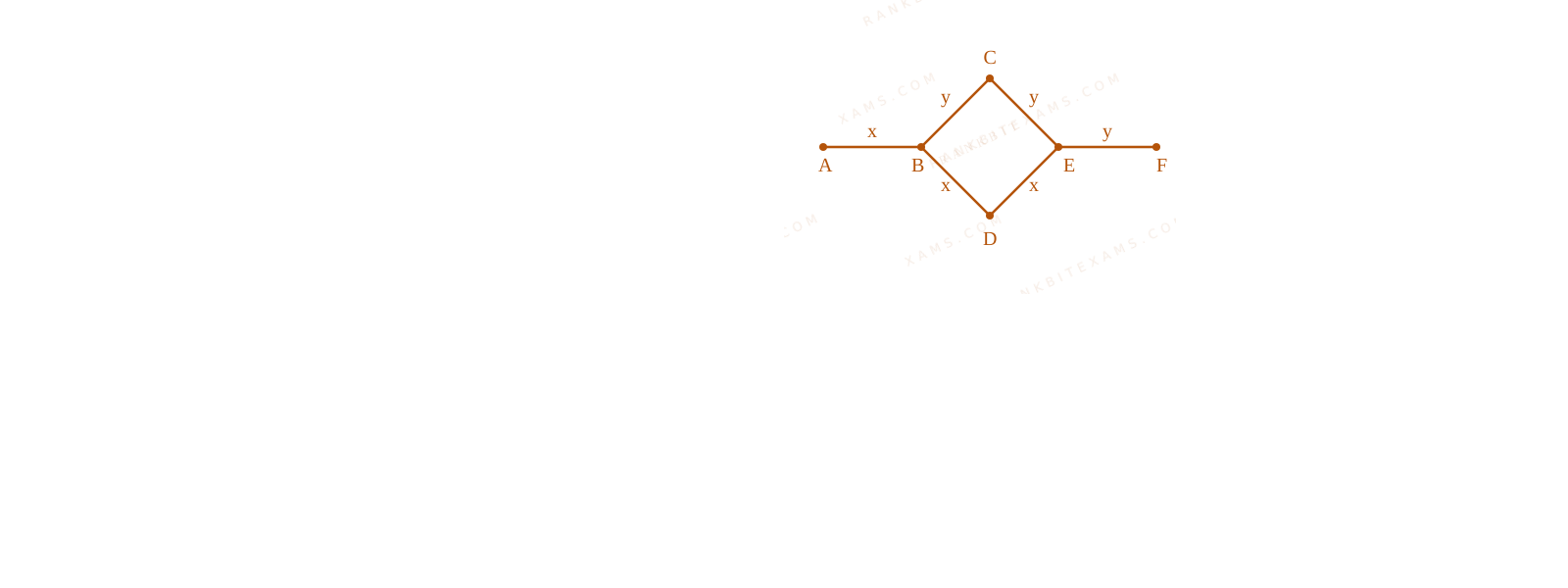
Two cylindrical rods A and B made of different materials, are joined in a straight line. The ratio of lengths, radii and thermal conductivities of these rods are: fracmathrmL_mathrmAmathrmL_mathrmB = frac12, fracmathrmr_mathrmAmathrmr_mathrmB = 2$\frac{\mathrm{L}_{\mathrm{A}}}{\mathrm{L}_{\mathrm{B}}} = \frac{1}{2}, \frac{\mathrm{r}_{\mathrm{A}}}{\mathrm{r}_{\mathrm{B}}} = 2$ and fracmathrmK_mathrmAmathrmK_mathrmB = frac12$\frac{\mathrm{K}_{\mathrm{A}}}{\mathrm{K}_{\mathrm{B}}} = \frac{1}{2}$ . The free ends of rods A and B are maintained at 400mathrm~K$400\mathrm{~K}$, 200mathrm~K$200\mathrm{~K}$, respectively. The temperature of rods interface is ________ K, when equilibrium is established. [cite: 187, 188, 189, 190, 191, 192, 193]
Numerical Answer Type:
Enter a numerical valueAnswer: 360 to 360+4 marks
Solution & Explanation
### Related Formula
R_textth = fracLKA = fracLK(pi r^2)$R_{\text{th}} = \frac{L}{KA} = \frac{L}{K(\pi r^2)}$ [cite: 817]
fracdQdt = fracDelta TR_textth$\frac{dQ}{dt} = \frac{\Delta T}{R_{\text{th}}}$ [cite: 818]
### Core Logic
At steady state equilibrium, the rate of heat flow through both sections in series must be identical: [cite: 193, 819]
frac400 - TR_1 = fracT - 200R_2 implies frac400 - TT - 200 = fracR_1R_2$\frac{400 - T}{R_1} = \frac{T - 200}{R_2} \implies \frac{400 - T}{T - 200} = \frac{R_1}{R_2}$ [cite: 192, 820]
Let's evaluate the resistance ratio fracR_1R_2$\frac{R_1}{R_2}$ using the dimensional parameters: [cite: 820]
fracR_1R_2 = left(fracL_AL_Bright) cdot left(fracr_Br_Aright)^2 cdot left(fracK_BK_Aright)$\frac{R_1}{R_2} = \left(\frac{L_A}{L_B}\right) \cdot \left(\frac{r_B}{r_A}\right)^2 \cdot \left(\frac{K_B}{K_A}\right)$ [cite: 820]
Substitute the given values: fracL_AL_B = frac12$\frac{L_A}{L_B} = \frac{1}{2}$, fracr_Ar_B = 2 implies fracr_Br_A = frac12$\frac{r_A}{r_B} = 2 \implies \frac{r_B}{r_A} = \frac{1}{2}$, and fracK_AK_B = frac12 implies fracK_BK_A = 2$\frac{K_A}{K_B} = \frac{1}{2} \implies \frac{K_B}{K_A} = 2$ [cite: 189, 190]:
fracR_1R_2 = frac12 times left(frac12right)^2 times 2 = frac14$\frac{R_1}{R_2} = \frac{1}{2} \times \left(\frac{1}{2}\right)^2 \times 2 = \frac{1}{4}$ [cite: 821]
Now link this back into the temperature equation: [cite: 822]
frac400 - TT - 200 = frac14 implies 1600 - 4T = T - 200$\frac{400 - T}{T - 200} = \frac{1}{4} \implies 1600 - 4T = T - 200$ [cite: 822, 823]
5T = 1800 implies T = 360\ textK$5T = 1800 \implies T = 360\ \text{K}$ [cite: 824, 825]
### Pattern Recognition
Thermal conduction processes behave exactly like electric current fields in series connections[cite: 818, 819]. Cross-sectional area scales squarely with radius parameters, which requires extra care during substitution.
### Evaluation Rubric / Model Answer
null
### Chapter Mix
Class 11 Physics: Thermal Properties of Matter
Keywords:#steady state interface temperature#JEE Main 2025 Evening Q23#thermal resistance cylinder rods#heat flux continuity series
More Thermal Properties of Matter Previous-Year Questions
Q192025Specific Heat Capacity and Thermal Conductivity
Match List-I with List-II.
List-I:
(A) Heat capacity of body
(B) Specific heat capacity of body
(C) Latent heat
(D) Thermal conductivity
List-II:
(I) mathrmJkg^-1$\mathrm{Jkg^{-1}}$
(II) mathrmJK^-1$\mathrm{JK}^{-1}$
(III) mathrmJkg^-1K^-1$\mathrm{Jkg^{-1}K^{-1}}$
(IV) mathrmJm^-1mathrmK^-1mathrms^-1$\mathrm{Jm}^{-1}\mathrm{K}^{-1}\mathrm{s}^{-1}$
Choose the correct answer from the options given below:
### Related Formula
Governing mathematical equations for thermal properties:
1. Heat capacity: C' = fracDelta QDelta T$C' = \frac{\Delta Q}{\Delta T}$
2. Specific heat capacity: s = fracDelta Qm Delta T$s = \frac{\Delta Q}{m \Delta T}$
3. Latent heat: L = fracDelta Qm$L = \frac{\Delta Q}{m}$
4. Thermal conductivity: K = fracDelta Q cdot LA cdot Delta T cdot t$K = \frac{\Delta Q \cdot L}{A \cdot \Delta T \cdot t}$
### Core Logic
Let's derive the SI units for each property:
- **(A) Heat capacity of body:**
[C'] = fracmathrmJmathrmK = mathrmJK^-1 quad implies text(II)$[C'] = \frac{\mathrm{J}}{\mathrm{K}} = \mathrm{JK^{-1}} \quad \implies \text{(II)}$
- **(B) Specific heat capacity of body:**
[s] = fracmathrmJmathrmkg cdot K = mathrmJkg^-1K^-1 quad implies text(III)$[s] = \frac{\mathrm{J}}{\mathrm{kg \cdot K}} = \mathrm{Jkg^{-1}K^{-1}} \quad \implies \text{(III)}$
- **(C) Latent heat:**
[L] = fracmathrmJmathrmkg = mathrmJkg^-1 quad implies text(I)$[L] = \frac{\mathrm{J}}{\mathrm{kg}} = \mathrm{Jkg^{-1}} \quad \implies \text{(I)}$
- **(D) Thermal conductivity:**
From heat transfer equation fracdQdt = K A fracdTdx$\frac{dQ}{dt} = K A \frac{dT}{dx}$:
K = fracdQ/dtA (dT/dx) implies [K] = fracmathrmJ/smathrmm^2 cdot (mathrmK/m) = mathrmJ cdot m^-1 cdot K^-1 cdot s^-1 quad implies text(IV)$K = \frac{dQ/dt}{A (dT/dx)} \implies [K] = \frac{\mathrm{J/s}}{\mathrm{m}^2 \cdot (\mathrm{K/m})} = \mathrm{J \cdot m^{-1} \cdot K^{-1} \cdot s^{-1}} \quad \implies \text{(IV)}$
### Step 1: Match values
Applying our mappings:
- (A) to$\to$ (II)
- (B) to$\to$ (III)
- (C) to$\to$ (I)
- (D) to$\to$ (IV)
This maps to Option (4).
### Pattern Recognition
Sees: Dimensional unit matching of thermal parameters.
Trap: Confusing Specific Heat Capacity (scaled per mass unit) with Heat Capacity (unscaled entire body parameter).
Shortcut: Specific heat is normalized by mass, meaning its unit must contain kg in the denominator. Heat capacity has no mass constraint, meaning A maps directly to II.
### Evaluation Rubric / Model Answer
null
### Chapter Mix
Class 11 Physics: Thermal Properties of Matter
Q242025Radiation
A wire of length 10mathrmcm$10\mathrm{cm}$ and diameter 0.5mathrmmm$0.5\mathrm{mm}$ is used in a bulb. The temperature of the wire is 1727^circmathrmC$1727^{\circ}\mathrm{C}$ and power radiated by the wire is 94.2 W. Its emissivity is fracmathrmx8$\frac{\mathrm{x}}{8}$ where mathrmx =$\mathrm{x} =$
(Given sigma = 6.0 times 10^-8 mathrm~W mathrm~m^-2 mathrm~K^-4$\sigma = 6.0 \times 10^{-8} \mathrm{~W} \mathrm{~m}^{-2} \mathrm{~K}^{-4}$ , pi = 3.14$pi = 3.14$ and assume that the emissivity of wire material is same at all wavelength.)
Numerical Answer.Answer: 5 to 5
Solution
### Related Formula
Stefan-Boltzmann Law for radiated thermal power:
P = epsilon sigma A T^4$P = \epsilon \sigma A T^4$
Surface area A$A$ of a cylindrical wire of diameter d$d$ and length L$L$ is:
A = pi d L$A = \pi d L$
### Core Logic
Convert given parameters to standard SI units:
- L = 10 mathrm~cm = 0.1 mathrm~m$L = 10 \mathrm{~cm} = 0.1 \mathrm{~m}$
- d = 0.5 mathrm~mm = 0.5 times 10^-3 mathrm~m$d = 0.5 \mathrm{~mm} = 0.5 \times 10^{-3} \mathrm{~m}$
- T = 1727 + 273.15 = 2000 mathrm~K$T = 1727 + 273.15 = 2000 \mathrm{~K}$
- P = 94.2 mathrm~W$P = 94.2 \mathrm{~W}$
- sigma = 6.0 times 10^-8 mathrm~W cdot m^-2 cdot K^-4$\sigma = 6.0 \times 10^{-8} \mathrm{~W \cdot m^{-2} \cdot K^{-4}}$
### Step 1: Express Radiated Power and Emissivity
First, calculate the surface area A$A$:
A = 3.14 times (0.5 times 10^-3) times 0.1 = 1.57 times 10^-4 mathrm~m^2$A = 3.14 \times (0.5 \times 10^{-3}) \times 0.1 = 1.57 \times 10^{-4} \mathrm{~m}^2$
Substitute A$A$, sigma$\sigma$, and T$T$ into Stefan's formula:
94.2 = epsilon times (6.0 times 10^-8) times [3.14 times (0.5 times 10^-3) times (10 times 10^-2)] times (2000)^4$94.2 = \epsilon \times (6.0 \times 10^{-8}) \times [3.14 \times (0.5 \times 10^{-3}) \times (10 \times 10^{-2})] \times (2000)^4$
Calculate temperature term:
(2000)^4 = 1.6 times 10^12$(2000)^4 = 1.6 \times 10^{12}$94.2 = epsilon times (6 times 10^-8) times (1.57 times 10^-4) times (16 times 10^12)$94.2 = \epsilon \times (6 \times 10^{-8}) \times (1.57 \times 10^{-4}) \times (16 \times 10^{12})$94.2 = epsilon times 6 times 1.57 times 16 times 1 = epsilon times 150.72$94.2 = \epsilon \times 6 \times 1.57 \times 16 \times 1 = \epsilon \times 150.72$epsilon = frac94.2150.72 = frac58$\epsilon = \frac{94.2}{150.72} = \frac{5}{8}$
Thus, fracx8 = frac58 implies x = 5$\frac{x}{8} = \frac{5}{8} \implies x = 5$.
### Pattern Recognition
Sees: Bulb filament heat radiation equation.
Shortcut: Simplify the multiplication with factors of 10 first. T=2000 mathrm~K$T=2000 \mathrm{~K}$ has four zeros, so T^4$T^4$ adds 10^12$10^{12}$ which cancels the 10^-8$10^{-8}$ and 10^-4$10^{-4}$ from area and constant. The coefficient equation directly yields the ratio epsilon = 5/8$\epsilon = 5/8$.
### Evaluation Rubric / Model Answer
null
### Chapter Mix
Class 11 Physics: Thermal Properties of Matter
Q192025Newton's Law of Cooling
A cup of coffee cools from 90^circmathrmC$90^{\circ}\mathrm{C}$ to 80^circmathrmC$80^{\circ}\mathrm{C}$ in t$t$ minutes when the room temperature is 20^circmathrmC$20^{\circ}\mathrm{C}$ . The time taken by the similar cup of coffee to cool from 80^circmathrmC$80^{\circ}\mathrm{C}$ to 60^circmathrmC$60^{\circ}\mathrm{C}$ at the same room temperature is :
A.frac135 t$\frac{13}{5} t$
B.frac1013 t$\frac{10}{13} t$
C.frac1310 t$\frac{13}{10} t$
D.frac513 t$\frac{5}{13} t$
Solution
### Related Formula
fracT_i - T_fDelta t = Kleft(fracT_i + T_f2 - T_0right)$\frac{T_i - T_f}{\Delta t} = K\left(\frac{T_i + T_f}{2} - T_0\right)$
### Core Logic
**Case 1** (90^circmathrmC rightarrow 80^circmathrmC$90^{\circ}\mathrm{C} \rightarrow 80^{\circ}\mathrm{C}$ in time t$t$):
frac90 - 80t = Kleft(frac90 + 802 - 20
ight)$\frac{90 - 80}{t} = K\left(\frac{90 + 80}{2} - 20
ight)$frac10t = K(85 - 20) = 65K quad dots (i)$\frac{10}{t} = K(85 - 20) = 65K \quad \dots (i)$
**Case 2** (80^circmathrmC rightarrow 60^circmathrmC$80^{\circ}\mathrm{C} \rightarrow 60^{\circ}\mathrm{C}$ in time t'$t'$):
frac80 - 60t' = Kleft(frac80 + 602 - 20
ight)$\frac{80 - 60}{t'} = K\left(\frac{80 + 60}{2} - 20
ight)$frac20t' = K(70 - 20) = 50K quad dots (ii)$\frac{20}{t'} = K(70 - 20) = 50K \quad \dots (ii)$
Dividing equation (i)$(i)$ by equation (ii)$(ii)$:
frac10/t20/t' = frac65K50K$\frac{10/t}{20/t'} = \frac{65K}{50K}$fract'2t = frac1310 implies t' = frac135t$\frac{t'}{2t} = \frac{13}{10} \implies t' = \frac{13}{5}t$
### Pattern Recognition
Newton's law of cooling in average form uses the arithmetic mean of temperatures to approximate the driving temperature difference over the interval.
### Evaluation Rubric / Model Answer
null
### Chapter Mix
Class 11 Physics: Thermal Properties of Matter

Q32025Thermal Expansion
Consider a rectangular sheet of solid material of length ell=9$\ell=9$ cm and width d=4$d=4$ cm. The coefficient of linear expansion is alpha=3.1times10^-5text K^-1$\alpha=3.1\times10^{-5}\text{ K}^{-1}$ at room temperature and one atmospheric pressure. The mass of sheet m=0.1text kg$m=0.1\text{ kg}$ and the specific heat capacity C_v=900text J kg^-1textK^-1$C_{v}=900\text{ J kg}^{-1}\text{K}^{-1}$. If the amount of heat supplied to the material is 8.1times10^2$8.1\times10^{2}$ J then change in area of the rectangular sheet is :-
### Related Formula
Delta Q = m C_v Delta T$\Delta Q = m C_v \Delta T$Delta A = A_0 beta Delta T = A_0 (2alpha) Delta T$\Delta A = A_0 \beta \Delta T = A_0 (2\alpha) \Delta T$
### Core Logic
First, calculate the temperature change using heat supplied:
Delta T = fracDelta Qm C_v$\Delta T = \frac{\Delta Q}{m C_v}$
Substituting the values:
Delta T = frac8.1 times 10^20.1 times 900 = frac81090 = 9text K$\Delta T = \frac{8.1 \times 10^2}{0.1 \times 900} = \frac{810}{90} = 9\text{ K}$
### Step 1: Calculate Change in Area
Initial area A_0 = ell times d = 9text cm times 4text cm = 36text cm^2 = 36 times 10^-4text m^2$A_0 = \ell \times d = 9\text{ cm} \times 4\text{ cm} = 36\text{ cm}^2 = 36 \times 10^{-4}\text{ m}^2$.
Now, substitute into the area expansion formula:
Delta A = 36 times 10^-4 times 2 times (3.1 times 10^-5) times 9$\Delta A = 36 \times 10^{-4} \times 2 \times (3.1 \times 10^{-5}) \times 9$Delta A = 36 times 18 times 3.1 times 10^-9 = 2008.8 times 10^-9text m^2 approx 2.0 times 10^-6text m^2$\Delta A = 36 \times 18 \times 3.1 \times 10^{-9} = 2008.8 \times 10^{-9}\text{ m}^2 \approx 2.0 \times 10^{-6}\text{ m}^2$
### Pattern Recognition
Always remember that areal expansion coefficient beta = 2alpha$\beta = 2\alpha$. Convert geometry dimensions to standard units (1text cm^2 = 10^-4text m^2$1\text{ cm}^2 = 10^{-4}\text{ m}^2$) cleanly before concluding arithmetic.
### Evaluation Rubric / Model Answer
null
### Chapter Mix
Class 11 Physics: Thermal Properties of Matter
More Thermal Properties of Matter Questions — jee_main_2025_07_april_evening
We Map Every Repeating Question in Competitive Exams.
Say goodbye to generic mock test fatigue. RankBit uses smart analysis to group past exam questions into their foundational Repeating Question Types. Find chapter weightage, track repeating questions, and score higher with targeted practice.
Select Your Target Exam
Choose an exam track below to find formulas per chapter and patterns.
Syncing Exam Intelligence
Mapping formulas and patterns across all tracks…
PATH A — FULL LENGTH PRACTICE
Full Mock Test Hub
Simulate real NTA exam conditions with fully tracked mocks. Time yourself against past papers.
Under Development
PATH B — TARGETED PRACTICE
Topic-wise Practice Hub
Practice past-year questions one chapter at a time. Pick an exam → subject → chapter and get every PYQ for that topic — pulled together from all past papers — with the chapter's key formulas alongside.