A gas based geyser heats water flowing at the rate of 5.0 litres per minute from 27^circtextC to 87^circtextC. The rate of consumption of the gas is ____ g/s. (Take heat of combustion of gas = 5.0 times 10^4 J/g, specific heat capacity of water = 4200text J/kg.^circtextC)

Solution & Explanation

### Related Formula P = fracdmdt S Delta T P_textheater = textRate of combustion times textHeat of combustion ### Core Logic Water flow rate = 5text l/min = frac560text kg/s = frac112text kg/s. The power required to heat the water is: P_textheater = left(fracdmdtright)_textwater cdot S cdot Delta T P_textheater = frac112 times 4200 times (87 - 27) = frac112 times 4200 times 60text W ### Step 1: Solving for Gas Consumption Let the rate of consumption of gas be xtext g/s. Heat generated by the gas per second must equal the power required to heat the water: x times 5.0 times 10^4 = frac112 times 4200 times 60 x times 5.0 times 10^4 = 4200 times 5 x = frac4200 times 55 times 10^4 = 4200 times 10^-4 x = 0.42text g/s
Calorimetry diagram for Q27 - JEE Main 2026 Morning
### Pattern Recognition Equate the thermal power absorbed by fluid (dm/dt cdot c cdot Delta T) with the power output of fuel (dm_textfuel/dt cdot L_textcombustion). ### Evaluation Rubric / Model Answer null ### Chapter Mix Class 11 Physics: Thermal Properties of Matter
Reference Study Guides

More Thermal Properties of Matter Previous-Year Questions

Q40 jee_main_2026_21_jan_morning Thermal Expansion
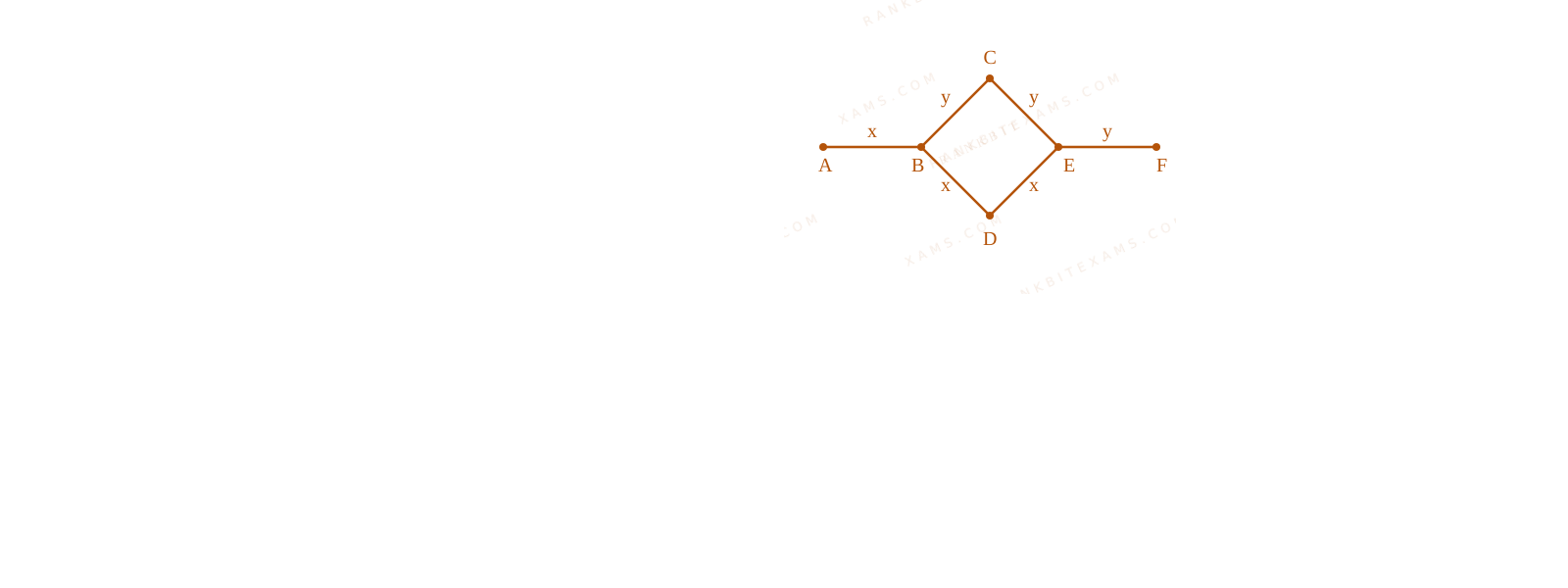
An aluminium and steel rods having same lengths and cross-sections are joined to make total length of 120 cm at 30°C. The coefficient of linear expansion of aluminium and steel are 24 times 10^-6/^circmathrmC and 1.2 times 10^-5/^circmathrmC, respectively. The length of this composite rod when its temperature is raised to 100°C, is ____ cm.
  • A. 120.20
  • B. 120.15
  • C. 120.03
  • D. 120.06

Solution

### Related Formula Delta l = l_0 alpha Delta T l_textfinal = l_1 + l_2 + Delta l_1 + Delta l_2 ### Core Logic Let the original lengths be l_0A (aluminium) and l_0S (steel). They have same length, so l_0A = l_0S = 60text cm. Change in temperature Delta T = 100^circtextC - 30^circtextC = 70^circtextC. Expansion of Aluminium: Delta l_A = l_0 alpha_A Delta T Expansion of Steel: Delta l_S = l_0 alpha_S Delta T ### Step 1: Calculate Final Length l_textfinal = l_0(1 + alpha_A Delta T) + l_0(1 + alpha_S Delta T) l_textfinal = l_0 [2 + (alpha_A + alpha_S)Delta T] l_textfinal = 60 left[ 2 + (24 times 10^-6 + 12 times 10^-6) times 70 right] l_textfinal = 60 left[ 2 + (36 times 10^-6) times 70 right] l_textfinal = 60 [2 + 0.00252] = 120 + 60(0.00252) = 120 + 0.1512 = 120.15text cm
Thermal Expansion diagram for Q40 - JEE Main 2026 Morning
### Pattern Recognition For composite rods connected end-to-end, expansions simply add up. Convert 1.2 times 10^-5 to 12 times 10^-6 immediately for easy mental addition. ### Evaluation Rubric / Model Answer null ### Chapter Mix Class 11 Physics: Thermal Properties of Matter
Q19 jee_main_2025_02_april_evening Specific Heat Capacity and Thermal Conductivity
Match List-I with List-II. List-I: (A) Heat capacity of body (B) Specific heat capacity of body (C) Latent heat (D) Thermal conductivity List-II: (I) mathrmJkg^-1 (II) mathrmJK^-1 (III) mathrmJkg^-1K^-1 (IV) mathrmJm^-1mathrmK^-1mathrms^-1 Choose the correct answer from the options given below:
  • A. text(A)-(III), (B)-(I), (C)-(II), (D)-(IV)
  • B. text(A)-(IV), (B)-(III), (C)-(II), (D)-(I)
  • C. text(A)-(III), (B)-(IV), (C)-(I), (D)-(II)
  • D. text(A)-(II), (B)-(III), (C)-(I), (D)-(IV)

Solution

### Related Formula Governing mathematical equations for thermal properties: 1. Heat capacity: C' = fracDelta QDelta T 2. Specific heat capacity: s = fracDelta Qm Delta T 3. Latent heat: L = fracDelta Qm 4. Thermal conductivity: K = fracDelta Q cdot LA cdot Delta T cdot t ### Core Logic Let's derive the SI units for each property: - **(A) Heat capacity of body:** [C'] = fracmathrmJmathrmK = mathrmJK^-1 quad implies text(II) - **(B) Specific heat capacity of body:** [s] = fracmathrmJmathrmkg cdot K = mathrmJkg^-1K^-1 quad implies text(III) - **(C) Latent heat:** [L] = fracmathrmJmathrmkg = mathrmJkg^-1 quad implies text(I) - **(D) Thermal conductivity:** From heat transfer equation fracdQdt = K A fracdTdx: K = fracdQ/dtA (dT/dx) implies [K] = fracmathrmJ/smathrmm^2 cdot (mathrmK/m) = mathrmJ cdot m^-1 cdot K^-1 cdot s^-1 quad implies text(IV) ### Step 1: Match values Applying our mappings: - (A) to (II) - (B) to (III) - (C) to (I) - (D) to (IV) This maps to Option (4). ### Pattern Recognition Sees: Dimensional unit matching of thermal parameters. Trap: Confusing Specific Heat Capacity (scaled per mass unit) with Heat Capacity (unscaled entire body parameter). Shortcut: Specific heat is normalized by mass, meaning its unit must contain kg in the denominator. Heat capacity has no mass constraint, meaning A maps directly to II. ### Evaluation Rubric / Model Answer null ### Chapter Mix Class 11 Physics: Thermal Properties of Matter

Q24 jee_main_2025_07_april_morning Radiation
A wire of length 10mathrmcm and diameter 0.5mathrmmm is used in a bulb. The temperature of the wire is 1727^circmathrmC and power radiated by the wire is 94.2 W. Its emissivity is fracmathrmx8 where mathrmx = (Given sigma = 6.0 times 10^-8 mathrm~W mathrm~m^-2 mathrm~K^-4 , pi = 3.14 and assume that the emissivity of wire material is same at all wavelength.)
Numerical Answer. Answer: 5 to 5

Solution

### Related Formula Stefan-Boltzmann Law for radiated thermal power: P = epsilon sigma A T^4 Surface area A of a cylindrical wire of diameter d and length L is: A = pi d L ### Core Logic Convert given parameters to standard SI units: - L = 10 mathrm~cm = 0.1 mathrm~m - d = 0.5 mathrm~mm = 0.5 times 10^-3 mathrm~m - T = 1727 + 273.15 = 2000 mathrm~K - P = 94.2 mathrm~W - sigma = 6.0 times 10^-8 mathrm~W cdot m^-2 cdot K^-4 ### Step 1: Express Radiated Power and Emissivity First, calculate the surface area A: A = 3.14 times (0.5 times 10^-3) times 0.1 = 1.57 times 10^-4 mathrm~m^2 Substitute A, sigma, and T into Stefan's formula: 94.2 = epsilon times (6.0 times 10^-8) times [3.14 times (0.5 times 10^-3) times (10 times 10^-2)] times (2000)^4 Calculate temperature term: (2000)^4 = 1.6 times 10^12 94.2 = epsilon times (6 times 10^-8) times (1.57 times 10^-4) times (16 times 10^12) 94.2 = epsilon times 6 times 1.57 times 16 times 1 = epsilon times 150.72 epsilon = frac94.2150.72 = frac58 Thus, fracx8 = frac58 implies x = 5. ### Pattern Recognition Sees: Bulb filament heat radiation equation. Shortcut: Simplify the multiplication with factors of 10 first. T=2000 mathrm~K has four zeros, so T^4 adds 10^12 which cancels the 10^-8 and 10^-4 from area and constant. The coefficient equation directly yields the ratio epsilon = 5/8. ### Evaluation Rubric / Model Answer null ### Chapter Mix Class 11 Physics: Thermal Properties of Matter
Q19 jee_main_2025_29_jan_evening Newton's Law of Cooling
A cup of coffee cools from 90^circmathrmC to 80^circmathrmC in t minutes when the room temperature is 20^circmathrmC . The time taken by the similar cup of coffee to cool from 80^circmathrmC to 60^circmathrmC at the same room temperature is :
  • A. frac135 t
  • B. frac1013 t
  • C. frac1310 t
  • D. frac513 t

Solution

### Related Formula fracT_i - T_fDelta t = Kleft(fracT_i + T_f2 - T_0right) ### Core Logic **Case 1** (90^circmathrmC rightarrow 80^circmathrmC in time t): frac90 - 80t = Kleft(frac90 + 802 - 20 ight) frac10t = K(85 - 20) = 65K quad dots (i) **Case 2** (80^circmathrmC rightarrow 60^circmathrmC in time t'): frac80 - 60t' = Kleft(frac80 + 602 - 20 ight) frac20t' = K(70 - 20) = 50K quad dots (ii) Dividing equation (i) by equation (ii): frac10/t20/t' = frac65K50K fract'2t = frac1310 implies t' = frac135t ### Pattern Recognition Newton's law of cooling in average form uses the arithmetic mean of temperatures to approximate the driving temperature difference over the interval. ### Evaluation Rubric / Model Answer null ### Chapter Mix Class 11 Physics: Thermal Properties of Matter

More Thermal Properties of Matter Questions — jee_main_2026_21_jan_morning

Practice all Thermal Properties of Matter previous-year questions →

Rankbit System
JEE Physics: Waves (+15.5%) | Electrostatics: Concentric Shells (-29.7%) | Modern Physics: Photoelectric Clones (+34.2%) | Mathematics: Definite Integrals (+18.1%) | Chemistry: Coordination Splitting (-11.4%) | JEE Physics: Waves (+15.5%) | Electrostatics: Concentric Shells (-29.7%) | Modern Physics: Photoelectric Clones (+34.2%) | Mathematics: Definite Integrals (+18.1%) | Chemistry: Coordination Splitting (-11.4%)
YOUR FIRST PREP STEP STARTS HERE

We Map Every Repeating Question in Competitive Exams.

Say goodbye to generic mock test fatigue. RankBit uses smart analysis to group past exam questions into their foundational Repeating Question Types. Find chapter weightage, track repeating questions, and score higher with targeted practice.

Select Your Target Exam

Choose an exam track below to find formulas per chapter and patterns.

Syncing Exam Intelligence

Mapping formulas and patterns across all tracks…

PATH A — FULL LENGTH PRACTICE

Full Mock Test Hub

Simulate real NTA exam conditions with fully tracked mocks. Time yourself against past papers.

Now Live Open
PATH B — TARGETED PRACTICE

Topic-wise Practice Hub

Practice past-year questions one chapter at a time. Pick an exam → subject → chapter and get every PYQ for that topic — pulled together from all past papers — with the chapter's key formulas alongside.

Loading Questions... Browse Topics
Latest from the Blog
View all →

Loading articles...