JEE Main · Physics → Steady

Ray Optics and Optical Instruments appeared 63 times across 3 years — 7.3% of Physics. This question is from Spherical Mirrors.

Year 2026 2025 2024 Total
Questions 19 34 10 63

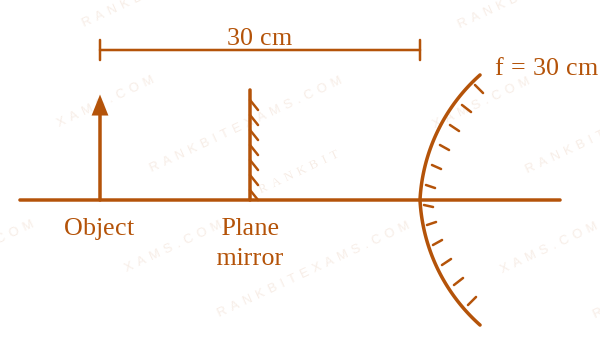
A finite size object is placed normal to the principal axis at a distance of 30 cm from a convex mirror of focal length 30 cm. A plane mirror is now placed in such a way that the image produced by both the mirrors coincide with each other. The distance between the two mirrors is :

Solution & Explanation

Related Formula

Mirror Formula:

(1)/(v) + (1)/(u) = (1)/(f)
Core Logic

For the convex mirror, u = -30 cm and f = +30 cm.

(1)/(v) - (1)/(30) = (1)/(30) (1)/(v) = (2)/(30) v = +15 cm

So, the convex mirror forms a virtual image 15 cm behind its surface.

Step 1: Align Plane Mirror Image

The total distance from the object to the image location is 30 + 15 = 45 cm. For a plane mirror to create an image at this same exact location, it must be placed precisely midway between the object and the image. Distance from object to plane mirror:

d = (45)/(2) = 22.5 cm

Therefore, the clearance distance between the convex mirror and the plane mirror surface is:

Distance = 30 - 22.5 = 7.5 cm
Pattern Recognition

Coinciding images imply identical coordinate endpoints. Calculate the convex position explicitly, find the total path length from the real source object, and slice it in half for the plane mirror location.

Chapter Mix

Class 12 Physics: Ray Optics and Optical Instruments

Ray tracing diagram for coinciding convex and plane mirror images

Reference Study Guides

More Ray Optics and Optical Instruments Previous-Year Questions — Page 9

Q jee_main_2025_04_april_morning Spherical Mirrors
Distance between object and its image (magnified by -(1)/(3)) is 30 cm. The focal length of the mirror used is ((x)/(4)) cm, where magnitude of value of x is
Numerical Answer. Answer: 45 to 45

Solution

Related Formula

Magnification relation for spherical mirrors:

m = -(v)/(u)

Mirror equation:

(1)/(f) = (1)/(v) + (1)/(u)
Core Logic

Given m = -(1)/(3):

-(v)/(u) = -(1)/(3) implies u = 3v

Since magnification is negative, a real inverted image is formed on the same side as the object in a concave mirror layout configuration.
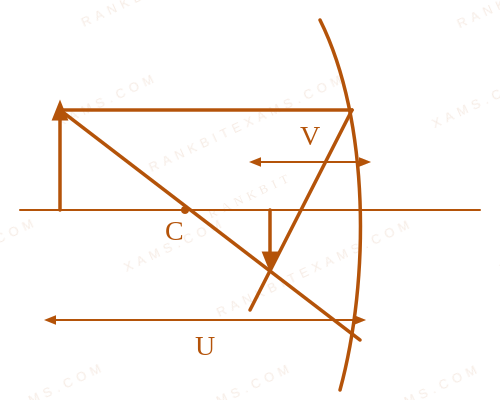
Concave mirror real image trace tracking for Q23 - JEE Main 2025 Morning

Step 1: Formulate Position Distances

The distance between the object and image is given as 30~cm:

|u| - |v| = 30 implies 3v - v = 30 implies 2v = 30 implies v = 15~cm

This gives u = 3(15) = 45~cm.

Step 2: Solve for Focal Length and x

Apply standard sign conventions (u = -45~cm, v = -15~cm):

(1)/(f) = -(1)/(15) - (1)/(45) = (-3 - 1)/(45) = -(4)/(45) |f| = (45)/(4)~cm

Matching this with the prompt pattern form (x)/(4) yields: x = 45

Pattern Recognition

Real inverted diminished images (|m| < 1) mean the image forms closer to the mirror surface than the object, situated between the focal center F and center of curvature C.

Chapter Mix

Class 12 Physics: Ray Optics and Optical Instruments
Q9 jee_main_2025_07_april_evening Spherical Mirrors
A mirror is used to produce an image with magnification of (1)/(4) If the distance between object and its image is 40 cm, then the focal length of the mirror is [cite: 113, 114, 116]
  • A. 10 cm [cite: 117]
  • B. 12.7 cm [cite: 119]
  • C. 10.7 cm [cite: 118]
  • D. 15 cm [cite: 119]

Solution

Related Formula

m = -(v)/(u) [cite: 700]

(1)/(v) + (1)/(u) = (1)/(f) [cite: 707]

Core Logic

Given magnification magnitude |m| = (1)/(4)[cite: 113]. Assuming a real image formed by a concave mirror: [cite: 701]

(v)/(u) = (1)/(4) u = 4v [cite: 701]

The distance between the object and the image is given as 40 cm [cite: 114, 116]:

u - v = 40 4v - v = 40 3v = 40 v = (40)/(3) cm u = 4 × (40)/(3) = (160)/(3) cm

Applying mirror sign conventions (u = -(160)/(3), v = -(40)/(3)): [cite: 701, 704]

(1)/(f) = -(3)/(40) - (3)/(160) = -(12 + 3)/(160) = -(15)/(160)

f = -(160)/(15) ≈ -10.67 cm [cite: 712]

Rounding to the matching options choice gives 10.7 cm[cite: 118, 712].

Pattern Recognition

Pay attention to sign conventions in mirror systems. A smaller real image formed by a concave mirror sits between the focus and center of curvature, resulting in u > v configurations.

Chapter Mix

Class 12 Physics: Ray Optics and Optical Instruments

Q14 jee_main_2025_07_april_evening Refractive Index
Given below are two statements: one is labelled as Assertion (A) and the other is labelled as Reason (R). Assertion (A) : Refractive index of glass is higher than that of air. [cite: 130] Reason (R): Optical density of a medium is directly proportionate to its mass density which results in a proportionate refractive index. [cite: 131] In the light of the above statements, choose the most appropriate answer from the options given below: [cite: 132]
  • A. (A) is not correct but (R) is correct [cite: 133]
  • B. Both (A) and (R) are correct and (R) is the correct explanation of (A) [cite: 134]
  • C. (A) is correct but (R) is not correct [cite: 135]
  • D. Both (A) and (R) are correct but (R) is not the correct explanation of (A) [cite: 136]

Solution

Core Logic

Refractive index represents the ratio of the speed of light in vacuum to its speed in a given medium[cite: 719]. Glass slows light down more than air does, hence μglass ≈ 1.5 > μₐᵢᵣ ≈ 1.0, which makes Assertion (A) correct[cite: 130]. However, optical density is defined by a medium's capacity to refract light and is completely conceptually distinct from inertial mass density (mass per unit volume)[cite: 719]. For example, turpentine has a lower mass density than water but possesses a higher optical density and refractive index. Therefore, Reason (R) is fundamentally incorrect[cite: 722].

Pattern Recognition

Optical density vs mass density is a signature conceptual trick in refraction theory[cite: 719]. They share the word 'density' but have entirely different physical meanings and no fixed mathematical proportionality[cite: 719, 722].

Chapter Mix

Class 12 Physics: Ray Optics and Optical Instruments

Q20 jee_main_2025_07_april_evening Total Internal Reflection
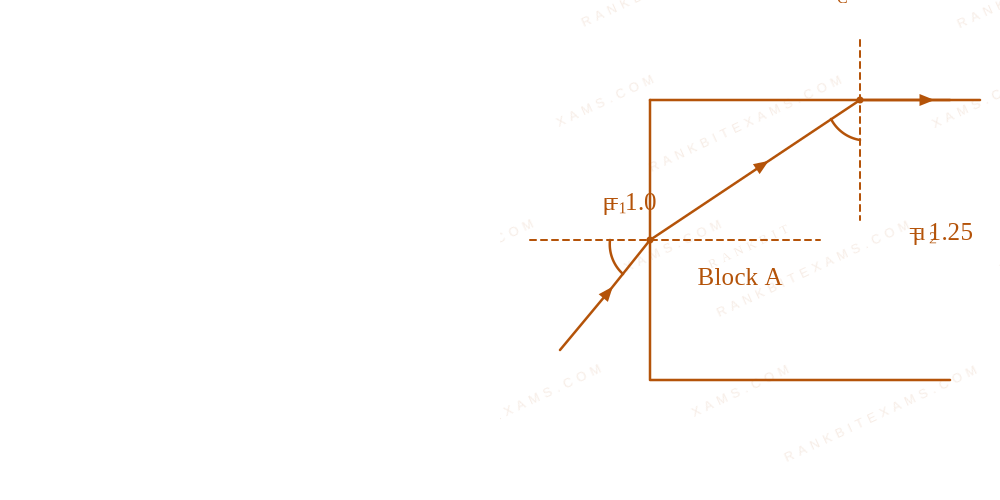
A transparent block A having refractive index μ=1.25 is surrounded by another medium of refractive index μ=1.0 as shown in figure. A light ray is incident on the flat face of the block with incident angle θ as shown in figure. What is the maximum value of θ for which light suffers total internal reflection at the top surface of the block?
Total Internal Reflection diagram for Q20 - JEE Main 2025 Evening
The diagram displays a light ray entering a rectangular block from a medium of lower refractive index, hitting the top wall at the critical boundary angle.
[cite: 169, 170, 171]
  • A. ⁻¹(4/3) [cite: 175]
  • B. ⁻¹(3/4) [cite: 176]
  • C. ⁻¹(3/4) [cite: 177]
  • D. ⁻¹(3/4) [cite: 178]

Solution

Related Formula

θc = (μ₁)/(μ₂) [cite: 810]

μ₁ θ = μ₂ r [cite: 807]

Core Logic

From the boundary geometry at the top interface, the angle of refraction r at the first surface satisfies: [cite: 806]

r + θc = 90° r = 90° - θc [cite: 806]

Applying Snell's law at the first entry interface: [cite: 170, 807]

μ₁ θ = μ₂ r = μ₂ (90° - θc) = μ₂ θc [cite: 172, 173, 807, 809]

Since θc = (μ₁)/(μ₂) = (1.0)/(1.25) = (4)/(5), we have θc = √(1 - ((4)/(5))²) = (3)/(5)[cite: 169, 810, 811]. Substituting back into the expression: [cite: 811]

1.0 · θ = 1.25 × (3)/(5) = (5)/(4) × (3)/(5) = (3)/(4) [cite: 169, 811]

θ = ⁻¹((3)/(4)) [cite: 811]

Pattern Recognition

Maximum angle at the entry face ensures minimum angle of incidence at the subsequent wall[cite: 806, 807]. Setting that exact internal angle equal to the critical threshold condition values solves for the operational scanning range edge directly[cite: 808].

Chapter Mix

Class 12 Physics: Ray Optics and Optical Instruments

Q14 jee_main_2025_24_jan_evening Lenses and Magnification
A photograph of a landscape is captured by a drone camera at a height of 18 km. The size of the camera film is 2 cm × 2 cm and the area of the landscape photographed is 400 km² . The focal length of the lens in the drone camera is:
  • A. 1.8 cm
  • B. 2.8 cm
  • C. 2.5 cm
  • D. 0.9 cm

Solution

Related Formula

Areal Magnification:

m² = AimageAobject = ((f)/(f+u))² ≈ ((f)/(u))²

since object distance u = -18 km is vastly larger than f.

Core Logic

Given parameters:

Ray context geometry for drone camera scaling layout Q14

  • Object height distance, H = 18 km = 18 × 10³ m
  • Film size area, Aimage = 2 cm × 2 cm = 4 cm² = 4 × 10⁻⁴ m²
  • Landscape area, Aobject = 400 km² = 400 × 10⁶ m²
  • Linear magnification factor:

(y)/(x) = AimageAobject = 4 × 10⁻⁴400 × 10⁶ = 10⁻¹² = 10⁻⁶

Using the simple pinhole/thin lens perspective ratio:

(f)/(H) = 10⁻⁶ f = 18 × 10³ × 10⁻⁶ = 18 × 10⁻³ m = 1.8 cm
Pattern Recognition

For aerial satellite imaging contexts where u gg f, linear sizing scales directly as film sideground side = (f)/(H).

Chapter Mix

Class 12 Physics: Ray Optics and Optical Instruments

More Ray Optics and Optical Instruments Questions — jee_main_2025_04_april_evening

Practice all Ray Optics and Optical Instruments previous-year questions →

Rankbit System
JEE Physics: Waves (+15.5%) | Electrostatics: Concentric Shells (-29.7%) | Modern Physics: Photoelectric Clones (+34.2%) | Mathematics: Definite Integrals (+18.1%) | Chemistry: Coordination Splitting (-11.4%) | JEE Physics: Waves (+15.5%) | Electrostatics: Concentric Shells (-29.7%) | Modern Physics: Photoelectric Clones (+34.2%) | Mathematics: Definite Integrals (+18.1%) | Chemistry: Coordination Splitting (-11.4%)
