Consider following statements for refraction of light through prism, when angle of deviation is minimum.
(A) The refracted ray inside prism becomes parallel to the base.
(B) Larger angle prisms provide smaller angle of minimum deviation.
(C) Angle of incidence and angle of emergence becomes equal.
(D) There are always two sets of angle of incidence for which deviation will be same except at minimum deviation setting.
(E) Angle of refraction becomes double of prism angle.
Choose the correct answer from the options given below.
As A$A$ increases, δmin$\delta_{\text{min}}$ generally increases, not decreases. (False)
Statement (C): Angle of incidence i$i$ and angle of emergence e$e$ become equal (i = e$i = e$) during the minimum deviation state. (True)
Statement (D): The δ-i$\delta-i$ curve is asymmetric and parabolic-like; for any deviation δ > δmin$\delta > \delta_{\text{min}}$, there are always exactly two different incident angles (i$i$ and e$e$) that yield the same deviation, except at the minimum deviation point (which has a single unique value). (True)
Statement (E): Angle of refraction r = A/2$r = A/2$, which is half of the prism angle, not double. (False)
Step 1: Conclusion
Since statements A, C, and D are true, the correct option is (1).
Pattern Recognition
Review the classic parabolic shape of the deviation vs. angle of incidence (δ-i$\delta-i$) graph. Notice that any horizontal line above the minimum point intersects twice (representing i$i$ and e$e$ for that deviation). Minimum deviation is the unique local minimum, where i = e$i = e$ and r₁ = r₂ = A/2$r_1 = r_2 = A/2$.
Chapter Mix
Class 12 Physics: Ray Optics and Optical Instruments: Refraction through Prism
Keywords:#prism minimum deviation i=e#refracted ray parallel base#JEE Main 2025 Morning Q20#deviation angle of incidence curve
More Ray Optics and Optical Instruments Previous-Year Questions — Page 10
Qjee_main_2025_24_jan_morningSilvering of Lenses
A thin plano convex lens made of glass of refractive index 1.5 is immersed in a liquid of refractive index 1.2. When the plane side of the lens is silver coated for complete reflection, the lens immersed in the liquid behaves like a concave mirror of focal length 0.2 m. The radius of curvature of the curved surface of the lens is :-
A. 0.15 m
B. 0.10 m
C. 0.20 m
D. 0.25 m
Solution
Related Formula
The net focal power of a silvered tracking lens system is given by:
As shown in diagram Silvering of Lenses diagram for Q12 - JEE Main 2025 Morning, the plane flat side boundary interface has an infinite radius of curvature (R₂ = ∞$R_{2} = \infty$), meaning its mirror focal component is fM = ∞ PM = 0$f_{M} = \infty \implies P_{M} = 0$. The power depends entirely on the refraction step:
(1)/(f) = 2fL$$\frac{1}{f} = \frac{2}{f_{L}} $$
Step 1: Lens Maker Formulation
Find the focal expression of the immersed lens element [cite: 91, 679]:
Silvering a plano-flat back boundary means light traverses the initial curved face interface exactly twice, mapping to R = 2 · f · (μrel - 1)$R = 2 \cdot f \cdot (\mu_{\text{rel}} - 1)$.
Chapter Mix
Class 12 Physics: Ray Optics and Optical Instruments
Qjee_main_2025_24_jan_morningLens Maker's Formula
A plano-convex lens having radius of curvature of first surface 2 cm exhibits focal length of f₁$f_{1}$ in air. Another plano-convex lens with first surface radius of curvature 3 cm has focal length of f₂$f_{2}$ when it is immersed in a liquid of refractive index 1.2. If both the lenses are made of same glass of refractive index 1.5, the ratio of f₁$f_{1}$ and f₂$f_{2}$ will be :-
A. 3:5
B. 1:3
C. 1:2
D. 2:3
Solution
Related Formula
Lens Maker's Formula for a lens in a surrounding medium of refractive index μm$\mu_{m}$ is:
Always separate the refractive index multiplier from the geometric shape factor. This lets you calculate each change independently before taking the final ratio.
Chapter Mix
Class 12 Physics: Ray Optics and Optical Instruments
Q2jee_main_2025_24_jan_morningPower of a Lens
What is the relative decrease in focal length of a lens for an increase in optical power by 0.1 D from 2.5 D ? ['D' stands for dioptre]
A. 0.04
B. 0.40
C. 0.1
D. 0.01
Solution
Related Formula
The relationship between optical power P$P$ and focal length F$F$ is given by:
For a small change, we can approximate using differentiation: P = (1)/(F) dP = -(dF)/(F²) (dF)/(F) = -(dP)/(P)$P = \frac{1}{F} \implies dP = -\frac{dF}{F^2} \implies \frac{dF}{F} = -\frac{dP}{P}$. Thus, the relative change magnitude is (0.1)/(2.5) = (1)/(25) = 0.04$\frac{0.1}{2.5} = \frac{1}{25} = 0.04$.
Chapter Mix
Class 12 Physics: Ray Optics and Optical Instruments
Q6jee_main_2025_28_jan_eveningRefraction at Spherical Surfaces
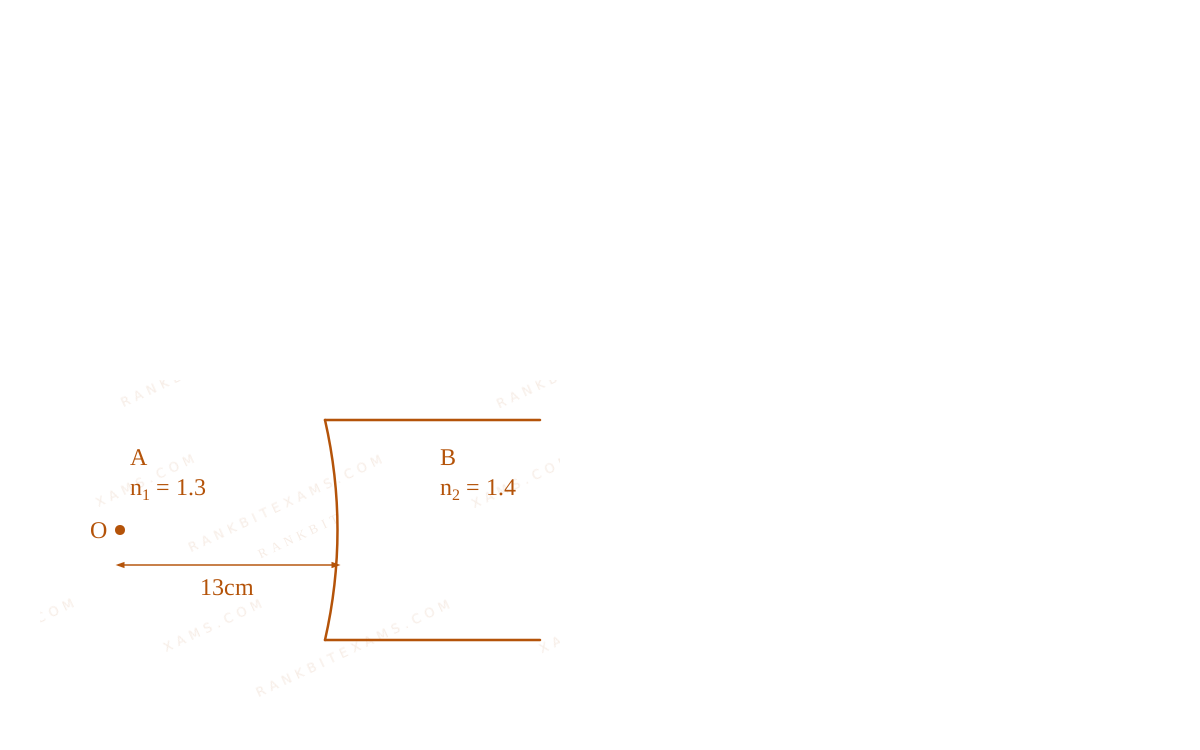
In a long glass tube, mixture of two liquids A and B with refractive indices 1.3 and 1.4 respectively, forms a convex refractive meniscus towards A. If an object placed at 13cm$13\mathrm{cm}$ from the vertex of the meniscus in A forms an image with a magnification of -2$-2$ then the radius of curvature of meniscus is :
A.1 cm$1 \, \text{cm}$
B.(1)/(3)cm$\frac{1}{3}\mathrm{cm}$
C.(2)/(3) ~cm$\frac{2}{3} \mathrm{~cm}$
D.(4)/(3) ~cm$\frac{4}{3} \mathrm{~cm}$
Solution
Related Formula
For refraction at a single spherical surface separating two mediums :
The visual system configuration of the refracting interface is tracked here:
Refraction at Spherical Surfaces diagram for Q6 - JEE Main 2025 Evening
Pattern Recognition
Keep precise track of sign conventions for single spherical surfaces. A convex meniscus towards A means the center of curvature lies inside medium B, meaning
$
Step 1: Visual Context
The visual system configuration of the refracting interface is tracked here:
Refraction at Spherical Surfaces diagram for Q6 - JEE Main 2025 Evening
Pattern Recognition
Keep precise track of sign conventions for single spherical surfaces. A convex meniscus towards A means the center of curvature lies inside medium B, meaning $
R$ will mathematically return as a positive parameter.
Chapter Mix
Class 12 Physics: Ray Optics
Q13jee_main_2025_28_jan_eveningReflection by Spherical Mirrors
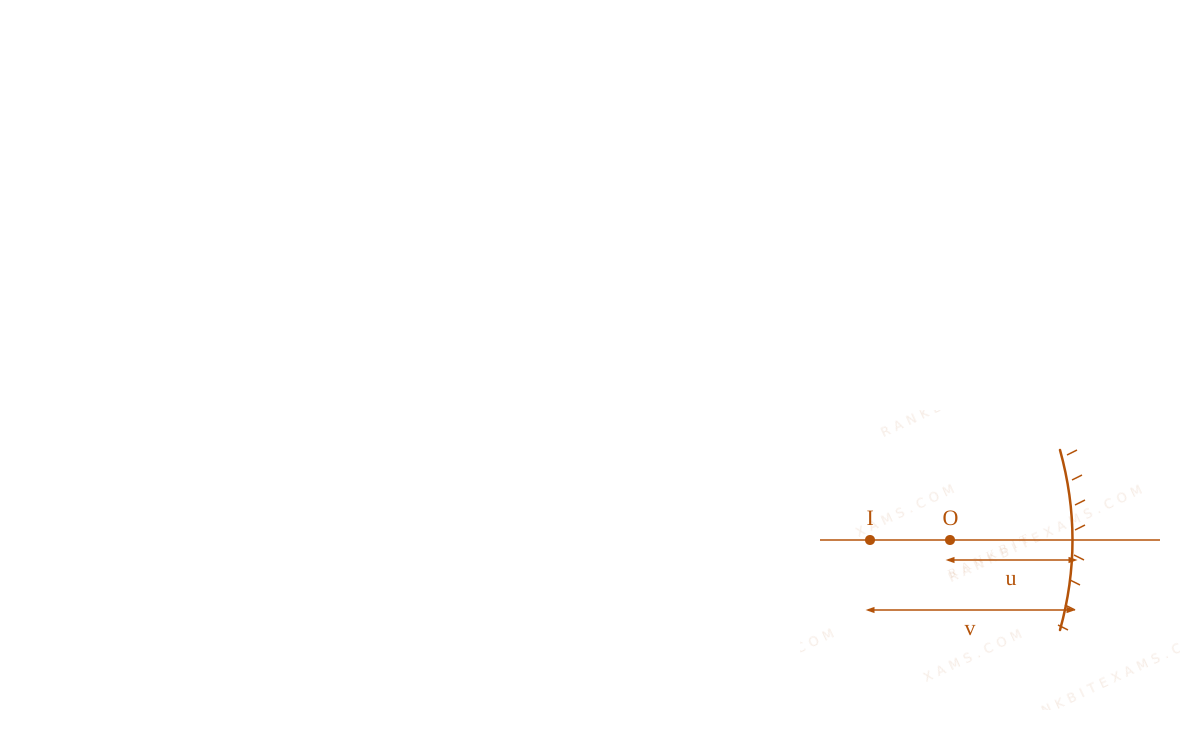
A concave mirror produces an image of an object such that the distance between the object and image is 20 cm$20 \, \text{cm}$. If the magnification of the image is -3'$-3'$ , then the magnitude of the radius of curvature of the mirror is:
A.3.75cm$3.75\mathrm{cm}$
B.30cm$30\mathrm{cm}$
C.7.5cm$7.5\mathrm{cm}$
D.15cm$15\mathrm{cm}$
Solution
Related Formula
Magnification m$m$ of a mirror is given by:
m = -(v)/(u)$$m = -\frac{v}{u}$$
The mirror equation relates focal length to distance positions:
(1)/(f) = (1)/(v) + (1)/(u) f = (uv)/(u+v)$$\frac{1}{f} = \frac{1}{v} + \frac{1}{u} \implies f = \frac{uv}{u+v}$$
Radius of curvature R = 2f$R = 2f$.
Core Logic
Given, magnification m = -3$m = -3$. This tells us the image is real and inverted[cite: 131, 757]:
-3 = -(v)/(u) v = 3u$$-3 = -\frac{v}{u} \implies v = 3u$$
Since both real objects and real images lie on the same side in front of a concave mirror, u$u$ and v$v$ are both negative fields. The physical distance separation between them is:
The visual positioning profile tracking focal path boundaries is given below:
Reflection by Spherical Mirrors diagram for Q13 - JEE Main 2025 Evening
Pattern Recognition
A magnification of -3$-3$ tells you immediately that the object lies between the Focus (F$F$) and Center of Curvature (C$C$), while the image forms beyond C$C$. This geometric layout instantly verifies that the radius value must exceed 10 cm$10\text{ cm}$.
Chapter Mix
Class 12 Physics: Ray Optics
More Ray Optics and Optical Instruments Questions — jee_main_2025_03_april_morning
Practice past-year questions one chapter at a time. Pick an exam → subject → chapter and get every PYQ for that topic — pulled together from all past papers — with the chapter's key formulas alongside.